Live music evenings at the hotel: the booking, the sound check, the volume and the neighbors
Run live music evenings with a clear agreement, fixed sound checks and named staff. Learn how to control volume, handle complaints and cost the night against bar sales.
AI draft · awaiting editorial review
Contents
Key takeaways
- The booking is a written agreement about hours, set length, equipment, who decides the volume and who may end the set, not a phone call about a fee.
- A sound check done before the first guest sits down, at the level the set will actually run, is the cheapest complaint prevention a hotel has.
- Volume is one named person's job at fixed times on a fixed route, not a matter of taste argued at the bar.
- The front desk needs a short script for the complaint call, and the duty manager needs the authority to bring the set down or end it.
- Cost the night against the bar's contribution margin, not its revenue, and judge it after several nights rather than one.
A live music evening is run from one sheet: hours and set lengths written into the musician's agreement, a sound check before guests arrive, speakers aimed away from guest rooms, a named person who walks a fixed route with a sound-level meter at fixed times, and a complaint call the front desk follows word by word.
At 23:40 the bass reaches the third floor and the guest in the room above calls the front desk, not the bar. What the hotel does in the next few minutes decides whether the night ends as a complaint or as a good evening. This article walks through hotel live music evening organization as one run sheet: the agreement with the musician, the sound check, the volume checks during the night, the complaint call, and the costing that tells you whether to keep the night. After reading, you can book the next act with a written agreement and run the evening with named people and fixed steps.
Why host live music at a hotel, and for whom?
Live music is worth hosting when it fills a named room for a named guest and the hotel can hold the sound at its own boundary. It is not worth hosting as a general promise of atmosphere.
Choose the guest before the act. In-house guests on half board who stay in for the evening need different hours, volume and repertoire from outside trade arriving from the city. Choose the venue by distance from sleeping rooms, not by how it looks: a lobby bar under three floors of rooms is a different proposition from a poolside deck at the edge of the property.
Name the business reason in one sentence: extending dwell time after dinner, filling a quiet bar night, or giving the terrace a reason to exist in shoulder season. If the reason is vague, the night will be judged on complaints alone. Accept the trade-off openly: the same low end that keeps the bar full reaches the room directly above, so the hotel is always choosing which guest it protects at which hour.
Apply one test before booking. If the hotel cannot control the sound at the edge of its own property, it is not ready for amplified music and should start with an unamplified set. Fix the rhythm too: one fixed night a week beats an irregular program, because staff routines, guest expectations and the bar roster all form around a known night. This fits the wider entertainment picture described in hotel animation programs: a weekly plan, the team and the guests it is for.
| Venue | Guest it serves | Main constraint | Decide before booking |
|---|---|---|---|
| Lobby bar | In-house guests after dinner | Sleeping rooms directly above | Which floors sit over the bar, and how the level is checked there |
| Terrace | In-house and outside trade | Open air carries to the street and the neighbor's building line | Where the speakers face, and who walks the boundary |
| Poolside deck | Families and early-evening guests | Distance from rooms, pool safety | The finish time and the clear-down route |
| Restaurant during dinner | Diners who did not choose music | Conversation at the table | Whether the set starts after the main course or during it |
What should the agreement with the musician cover?
The agreement should fix hours, set structure, equipment, the sound check window and, above all, who decides the volume and who may end the set.
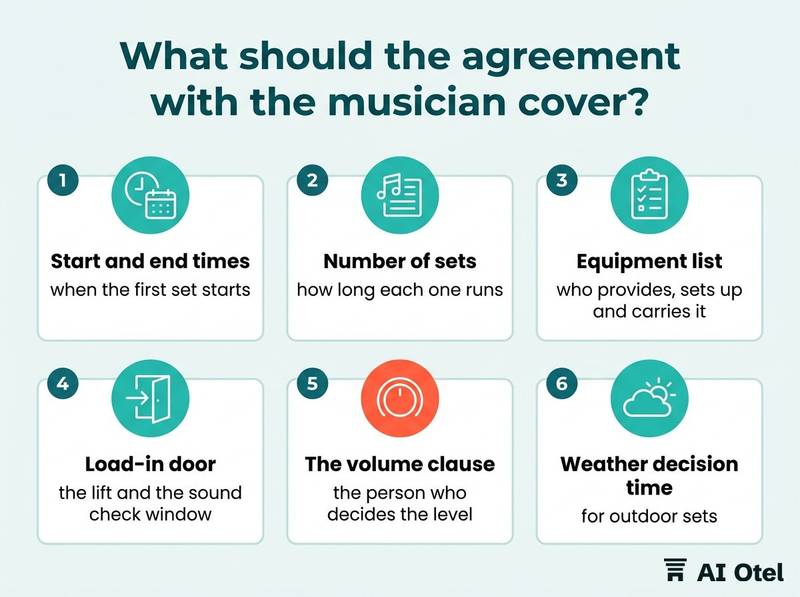
Write the hours as clock times: when the first set starts, when the last set finishes, and how long the clear-down may run. An agreement that says "evening" leaves the end of the night to whoever is on stage. Fix the structure as well: how many sets, how long each one runs, how long the breaks are and the total playing time. Breaks are when the room buys drinks and when the desk can catch up with the duty manager.
List the equipment and say who provides, sets up and carries it: speakers, microphones, stands, cables, power, lighting. Ambiguity here becomes a sound check that starts late. Name the load-in door, the lift and the sound check window, so the band is not crossing the lobby with a bass cabinet at dinner service.
Put the volume clause in writing. The hotel names the person who decides the level, the musician agrees to follow an agreed hand signal, and the hotel may end the set if the level rises again. Cover repertoire and language, whether requests are taken, and whether the musician sells anything on the premises. For outdoor sets, set a weather decision time and say who makes the call and what is paid when the set is cancelled. The same fixed wording belongs with the rest of your hotel house rules: what to write, where guests see them and how staff apply them.
ChecklistAgreement checklist
- Start and end times, and the finish of the last set
- Number of sets, length of each, break length
- Equipment list, and who provides, sets up and carries it
- Load-in door, lift and sound check window
- The named hotel person who decides the volume, and the hand signal
- The hotel's right to end the set, and what is paid if it does
- Repertoire, language, and whether requests are taken
- Weather decision time for outdoor sets, and cancellation terms
- Payment terms and the invoice
How do you run a sound check that prevents complaints?
A sound check prevents complaints when it happens before guests arrive, at the level the set will actually run, and is heard from the guest floors rather than from the bar.
Time it with the room empty and before the first guest sits down. A check held during dinner is a rehearsal with an audience of paying guests. Check at performance level: a quiet check tells you nothing about the low end, because the mix changes as the level rises and the bass is what travels.
Place the speakers for the room, not for the stage: aimed at the audience, away from walls, open windows and ceilings, off the floor and away from structural columns that carry sound upward. Fix one reference point and one device, and write the reading on the run sheet, so tonight's number can be compared with last week's.
Walk the boundary during the check: the floor directly above, the corridor ends, the terrace edge, the street façade and the neighbor's building line. Fix the room before turning the artist down. If the reading at the reference point is too high, move a speaker or add a barrier first, because a quieter set in a badly placed room still reaches the third floor.
TipOne point, one device, never change either
For example, the lift lobby on the floor directly above the venue, measured with the same handheld meter every night. The number means little on its own; it means something when it is the same number, at the same place, taken the same way. Tape the fader at the position that produced the accepted reading, so the second set starts where the first one was approved.
Who checks the volume during the night, and when?
One named person per shift walks a fixed route at fixed times with a meter and the authority to act, and writes down what they found.
Name the person on the run sheet: the duty manager, not the bar team and not the musician. A responsibility shared by everyone is checked by no one. Fix the times: at the start of the first set, once in the middle of the evening, and during the last set. The last set is when the room is fullest and the level creeps up unnoticed.
Fix the route so readings are comparable: the same points, in the same order, every night. Record time, point, reading and action. The log is what turns a disagreement with a guest, a neighbor or the musician into a fact. Act in steps with a named owner for each: signal the band first, lower at the desk second, end the set third.
Hand over in writing: the incoming shift reads the log before the band starts, not after the first complaint. Keep the reading and the complaint apart. A reading under the agreed level with a complaining guest is still a complaint, and is handled as one.
| Check | Where | Who | If over the agreed level |
|---|---|---|---|
| First set start | Corridor of the floor above, at the lift lobby | Duty manager | Signal the band, then lower at the desk |
| Mid-evening | Terrace edge and street façade | Duty manager | Move the speaker, then lower |
| Last set | Both points above, plus the neighbor's building line | Duty manager | Lower once; end the set if it rises again |
| Shift handover | The log at the desk | Incoming duty manager | Read the readings before the band starts |
What does the front desk say when a guest complains about the music?
The desk apologizes, takes the details, says what will happen and when, gets it done, and calls the guest back.
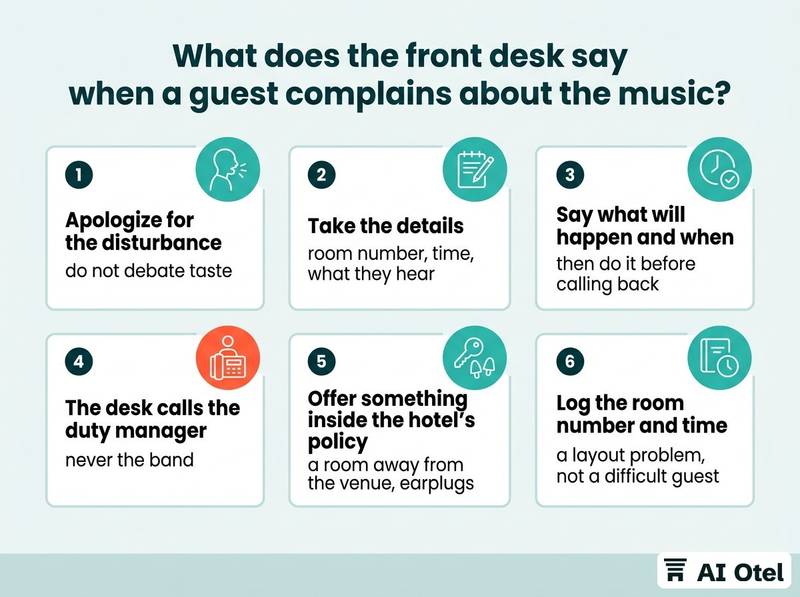
Answer the guest, not the argument. Apologize for the disturbance and do not debate taste or defend the program; the guest did not buy a ticket to the evening. Take the details in one go: room number, time, what they hear (low end, voices, the terrace), and whether they are staying more than one night.
Say what will happen and when, then do it before calling back. The desk calls the duty manager, never the band. Call back once the level is down, and again after the set ends if the guest is still awake. Offer something inside the hotel's own policy: a room away from the venue, earplugs, a drink, a late checkout. Decide the menu of options before the season, not at midnight.
Log the room number and the time. The same room complaining on three music nights is a layout problem, not a difficult guest. Route outside neighbors to the manager on duty, take a name and a number, and call back the next day rather than arguing at the door. The fuller routine is in noise complaints in hotels: answering the night call and preventing the next one.
Key pointFour lines the desk can say without improvising
1) I am sorry the music is disturbing you. I am noting your room number and the time. 2) The duty manager is lowering the level now. 3) I will call you back once it is done, and again after the set ends if you are still awake. 4) If it is still too loud, we can move you to a room away from the venue tonight.
How do you cost the night against bar sales?
Cost the whole night, compare the bar's contribution margin with the same night without music, and decide after several nights rather than one.
Count every cost line, not the fee: extra bar and service staff hours, door or security staff, equipment rental or wear, the drinks given away, the electricity, and the setup and clear-down hours on both sides of midnight. Add the invisible cost: rooms moved or discounted after a complaint, and the staff time spent on it.
Measure the bar by contribution margin, revenue minus the cost of what was poured, not by revenue. A full bar with heavy discounting can cost more than an empty one. Compare with a baseline: the same weekday without music, averaged over several weeks, so a good night is not mistaken for a trend. Count covers and average spend per guest, and separate outside guests from in-house guests, because only one of the two is also paying for a room. The pour-cost side of this is covered in pricing a cocktail list at a hotel bar: recipe card, pour size, cost per drink and the price ladder.
| Cost line | How to measure it | Where it hides |
|---|---|---|
| Fee | The signed agreement | Travel and meals outside the fee |
| Extra staff hours | The roster against a music-free night | The clear-down after midnight |
| Equipment | The rental invoice, or wear on owned gear | Cables and stands replaced |
| Complimentary drinks | The bar's void and comp report | Drinks for the band and for a table |
| Room recovery | The night's room moves and discounts | The guest who checks out early |
| Bar margin | Revenue minus pour cost | The cost per drink behind the cocktail list |
Decide after three or four nights: keep the night, move it to another weekday, change the format to a smaller unamplified act, or stop. Review frequency with the season: a weekly night in high season and a monthly one in low season, reviewed alongside the rest of the entertainment plan.
What to do next
Write the one-page run sheet before the next act is booked: hours and set structure, the sound check window, the reference point and its reading, the named person who walks the route, the four-line call script, and the cost lines you will compare against a music-free night. Run it for three nights unchanged, then decide whether the evening earns its place. If you want the readings, the log and the bar numbers in one place rather than on paper, a hotel operating system built and working, ahead of launch, keeps restaurant and bar sales, reports and front-desk records together, and the platform overview shows how the pieces connect. If you are reading this as a traveler rather than a hotelier, you can browse hotels in Türkiye (opens in a new tab) and pick one that suits your evening plans.
Frequently asked questions
Does a live music night need a permit or a license?
Rules on amplified music, closing hours and permits depend on the venue, on whether the space is inside or open air, and on the local authority. The hotel confirms its own case with its legal adviser and its municipality before the first booking, and writes the outcome into the run sheet. The same answer sets the finish time in the musician's agreement.
Is a sound-level app on a phone enough, or do we need a meter?
A handheld meter gives a repeatable reading. A phone app varies between devices and models, so if a phone is used, use the same phone at the same point every night and treat the number as a comparison rather than an absolute. The routine matters more than the instrument.
What if the musician plays louder than agreed?
The agreement names the hotel's decision-maker and the hand signal. The duty manager asks once, off the microphone. If the level rises again the set ends and the contract's terms apply, and the conversation about the night happens the next day, not at the bar.
Should the music be inside or on the terrace?
Inside is easier to contain, because walls and doors do work. A terrace needs a boundary walk to the neighbor's building line and to the rooms above, and speakers aimed inward. The choice changes the equipment list, so it is made before booking, not on the night.
How should we tell guests about the music?
At booking, at check-in, in the room directory and on the guest app. Guests who know in advance ask for a room away from the venue or plan around the set. The same text belongs in the hotel's house rules, so the desk quotes one version instead of three.