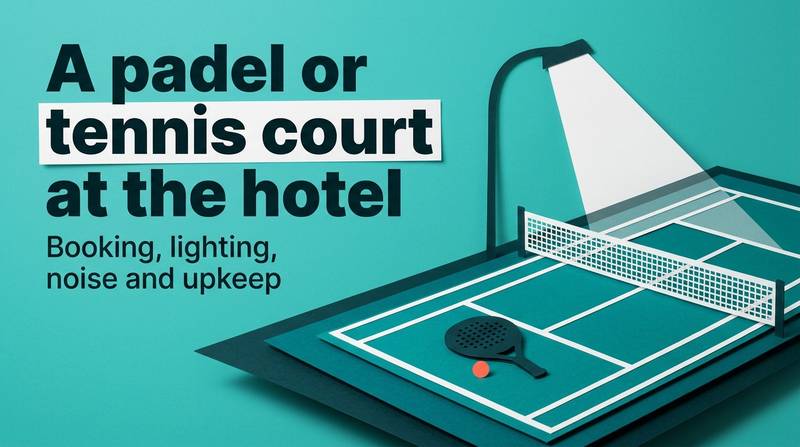
A padel or tennis court at the hotel: booking, lighting, noise and upkeep
Run your hotel padel or tennis court with one booking sheet and clear rules. This guide covers slot management, lighting schedules, noise control, and maintenance checks.
AI draft · awaiting editorial review
Contents
Key takeaways
- One booking sheet with one owner: a court shared between the front desk, the animation team and outside callers loses slots to double bookings and no-shows.
- In-house guests book first inside a published window; whatever is left opens to outside players, whose slot is held by a deposit.
- Lighting hours belong in a written schedule tied to sunset, with a timer and a key held by the duty manager, not a switch any player can reach.
- A signed daily and weekly check sheet turns a cracked glass panel or a slack net into a dated fault instead of an accident.
- Free use fills the court and removes the commitment; a small hourly charge, or a booking window at peak, is what makes people turn up.
A hotel padel court is an enclosed doubles court whose glass walls are in play; a tennis court is an open court for singles or doubles. Run either from one booking sheet with written rules for slots, lighting hours and upkeep, and decide free versus paid use from your own peak demand, not from the market.
For example, two courts go in over the winter, and by July the front desk is keeping bookings on a paper sheet, the floodlights are still on at midnight, and the rooms in the second row have started to complain about the ball on the glass. None of this is a construction problem; it is an operating problem, and it appears in the first season of almost every court. After reading this article you will be able to write the one page that runs the court: who books it, when the lights go off, what gets checked and by whom, and whether an hour is free or charged.
Padel or tennis: which court fits this hotel?
Padel fits where a tennis court will not, and tennis serves a guest that padel does not. The choice turns on space, noise and who actually plays, not on which sport is talked about more.
Padel is doubles only, played inside a glass-walled box where the walls are part of the game: four players share one court and the ball stays inside the enclosure. Tennis is singles or doubles on an open court and needs run-off behind the baselines and beside the sidelines, so it takes more ground for fewer players per hour.
The enclosure is the interesting part. Because the ball stays in, a padel court can sit closer to a path, a bar or a terrace than a tennis court safely can. The glass, however, is also the noise source, and that trade shapes everything in the lighting and noise section below.
The guests differ too. Tennis players usually arrive with their own racket and expect a proper surface. Padel players often arrive with nothing and expect to hire everything at the desk, which makes the padel court a bigger equipment operation and a smaller surface-snobbery operation.
Count the requests before you build. A season of desk requests split into in-house guests and outside callers tells you which court your guests actually ask for, and it costs nothing to collect. If the plot allows only one court and the guest mix is families and young couples, padel turns the same square meters into more playing hours. If the hotel has a tennis tradition or a serious-player clientele, keep the tennis court and add padel beside it.
Never build both without deciding who runs both. Two courts with one part-time attendant is how a court ends up locked and the guests end up at the desk asking why.
| Question | Padel | Tennis |
|---|---|---|
| Players per court | Four, doubles only | Two or four |
| Enclosure | Glass walls in play, ball stays inside | Open court, ball leaves |
| Noise character | Sharp repeated hit on glass and frame | Lower and less frequent, larger footprint |
| Surface upkeep | Turf, seams, infill, glass, frame | Clay dragged and watered, or hard court checked for cracks, plus lines and net |
| Equipment guests bring | Often nothing | Usually their own racket |
| Weather sensitivity | Playable in light rain, wind tamed by walls | Wind and rain stop play |
| What the desk holds | Rackets, balls, deposit | Balls, court shoes, towels |
How should the hotel run court bookings for guests and outside players?
From one sheet with one owner, a fixed slot length, and a published booking window that favors in-house guests before it opens to outside players.
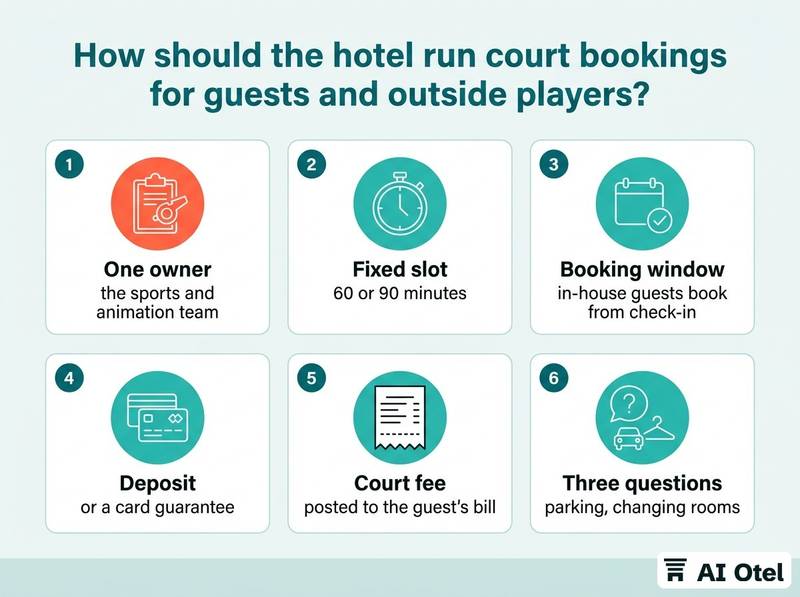
Name the owner first. The activity desk or the sports and animation team holds the sheet; the front desk may take a request but must not keep a second list. The moment two lists exist, the same slot sells twice and nobody can say which list is right.
Fix the slot at 60 or 90 minutes with a short changeover, so the next four players are not standing at the gate while the previous four finish their last game. Publish the window: in-house guests may book from the moment they check in, up to a stated number of hours ahead, and remaining slots open to outside players at a stated time each day.
Take a deposit or a card guarantee from outside players, and write it into the terms the player accepts at booking. It is the simplest mechanism that gives a no-show a cost. Write the release rule too: a slot not claimed within a set time after its start goes to whoever is waiting, and the deposit is handled exactly as the terms say.
Put the money where the guest can see it. An in-house court fee is posted to the guest's bill as a line item, so the booking sheet and the bill agree at check-out; a hotel operating system built and working, ahead of launch, that posts charges to the guest's bill from one place does this without a second ledger (see how a hotel operating system handles billing). The same deposit-and-return logic works as it does when renting bicycles to guests.
Answer three questions before the first outside booking: parking, changing rooms, and whether the court fee includes the pool and the rest of the facilities. Outside players will ask all three at the gate, not at booking.
ChecklistEvery line of the booking sheet must carry
- Date
- Slot start and end
- Court number
- Guest name and room number, or the word "outside"
- Phone number for outside players
- Deposit taken, and how
- Charge posted to the bill (yes or no)
- Lesson or coach attached
- No-show rule applied (yes or no)
- Initials of the person who took the booking
What lighting hours and noise limits keep the court a good neighbor?
Two separate problems: light that lands in a guest room window, and sound that reaches the boundary. Both are settled by where the court sits and by a written hour, not by asking players to keep it down.
Start with light. Fixtures aimed down and inward, with shields on the boundary side, are planned before the poles go up; a court lit to broadcast brightness will spill into rooms and gardens. Hours belong to a schedule tied to sunset rather than a fixed clock: lights on at dusk, off at a stated hour, and the last bookable slot ending before the lights go off so nobody plays in the dark or argues at the gate.
Control is a physical question. A timer with a manual override, and the key or code held by the duty manager, works. A switch inside the court will be used, and it will be used late.
Padel noise is a sharp, repeated hit of a hollow ball on glass and frame, and it carries further at night than most operators expect; the glass back wall is the loudest surface on the court. Tennis noise is lower and less frequent per point, but the court is larger, so the distance from the boundary to the nearest room matters more than the surface does. In both cases, place the court with its glass walls parallel to, not facing, the nearest room block, and put a solid screen or a planted berm on the boundary side.
Do the check once: stand at the nearest guest room window and at the property line with a full court playing after dark, and write down what you hear and at what hour. The same evening walk is the habit behind live music evenings at the hotel, where the sound check and the volume follow the same logic.
Municipal noise conditions and any permit attached to the court are the hotel's own to confirm with its municipality. The written hours and the screen are what the hotel controls and can change this week.
Watch outThe late-evening test
Walk the boundary and the nearest room corridor with a full court playing after dark. If the ball is audible from a room with the window closed, the fix is the schedule and the screen, not a request to the players.
What does the court need every day and every week?
A short daily walk against a written list, and a longer weekly check that ends with a signature, on both sports.
Daily on both courts: sweep the surface, clear leaves and debris, check the gate latch and the lock, check the net height at both posts and the tension, count the balls and dry them, and look along the fence or the glass for new damage. On padel, add a hand run along the glass panels for cracks and chips, a check of the frame joints and screws, a look at the turf for lifted seams, a top-up of sand infill if the surface is sand-dressed, and clearing the corners where the ball scuffs. On tennis, drag and water a clay court, check the lines, and check the net strap and the center strap; on a hard court, sweep and look for cracks and lifted paint.
Weekly, on both: a torque check on the padel frame bolts, a check of the light fixtures and the timer, a look at the drainage after rain, and a sheet signed with initials and the date. The signed record is the part that matters: it turns a fault into a dated entry, which is what protects the hotel when a panel breaks or a guest slips. It is the same discipline as the weekly safety check and record kept for the playground.
Equipment has its own rule. A racket with a cracked frame or a worn grip comes out of service rather than back on the hook. Balls rotate on a schedule, because a dead ball is the complaint guests never report; they simply stop playing. Decide also who dries the court before the first morning slot, where the covers live, and what happens to a booking when the court is unplayable.
ChecklistDaily, ten minutes
- Surface swept
- Gate and latch working
- Net height and tension
- Glass and frame inspected
- Balls counted and dried
- Lights and timer checked
- Bin emptied
ChecklistWeekly, with initials and date
- Frame bolts torqued
- Seams and infill checked
- Drainage cleared
- Light fixtures and timer checked
- Equipment audit; damaged rackets withdrawn
- Sheet signed and filed
Who runs lessons and equipment hire?
One named person, one published schedule, and a written answer to who bills whom.
Three workable models exist. Hotel staff coach the guests; an outside coach rents the court or shares the lesson revenue; or a partner academy runs the court and brings its own outside players. Whatever the model, one name sits against the court on the sheet, and a lesson blocks the court for a stated period like any other booking.
Ask the coach for proof of coaching qualification and liability cover, and keep a copy with the contract. The exposure is the hotel's, not the coach's alone. If the coach is an outside party, the contract should say who opens the gate, who cleans the court, who handles a no-show and who pays for a broken panel.
Equipment hire is simple if it is written down: rackets in more than one grip size, balls by the tube, a deposit or a room charge, and a return check at the desk before the guest checks out. Price the lesson and the court as separate lines, and state whether the coach collects or the hotel bills, so the guest is never asked to pay twice.
Fixed group clinics in the quiet hours fill the court better than one-to-one lessons at peak, and they give the animation team something concrete to print in the weekly program, as covered in the weekly animation plan the clinic times have to fit into.
TipThe lesson rule
Write the lesson rule on the same sheet as the booking: a lesson is a booking with a name against it, and it displaces a guest slot only in the hours the hotel has published as lesson hours.
Should the court be free or charged by the hour?
Decide from your own booking sheet rather than from what other hotels do: free use fills the court and removes the commitment, and a charge works mainly as booking discipline.
Free use means no friction at the desk, but no-shows rise, the sheet fills with names that never arrive, and the court becomes a queue at peak while sitting empty in the afternoon. A charge, even a small one, gives you a name, a payment and a posted line, and those three things make people turn up.
Read your own pattern before deciding. Last season's occupancy curve, the number of desk requests, and how many slots you can genuinely fill at peak tell you more than any benchmark. If peak demand sits below capacity, free use costs you little; if it sits above, you need an allocation rule.
Hybrid options work well in practice: free for in-house guests in off-peak hours and in low season, charged at peak and for outside players; or free for the first hour and charged after it. Publish the rule in three places, the guest app or welcome sheet, the gate, and the front desk, so the answer is the same whoever is asked.
Review with the sheet after one season: unused slots, no-shows, outside players, lessons. Change one thing, not five. And keep the decision about allocation and upkeep rather than revenue: a court is a facility with a lighting bill and a maintenance list, not a return calculation.
| Model | What it fixes | What it costs you | When it fits |
|---|---|---|---|
| Free for in-house guests | Fills quiet hours, no desk friction | No-shows, queueing at peak, lighting and upkeep paid from elsewhere | Low peak demand, small court, strong all-inclusive promise |
| Hourly charge for everyone | Commitment, a name and a posted line | Desk time, a pricing conversation at check-in | Peak demand above capacity |
| Hybrid: free off-peak, charged at peak and for outside players | Allocates the scarce hours, keeps the quiet ones full | The most explaining, so it needs one written page | Mixed guest base, court near a city or a beach promenade |
Write the one-page operating sheet this week
Everything in this article fits on one page: who holds the booking sheet, the slot length and the booking window, the lighting hours, the daily and weekly checks, and the free-or-paid rule. The page is what makes the court runnable by whoever is on duty. Run it for a season, then read the sheet before you change anything; hotels that manage facilities from one written sheet tend to be the same ones managing everything else from one place, as the overview of a hotel's systems working together describes, with the hotel operating system built and working, ahead of launch. If you are reading this as a traveler rather than an operator, you can look for a hotel in Türkiye (opens in a new tab) with the sports facilities you want.
Frequently asked questions
How long should a court booking be?
60 or 90 minutes is the usual unit, with a short changeover between slots. Shorter slots at peak and longer slots in the quiet afternoon get more out of the same court. The changeover matters as much as the length: without it, every booking starts late and the last one of the evening runs past the lighting hour.
Can a hotel open its court to outside players?
It is a commercial decision the hotel makes and writes down. Decide what the fee includes (parking, changing rooms, pool), take a deposit, and put the terms in front of the player at booking. Confirm insurance cover for non-resident players and any permission the municipality requires with your insurer and your municipality before the first outside booking.
Is a hotel padel court noisier than a tennis court?
The noise is different rather than simply louder. A hotel padel court produces a sharp, repeated hit of a hollow ball on glass and frame inside an enclosure, and it carries at night. Tennis is lower and less frequent per point, but the court is larger, so the distance to the nearest room matters more. Both are managed by placement, a screen on the boundary side, and written lighting hours.
Do we need a coach on the hotel staff?
No. The hotel can coach with its own staff, rent the court to an outside coach, or hand the court to a partner academy. What matters is one named person against the court, a published lesson schedule, and a copy of the coach's qualification and liability cover kept with the contract.
How often should a padel or tennis court be checked?
A short daily walk against a written list, and a longer weekly check that ends with a signature and a date. The daily walk catches glass, net and gate faults; the weekly check covers bolts, seams, drainage and lights. The signed record is the part that protects the hotel when something breaks.