Outside photographers in the hotel garden: a booking form, a fee and a schedule that protects in-house guests
Turn garden photo requests into booked slots with a signed form, a clear fee, and protected time windows. This guide shows how to charge fairly while keeping other guests comfortable and unphotographed.
AI draft · awaiting editorial review
Contents
Key takeaways
- A garden shoot is a commercial use of hotel space, so it needs the same written terms as any other booking: date, window, area, party, fee and cancellation.
- One page is enough: a form that names the guest, the photographer, the areas, the window and who pays.
- Time windows do the protecting: the shoot gets a route and an hour, never the whole garden.
- The rule on other guests is a rule about what is delivered, and the photographer is told it before the shoot, not after.
- A tag or a credit is a request written into the form, never a condition of entry, and the fee does not change if the photographer declines.
The logic behind a photo shoot at hotel garden fee structures is what turns a request into a booking: a signed one-page form, one written fee rule, fixed time windows outside peak garden use, and a stated rule that no other guest appears in a delivered image without the hotel asking first. A shoot is a paid, time-boxed use of hotel space, not a favor.
A couple books two nights and asks whether their photographer can use the garden at sunset on Saturday. At that hour the garden is also where every other guest is having a drink, and the receptionist has no rule to fall back on. After reading this article you will have one: a one-page form, a fee logic you can state in a sentence, a window that avoids the busy hours, and a clear line on other guests appearing in photos.
Why allow outside photographers at all, and when should you refuse?
Allow the shoot when it can be held inside one area and one time window, because the request usually arrives with a booking attached. Refuse when it needs the whole property or collides with an event already sold.
Look at what arrives with the request. The couple's room nights come first, then their party's restaurant covers, and then a photographer who works the same coast every week and talks to other couples planning the same trip. Against that, count what the shoot costs: one staff member walking the route, one area closed for under an hour, and the risk of another guest standing in a delivered frame.
Refuse on four triggers. First, the garden is sold for a wedding or an event that day. Second, the party cannot name the photographer who will actually be on site. Third, the shoot needs lighting stands, a generator, smoke or a drone. Fourth, the route would cross the pool deck at peak. Each trigger is objective, which is what makes it safe for a junior receptionist to apply.
Give the answer a short form at the desk: reception offers the next free window instead of a yes or no on the spot. Name one owner as well: sales or guest relations holds the form and the shoot calendar, and the duty manager covers evenings and weekends.
Finally, keep the shoot separate from the stay. Plan the couple's occasion as its own booking, as with planning special-occasion stays in a hotel, so the room, the cake and the photographer do not arrive as one surprise on the day.
Three requests that look the same and are not
| Request | Who is shooting | Who approves | What is signed | Fee logic |
|---|---|---|---|---|
| In-house guest's own photographer | A shooter the guest names | Guest relations | Form, by guest and photographer | Waived or credited to the room bill |
| Wedding photographer, booked wedding | The wedding's photographer | Events manager | Wedding contract plus shoot form | Inside the event contract |
| Commercial shoot for a brand | A production crew | Sales manager | Contract, form, equipment list | Flat location fee, invoiced to the company |
| Walk-in request on the day | Whoever is holding a camera | Duty manager | Form, before the shutter | Next available window only |
What should the booking form contain?
One page, signed before the shoot, that names the people, the space, the window, the equipment and the money. If the form runs to two pages it will not be signed on a busy Saturday, and an unsigned form is a conversation.
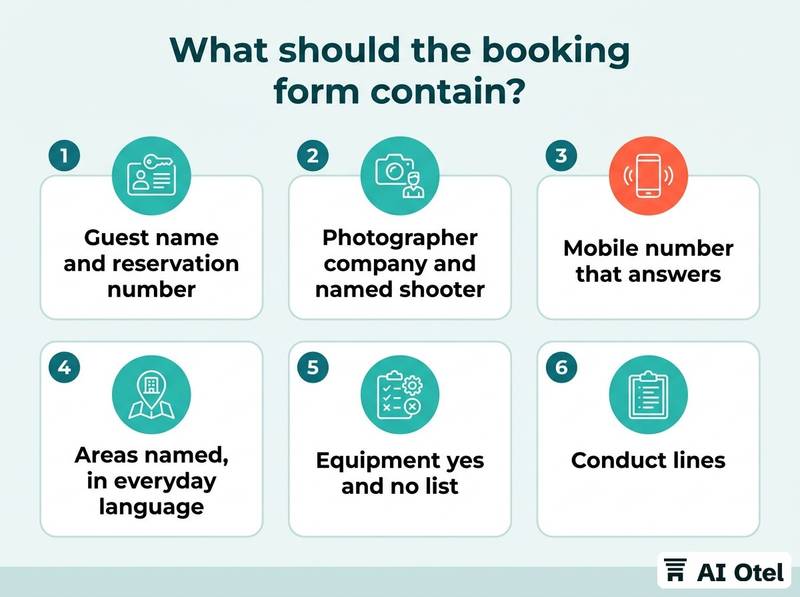
Start with identity: the guest's name and reservation number, the photographer's company, the named shooter who will actually be on site, and a mobile number that answers on the day. Then space and time: the areas written in their everyday names, the date, the start and end time, and a setup and pack-down buffer counted inside the window. A thirty-minute shoot with light stands is a longer closure than the shutter time suggests.
Equipment gets a yes and a no column. Handheld camera and one tripod: yes. Light stands, generator, smoke, confetti, open flame and drone: separate approval only. When a drone is involved the paperwork goes beyond this form, so the form should route that request rather than approve it; the same applies to a promo video plan, covered in hotel promo video and drone shots: permits and people in the frame.
Conduct lines come next: no photographing other guests, no access to guest room floors, no moving hotel furniture without asking, no blocking the path between the pool and the bar. Then money: the fee, how it is paid, whether it goes on the room bill, and the rain and cancellation rule in one sentence each. Three signatures close the form, guest, photographer and hotel, with a copy to each and a scan attached to the reservation.
The one-page form, line by line
Checklist
- Hotel name, form title and version date
- The staff member who owns the form
- Guest name and reservation number
- Photographer company and named shooter
- Mobile number that answers on the day
- Areas named, in everyday language
- Date and window, including setup and pack-down
- Equipment yes and no list
- Conduct lines
- Fee and payment route
- Rain and cancellation rule
- Three signature blocks
- Copy filed with the reservation
Flat fee, hourly rate or credit against the stay?
Choose one fee logic, write it down, and apply it to every request so the answer does not depend on who is on shift. If the question of a photo shoot at hotel garden fee is answered three different ways in one month, it becomes a negotiation at the desk, and negotiations at the desk happen in front of other guests.
A flat fee per shoot is the simplest to explain and to invoice, and fits commercial shoots and any shoot whose length is known in advance. An hourly rate with a minimum fits shoots that may run long; the minimum covers the staff hour and the closed area even when the shoot ends early. Crediting the fee to the stay fits an in-house guest's own photographer, where the charge goes onto the room bill and the hotel may offset it against food and beverage.
Set the amount against the hotel's own costs, not the photographer's day rate: the staff hour, the closed area, the extra cleaning, and the lost use of the space. The fee is a charge for use of space, invoiced like any other service. It is not a share of the photographer's income and it is not a permit.
Write the waiver rule down too: in-house guests, low season, and shoots that fall in a window nothing else uses. A deposit holds the window, and the form states either a free move to another date inside a set period or a credit. Publish the whole logic on the request page or in the first reply, so nobody arrives at the gate expecting free.
Why a revenue share is the wrong model here
| Model | Best for | What it protects | What to watch |
|---|---|---|---|
| Flat fee per shoot | Commercial and brand shoots | The calendar and the invoice | Shoots that overrun |
| Hourly with a minimum | Shoots of unknown length | The staff hour | The clock at pack-down |
| Credited to the stay | In-house guests | The relationship | The credit written, not promised |
| Waived | Low season, quiet windows | Goodwill | The waiver as a written rule |
A revenue share is the wrong model because the hotel cannot verify the photographer's income from a shoot, and because the question of who owns which space is a rent question, not a partnership question. The same reasoning applies to every third party that wants to work inside the hotel, as discussed in rent, revenue share or run it yourself.
Which hours and areas protect in-house guests?
The shoot gets a window and a route, never the garden. Map the garden by when each part is busy, then place the shoot where nothing else is happening.
Map by use, not by size. The pool deck fills from mid-morning, the shaded lawn fills after lunch, and the terrace belongs to the bar at sunset. Two windows usually work: early morning before breakfast service peaks, and late afternoon after the pool empties. The sunset hour on the terrace is the one to avoid in high season, which is exactly when most couples will ask for it.
Give the shoot one route with four backdrops: a fixed path from the gate, so staff walk it once and know exactly what is closed and for how long. The window includes setup and pack-down. Use physical signals: a small sign at the path entrance, a planter or rope line, and a line in the daily briefing so the pool attendant and the bar staff know before the photographer arrives.
Overrun is the duty manager's call, and the extra time is charged at the hourly rate or the shoot stops. Season changes the rule: in high season the window narrows to the quiet hours, and in low season the garden is empty and the hotel can be generous.
TipThe route walk
The sales manager walks the route with the photographer a day before, marks four backdrops, and notes which of them are visible from the bar and the pool deck. The walk takes minutes and removes the argument on the day.
What do you do when other guests appear in the frame?
Make it a rule about what is delivered: no image leaves the shoot showing a guest the hotel has not asked. This framing works because it is enforceable, while a rule about what a camera happens to catch is not.
Framing comes first: choose backdrops with the bar, the pool edge and the sun loungers behind the camera rather than in front of it. The photographer checks the frame before pressing and deletes what cannot be used; a shot that needs a crowd is not taken. A guest who asks to be in a photo can be, and the form notes it with their name and the time.
If a guest objects during the shoot, staff stop the shoot, move the route, apologize, and log the objection with the time and the area. Children never appear in a delivered image without a parent's written permission. Staff are neighbors, not scenery: no photographing them at work without their agreement, and no images of the reception screen or the key rack.
Two honest limits close this rule. The form is a house rule about what happens on the property; the hotel's own legal position on images is confirmed with its legal adviser. And do not promise a guest that they will never be in the background of another guest's phone photo. The policy covers the booked shoot, and it should say so in one line.
Five framing checks before the shutter
Checklist
- Is the bar or pool edge behind the camera?
- Is anyone identifiable in the frame?
- Is the path clear for guests walking through?
- Is any child in the frame without a parent present?
- Does the shot need a backdrop that is closed today?
Can you ask the photographer to tag the hotel?
Ask in the form and expect a no. A tag is a request, never a condition of entry, and the fee does not move if the photographer declines.
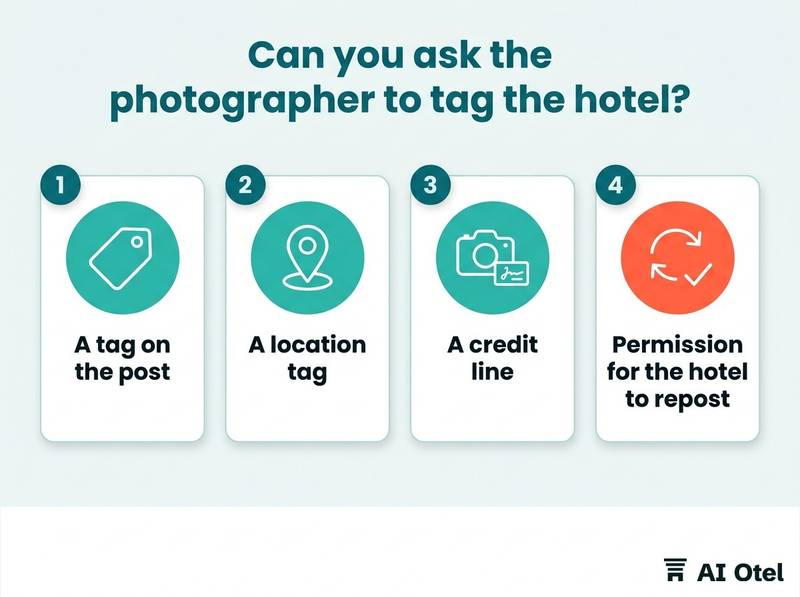
Ask for four things: a tag on the post, a location tag, a credit line, and permission for the hotel to repost a set number of images with credit. Put the request on the form with a tick box, so the answer is recorded before the shoot rather than discussed afterward. Do not ask for approval of every image, ownership of the work, or a ban on shooting at other hotels. Those requests end the relationship.
The couple's permission comes first: the hotel asks them in writing before reposting any image they appear in. Treat a tag as a bonus rather than a channel. It reaches the photographer's local audience, which is small and specific, and it is not something the hotel can plan around. Delivery terms belong in the same conversation: how many images, in what format, and by when, as covered in the shot list, choosing a photographer and delivery terms.
Where the images go matters less than where they can go. A hotel that runs its own channels can publish the approved set there, and a hotel using each hotel's own guest app, built and working ahead of launch, already has a place where an accepted offer goes onto the guest's bill rather than a loose email attachment. The same logic sits inside a broader hotel technology platform, where the hotel operating system is built and working ahead of launch, and where the bill, room service, spa bookings, requests and offers sit in one place.
NoteWhat a tag is worth, and what it is not
A tag brings the photographer's own audience, which is local and narrow. Write it into the form as a request with a tick box, keep the fee independent of the answer, and never make a tag a condition of using the garden.
What to do this week
Write the one-page form this week, walk the route once with a photographer, and fix a single fee logic before the next request arrives. The form, the window and the framing rule are three parts of one decision: the hotel sells the use of its garden for a defined hour without selling the peace of the guests who are already there.
If you are a traveler rather than a hotelier, and you are looking for a garden worth photographing, you can browse hotels across Türkiye (opens in a new tab) and ask the hotel directly about its photo policy before you book.
Frequently asked questions
Do we charge a guest's own photographer the same fee as a commercial shoot?
The form is the same for every request, but the fee logic can differ by request type and should be written down. An in-house guest's photographer is often waived or credited to the room bill, while a brand shoot pays a flat location fee invoiced to the company. What matters is that the rule is published and applied the same way on every shift.
What happens if it rains on the shoot day?
Decide before the day and put it in one sentence on the form. The usual choice is a free move to another date inside a set period, or a credit against a later shoot. A deposit holds the window either way, and the duty manager does not negotiate the rain rule at the gate.
Should the shoot fee go on the room bill or be invoiced separately?
Follow who pays. A guest's own shoot goes onto the room bill like any other extra. A commercial shoot is invoiced to the company with its own billing details, because the guest is not the buyer. The form states which route applies before the shoot starts.
How do we handle a guest who complains about a shoot in progress?
Stop the shoot, move the route away from the guest, and apologize without arguing the policy at that moment. Log the objection with the time and the area, then review the window at the next weekly meeting. A complaint about a shoot is usually a complaint about a window that was set badly.
Can we ask the photographer to send us the images afterward?
Ask for a set number of images with credit, in writing, on the form. Expect a license to use them, not ownership of the work, and expect the photographer to say no to approving every frame. Any image showing the couple is reposted only after the hotel asks them in writing.