Marathon and running-event weekends: a hotel plan for early breakfasts, luggage and late check-out
Create a race-weekend routine by counting back from the start gun. Define breakfast formats, bag tags and late check-out limits in writing before the first booking arrives.
AI draft · awaiting editorial review

Contents
Key takeaways
- A race weekend is decided by the start time, not by the race: breakfast, staffing and transport all count backwards from it.
- A breakfast box is the cheapest way to feed an early start; a partial buffet is the one that keeps runners inside the hotel.
- Late check-out on race day is a capacity decision made room by room at booking, not a favor granted at the desk.
- Every bag left after check-out needs a tag, a log line and a named person, or the desk loses track of it by noon.
- A minimum stay protects the weekend only when the rate, the rule and the cancellation terms are published together.
A hotel marathon weekend plan is one written routine for the hours around a race: breakfast open before the start, a tagged bag store, a late check-out held until the runner returns, and quiet corridors the night before. Build it backwards from the race's published start time, and publish every promise at booking.
It is 04:40 on race day. Guests in running kit are standing in a lobby where the breakfast buffet opens at 07:00, and the night receptionist has no instruction about any of them. This scene repeats in host cities every year, and it is avoidable. After reading this article you will be able to build one race-weekend plan: a timetable counted back from the start gun, a breakfast format chosen for your kitchen, a bag procedure, a late check-out rule set at booking, and a pre-arrival message that puts every promise in writing.
What do runners actually ask a hotel for?
Four things, usually in this order: breakfast before the start, a safe place for the bag, a shower and a late check-out after the finish, and a quiet room the night before.
The order is predictable. The pre-arrival question is almost always about breakfast time; the question at check-in is where the bag goes; the question at departure is whether the room can be kept a few hours longer. If your answers to those three questions are written down before the first booking arrives, most of the weekend runs itself.
Quiet is a housekeeping and maintenance decision, not a room category. Corridor vacuuming hours, lift door adjustments, deliveries at the back door, and any drilling or painting scheduled for the Saturday all decide whether the runner sleeps. Move noisy work off the race weekend, and tell housekeeping which floors hold runners.
The runner's clock runs early. Wake-up comes two to three hours before the start, so the hotel's timetable has to sit in front of that, not behind it. Road races and trail races are different guests: a road runner leaves and returns within a morning, while a trail runner may be out for most of the day and wants a shower well after the standard check-out hour. Ask which race the guest is running.
Some things runners rarely want: a shuttle they did not ask for, a branded kit bag, or a pasta dinner that any restaurant in the city serves. These cost money and answer nothing they asked. Skip them and spend the effort on the four real requests.
The promise made at booking is the one tested at 05:00 by a person who may not have taken the booking. That gap, between what was sold and what the night shift knows, is where most race weekends fail. The fix is not charm at the desk; it is a written plan that reaches whoever is on shift.
Supporters and family travel with the runner and ask different questions: a later breakfast, a place to wait near the finish, and a room away from the street side. They are guests too, and their needs peak at different hours.
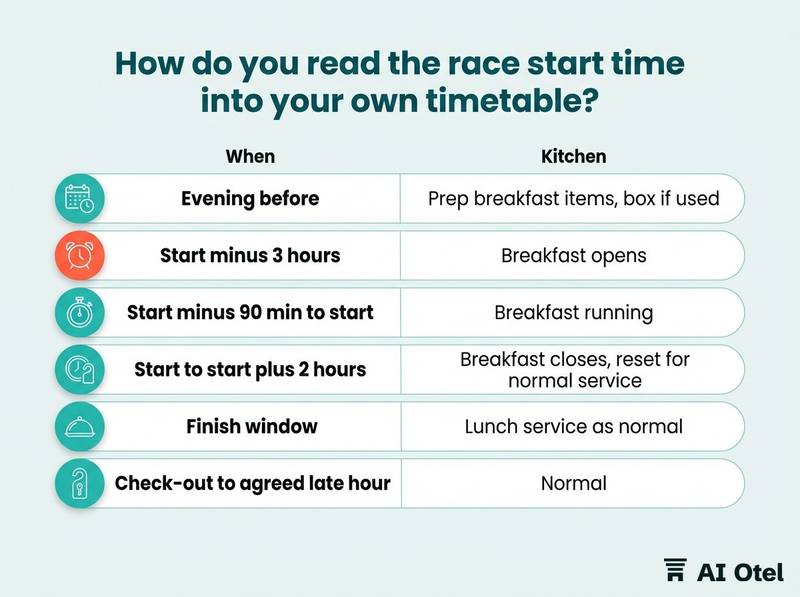
How do you read the race start time into your own timetable?
Put the race on the hotel calendar as a date with three times attached: the published start, the expected finish window, and the road closures, because each one moves a different department.
Take the start time and the course map from the organizer's public information. The course matters as much as the start: closed streets decide when your night staff can leave and when your early staff can arrive. If the hotel sits inside the closure zone, your own commute plan changes, not just the guest's.
Work backwards. Breakfast has to be over before the runner leaves for the start area, and the runner leaves earlier than the start to allow for warm-up, bag drop and toilets. If the gun goes at 07:00 and the start area is twenty minutes away, breakfast has to be running by 04:30.
Build three timetables, not one: kitchen, front desk, housekeeping. They peak at different hours, and on race day the housekeeping peak is the afternoon, not the morning, because late check-outs push the whole cleaning day back. Identity is checked in person at the desk, so the arrival peak on the Friday and Saturday evenings needs a second person on reception, not the morning shift.
Check the group blocks. Running clubs, tour operators and the organizer may hold rooms; confirm whether those guests eat with everyone else or on their own schedule. Look at the same weekend in your own calendar for a concert, a fair or a match, because a clash changes the rate decision and the staffing decision at the same time.
Write the plan as a document with a named owner and a review date, so it does not depend on the person who wrote it being on shift next year. The table below is an example; every time is given relative to the published start, so any hotel can shift it.
| When | Kitchen | Front desk | Housekeeping |
|---|---|---|---|
| Evening before | Prep breakfast items, box if used | Late check-out hours confirmed in writing on each booking | Quiet hours set, noisy jobs moved |
| Start minus 3 hours | Breakfast opens | Bag store unlocked, tags ready | Corridor work stopped |
| Start minus 90 min to start | Breakfast running | Runner questions, wake-up calls | No corridor work |
| Start to start plus 2 hours | Breakfast closes, reset for normal service | Bill reviews before guests leave for the finish | Normal rooms cleaned |
| Finish window | Lunch service as normal | Bag collection, shower requests | Late check-out rooms left for last |
| Check-out to agreed late hour | Normal | Late departures, key card checks | Late rooms cleaned after departure |
Early breakfast: a box, a pre-opened buffet or a lobby corner?
Choose by how many runners you expect and whether the kitchen can staff the hour, not by what reads best in the offer text.
The box is prepared the night before and handed out against a name list. It costs the least staff time, but it limits you to food that survives a night, and uncollected boxes are waste. It suits a hotel with a handful of runners and a kitchen that cannot open early.
A partial buffet, bread, fruit, yogurt, coffee and hot water, keeps runners inside the building and gives the kitchen one start and one close. It needs one cook and a clear finish time. This is the option that most often earns a good word from runners, because they eat what they want, when they want, inside the hotel.
A lobby corner with flasks, cups and wrapped items works for small numbers and fails when a club block arrives at once. Staff it with the night person and give that person the authority to restock. If you expect more than a dozen runners at the same hour, this option will run out before the last guest arrives.
Fluid and familiarity beat display. Coffee, hot water, water and plain food are what most runners take before a race; a wide menu is mostly photographed and not eaten. Ask about dietary and religious needs at booking, not at the counter, because a note on the reservation is cheaper than an apology at 05:00.
Decide the commercial side before you publish: included in the rate, sold as a supplement, or free for the race weekend. A price invented at the desk is the complaint you read on Monday. Announce the time and the place twice: in the pre-arrival message and on a sign in the lift the night before.
| Option | Staff time | Best when | Watch out for |
|---|---|---|---|
| Breakfast box (night before) | Lowest | Few runners, kitchen closed | Food must survive a night; uncollected boxes are waste |
| Partial buffet, opened early | One cook, one open and one close | Most runners; keeps them in the hotel | Needs a clear finish time |
| Lobby corner, flasks and wrapped items | Night person only | Small numbers | Fails when a club block arrives at once |
Luggage and late check-out after the finish
The bag and the room are two separate promises: the bag store is a procedure the desk runs, and the late check-out is a capacity decision the hotel makes at booking.
A bag left after check-out gets a tag with the guest's name, room number, mobile number and expected collection time, a line in a log, and a named person responsible. Store bags in a locked, ventilated room, not the space behind the desk. A fuller procedure for tags and the log is in hotel luggage storage procedure: tags, the log and bags left for weeks.
Race bags come back wet. Keep plastic bags and a drying area ready, and never put a wet bag on top of another guest's luggage. This one habit prevents the ugliest complaint of the weekend.
Decide the latest hour you can hold a room, room by room, from the arrival pattern of that night. A Sunday with few arrivals can hold rooms late; a sold-out Sunday cannot. For guests who must vacate, offer a shower and change: a day room, a spa shower or a changing room with towels. Decide whether it is charged or included, and publish it with the rate.
Mark late check-out rooms on the housekeeping board so nobody knocks at the standard hour, and extend the key card in the system rather than at the door. Review the bill with the guest before the start, so nothing is added while they are on the course and the desk is not settling accounts in a queue at noon. Answer the late check-out question at booking, in writing: a yes given at the desk on the morning cannot be kept if the room has been resold. The wider policy questions are covered in early check-in and late checkout: setting the policy and answering requests.
ChecklistRace-day departure checklist
- The room is marked on the housekeeping board
- The key card expiry is extended in the system
- The bag is tagged and logged
- The collection time is written on the tag
- A named person owns the bag room
- A shower option is offered to guests who must vacate
- The bill is reviewed before the guest leaves for the start
Should you set a minimum stay or a race-weekend rate?
A minimum stay protects the weekend only when the rate, the rule and the cancellation terms are published together; a surcharge that appears at the desk is a complaint in waiting.
Choose the shape of the rule: a two-night minimum covering the nights before and after the race, or a single-night minimum on the busiest night. The first fills the quiet Friday; the second leaves it empty. For most host-city hotels the two-night rule earns more across the weekend than one expensive Saturday.
Publish the rule in the rate's own terms, not in a footnote. A guest who learns about a minimum stay at the payment page books somewhere else and does not come back. Name what the rate includes: the early breakfast, the bag store, the late check-out hour. An inclusion is easier to defend than a surcharge with no content.
Cancellation terms need a clear cut-off date. Race entries get cancelled and injuries happen; a rule that ignores this produces disputes at the desk on the Friday night. Remember the guest who did not come for the race: a blanket minimum stay pushes the ordinary weekend booking to another hotel, and that guest is the one who returns in November. Keep some inventory free of the rule.
Price from your own pickup and your own booking pace, not from the race's published entry numbers. Your block and your pace are the demand signals you control. The same discipline applies to any one-off date, as described in pricing around fairs, concerts and matches: a checklist for one-off dates.
Watch outThe confirmation wins
A race surcharge or minimum stay that is not in the rate terms at the moment of booking will be disputed at the desk, and the desk will lose, because the guest can show the confirmation. Whatever the hotel charges, it must appear in the terms the guest accepted when paying.
What goes in the pre-arrival message, and what comes after the race?
One message, sent a few days before arrival, that answers the four questions in writing, and one short follow-up after the finish.
The message states the breakfast time and place, where the bag goes, the late check-out hour agreed for this booking, and the desk number to call at that hour. Send it once, to the address on the booking, and put the same text where the guest will look at 05:00 without searching. A hotel guest app installed from the browser, built and working ahead of launch, keeps the message, the bill and the requests in one place, with no app store download.
Paper still works. A sign in the lift and a card at check-in cover the guest whose phone is in a bag in the room. Use both channels; the cost is minutes.
The follow-up is one short thank-you and one question: what would have made the morning easier. Not a survey, not a request for a review. Log the answers, because the same three complaints return every year, and each one becomes a line in next year's plan. Close the loop with the departments: the kitchen, the desk and housekeeping each get the two or three points that concern them, in writing, before the next race date.
Key pointFour lines that answer everything
Breakfast opens at (time) in (place). Leave your bag at (place) until (time). Your check-out is held until (hour) for this booking. Call the desk on (number) at that hour.
Write the plan down this week
One page, one named owner, the four promises and the times attached to them, reviewed after the race. The pieces only work in one order: the start time sets the timetable, the timetable sets the breakfast, the breakfast and the bag store make the late check-out worth having, and the rate publishes all of it before the guest arrives. If you run a hotel that wants the timetable, the messages and the room decisions to live in one system, a hotel operating system with reservations, housekeeping and billing in one place, built and working ahead of launch, is where that plan can be written once and reused every year. And if you are the one running, you can look for a place to stay in Istanbul (opens in a new tab) on a race weekend.
Frequently asked questions
What time should breakfast open on marathon morning?
Work backwards from the published start: the runner has to eat, then travel, warm up and drop a bag before the gun. Decide whether that hour is served as a partial buffet, a box or a staffed lobby corner, and keep the same time for the whole race weekend so staff and guests can rely on it. State the exact time and place in the pre-arrival message and on a lift sign the night before.
Can a hotel say no to a late check-out on race day?
Yes. It is a commercial decision that belongs in the booking terms, and the guest needs the answer at booking, in writing. If the room cannot be held, offer a shower and change plus the bag store instead. A refusal delivered at the desk on the morning is the version that becomes a complaint.
Do runners want a special package or just a normal room?
The timetable matters more than the package. If you build one, name only the inclusions the hotel will actually deliver: the early breakfast, the bag store, a stated late check-out hour. A package that promises what the desk cannot give is worse than a plain room sold with a clear message.
Where should guests leave bags after check-out?
In a locked, ventilated room, with a tag carrying the guest's name, room number, mobile number and collection time, a line in a log, and a named person responsible. Never behind the desk or in a corridor. Keep plastic bags and a drying area for wet kit, and never stack one guest's wet bag on another's luggage.
How do you plan for a guest who finishes after the standard check-out time?
Decide before the weekend which of three answers the hotel gives: hold the room to an agreed hour, offer a day room, or offer a shower and change. Publish whether it is charged or included, mark it on the housekeeping board, and extend the key card in the system so the guest is not locked out mid-afternoon.