Hikers and trekkers as guests: the route sheet, the sign-out board and the late-return rule
A hiker-friendly hotel runs four written routines: early food, current route sheets, a sign-out board with a late-return rule, and a drying corner. Each uses what the building already has.
AI draft · awaiting editorial review
Contents
Key takeaways
- A route sheet is one page per trail, dated, with distance, ascent, waymarking, water, exit points and an expected time, and it names the member of staff who last walked it.
- A hiker plans tomorrow the evening before, so the desk's useful moment is at check-in and after dinner, not at nine in the morning.
- The sign-out board records name, room, route, departure and expected return, and it stays behind the desk because it holds personal data.
- The late-return rule needs three fixed times and a named person for each, and it never includes sending staff onto a trail in the dark.
- Boots dry on moving air at moderate warmth; a hot radiator drives moisture into the leather and leaves the inside damp.
A hiker-friendly hotel runs four routines: a packed lunch or early breakfast ordered the night before; a route sheet, a one-page card per trail with distance, ascent, water and exit points, kept current by a named member of staff; a sign-out board with a late-return rule; and a ventilated drying corner. None needs building work.
The group leaves at six and the breakfast room opens at seven. By the time they are back, the kitchen is closed and nobody at the desk knows which trail they took. This article sets out how to run hotel hiking guests service as four written routines, each using what the building already has: a kitchen, a printer, a night shift and a spare corner.
What do hikers actually ask a hotel for?
They ask for four things, and only one of them is a room: food before the trail, a route they can trust, someone who notices when they are back, and a way to dry kit overnight.
The day is set by daylight and weather, not by the hotel's timetable. Departures fall before the breakfast room opens; returns fall after the kitchen has closed. The questions at the desk are practical: where the trail starts, whether there is water on the way, how long it takes, when it gets dark, whether a bag can be left. What they leave behind is a car, a suitcase, yesterday's wet kit, and often a phone that will have no signal for hours.
The failure that repeats is small and costly. The desk answers from memory, the answer is out of date, and the guest loses half a day before finding the real trailhead. A hiker is not a leisure guest on a later schedule: they decide tomorrow tonight, so the two moments that matter are check-in and after dinner. The hotel already owns what is needed, and every routine below uses that, not new construction.
ChecklistWhat the desk should hand over before a guest leaves
- A packed breakfast or lunch ordered the night before
- A route sheet for the trail the guest has chosen
- The day's first and last light times
- Water points and the last place to fill
- The desk's phone number and its opening hours
- The expected return time written on the sign-out board
The same check-in briefing pattern works for other early risers; how event weekends handle early breakfasts and late check-out follows the same logic.
Early breakfast or a packed lunch: which one, and what does it cost?
Offer both and let the departure time decide: an early cold buffet for guests leaving after the breakfast room could open, a packed lunch ordered the night before for everyone else.
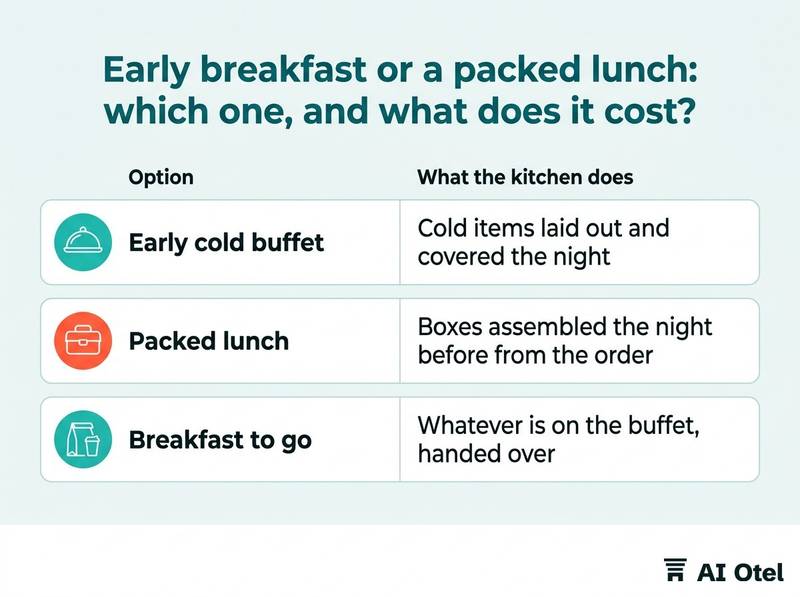
The order cut-off is the whole mechanism. One line on the check-in form, for example a packed lunch ordered by 21:00 for the next morning, and the kitchen plans from a real count instead of a guess. A packed lunch is assembled the night before from stock the kitchen already holds; an early hot buffet costs staff hours and a hot line. Include one and charge for the other, or price them differently and say so.
Choose contents that survive a day in a rucksack: bread, hard cheese, boiled eggs, nuts, dried fruit, and a refillable water bottle. Avoid soft fruit, mayonnaise-heavy fillings and anything that leaks. Label each box with the room number and the guest's name, and take allergies at the moment of ordering, not in the kitchen at six in the morning.
Put the charge on the room account so it settles in one bill at check-out, rather than as a cash sale at the desk while the guest is trying to leave. The waste problem is real, because boxes get made for guests who leave without collecting: count orders, keep two spares, and record who did not collect. Say plainly what the price includes, so nobody discovers the charge at departure.
| Option | Suits | What the kitchen does | What the desk records |
|---|---|---|---|
| Early cold buffet | Departure after the room opens, before the hot line | Cold items laid out and covered the night before | Room number, collection time |
| Packed lunch | Departure before the room opens, or a full-day route | Boxes assembled the night before from the order count | Room, name, allergies, charge |
| Breakfast to go | A guest leaving in ten minutes | Whatever is on the buffet, handed over in a bag | Room number only |
What belongs on a route sheet the desk keeps current?
One page per route, dated, with distance, ascent, waymarking, water, exit points and an expected time, plus a named member of staff who walks it and re-dates it.
The fields are fixed: start and end point, distance, total ascent, how the route is waymarked and by whom, water points, the places where a guest can leave the route early, the expected time for an average walker, and the date it was last checked. The named owner is what separates a route sheet from a photocopied map: one person, by name, walks it in season and writes the date on it.
Write it in the languages the desk can actually speak. A sheet in a language nobody at reception reads helps nobody at six in the morning. The same text should exist twice, as a printed card in a folder at the desk and as the same words on the guest's phone, so nobody is photographing a laminated sheet. Where a route crosses private land, or a section is closed for the season, the sheet says so and says who told the hotel.
Update on a rhythm, not on a complaint: a check before the season, and a re-date after any closure or storm. The check-in briefing cyclists get follows the same rule of describing the ground rather than recommending it.
Watch outA sheet describes; it does not certify
Do not print words like safe, easy, family-friendly or suitable for beginners. Do not grade difficulty beyond what the waymarking authority publishes, and do not give medical or rescue advice. If a guest asks whether a route is safe, the honest answer is what the hotel knows about the ground, the water and the weather, and that the decision is the guest's.
The sign-out board: who is out, where, and when back
A sheet or whiteboard behind the desk where each guest leaving on a trail is recorded with name, room, route, departure time and expected return, and cleared when they walk back in.
It is voluntary, and say why it exists: so that if the guest is not back, someone notices and knows where to start. A guest who declines is not a problem; note the refusal and move on. Keep it behind the desk, not in the lobby. It holds names, room numbers and movements, which is personal data, and other guests should not be able to read it.
Record the minimum: name, room, the route name as it appears on the sheet, departure time, expected return, a mobile number, and the initials of whoever took the entry. The night shift handover is where the board earns its place: the evening supervisor reads it at the start of the shift and again at the check time. Mirror the expected return into the reservation note in the hotel system, so the information survives a shift change and a wiped whiteboard.
For groups, one line for the leader with a headcount, not fifteen lines, but the headcount is written down. Clear the entry when the guest returns, and destroy the day's sheet at the end of the stay.
ChecklistFields on the board
- Guest name
- Room number
- Route as named on the route sheet
- Departure time
- Expected return
- Mobile number
- Emergency contact if the guest gave one
- Staff initials
- Returned, with the time and initials
What is the late-return rule, and who gets called?
A written rule with three fixed times and a named person for each: a check time, a call time and an escalation time, after which the duty manager decides what happens next.
The check comes first. At the check time, an hour after the expected return for example, the desk looks at the board and confirms the guest has neither returned nor called. Then the call: the desk rings the mobile number on the entry and leaves a message if there is no answer. Many late returns are a guest who stayed for dinner in the village.
The escalation is not the desk's to make alone at eleven at night. The duty manager named in the rule decides whether to call the emergency contact the guest gave and whether to inform the authorities. The hotel does not send staff onto a trail in the dark and does not promise a search; write both into the rule so that nobody improvises them.
Collect the emergency contact at check-in with the guest's consent, and record that consent. A contact held without it is a liability, not a safety net. Write down what was done and when: the check, the call, the message, the decision and who made it. That record protects the guest and the hotel. Rehearse it once with the night shift before the season, on a quiet night, so that the first real use is not the first reading.
| Time | Who acts | What they do |
|---|---|---|
| Expected return + 1 hour | The desk | Check the board, confirm no return and no call, note the time |
| Expected return + 2 hours | The desk | Call the mobile, leave a message, note it |
| Expected return + 3 hours or nightfall, whichever first | The duty manager | Decide on the emergency contact and the authorities, record the decision and reason |
| On return at any hour | The desk | Clear the entry, note the time, offer a hot drink and a late plate |
Drying boots and wet clothes: what actually works
Moving air at moderate warmth, not a hot radiator: a ventilated corner with racks, a fan and something to catch the water dries leather overnight without cooking it.
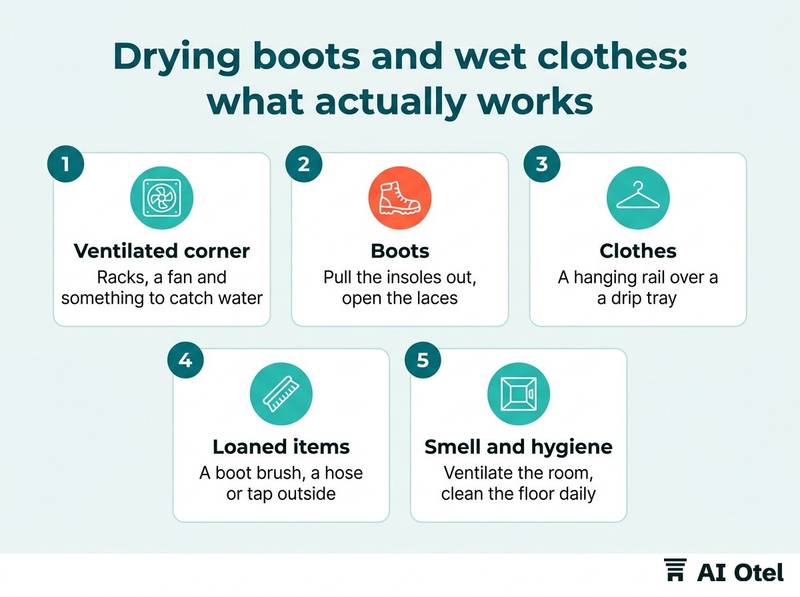
The space can be a spare room, a covered corner of a service corridor or an annex, with a door that closes and a floor that can get wet. It does not need to be purpose-built. Air moves water; heat alone drives moisture into the leather and leaves the inside damp, so a fan on low overnight does more than a radiator on high.
For boots, pull the insoles out, open the laces, stuff with newspaper and change it once, or use a boot dryer on its lowest setting. Never on a radiator or in front of an oven. For clothes, a hanging rail over a drip tray, hangers with clips, and a notice saying when the room is open and who holds the key. What the hotel lends and wants back, a boot brush, a hose or tap outside, a plastic bag for wet kit, is recorded the way any loaned item is; a lending log that gets items back does that job.
The smell and hygiene question is real: ventilate the room, clean the floor daily, and keep wet kit out of guest rooms and off the corridors. Tell guests at check-in that the corner exists, because a drying room nobody knows about is a store room.
TipPut the drying corner in the briefing
Mention it at check-in and on the route sheet: where it is, when it opens, who has the key, and the one house rule, which is no boots on the radiators in the rooms.
Weather change messages: what to send, and when?
One short message at a fixed evening hour, carrying tomorrow's forecast from the state meteorological service, what the hotel knows about the ground, and the desk's opening hours.
Time it with the packed-lunch cut-off so one message does the work of two: the forecast, the reminder to order, and the desk's hours in a single read. Quote the forecast; do not interpret it. Rain from two in the afternoon and wind on the ridge is the hotel passing on a source. It will be fine by noon is the hotel making a promise it cannot keep.
Say what the hotel knows and what it does not: a stream crossing that rises, an exposed section, a path nobody has walked since the storm. The heat case and the cold case need different words, water and start times in summer, daylight and layers in the shoulder season. For the wider summer picture, the hotel's heat wave plan for rooms, pools and outdoor staff covers the rest of the building.
The channel can be the guest app, or a printed note at the desk and in the lift. A message to a phone needs the guest's consent, and consent is recorded, not assumed. One named person writes it from a template, so the message is the same quality on a busy Friday and a quiet Tuesday. Keep it short enough to read standing up, and put the desk's number in it.
NoteInformation, not instruction
Tell the guest what the forecast says and what the hotel has seen on the ground. Do not tell them a route is safe today, and do not tell them not to go.
A hotel that wants to send these messages from one system, and to let guests read them on their own phones, can look at how a guest app installed from the browser is built and working, ahead of launch, and at what a hotel operating system covers across the desk, the kitchen and the bill, built and working, ahead of launch.
What to do next
Write the four routines on one page this week: the lunch order line, the route sheet with a name and a date on it, the sign-out board with its three times, and the drying corner's opening hours. Then walk the shortest route yourself and re-date the sheet. The routines hold together because each feeds the next: the sheet tells the desk what to ask, the board tells the night shift whom to call, and the evening weather message tells the guest what to order and when to leave.
If you are reading this as a guest rather than a hotelier, you can look for a hotel for your next hike in Türkiye (opens in a new tab).
Frequently asked questions
Should guests have to sign out before a hike?
No. Keep it voluntary and explain the purpose: if the guest is not back, someone notices and knows where to start. Record a refusal without argument, keep the board behind the desk because it holds personal data, and mirror the expected return into the reservation note so the night shift sees it.
What should a hotel put in a packed lunch for a full day on the trail?
Durable food that survives a warm rucksack: bread, hard cheese, boiled eggs, nuts, dried fruit, and a refillable water bottle. Avoid soft fruit, heavy mayonnaise and anything that leaks. Label the box with room and name, take allergies when the order is placed, count orders the night before, and put the charge on the room account.
What should the night shift do if a guest has not returned?
Follow the three times in the written rule: check the board, call the mobile and leave a message, then hand the decision to the named duty manager, who decides on the emergency contact and the authorities. Staff do not go onto the trail in the dark. Write down each step and its time.
Does a small hotel need a drying room to attract hikers?
No. A ventilated corner with a rack, a fan, a drip tray and stated opening hours does the work, plus a house rule against boots on room radiators. Tell guests at check-in that it exists and record any equipment lent to them.
How often should a route sheet be updated?
Before the season, and again after any closure, storm or change of waymarking. One named member of staff walks the route and prints the date on the sheet. A sheet with no owner and no date is a photocopied map with extra steps.