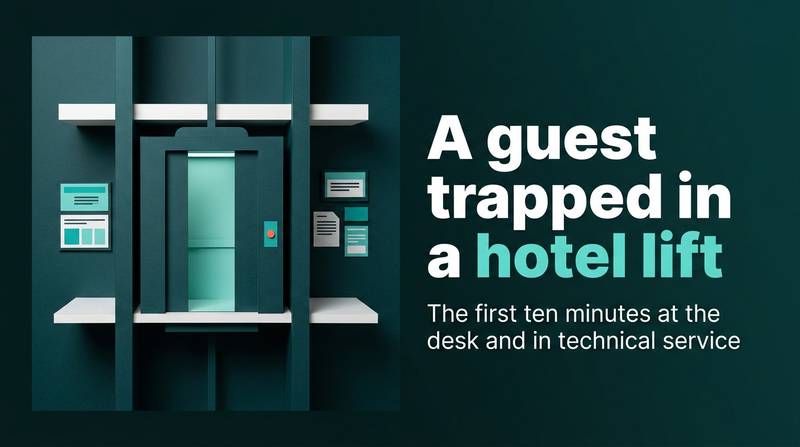
A guest trapped in a hotel lift: the first ten minutes at the desk and in technical service
This guide covers the first ten minutes when a guest is trapped in a hotel lift. It provides a response card, call order, safety rules and post-incident steps.
AI draft · awaiting editorial review
Contents
Key takeaways
- The lift alarm must ring at a desk that is staffed at 03:00, not in an office that closes in the evening.
- One person stays on the intercom and owns the guest; a second person makes the calls and writes the times down.
- Staff never force the doors, never ask the guest to climb out, and never try to move the car with someone inside.
- Give the guest only times you were actually given, and call back when a promised time passes, even with no news.
- The lift stays out of service until the maintenance company has inspected it and released it in writing.
A lift entrapment is a guest shut inside a lift car with the doors closed. The desk answers the intercom, keeps the guest talking, sends one person to the landing, calls the lift maintenance company and 112 if anyone is unwell, and never forces the doors.
The intercom buzzes at 02:40. Someone is between floors with the doors shut, and the person who answers is a night receptionist alone at the desk with no technician on site. That is the moment this article prepares you for. By the end you will have a one-page response card, the words to say through the intercom, the order of calls, the things staff must never do, and a twenty-minute drill to test whether the card is true.
What should happen when a hotel lift alarm sounds?
The alarm must reach a desk that is staffed at night, and one named role must own the guest from the first ring until the doors open.
Start by finding out where the alarm actually rings. On many lifts the button in the car calls an intercom at the front desk, but on older installations it can ring a bell in the machine room or a panel nobody watches. The lift's own documentation says which, and a test press settles it.
Keep the response card in two places: at the front desk and in the technical service office. One side of A4, large type, with the lift numbers, the maintenance company's 24-hour line and the internal extensions. Name roles, not people: "the receptionist on shift answers, the shift supervisor makes the calls" survives a staff change; a name on a card does not.
Treat the night as the hard case, because it is. One person at the desk, no technician on site, the maintenance company's office closed. The 24-hour number belongs on the card, not buried in an email inbox. Write down what staff may promise and what they may not: they can promise to stay on the line and to call back at a stated time, but not an arrival time nobody has given them.
The card is one page of a wider plan. The rest, teams, evacuation, first aiders, sits in a hotel emergency plan: teams, guests, first aiders and evacuation.
The first three minutes: what do you say through the intercom?
Answer on the first ring, say who you are, and get three facts: which lift, which floor, and whether anyone inside is unwell.
Identify the lift from the number painted inside the car and on the landing panel. If the desk cannot tell which one, ask the guest to read the number aloud. Find the floor from the indicator above the landing door, or ask the guest what the display inside the car shows. A car stopped between floors is normal and is not an emergency in itself.
Ask three questions and no more at first: how many people are inside, is anyone unwell or injured, are the doors fully closed. Then say what happens next in plain words: "You are in lift 2. I am at the desk and I am staying on this line. The maintenance company is being called now."
Silence is what frightens people. If you must leave the line, say when you will be back and come back at that minute. Write the times as they happen: alarm, answer, first call to the maintenance company, release. Memory is unreliable an hour later, and the note is needed for the incident record. Use the guest's language if anyone on shift speaks it; otherwise short, slow sentences and no technical words.
ChecklistThe response card, ten items in the order they are used
- Answer the intercom on the first ring and give your name and the desk.
- Note the time.
- Get the lift number.
- Get the floor from the indicator or the guest.
- Ask how many people, whether anyone is unwell, whether the doors are shut.
- Tell the guest you are staying on the line.
- Signal a second staff member to start the calls.
- Send someone to stand at the landing.
- Call back at the time you promised.
- Record the release time and keep the note.
Who do you call, and in what order?
The desk keeps the guest; a second person calls the in-house technician, then the lift maintenance company's 24-hour line, and 112 when someone inside needs medical help.
Split the two jobs. The person on the intercom does not make calls, and the person making calls does not leave the desk unattended. In-house technical service comes first only if it can reach the hotel sooner than the maintenance company and the maintenance contract lets it attend; otherwise go straight to the maintenance company and tell the technician what is happening.
On the call to the maintenance company, give the hotel name and address, the lift number, the floor, how many people are inside, and a callback number. Ask for an estimated arrival and write it down. Call 112 when someone inside is unwell, injured, pregnant, a child alone, or panicking badly, and when there is smoke, fire or a building-wide power failure. Say the word "lift" and the full address clearly.
If the contract changed and the card was not updated, the inspection plate inside the car and the maintenance log in the machine room name the company that services the lift. If the promised time passes, call again and note it. If the company cannot be reached at all, the duty manager decides the next step, not the receptionist alone.
| Call | When | What to say | Who owns it |
|---|---|---|---|
| In-house technician | On site and allowed by the contract | Lift number and floor | Shift supervisor |
| Maintenance company 24-hour line | Always, immediately | Address, lift number, floor, people inside, callback; ask for arrival estimate | Shift supervisor |
| 112 | Anyone unwell, injured, a child alone, panicking badly; smoke, fire or power failure | The word "lift" plus full address | Shift supervisor |
| Duty manager | Promised time passes, or company unreachable | Facts and times so far | Shift supervisor |
| Guest's own contact | Only if the guest asks | The situation in one sentence | Front desk |
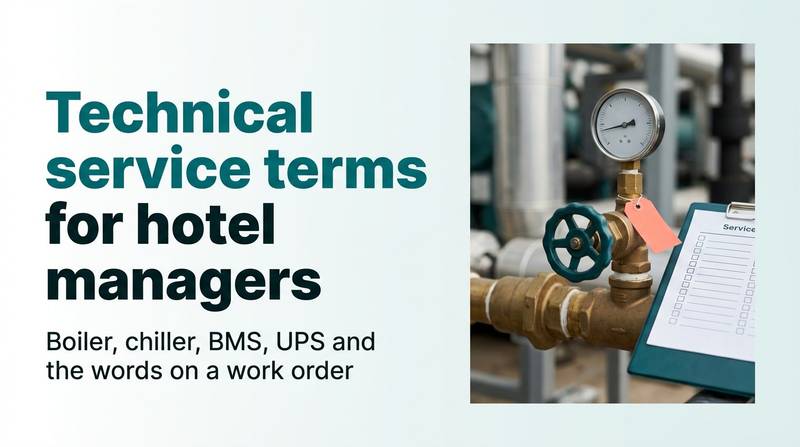
The words on a work order and the terms of the maintenance contract are worth knowing in advance; see technical service terms for hotel managers: boiler, chiller, BMS, UPS and the words on a work order.
What must staff never do when a guest is stuck in a lift?
Staff never force the doors, never ask the guest to climb out, and never try to move the car while someone is inside.
Forcing the doors can leave the car unlocked between floors. The guest can fall into the shaft, and a car that is no longer held can start moving. Telling a guest to open the doors or climb out moves the risk onto the person least able to judge it, in a space they do not know.
The manual release in the machine room belongs to trained people working under the maintenance contract. A key in a drawer is not permission to use it. Do not switch the lift off and on to reset it with someone inside, and do not treat the fire service switch as a repair.
Do not put an out of order sign on the landing and walk away: someone is inside and needs a voice outside the door. Do not promise an arrival time you were not given, and do not guess to make the moment easier. A missed promise is worse than an honest "I do not know yet". Do not discuss the incident with other guests or on social media; what happened inside the car is the guest's account to give.
Watch outNever, in this order of harm
Force the doors; ask the guest to climb out; move the car with someone inside; use the machine-room release without the maintenance company; reset the lift with someone inside; leave the landing unattended; invent an arrival time.
How do you look after the trapped guest and the people waiting?
Keep the person inside informed and the landing outside calm, and treat both as guests rather than as an interruption to the shift.
A staff member stands at the landing for the whole time, so the guest hears a voice outside the door as well as through the intercom. Bring water and a chair for the landing, and a screen or a sign. Pass nothing through a partly open gap; that is a question for the maintenance company on the phone, not a decision for the desk.
Give honest times. Say what you know, name the time you were given, and call back when it passes even if there is no news. Redirect other guests to the stairs or the second lift, put a sign at the landing, and tell housekeeping so no trolley is sent into a closed corridor.
If the guest inside becomes unwell, that is the moment for 112, and the illness routine takes over from the lift routine, as in when a hotel guest falls ill: a response routine from the first call to the follow-up. For a child or anyone alone, stay on the line, keep sentences short, and ask them to describe what they can see.
What happens after the doors open?
Check the guest first, keep the lift out of service until the maintenance company has inspected it, and write a short factual note on the same shift.
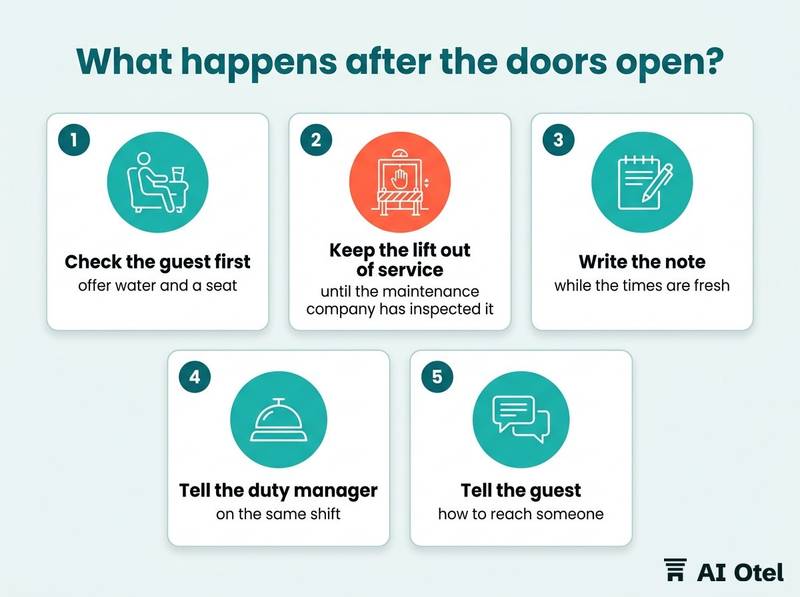
Ask the guest how they are, offer water and a seat, offer to call a doctor, and ask whether they want to go to their room. Do not argue about whether it was serious. Keep the lift out of service until the maintenance company has inspected it and confirmed it can return to service; a verbal "it is fine" on the phone is not a release.
Write the note while the times are fresh: alarm, answer, calls made and their times, release, lift number, floor, who attended, what the guest reported, what the company found. Short and factual, no blame. Keep the maintenance company's job sheet, and the intercom recording if the system records calls.
Tell the duty manager on the same shift, and tell the guest how to reach someone if they feel unwell later. If the guest raises compensation, that is a management decision the next morning, not something the desk agrees at 03:00.
How do you keep the response card current?
Test it with a drill once a year, and check the contacts every time a maintenance contract or a role changes.
The drill: press the alarm button in each lift at a quiet hour, see where it rings, time how long the answer takes, and check that the person who answered knew where the card was. Check the contact list at every contract renewal and every change of role: the maintenance company's 24-hour line, the in-house technician, the duty manager, the hotel's own emergency line.
Keep the lift records together: the maintenance log in the machine room, the inspection plate in the car, and the inspection dates on the technical calendar, alongside periodic inspections in hotels: boilers, lifts, electrics and fire systems on one calendar. After any entrapment, review the note: what took longest, what was missing from the card, what the guest said afterwards. Keep the card short enough to read at 03:00: one side, large type, no paragraphs, no policy language.
TipA twenty-minute drill script
Pick a quiet hour and tell the maintenance company in advance that it is a test. Press the alarm in lift 1 and time the answer. Ask the person who answered to fetch the card and read the maintenance number aloud. Repeat for each lift, write down what failed, and fix it the same week.
What to do next
Write the card today from your own lift records: the lift numbers, the maintenance company's 24-hour line, and the role that answers at night. Then press one alarm button at a quiet hour and see whether the card is true. The whole routine is one line: answer and stay, send a voice to the landing, call in the right order, never force the doors, look after the guest, note what happened, and test the card before you need it.
Frequently asked questions
Is it ever acceptable to hold the lift doors open to pass water in?
No. A partly open door is a door that may not close again, and the gap invites the guest to try more. Keep the guest talking, keep water ready at the landing, and ask the maintenance company on the phone what they advise if the wait is long. Their answer, not the desk's, decides.
What if the guest inside starts to panic?
Stay on the line and slow the conversation down: ask the guest to name what they can see, count the buttons, describe the panel. Send a second staff member to the landing so there are two voices. If the guest becomes unwell or cannot be calmed, call 112 and say the word "lift" and the full address.
What should the incident note contain?
Times for the alarm, the answer, each call and the release; the lift number and the floor; who attended; what the guest reported; what the maintenance company found. One page, factual, no blame and no opinion. It is the document the manager reads the next morning and the one that shows what to fix on the card.
How often should we test the lift intercom and the alarm button?
The hotel sets its own interval, and once a year is the minimum worth having. Test at a quiet hour, tell the maintenance company it is a test, time the answer, and confirm the person who answered could find the card and read the 24-hour number aloud. Log the result and fix failures the same week.
Should the lift go back into service the same night?
Only after the maintenance company has inspected it and confirmed it can return to service. Until then it stays out of service with a sign at every landing, and the desk tells guests why. A lift that trapped one guest can trap the next one an hour later.