Technical service terms for hotel managers: boiler, chiller, BMS, UPS and the words on a work order
This glossary groups hotel engineering terms by system, from boilers to BMS, and links each to the guest symptom it causes. Learn to name the fault, ask the right questions, and write clear work orders.
AI draft · awaiting editorial review
Contents
Key takeaways
- A technical term is useful to a hotel manager only when it comes with the guest symptom it causes and the question to ask next.
- Plant and maintenance are two separate lists: boiler, chiller, fan coil and UPS are equipment; preventive, corrective, work order and MTTR describe the work done on that equipment.
- A BMS monitors, schedules and raises alarms; it repairs nothing, so an alarm on the screen is a question rather than an answer.
- MTTR only means something when the clock starts at the guest's report, not at the technician's arrival.
- Naming the system turns a complaint into a work order with an owner, a location and a time pattern.
Hotel engineering terms are the shared vocabulary for the plant that heats, cools and powers a building, and for the jobs that keep that plant running. This glossary groups them by system rather than alphabetically, and gives each term one plain sentence plus the guest symptom it produces.
The call ends and the front office is left with a sentence it cannot repeat to a guest: the fan coil trips the chiller. Nothing in that sentence says whether one room is warm or the whole building is, who is coming, or what the desk should tell the person waiting at reception. After reading this article you will be able to name the system behind a complaint, ask the four questions that route the job correctly, and keep a record the next shift can use.
How should a hotel manager read a technical service report?
Read it by system, not by alphabet. A glossary sorted by the plant that produces the symptom tells you where to look; a glossary sorted A to Z only teaches you how a word is spelled.
Group the vocabulary into five blocks: heating and hot water, cooling and air, power, controls and meters, and the words used to describe work on all of them. Each block maps to a trade, a plant room and a set of guest symptoms. Every entry should answer three things in one line: what it is, what it does for the guest, and what it looks like when it fails.
You are not being asked to diagnose. You are being asked to name the system, the part of the building and the time pattern, then hand the diagnosis to the person who owns that system. Separate the guest answer from the technical answer: the desk needs one sentence it can say, technical service needs one sentence it can act on, and they are rarely the same sentence. Write the answer into the work order rather than a chat thread, so the next shift inherits the history instead of the rumor, as we cover in hotel maintenance work orders from complaint to closed job.
When a contractor uses a term you do not recognize, ask for it in the form of a symptom and a location. A term that cannot be tied to a symptom is usually being used to end the conversation.
ChecklistFour questions to ask on any technical call
- Which system is this, in plain words?
- Which part of the building does it affect: one room, one wing, one floor, or the whole property?
- Since when, and does it repeat at the same time of day?
- What does the guest actually notice, and what should the desk say until it is fixed?
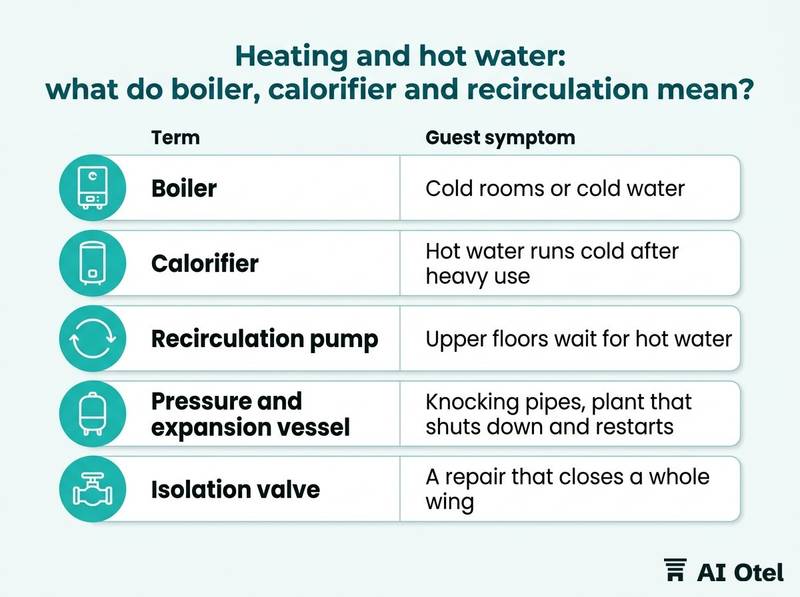
Heating and hot water: what do boiler, calorifier and recirculation mean?
The boiler makes heat, the calorifier stores and transfers it into the water guests use, and the recirculation pump keeps that water moving so a tap runs hot quickly. Three different failures, three different guest complaints.
A boiler is a fuel-fired vessel that heats water for the building's heating circuit, for domestic hot water, or for both. A steam boiler is a different plant with a different operating regime, so ask which type the property has before discussing anything else. A calorifier is a tank in which hot primary water passes through a coil and heats the domestic hot water indirectly: the water in the guest's shower never mixes with the water in the boiler circuit, which is why a boiler fault does not automatically mean a hot-water outage.
A recirculation pump keeps hot water circulating around the loop, so an upper-floor tap runs hot without waiting. When the pump fails, or is switched off overnight to save energy, the guest waits and then lets the water run, which costs more than the pump. A sealed heating circuit also needs a pressure vessel to absorb the water's expansion; a pressure fault shows up as knocking pipes, repeated topping up, or a plant that shuts itself down and restarts without explanation.
| Term | One plain sentence | Guest symptom |
|---|---|---|
| Boiler | Vessel that heats water for heating or hot water | Cold rooms or cold water, depending on which circuit it serves |
| Calorifier | Tank that transfers heat into domestic hot water without mixing the two waters | Hot water runs cold after heavy use at peak |
| Recirculation pump | Keeps hot water moving around the loop | Upper floors wait for hot water, then run the tap |
| Pressure and expansion vessel | Absorbs expansion in a sealed circuit | Knocking pipes, plant that shuts down and restarts |
| Isolation valve | Shuts one section without stopping the building | A repair that closes a whole wing when it needed to close one riser |
Isolation valves deserve their own word: they let one riser or one wing be shut down without stopping the whole building. Knowing where they are is a management question, not a technician's private knowledge. Listen for the symptoms that point here: hot water that arrives late or disappears at peak times, knocking in the pipes, discolored water after a shutdown, and a single floor affected while the rest of the building is fine. The daily side of this lives in the hotel boiler room checklist and warning signs.
Cooling and air: what is the difference between a chiller, a fan coil and an air handling unit?
The chiller makes chilled water centrally, the fan coil uses that water to cool one room, and the air handling unit conditions air and pushes it through ducts to large spaces. A fault in the first is a building event; a fault in the second is a room event.
The chiller is the central machine that produces chilled water for the building or for a large zone. When it stops, many rooms stop together, which is why the phrase is overused for faults that are not central at all. The fan coil is the unit in the room, with a coil that chilled or hot water passes through, a fan, a filter and a condensate tray; it is what the guest points at and calls the air conditioner. The air handling unit is a larger central unit that conditions air and distributes it through ducts to lobbies, ballrooms, restaurants and corridors, and the guest experiences it as draught, stuffiness or noise, never as a machine in the room.
The phrase "the fan coil trips the chiller" usually means one room unit's fault is being described in the language of the central plant. Ask which of the three is at fault before accepting a shutdown or a large quote.
Condensate is the water a cooling coil pulls out of the air, and it has to drain somewhere. A blocked drain appears as a damp patch on the ceiling below, which is a room-closure and guest-communication decision, not only a repair. A dirty filter or a fouled coil reduces cooling and raises energy use with no alarm at all; it is found on a schedule, never by complaint. Guest symptoms in this block: one room that will not cool while the corridor is fine, a damp smell on entering, a unit that is noisy at night, and a ceiling stain that appears after a hot, humid day.
Watch outBefore you accept the word "chiller"
When someone reports a chiller fault, ask three things in this order: is it one room, one zone or the whole building; is the complaint about temperature, noise or water; and which of the three units (chiller, fan coil, air handling unit) has actually been inspected. A building-wide shutdown or a large quote should never be approved on a single unverified sentence.
Power: what are transformer, genset, UPS and reactive power?
The transformer connects the hotel to the grid, the genset replaces the grid when it fails, and the UPS covers the seconds in between for the equipment that cannot restart. Reactive power is a billing concept, not a fault.
The transformer is the hotel's own connection to the distribution grid, stepping the supply down to the voltage the building uses. Depending on the contract it belongs to the utility or to the hotel, and a manager should know which before a fault turns into an argument. The genset, or generator set, is an engine that starts when the grid fails, but it only carries the circuits that were wired to the emergency panel. Ask for that list in writing; it is usually shorter than managers assume, and it decides what the hotel can still do.
The UPS, or uninterruptible power supply, is a battery unit that bridges the gap between the grid failing and the genset taking load, and protects what cannot simply restart: servers, the front desk, the property management system, card locks, lift controls and the network. Reactive power is the part of the electricity a building draws that does no useful work and shuttles back and forth in the system; a capacitor bank corrects it, and the manager meets it as a line on the electricity bill rather than as a guest symptom.
The sequence is the thing to write down: grid fails, UPS holds, genset starts and takes the emergency panel, everything else stays dark until the grid returns. Without that sequence on paper, the desk improvises in the dark. Guest symptoms: lifts stopping with people inside, key cards that no longer open doors, front desk screens restarting during check-in, clocks flashing, and lights that flicker before they go out. If a lift stops with someone inside, follow the first ten minutes of a lift entrapment.
ChecklistAfter any power interruption
- Did the UPS hold, and for how long did it hold?
- Did the genset start, and which circuits came back on it?
- Which guest-facing systems restarted by themselves, and which needed a person?
- Were any lifts occupied, and who confirmed they were clear?
- Was the sequence written into the log, with the time the grid failed and the time it returned?
Controls and meters: what does BMS mean in a hotel?
A BMS, or building management system, is the software layer that reads sensors, switches plant on schedules and raises alarms. It watches and steers; it repairs nothing, so an alarm is a question to be answered, not a diagnosis.
A BMS usually covers heating and cooling plant, air handling, energy meters and alarms. Lifts and fire systems are often watched by it but not controlled by it, and that boundary is exactly what you need to know in an emergency. Sub-meters on floors, kitchens, laundry, pools and individual outlets show where energy actually goes; without them, any conversation about energy cost is an opinion, and the biggest consumer is usually not the one people guess. The wider picture is in energy management and room controls before you invest.
A temperature, humidity or occupancy sensor that has drifted reads exactly like a plant fault. Compare the sensor reading with a hand reading before sending a technician to a machine that may be working correctly. A system that raises hundreds of alarms trains people to ignore all of them, so ask for a priority list, agreed with technical service, so that a chiller alarm and a door alarm do not look the same on the screen.
Ownership matters as much as function: someone in the hotel must be able to read the system and change a schedule. If only the installing contractor can, the hotel is renting its own building.
NoteThe one report to ask for
A weekly exception report, showing which equipment ran outside its normal range, for how long, and what action followed, is more useful to a general manager than any live dashboard. It produces a decision and a record rather than a screen.
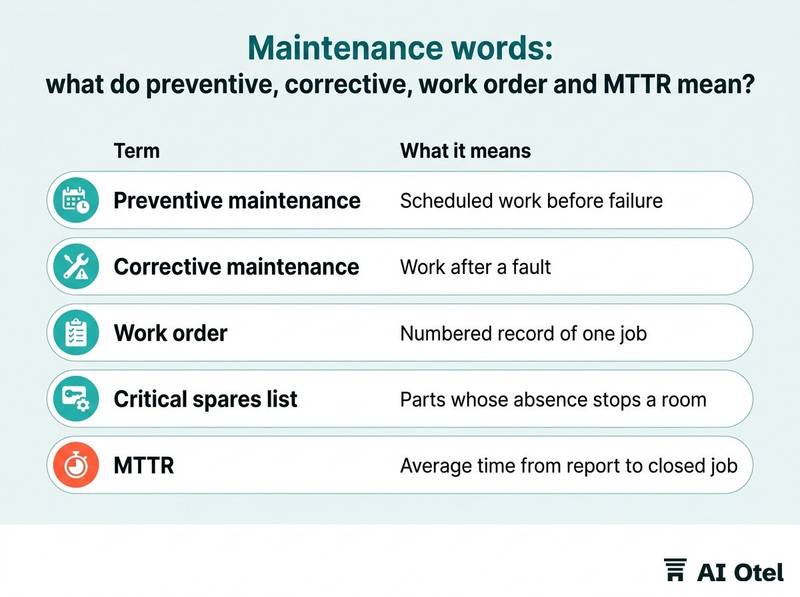
Maintenance words: what do preventive, corrective, work order and MTTR mean?
Preventive work happens on a schedule before failure, corrective work happens after it, and a work order is the numbered record of either. MTTR measures how long the hotel takes to close a fault, and it is only honest if the clock starts at the guest's report.
Preventive maintenance is work done on a schedule before failure, with a task list, an owner and a record. Its value lies in the record, because a task with no record cannot be checked, repeated or defended. Corrective maintenance is work done after a fault; it is not a failure of the plan unless the same fault returns, which is why the work order has to say what was found, not only what was replaced. Condition-based work is a third category, triggered by a reading such as vibration, pressure or temperature rather than by a date; it needs instruments and someone who reads them, and without both it is a schedule with extra words.
A work order is the numbered record of one job: what was reported, where, by whom, what was found, which parts were used, what was done and who closed it. A job closed with a single word teaches the next shift nothing. Keep a short critical spares list, the parts whose absence stops a room, a lift or a kitchen, with a location and a reorder point; everything else can wait for delivery, and pretending otherwise ties up capital on shelves. The scheduling side is covered in the hotel preventive maintenance plan.
| Term | What it means | What it tells a manager |
|---|---|---|
| Preventive maintenance | Scheduled work before failure | Whether the plan exists on paper and in records |
| Corrective maintenance | Work after a fault | Whether the same fault keeps returning |
| Work order | Numbered record of one job | Whether the hotel can reconstruct what happened and when |
| Critical spares list | Parts whose absence stops a room or a lift | How long a repair will really take |
| MTTR | Average time from report to closed job | Where the delay sits, in the queue or in the repair |
MTTR, mean time to repair, is the average time from a fault being reported to the job being closed. Measured from the technician's arrival it flatters everyone; measured from the guest's report it exposes the real problem, which is usually the gap between the two.
Which term should I ask about for a given guest symptom?
Start from the symptom, name the system, and ask for a check rather than a fix. That single habit turns a vague complaint into a job that reaches the right trade the first time.
Describe what the guest notices, where, and when. "Room 214 is warm in the afternoon and fine in the morning" is actionable; "the air conditioning is broken" is not. Name the system in the request so the job routes correctly, and ask for a check, not a fix: "please confirm whether the room unit or the zone is at fault" is a job with an end point, while "please fix the air conditioning" is a wish.
Record the pattern: time of day, floor, weather, occupancy. A fault that appears at the same hour every day and a fault that appears at random are different problems with different owners. Agree a one-line guest answer for each system in advance, with technical service, so the desk is never composing an explanation while a guest is waiting. Put the escalation threshold in the maintenance contract, not in memory: which symptoms bring a person on site, and how quickly, is a commercial term and should be written as one.
| What the guest reports | System involved | Term to use | Question to ask |
|---|---|---|---|
| No hot water on upper floors | Domestic hot water | Calorifier, recirculation pump | Is the recirculation pump running, and is the calorifier holding its temperature? |
| One room warm, corridor fine | Room cooling | Fan coil | Is the room unit or the zone valve at fault? |
| Lights flicker, lifts stop | Power | Transformer, genset, UPS | Did the genset start, and which circuits are on the emergency panel? |
| Damp patch on the ceiling | Condensate | Fan coil drain, air handling unit | Which drain is blocked, and which rooms are affected below it? |
| Front desk screens restart at check-in | Power and controls | UPS, BMS | Did the UPS hold, and what else restarted at the same moment? |
What to do next
Take the next technical call that reaches you and run it through the four questions: which system, which part of the building, since when, and what the guest notices. Then write the answers into the work order. The plant vocabulary tells you what is in the building, the maintenance vocabulary tells you how the work on it is described, and the symptom table joins the two, so the next conversation with technical service starts from a shared word instead of a nod.
Frequently asked questions
What is the difference between a chiller and a fan coil?
The chiller is the central machine that produces chilled water for the building or a large zone; the fan coil is the small unit in the room that uses that water to cool the air. A chiller fault affects many rooms at once, while a fan coil fault affects one room. The two are often confused in conversation because the room unit is what the guest calls the air conditioner.
Does a hotel manager need to understand the BMS?
Not to operate it, but to know three things: which systems it controls and which it only watches, who in the hotel can change a schedule, and what report comes out of it. A weekly exception report, showing what ran outside its normal range and what was done, is more useful than access to a live dashboard.
What does MTTR mean and why does the start time matter?
MTTR is mean time to repair, the average time from a fault being reported to the job being closed. If the clock starts when the technician arrives, the measure hides the queue; if it starts when the guest reports the fault, it shows where the delay really sits. The gap between the two numbers is usually the part worth fixing.
Why does hot water take so long on the upper floors?
Hot water has to travel from the plant to the tap, and a recirculation pump keeps it moving so the wait stays short. When that pump fails, is switched off overnight to save energy, or the loop is badly balanced, upper floors wait longest. The question to ask is whether the recirculation pump is running and whether the loop has been balanced, not whether the boiler is working.