Door lock batteries: a low-battery log, a replacement round and the night-time lockout
A hotel door lock battery routine turns a 2 a.m. lockout into a scheduled job. This guide covers reading battery levels, logging readings, running replacement rounds and handling night-time lockouts safely.
AI draft · awaiting editorial review
Contents
Key takeaways
- A lock reports a low battery long before it stops opening, so a lockout is usually a missed reading, not a surprise.
- Log the reading even when no action is taken: a level that never moves is as informative as one that drops.
- Replace on a round, not one lock at a time: batching keeps spare stock predictable and cuts trips to the corridor.
- At night, identity comes before the door: confirm who is asking, then open with the recorded emergency route and write it down.
- A room that returns to the log twice in a short window needs a lock service, not another battery.
A hotel door lock battery routine has three parts: a low-battery log that records what each lock reports, room by room; a fixed replacement round driven by those readings, with spare stock on hand; and a night procedure for a guest locked out. The log turns a 2 a.m. lockout into a scheduled job.
At 02:40 a guest comes down because the card will not open the door. The desk encodes a new card, the guest walks back up, and the same red light blinks. Nobody can say when that lock last reported its battery state, because nobody wrote it down. This article gives you the routine that prevents that night: how to read a lock's battery state, what to write down, how to run a replacement round, and what to do when the lockout happens anyway.
What does a flat lock battery look like to the guest and to the desk?
To the guest it looks like a card that stopped working. To the desk it looks like a card problem, which is why the first response is usually the wrong one.
The guest taps the card, there is no click, a red or amber light shows, and the handle does not turn. The guest blames the card, not the lock. The desk's first move is a fresh card, and the fresh card fails in exactly the same way, because the lock has no power to read it.
The decline is slow. Most electronic locks signal a low battery with a repeated beep or a light pattern for a period before they stop opening, so the warning was visible earlier to anyone who looked. Some locks also keep a mechanical override or an external power contact for exactly this case. What yours has is in the lock's own documentation, and the desk should know it before the night it is needed.
The cost is not the battery. It is a guest standing in a corridor at night, a room move that has to be explained, and a front desk that has lost control of the situation. Separate two failures that look alike: a lock with no power does not read the card at all, while a lock that reads and rejects the card shows a different light pattern. Learn both patterns on your own doors, and see how key cards, encoders and the PMS fit together for the wider picture.
NoteTwo light patterns, one card at the desk
A lock with no power and a lock that rejects a card can look the same in a dark corridor. Write down the two light patterns your own locks show and keep the note at the desk, not in the technical office.
How do you read a lock's battery level?
From the lock itself or from the software that talks to it: either a person reads the lock at the door with the handheld unit, or the lock system reports the level to the desk.
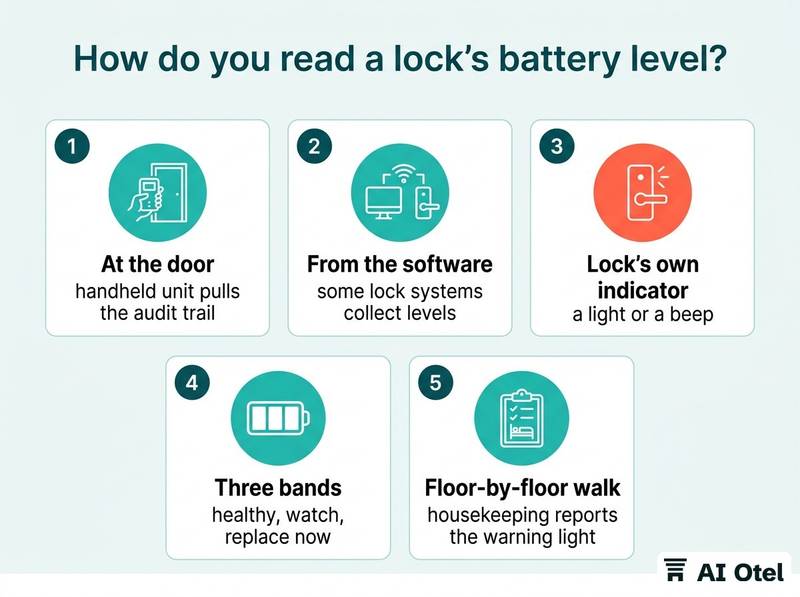
Route one is at the door. The handheld unit or the encoder's read function pulls the lock's audit trail, and the battery state comes back with it. This is the strongest reading because it comes from the lock, not from a record about the lock. Route two is from the software: some lock systems collect levels and can show them as a list or a report. Check what your system actually displays before promising a report to a general manager. Route three is the lock's own indicator, a light or a beep at the door. Treat it as a warning, not a measurement, because it appears late in the decline.
Treat the reported level as a band, not a percentage. Plan on three bands: healthy, watch, replace now, and write the band in the log rather than a number you cannot compare across lock models. Read the level in the same visit as the audit trail: the same read gives you the entry history you may need later for a dispute about who entered a room and when.
Reading every lock costs a person and a route. Schedule it as a floor-by-floor walk, and let housekeeping report the lock's own warning light between walks.
What goes in a low-battery log?
One row per lock, one line per reading, and a column for what was done about it.
Identify the lock, not only the room: room number plus the lock's serial or ID, because locks are swapped, moved and replaced, and the room number alone loses the history. Record the date of the reading, the reported band, the action taken (none, watch, replaced), who read it, and the date of the next read. Record the replacement as its own line: date, battery type, the batch or lot if the pack shows one, and who did it.
Log the reading even when nothing is done. A flat line across months is evidence that the routine works; a gap is not evidence of anything. Keep the log where the technical team already keeps maintenance records, so it is reviewed with the rest of the plan instead of living in a separate notebook that nobody opens, and see where a lock log sits inside the preventive maintenance plan. Add a second block for lockouts: date, time, room, method used, who authorized it. The battery log and the lockout log answer different questions and should not be merged.
For example, three rows might look like this. The rows show the three bands in use; they are illustrative, not real hotel data.
| Room and lock ID | Date read | Reported band | Action |
|---|---|---|---|
| 214 · LK-0214 | 03.11.2026 | Healthy | None; next read with the floor walk |
| 305 · LK-0305 | 03.11.2026 | Watch | Re-read in two weeks |
| 118 · LK-0118 | 03.11.2026 | Replace now | Replaced; battery type and lot written in |
How often should you run a replacement round?
On a fixed round set by the readings, not on the night a lock dies.
Set two triggers and use whichever comes first: the reading reaches the replace band, or a set date arrives. The date trigger catches the locks that report late or not at all. Replace a whole zone in one round instead of single locks: fewer trips to the same corridor, predictable stock, and a floor that is done for a period rather than half done indefinitely. Run the round in the quiet hours of the day and block the rooms on the housekeeping list, so nobody cleans around a technician working on a door.
Use one battery type per lock model, from one supplier where possible, and never mix types inside one lock. Keep two reserves: a small one at the desk for nights and a larger one in the technical store, with a reorder point written down so the reserve is not discovered empty at 3 a.m. After replacing, test with a guest card, confirm the lock's clock and date are right, and close the row in the log before leaving the door. Used batteries go into a closed container and follow the waste route the hotel already uses for hazardous material. They do not go into general waste.
ChecklistThe replacement round, in order
- Take the log extract for the zone
- Count the cells needed and take one spare
- Tell housekeeping and the desk which rooms are being done
- Open each room, replace the cell, test with a card, check the lock clock
- Write the row in the log
- Seal the used cells in the container
- Return the log to the technical office the same day
What do you do when a guest is locked out at night?
Confirm who is asking, open with the recorded emergency route, and write it down before you go back to the desk.
Identity first: name, room number, and one more thing that matches the reservation, such as an identity document, the name on the booking, or a companion already inside. A room number on its own is not identity. Never say the room number out loud at a busy desk; write it on the note you pass to the person who will open the door. The same discipline applies to checking who is asking before you open a door, whether the request is about a key card or a safe.
The emergency route is whatever the lock system provides: a mechanical override key held in a sealed box, or a master credential with emergency rights. Which one, and who may use it, is decided in daylight, not at the door. Two people at night where staffing allows: one opens, one witnesses. The record says who opened, at what time, by which method, and who authorized it.
Replace the battery or block the room before the guest goes back in. Sending a guest into a room whose lock has just failed invites the same call an hour later. If identity cannot be confirmed, do not open; offer a verified alternative and escalate to the duty manager. The next morning, check whether the lock had reported a low battery and whether the log missed it. That missed reading is the real failure, not the flat cell.
Watch outA room number is not identity
A person who knows a room number is not the same as a person who is staying in that room. Opening a door for the wrong person is a security incident that no battery replacement can undo, so the identity check comes before the key, every time.
What else can look like a dead battery?
A worn card, a badly encoded card, a binding door and a lock clock that has drifted all produce the same complaint at the desk.
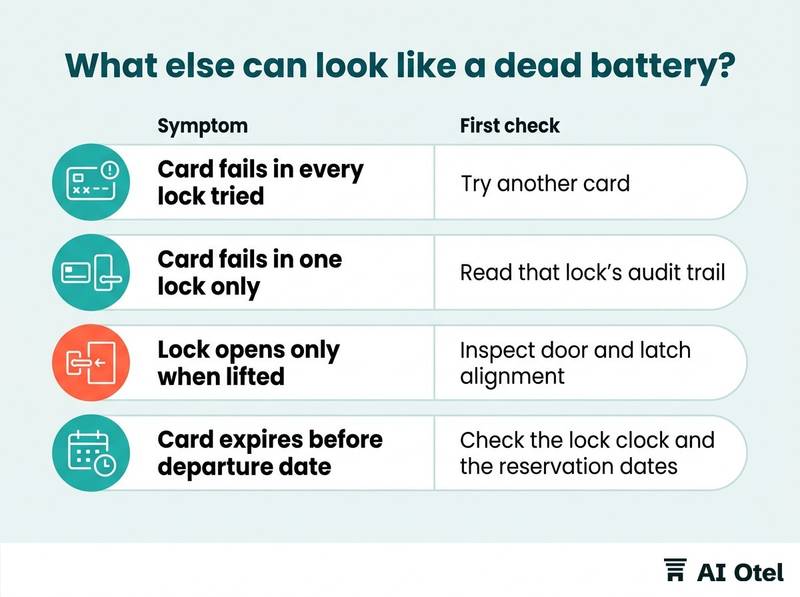
Work in a fixed order: try a fresh card at the door, then read the lock's audit trail, then look at the encoder and the reservation. Skipping the audit trail is how a card problem becomes a battery replacement. A card that fails in several different locks is a card problem; a card that fails in one lock only points at that lock. Door alignment and a binding latch produce a lock that opens when the guest lifts the handle or pushes the door, which is a door and frame job for maintenance, not a battery.
A lock whose clock has drifted expires cards before the departure date. The audit trail shows the lock's own time, which is why reading it settles the question quickly. After a lock swap, the room-to-lock mapping in the software must be updated, or every new card is written for the wrong door. The audit trail records rejected cards and the reason for the rejection, which is the fastest way to separate no power from no permission.
| Symptom | First check | Who owns it |
|---|---|---|
| Card fails in every lock tried | Try another card | Front desk |
| Card fails in one lock only | Read that lock's audit trail | Technical |
| Lock opens only when the handle is lifted | Inspect door and latch alignment | Maintenance |
| Card expires before the departure date | Check the lock clock and the reservation dates | Technical and front desk together |
Which rooms keep coming back, and what do they tell you?
A lock that returns to the log twice in a short window has a lock problem, not a battery problem.
Sort the log by room and by lock ID and look for repeats. A repeat is the cheapest diagnostic signal the technical team has. A lock that drains faster than its neighbors may be waking constantly: a door that does not close fully, a latch that does not seat, a reader that is triggered by movement in the corridor. A cluster of failures in one round points at the cells themselves: same lot, same supplier, same storage conditions. A single lock that fails again after every replacement points at the lock's power contacts or at the lock itself; flag it for service instead of feeding it batteries.
Review the log in the same meeting where the preventive maintenance plan is reviewed, and carry the repeats into the plan as work orders with an owner and a date. Keep the history under the lock serial, so a lock that is moved to another room carries its history with it.
What to do next
This week, take one floor, read every lock's battery state, and write the readings into a single sheet with room, lock ID, band, action and who read it. That one walk gives you the baseline the replacement round is built from, and the 2 a.m. lockout stops being the first time anyone thinks about that lock.
Frequently asked questions
How long does a hotel door lock battery last?
There is no single figure worth planning on: it depends on the lock model, how many openings a door takes, the temperature and the cell used. The lock reports its own state, so plan by readings and a date trigger rather than a calendar guess. A lock that drains faster than its neighbors is a signal about the door or the lock, not about the battery.
Can a lock be opened when the battery is completely flat?
Many electronic locks provide a mechanical override or an external power contact for this case. What yours has is in the lock's own documentation, and it should be tested before the night it is needed. Who holds the override key, and how its use is recorded, is a management decision rather than a technical one.
Should the battery log live in the PMS?
The log belongs wherever the technical team already keeps maintenance records, so it is reviewed on a schedule. The property management system holds rooms, work orders and the guest's bill. What matters is that one named person owns the log and that it is opened at a fixed interval, not which tool it sits in.
Do key cards themselves wear out?
Yes. Magnetic stripes wear with use, chip contacts collect dirt, and cards kept against a phone or a magnet fail early. A card that fails in several different locks is a card problem, not a lock problem. Retire cards in batches by age and replace them before they start failing at doors.
Who should hold the emergency opening key?
Named roles, not a drawer. The key sits in a sealed container, is signed out and back in, and at night two people are involved where staffing allows. Every use is written down with the time, the room, the method and the person who authorized it.