A rate test you can read: change one price for two comparable weeks and compare
A hotel rate test requires one price change, two comparable weeks, and a fixed reading date. This guide explains how to measure pickup and average rate, and when to ignore noisy results.
AI draft · awaiting editorial review
Contents
Key takeaways
- A price change teaches you nothing unless you write the expected result and the reading date before you change the rate.
- Test one room type on dates that share the same demand drivers, and read both weeks at the same number of days before arrival.
- Measure pickup, the average rate actually achieved and cancellations, because a higher rate that fills rooms which later cancel has told you nothing good.
- A difference of a room or two, or a week disturbed by a group block or an event, is too noisy to act on: keep the rate and test again.
- Record the prediction, the change, the numbers and the decision in one rate change log line, so next season starts from a record instead of a memory.
A hotel rate test is one deliberate price change on one room type for a defined set of dates, with everything else held as still as you can manage, read on a fixed date against comparable dates. It gives you an indication about your own hotel, not proof about the market.
The rate went up on a Friday, the following week felt busier, and by Monday everyone agreed it had worked. Nobody wrote down what they expected, nobody fixed a date to read the result, and nothing about that week can now be separated from the price. This article shows how to run the modest version of a hotel rate test that survives those failures: one room type, one price change, two comparable periods, a written prediction and a fixed reading date. After reading it, you can run your first readable test this week.
Why does a price change usually teach you nothing?
Because too many things move at once and nothing is written down, so the result you remember is the one that fits the story you already believe.
Several variables change together: the rate, the channel mix, a campaign, a competitor's move, a school break, a flight schedule, the weather. A single number afterwards cannot say which one did the work. Without a comparable set of dates and a fixed reading point, the only comparison available is a feeling about last week. And without a reading date, the person reading chooses, usually unconsciously, the moment that looks best: a change read three days later and the same change read three weeks later give different answers.
There is also a structural problem: the person who set the price also grades the price. That is not dishonesty; it is how hindsight works when no prediction was recorded beforehand. The result then gets read as a verdict on the whole hotel rather than on one room type for one set of dates, so it is either over-trusted or dismissed.
The cost is cumulative. A hotel that changes rates often and learns nothing each time is running on instinct for years while believing it is running on data.
NoteA decision, not an experiment
A price change is not an experiment until it has a prediction, a comparison and a reading date. Without those three, it is a decision with no feedback loop.
What is a hotel rate test, and what can it not prove?
A rate test is one price change on one room type for chosen dates, everything else held as still as possible, compared with comparable dates and read on a date you fixed in advance. It cannot prove that a price was right; it can only show whether your own numbers moved in the direction you expected.
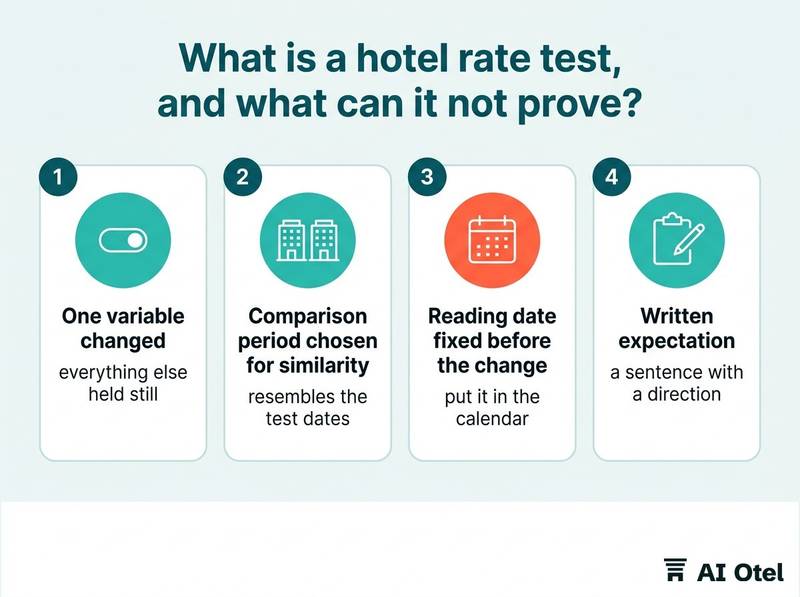
Four conditions make a test readable: one variable changed, a comparison period chosen for similarity, a reading date fixed before the change, and a written expectation of what should happen. Write the expectation as a sentence with a direction, not a wish. For example: "at this higher rate I expect fewer rooms picked up on these dates, and I expect the average rate achieved to rise enough that room revenue for the dates does not fall." That sentence is illustrative; write your own before you touch the rate.
A hotel cannot randomize guests the way a laboratory randomizes subjects. You are comparing two periods that resemble each other, not two identical periods, so the answer is an indication with a stated margin of doubt. The test answers a narrow question: did this rate, on this room type, on these dates, behave as I expected? It does not answer what the whole hotel should charge next summer.
A test that is never read is worse than no test, because it creates the impression of evidence. Put the reading date in the calendar at the moment you change the rate. And keep the test small enough to survive: one room type and one pair of periods is enough to learn the method, and the method is the thing you are really buying.
The four conditions of a readable test
Key pointFour conditions
(1) One variable: a single rate on a single room type. (2) A comparison: dates chosen to share demand drivers. (3) A fixed reading date: the same number of days before arrival on both periods. (4) A written prediction: the direction and the measure you expect to move, recorded before the change.
How do you choose the room type, the dates and the comparison?
Pick the room type with the most rooms and the simplest rate structure, and compare against a period that shares the same demand drivers, not simply the nearest week on the calendar.
For the room type, choose the category with the largest room count and one rate plan, so a single booking moves the count visibly. Leave suites, connecting rooms and rooms mostly sold to groups out of the first test.
For the dates, match the day of week and the length of the window. A three-night Thursday-to-Sunday block should be compared with another three-night Thursday-to-Sunday block. Exclude dates whose demand comes from something other than price: religious and public holidays and the days around them, school breaks, local fairs, concerts, congresses and sports fixtures. If you cannot exclude them, do not test on them.
Two comparison choices exist. The adjacent comparable week keeps the market close but carries whatever else changed in between; the same dates last year keeps the calendar fixed but carries a different market, a different room stock and a different set of competitors. For a first test, the adjacent comparable week is usually the more honest comparison.
Do not test on dates you expect to sell out. A full week tells you that you were full, not what demand would have done at a different price. Choose the reading date as a number of days before arrival, and use the same number on both periods: reading one period at sixty days out and the other at twenty days out compares booking windows, not prices. Write the pair of periods into the log before you touch the rate, so the comparison cannot be re-chosen afterwards to suit the answer.
What must stay unchanged during the test?
Everything that can move a booking: the rate plan and what it includes, the cancellation terms, the stay restrictions, the channel mix, the inventory you release, the campaigns running and the group blocks sitting on the dates.
Rate plan and inclusions come first: breakfast, transfers, spa access and package elements stay as they were, otherwise you have changed the product and the price at the same time. Cancellation and payment terms matter just as much, because a stricter or looser policy changes who books as much as the price does. Stay restrictions, meaning minimum stay, closed-to-arrival days and stop-sell rules, stay identical across both periods.
Keep the same channels open with the same inventory. A test that changes the price on one channel and not another measures the channel, not the price. Rate obligations in agency contracts are a matter for your contracts and your legal adviser. Group blocks, allotments and staff or friends rates sitting on the test dates should either be identical on both periods or the test moved to cleaner dates; if you use a staff and friends rate, it is worth being clear on who may use it and which dates. Marketing holds still too: no new campaign, no new paid placement, no newsletter to the past-guest list during the window.
Finally, write down what you could not hold fixed. If a charter series lands, a competitor closes or a large block appears on one of the two periods, mark the test void rather than reading it.
ChecklistBefore you change the rate, tick every line
- Rate plan and inclusions identical
- Cancellation and payment terms identical
- Minimum stay and closed-to-arrival rules identical
- Same channels open with the same inventory
- No group block or allotment on one period only
- No staff or friends rate on one period only
- No new campaign or mailing during the window
- Comparison periods and reading date written in the log
- A note of anything that could not be held fixed
What do you measure: pickup, average rate and cancellations?
Measure the same four things on both periods at the same reading points: rooms picked up, the average rate actually achieved, room revenue for those dates, and cancellations and no-shows read after the stay.
Pickup is the count of rooms already taken for the test dates at the reading date, and it is only meaningful when both periods are read at the same distance from arrival; if you want to go deeper, read how to read a pickup report day by day. Average rate achieved is room revenue for those dates divided by rooms sold for those dates. It is not the rate you published: upgrades, discounts applied at the desk and package inclusions all pull it away, and that gap is often the real finding.
Room revenue for the dates is the product of the two, and it is the number the owner will ask about. Compare it before you compare occupancy, because a higher rate with fewer rooms can still be the better outcome. Cancellations and no-shows must be read after the stay, not at pickup: a higher rate can buy bookings that later fall away, and a pickup-only reading will call that a success. Length of stay and rooms per booking show whether the price changed who books, not just how many, since a shift toward shorter stays can offset a higher rate. Keep the arithmetic in the log line, not in your head, and if cancellations are your weak point, measure them by channel and lead time.
| Measure | How to work it out | What it tells you | Where it misleads |
|---|---|---|---|
| Pickup | Rooms taken for the test dates at the reading date | Whether demand responded | If the periods are read at different distances from arrival |
| Average rate achieved | Room revenue ÷ rooms sold, for the dates | Whether the higher price stayed on the bill | When upgrades, desk discounts or inclusions pull it down |
| Room revenue for the dates | Rooms sold × average rate achieved | The money outcome | When commission or extras differ between the periods |
| Cancellations and no-shows | Count and share of bookings that fell away, read after the stay | Whether the higher rate held | If read at pickup, because cancellations arrive late |
| Length of stay | Room nights ÷ bookings for the dates | Whether the price changed who books | On small counts |
When is the result too noisy to act on?
When the counts are small, when something outside the price moved during the window, or when the two periods were not comparable in the first place. In all three cases the honest answer is that you have learned nothing yet.
Small counts are the most common failure. A difference of a room or two on a room type with modest volume is inside the ordinary week-to-week variation, and a single group booking can flip the direction of the whole test. One large booking outweighs the effect you were looking for: if a wedding block or a tour series lands on one period, the comparison is over.
The price and the market can also move together. If a competitor raised rates, a route opened or a fair was announced mid-window, you cannot separate your change from theirs. The reading date can be wrong too: read too early, and you are comparing booking windows; read too late, and the period is nearly settled and every rate looks the same.
Remember that a real result is narrow: it concerns one room type on one pair of periods. Carrying it to the whole hotel, or to next summer, is a separate decision that needs its own test. A null result is a result, but only if the counts were large enough to notice a change; with small counts, "no difference" means "no evidence", and the correct action is to keep the rate and test again on a bigger room type or a longer window. The practical rule: if you cannot state the result in one sentence with the numbers behind it, do not act on it.
Watch outThree signals the test is void
A difference of a room or two, a group block or event on one period only, and a reading date that differed between the periods. In each case: keep the rate, mark the test void in the log, and repeat on cleaner dates.
How do you write the decision into the rate change log?
Two lines per test: one written before the change with the prediction and the reading date, one written after with the numbers and the decision. Anything less and the test dissolves into memory within a month. The structure is the same one described in a rate change log: who changed which price, why, and what happened next.
The before-line holds the date, the room type, the dates affected, the old rate, the new rate, the reason, the expected direction, the comparison period, the reading date and who made the change. The after-line holds the same identifiers plus rooms picked up, average rate achieved, room revenue and cancellations for both periods, and one of three decisions: keep, revert or retest.
The prediction is the part that protects you from yourself. Once the outcome is known, every other explanation becomes available; a sentence written beforehand is the only thing that cannot be rewritten quietly. Record the reason in plain words, not a code: "raised because the same week last month sold out" is usable next year, "yield adjustment" is not.
The log is the input to the next season's pricing and to the weekly revenue meeting, where the reading dates fall due and decisions get confirmed rather than drifting; a good weekly revenue meeting agenda with a decision log is where that happens. Keep the log where the person on duty can reach it, not in one manager's notebook. A test whose record leaves with its author has not been run by the hotel. A hotel operating system that keeps rates, restrictions and reports in one place, like the one described on ai-otel.com's platform page, makes that easier, but a shared spreadsheet works for the first test.
What to do next
This week, pick one room type, choose a pair of comparable periods, write the prediction and the reading date in the log, and then change the rate. The method matters more than the first result: once the hotel can run a readable test, every later pricing decision, the pickup report, the cancellation reading and the weekly revenue meeting all start feeding the same record instead of a memory. If you want the wider context of how pricing and distribution decisions connect across a hotel's systems, the platform overview sets that out.
Frequently asked questions
How long should a hotel rate test run?
There is no universal length; the test must run long enough for both periods to be read at the same distance from arrival. Fix the reading date before the change, read both periods at that same number of days before arrival, and read cancellations after the stay rather than at pickup. A window that is too short compares booking behavior rather than price response.
Can I test a price on a week I expect to sell out?
No. A sold-out period shows that you were full, not what demand would have done at a different rate, so the comparison carries no information about the price. Test on dates where you have slack in the room type, and keep your peak dates for the decisions you already know how to make.
What should I do if the test shows no difference?
With small counts, no difference means no evidence rather than proof that the price does not matter. Keep the rate, mark the test as read with no conclusion, and repeat on a room type with more rooms or over a longer window. Only a null result from a large enough count is worth acting on.
Should I change the price on every channel during the test?
Yes, keep the channel mix identical across both periods and apply the change the same way on each channel you normally sell through. Changing the price on one channel and not another measures the channel rather than the price. What your agency contracts allow on rates is a question for your contracts and your legal adviser.
Does one rate test prove the right price for my hotel?
No. A test gives an indication about one room type on one pair of periods, and it cannot separate your price from everything else the market did at the same time. What it does give you is a repeatable method, a written prediction and a record, which is what makes the second and third test worth running.