A staff and friends rate: who may use it, which dates, and how to record it
A staff rate without a written rule becomes a leak. This guide defines eligibility, allowances, blackout dates and approval steps, and shows how to record every stay and report revenue forgone to the owner.
AI draft · awaiting editorial review
Contents
Key takeaways
- A staff rate without a written definition is not a benefit, it is a decision each shift makes differently.
- Eligibility, allowance, blackout calendar, rate design, approval and posting are the six parts of the rule, and leaving one out is what creates the leak.
- A percentage of the best available rate costs the hotel most on the nights the rooms are worth most, so pair it with a floor or a blackout calendar.
- Every staff stay is still a stay: it needs a reservation in the system, a guest bill, a fiscal document and a guest identity notification.
- The yearly report to the owner should show room nights, the estimated revenue forgone, and every exception with the name of the person who approved it.
A hotel staff friends and family rate is a discounted room price the hotel grants to its own employees and to people they nominate. It only works as a written rule: who qualifies, how many nights a year, which dates are closed, whether the discount is a percentage or a fixed rate, who approves, and how each use is posted and reported.
The last ten rooms before a peak weekend go at a price nobody agreed to, approved by whoever was on the desk, and the monthly report shows only a row of low rates with no explanation. The rate was never written down, so nobody can say it was broken. After reading this, you will be able to write the rule on one page: who qualifies, how many nights, which dates are closed, how the price is set, who approves, and how each stay is posted and reported.
Why does an unwritten staff rate turn into a leak?
Because a rate nobody wrote down has no boundary, so each shift invents one, and the rooms it takes never appear as a decision anyone made.
The rate usually starts as a favor at the desk. Without a definition of who qualifies, the second request is always framed as the same as last time. Nothing marks the reservation, so the room appears in the revenue report as an ordinary low rate, and nobody can count how many rooms left at it or on which dates.
The pressure shows on the nights that matter: a peak weekend, a handful of rooms left, and a request approved by whoever is on shift and wants to be helpful. Word travels faster than the rule. One approved friend becomes a group, and the standard becomes whatever the last person was granted.
The fix is not a stricter mood at the desk. It is a written rule with six parts: eligibility, allowance, calendar, rate design, approval and posting. The same discipline applies to rooms given away for free, which is why complimentary and house use rooms need their own written rule and their own report line.
Key pointA staff rate is a priced reservation with a named approver and a rate code, not a discount typed at checkout.
A staff rate is a priced reservation with a named approver and a rate code, not a discount typed at checkout.
Who qualifies for a staff and friends rate?
Write the list down and give each group its own approver, because the line between an employee, a household member and a friend is where most disputes start.
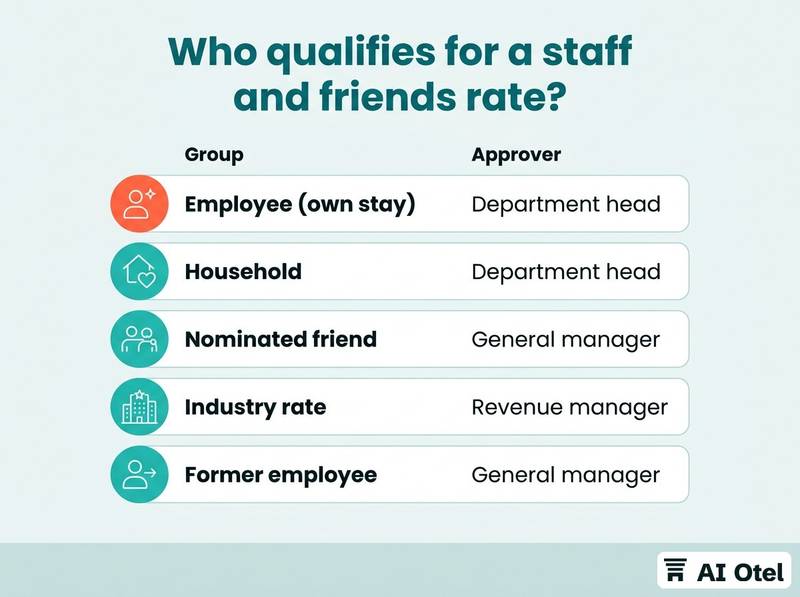
Separate at least four groups: current employees including seasonal and part-time staff, the employee's own household, friends the employee nominates by name, and a separate industry rate for people who work at other hotels. Decide whether former employees keep the right and for how long: a silent yes is the most common source of an awkward refusal later.
Make a nomination personal. The employee names the guest, the guest cannot pass the right on, and the name on the reservation must match the nomination. Give each group a different approver, so no one is judging their own request.
| Group | Who is included | Approver | Allowance |
|---|---|---|---|
| Employee (own stay) | Current staff, seasonal and part-time | Department head | Set by the hotel |
| Household | The employee's own household | Department head | Set by the hotel |
| Nominated friend | Named by the employee, non-transferable | General manager | Set by the hotel |
| Industry rate | Staff of other hotels | Revenue manager | Set by the hotel |
| Former employee | Defined period after leaving | General manager | Set by the hotel |
Write the disqualifiers as clearly as the entitlements. An employee on shift cannot book the rate for a friend at the desk, nobody approves their own booking, and a manager cannot approve a relative's. Keep the list short enough that a receptionist can apply it without calling anyone. Handing the rule to new staff on day one belongs in employee orientation and the first 30 days.
How many nights a year should each employee get?
Set an allowance per person per year, count it in room nights rather than bookings, and show the balance to the employee so it is spent deliberately.
Count room nights, not bookings. A three-night stay and a one-night stay are not the same cost to the hotel, and a booking count hides the difference. Decide whether the allowance covers one room or several, and whether friends draw from the employee's own pool or from a smaller separate one.
Decide carry-over explicitly. No carry-over is the simplest rule to explain and the hardest to argue with. Show the remaining balance where the employee can see it, and let the department head see the team's balances before approving a new request.
Decide what happens when the allowance is used up: the full rate, or a smaller standing discount that never changes. Never let unused allowance convert into cash, a transferable credit or a favor owed, because that turns a benefit into a liability the hotel cannot track.
Which dates should be blacked out?
Black out dates by expected demand, not by habit: publish a calendar, review it every season, and keep one rule that protects the last rooms.
Build the blackout list from the forecast the revenue team already uses: peak weekends, bayram periods, congress and event dates, and any date the hotel expects to sell out. Add a last-room rule: below a set number of rooms remaining, the staff rate closes automatically for that date, whatever the calendar says.
Publish the calendar where staff already read rosters, and date it, so nobody is working from last year's version. Keep one exception path with a named approver and a log, so an exception becomes a decision with a name on it rather than a habit.
Review the calendar each season. A date blacked out for three years running may no longer need it, and a new event date will not add itself. Say plainly in the rule that a blackout is a commercial decision about a date, not a judgment about the employee.
Should the discount be a percentage or a fixed rate?
A percentage is easier to explain and a fixed rate is easier to budget; a common design is a percentage of the best available rate with a floor under it.
A percentage of the best available rate grows in absolute terms exactly when the room is worth most, so the cost is highest on the nights the hotel can least afford it. A fixed rate is predictable for the employee and for the report, but it goes stale and can end up above a low-season best available rate, which looks absurd to everyone.
A percentage with a floor, meaning the staff price never falls below a stated minimum, protects the cost of the room while keeping the rule simple. Separate two numbers in your thinking: the direct cost of the room, which is cleaning, laundry, utilities and breakfast, and the revenue forgone, which is what another guest would have paid. Report both and label the second as an estimate.
Use one rate code per group so the report can separate an employee stay from a nominated friend without reading names. The discounted room is still a sale. In Türkiye every stay involves a payment, a fiscal document, a guest identity notification and personal data, and a staff guest is still a guest. Ask your accountant how the discount should be documented.
Watch outA staff rate typed as a manual discount at checkout leaves no rate code, no approver and no report line, and it cannot be reconciled at night audit.
A staff rate typed as a manual discount at checkout leaves no rate code, no approver and no report line, and it cannot be reconciled at night audit.
Who approves a staff booking, where is it made, and how is it posted?
The named approver approves it in writing, the reservation is created in the hotel's own system under a staff rate code, and it is posted like any other stay so the night audit sees it.
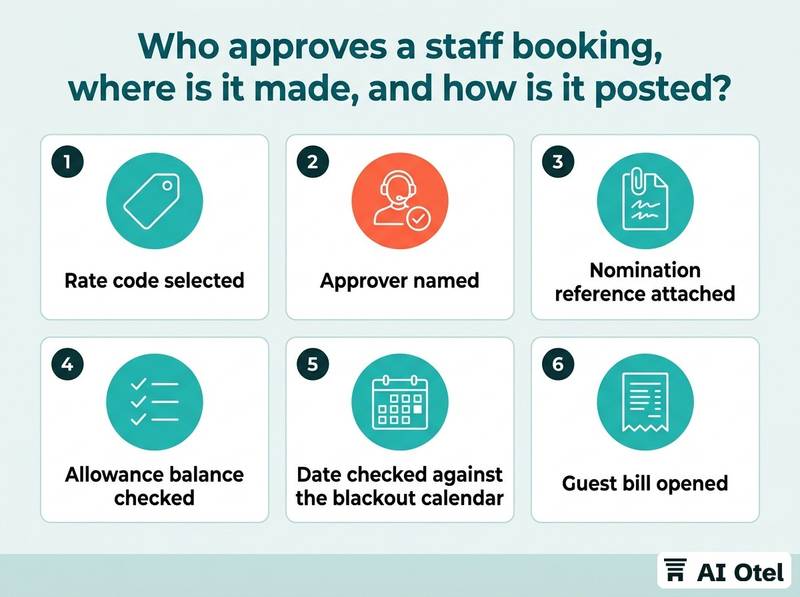
No walk-in favors. The reservation exists in the system before arrival, with the rate code, the approver's name and the nomination reference attached to it. The rate code is what makes the report possible later; a discount typed at checkout leaves no trace of why the price changed.
Set approval tiers in writing: routine stays within the allowance go to the department head, exceptions and blackout overrides go to the general manager, and the general manager's own bookings go to the owner or a named deputy. Open and close a guest bill like any other, even at a heavily discounted price, so the room night, the charges and the identity notification are recorded in the same flow as every other stay.
If several people can touch a price, read who may change a rate and the discount limits for hotel staff, and keep a rate change log that records who changed which price and why so the reason survives the person who gave it.
ChecklistThe check for every staff booking
- Rate code selected
- Approver named
- Nomination reference attached
- Allowance balance checked
- Date checked against the blackout calendar
- Guest bill opened
- Identity notification prepared in the check-in flow
- Night audit verified
What should the yearly report to the owner show?
One page: how many room nights went at each staff rate, what they would have sold for, who used them, and every exception with its reason and approver.
Room nights by group and by month, next to the allowance granted, so the owner sees take-up and not only cost. Revenue forgone at the best available rate, labelled as an estimate, beside the direct cost of the rooms. The exception list: blackout overrides, stays above the allowance, and the name of whoever approved each one.
| Report line | What it counts | Source in the system |
|---|---|---|
| Room nights by group | Staff stays per group and month | Staff rate codes |
| Allowance granted vs used | Balance per employee | Allowance records |
| Estimated revenue forgone | Best available rate minus staff rate | Rate history |
| Direct room cost | Cleaning, laundry, utilities, breakfast | Cost records |
| Exceptions and approvers | Overrides and over-allowance stays | Approval log |
| House use and complimentary | All non-commercial room nights | House use codes |
Flag any pattern worth a conversation, such as one department using most of the allowance or one employee nominating the same guest repeatedly. Add a line for house use and complimentary rooms, so all the non-commercial room nights sit in one place and can be compared, as described in tracking allowances, upgrades and complimentary rooms as a monthly number. End with a recommendation for next year: keep the rule, tighten the allowance or widen it, with the reason in one sentence.
What to do next
Write the one-page rule this week and give it to the front desk, the department heads and the owner on the same day. Eligibility, allowance, calendar, rate design, approval and posting fit on a single page, and once they are written the yearly report writes itself from the rate codes you already use. If your current system cannot hold a rate code, an approver and an allowance balance on one reservation, that is the first thing to fix, and the platform page describes how a hotel operating system is built to hold rate codes and reporting, while the ecosystem's hotel growth arm approaches revenue discipline with paying hotel clients today.
Frequently asked questions
Can a staff member pass the hotel staff friends and family rate to a friend of a friend?
No. A nomination is personal to the employee and to the named guest, and the name on the reservation must match. Say this in the written rule, because the second-hand request is the most common way the rate spreads beyond the people it was meant for.
Does a staff rate stay need an invoice and an identity notification?
Yes. In Türkiye every stay involves a payment, a fiscal document, a guest identity notification and personal data, and a discounted price does not change that. The staff guest is a guest, so the stay runs through the same check-in flow as any other. Ask your accountant how the discounted amount should be documented.
Can the general manager override a blackout date?
Yes, but only through one written exception path: a named approver, a reason recorded next to the reservation, and a line in the yearly report. An override that leaves no record is indistinguishable from a leak.
Who pays when a staff member's guest damages the room or takes from the minibar?
Decide before it happens. The guest bill belongs to the guest, so charges go on that bill and are settled at departure like any other stay. Write down whether the employee is informed, whether the hotel absorbs small amounts, and who approves anything written off.
Should a staff rate stay count toward loyalty points or stay history?
Decide it explicitly and write it in the rule. Counting it inflates the guest history the hotel uses for future decisions, and not counting it surprises the employee at the desk. Either answer works if it is the same answer every time.