How long before arrival should free cancellation end? Choosing a window from your own bookings
There is no universal number for cancellation windows. Learn to choose the right deadline by analyzing when cancellations arrive and how often rooms are resold. This guide shows how to test 24, 48, and 72-hour options on your own dates.
AI draft · awaiting editorial review
Contents
Key takeaways
- A free cancellation window is a pricing decision, not a terms-page formality: it decides how much of your inventory stays uncertain until the last days before arrival.
- Read cancellations by days before arrival, split by rate plan, channel and season, before choosing any deadline.
- A cancellation costs money only when the room is not resold or is resold below its original rate, so measure the refill, not the cancellation.
- Simulate 24, 48 and 72 hours on last season's bookings, then test one window live on comparable dates with the stopping rule agreed in advance.
- Write the deadline as one sentence with a time in it, and change it in every channel on the same day.
There is no universal number. The free cancellation window, the period before arrival in which a guest can cancel at no cost, should end where your own bookings say it earns more than it costs: read when cancellations arrive, how many of those rooms were resold, and at what rate, then test one change on comparable dates.
A guest cancels at nine the night before arrival. The room is clean, the rate is loaded, and there is no one left to sell it to. Whether that was bad luck or a rule you wrote is a question your own booking history can answer. This article shows how to read that history: when your cancellations arrive, what they actually cost, and how to choose and test a free cancellation deadline hotel policy that fits your dates rather than a general rule.
What does a free cancellation window actually cost?
It costs certainty, not cash. Every booking that can still be cancelled without charge is a room you have promised but cannot count, so the window decides how much of your inventory stays uncertain until the last days before arrival.
Define it precisely. The free cancellation window is the period before arrival during which a guest may cancel and pay nothing, and the deadline is the moment it ends, written either in days or in hours before the arrival date. Inside the window the room is committed to one guest and unavailable to others, but the revenue is not secured: you carry the room without the money.
Key pointFree cancellation window
The period before arrival in which a guest may cancel and pay nothing. The deadline is the moment it ends. Everything after that moment is a charge, a deposit kept, or a negotiation. The window is part of the rate, so it is set with the rate and reviewed with the rate.
A long window buys bookings from guests who plan and compare. A short window buys certainty and sells to guests who are ready to commit. The cost of a long window appears late: cancellations land when little time is left to refill, and refill prices are set by whoever is still buying. The cost of a short window appears early: fewer bookings, more abandoned checkouts, more questions at the reservations desk.
The deadline belongs with the rate, not with the terms page, because it changes what the guest is buying. And the cost is not the same on every date. A room that can be resold in an hour is cheap to leave flexible; a room that cannot is expensive. That asymmetry is why the rest of this article works from your own dates rather than from a rule of thumb.
How do you read your own cancellations by days before arrival?
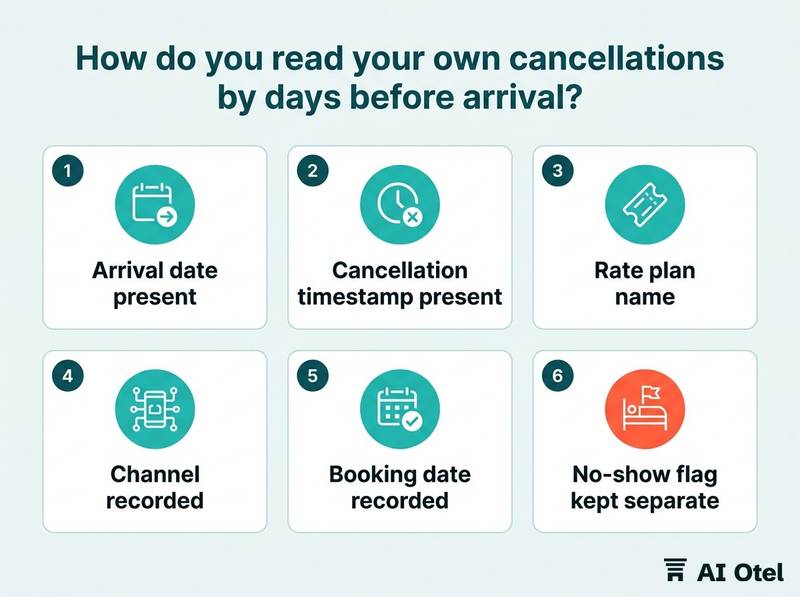
Export every cancelled reservation for the last twelve months with its arrival date, its cancellation timestamp and its rate plan, then subtract one from the other. The result, days before arrival at the moment of cancellation, is the number that tells you where your window should sit.
The fields to export
The three fields you cannot do without are the arrival date, the cancellation timestamp and the rate plan. Add the channel and the booking date if your system keeps them. Bucket the difference in bands that match the windows you are considering: 0 to 1 day, 2 to 3 days, 4 to 7, 8 to 14, 15 to 30, and more than 30. If you are starting from a cancellation count alone, the companion piece on measuring your cancellation rate by channel and lead time covers the denominator side of the same export.
The mistakes that spoil the curve
Use the cancellation timestamp, not the date the record was last edited. A modification entered as a cancel and a rebook will look like a cancellation, so check a sample by hand. No-shows are not cancellations and belong in a separate count, because they arrive after the room could still have been sold.
Split by rate plan and channel before you total anything: a flexible rate and a prepaid rate do not produce the same curve, and mixing them hides both. Split by season and by day of week too. A window that fits a Tuesday in February may be wrong for a Saturday in August. Finally, do not trust a band that holds a handful of bookings. Report it as a count, not as a percentage.
ChecklistBefore you trust the export
- Arrival date present on every record
- Cancellation timestamp present, not last-edited date
- Rate plan name on every record
- Channel recorded
- Booking date recorded
- No-show flag kept separate
- Modifications checked by hand on a sample
- Group blocks excluded or flagged
- Rate at time of booking kept, not today's rate
- Test and house-use bookings removed
How many cancelled rooms were resold, and at what rate?
A cancellation costs you only when the room stays empty or is refilled below the price it was booked at. Measure the refill, not the cancellation.
For each cancelled room-night, ask whether that room type on that night was sold again, and at what rate. The net effect is the original rate minus the refill rate, minus the cost of the extra selling you did: a discount, an upgrade, or a commission. A refill at the same rate a week later is not a loss. It is the same revenue under a different name.
Read the refill against the pickup curve for that date. If the date was still filling in the last seven days, a cancellation ten days out was cheap; if the date was already full, it was expensive. The share of cancellations that arrive after the date can no longer be refilled is the number that justifies shortening the window. Where the question is how much risk you can carry rather than how long, the method in how many rooms to oversell, read from your own data applies to the same numbers.
Watch for the cancellation that was really a rebooking at a lower rate: same guest, same dates, new price. That is a discount you gave without deciding to give it. Keep the measurement per date, not per month, because monthly averages hide the few dates where the window actually costs money.
| What you measure | How you compute it | What it tells you |
|---|---|---|
| Cancellation lead time | Arrival date minus cancellation timestamp, in bands | Where your window should sit |
| Refill rate | Cancelled room-nights resold for the same date and room type, divided by cancelled room-nights | Whether the room was truly lost |
| Refill rate gap | Original rate minus refill rate | Whether the refill paid for itself |
| Net revenue per cancelled room-night | Gap minus the cost of the extra selling | The real price of flexibility |
| Late cancellation share | Cancellations arriving after refill becomes unlikely | The case for a shorter window |
| Rebooking-at-lower-rate count | Same guest, same dates, lower price | Whether the problem is the window or the rate ladder |
Should the window be 24, 48 or 72 hours before arrival?
Choose the shortest window that still wins the bookings you would otherwise lose, and prove it on your own dates rather than on a general rule.
What each choice changes: 24 hours protects almost all guest flexibility and gives you one day to refill; 48 gives two; 72 gives three but removes a weekend of flexibility from a Monday arrival. None of these is better in general, which is why the answer has to come from your data and not from a competitor's policy page.
Simulate on last season
Reclassify each cancellation as inside or outside each candidate window, then check whether the room was refilled anyway. The simulation shows what you would have charged, not what you would have sold. The simulation cannot show the bookings you would have lost. That part only a live test can measure.
Test on this season
Run the live test on comparable dates, one change at a time, for a fixed period agreed in advance, and compare against the same dates a year earlier and against similar dates in the same season. Hold the price, the inventory and the marketing still during the test, or you will not know which change did the work. Decide the stopping rule before you start: what result would make you keep the change, and what would make you revert. The discipline is the same as in a rate test you can read on comparable weeks.
| If your data shows | Then test | What to watch |
|---|---|---|
| Most cancellations arrive inside 48 hours and those rooms are rarely refilled | A 24-hour window on the affected dates | Bookings lost in the final two days |
| Cancellations cluster 7 to 14 days out and refill is strong | Keep 72 hours or longer; the flexibility is cheap | Refill rate holding |
| Refill is weak on soft dates and strong on peak dates | Two windows by date type, not one for the year | Front desk confusion and channel mapping |
| Many cancellations are rebookings at a lower rate | The rate ladder, not the window | The same guest at a lower price |
| Booking volume falls when the window shortens | Revert and reconsider | The pace of new bookings, week by week |
Should peak and low season have different windows?
Yes, if your refill rate differs between them, and it usually does: the same deadline can be cheap in a compressed period and expensive in a soft one.
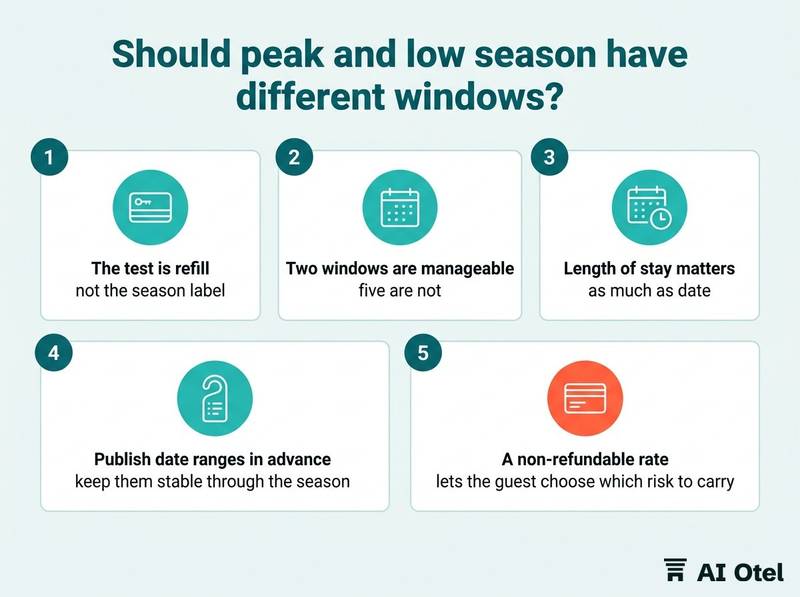
The test is refill, not the season label. A date is peak because rooms there are easy to resell, which is exactly what makes a long flexible window affordable. On soft dates the room you release late is often a room you keep. There, a shorter window or a non-refundable rate does more work than a longer one; the trade-offs between those levers are covered in early booking and non-refundable rates.
Two windows are manageable; five are not. Guests compare, channels map policies imperfectly, and the front desk cannot explain a calendar of exceptions. If you use date ranges, publish them in advance and keep them stable through the season. A window that moves with demand reads as a trick.
Length of stay matters as much as date: a seven-night booking cancelled three days out is a bigger hole than a one-night booking. And the alternative to a long window is not always a short one. A non-refundable rate sold next to a flexible rate lets the guest choose which risk to carry.
Watch outA moving deadline is a surprise
A window that changes with demand is not a policy, it is a surprise. If you vary the deadline by date, fix the date ranges before the season starts and say so where the guest books, not only in the terms page.
How do you write the rule and tell every channel?
Write the deadline as one sentence with a time in it, then change it everywhere a guest can read it, on the same day.
Express the deadline in hours before the stated arrival time, or in days plus a cut-off hour: free until 18:00, three days before arrival. Three days without an hour is a dispute waiting to happen. Say which arrival time the deadline refers to, and which time zone it uses. Say what happens after the deadline: what is charged, against what, and how a guest cancels.
Update in one pass: the rate plan text in the booking engine, the policy field on each channel, the confirmation email, the website terms page, the front desk script, and the group and agency contracts. Check how each channel displays the policy after the change. A rate plan's cancellation rule travels with the rate, not with the hotel, so an old rate plan can keep selling the old window. Train the reservations desk on the boundary case, the guest who calls two hours after the deadline, before the first one calls.
How a charge after the deadline is enforced, and whether your wording holds in your own case, is a contract question: confirm the sentence with your legal adviser before it goes live.
ChecklistThe change list
- Booking engine rate plan text
- Policy field on each connected channel
- Confirmation and pre-arrival emails
- Website terms and rate description
- Front desk and reservations script
- Group contracts and agency contracts
- Old rate plans retired or closed
- A test booking on each channel to read the policy as a guest sees it
What to do next
Pull the export this week: arrival date, cancellation timestamp, rate plan. Build the bands, mark which cancelled room-nights were refilled and at what rate, and pick one date band for a single test with its stopping rule written down first. The window is a decision only your own refill data can settle, and it should be reopened each season with the same three numbers: when cancellations arrive, whether the room was refilled, and at what rate.
If you are also weighing the systems that hold rate plans and policies together, a hotel operating system, built and working ahead of launch, keeps reservations, rates and channel policy in one place, and the platform overview shows how the pieces connect.
If you are reading this as a traveler rather than a hotelier, you can browse hotels in Türkiye (opens in a new tab) and check each property's cancellation terms before you book.
Frequently asked questions
Is a 24-hour cancellation policy better than 72 hours?
Neither is better in general. A 24-hour window gives you one day to refill and keeps almost all guest flexibility; a 72-hour window gives you three days but removes a weekend of flexibility from a Monday arrival. The right choice depends on whether your cancelled rooms were refilled and at what rate, which you can only read from your own booking history.
How do I calculate my cancellation rate by lead time?
Take each cancelled reservation, subtract the cancellation timestamp from the arrival date, and place it in a band such as 0 to 1 day, 2 to 3, 4 to 7, 8 to 14, 15 to 30 and more than 30. Divide by the bookings that were still cancellable in that band, not by all bookings, and split by rate plan and channel before you draw a conclusion.
Should the free cancellation deadline be in days or in hours?
Hours are unambiguous and travel better across time zones and channels; days need a stated cut-off hour or the deadline is argued about at the desk. Whichever you choose, write the arrival time the deadline refers to and the time zone it uses, and use the same sentence everywhere.
Does a longer free cancellation window bring more bookings?
Your own history cannot answer that, because it shows only the bookings you took under the window you had. A simulation on last season shows what you would have charged, not what you would have sold. Only a live test on comparable dates, with price and inventory held still, shows the effect on volume.
What is the alternative to shortening the cancellation window?
A non-refundable rate sold next to the flexible one. The guest then chooses which risk to carry, and you keep the flexible product for the guests who value it. The two levers solve different problems: the window controls how long a room stays uncertain, the rate controls who pays for that uncertainty.