Accommodation statistics terms: arrivals, overnight stays, bed capacity and occupancy, side by side
Arrivals count people, while overnight stays count nights. This guide explains Türkiye's accommodation statistics terms, helping you align your hotel reports with official data.
AI draft · awaiting editorial review
Contents
Key takeaways
- An arrival counts a person once, an overnight stay counts one night of that person's stay, so the two columns move apart as soon as stays get longer than one night.
- Room occupancy and bed occupancy share a shape but not a denominator, and a bed-based rate cannot be turned into a room rate without the bed mix of the rooms actually sold.
- Average length of stay is overnight stays divided by arrivals, and two such figures are comparable only when both name the base, the facility set and the period.
- A figure is only as useful as its coverage: certified facility totals include pensions, apart and boutique facilities, so they are not hotel totals.
- Write your own definitions down once, dated, and every published number can sit next to yours without a translation argument.
An arrival counts a person once, when a stay begins; an overnight stay counts each night of that stay. Bed capacity counts beds, not rooms, so a rate built on it is a bed-based rate. The same word can mean different things in different bulletins, so always check the unit, the coverage and the base.
A line in a Ministry bulletin and a line in your own monthly report can both be correct and still disagree, because one counts people and the other counts nights. The gap is rarely a data error; it is a definition you have not compared yet. This article walks through the accommodation statistics terms Türkiye's bulletins use, side by side: what each counts, who counts it, and how to map your own report lines onto them. After reading it, you will be able to quote a published figure and defend it a year later.
What is the difference between an arrival and an overnight stay?
An arrival counts a person once, at the start of a stay. An overnight stay counts one night of one person's stay, so a single arrival can produce several overnight stays.
The two columns look alike in a bulletin, but they count different objects. Arrivals are counted in people; overnight stays, in Turkish bulletins called geceleme, are counted in person-nights. Only one of them can be divided by the other to produce an average length of stay.
A three-night stay is one arrival and three overnight stays. If arrivals rise while overnight stays stay flat, the average stay is getting shorter, not the market smaller. The reverse also holds: flat arrivals with rising nights means longer stays, not more visitors.
Period boundaries complicate the monthly view. A stay that begins on the last day of a month contributes its arrival to that month and most of its nights to the next. Monthly arrivals and monthly nights therefore never divide neatly into a length of stay.
Groups behave as you would expect from the unit. Forty people arriving on one coach are forty arrivals; nothing in the arrival count records that they travelled together or booked as one block. Departures are a third count with a third base: border statistics count people entering and leaving the country, while facility statistics count stays inside certified facilities. Neither can be subtracted from the other to produce a number of travelers. The border side of that picture is covered in how Türkiye counts its tourists at the border.
| Term | Unit counted | Who counts it | What it cannot tell you |
|---|---|---|---|
| Arrival at a facility | Person, once per stay | Accommodation statistics | Length of stay |
| Overnight stay (geceleme) | Person-night | Accommodation statistics | How many people came |
| Border arrival or departure | Person crossing | Border statistics | Where the person stayed, or whether they stayed at all |
| Bed capacity | Bed | Facility stock statistics | How many rooms exist |
Room occupancy or bed occupancy: which one is the published figure?
They divide the same kind of numerator by different denominators. Room occupancy divides occupied rooms by available rooms; bed occupancy divides occupied beds by available beds. A rate built on bed capacity is not a room rate and cannot be read as one.
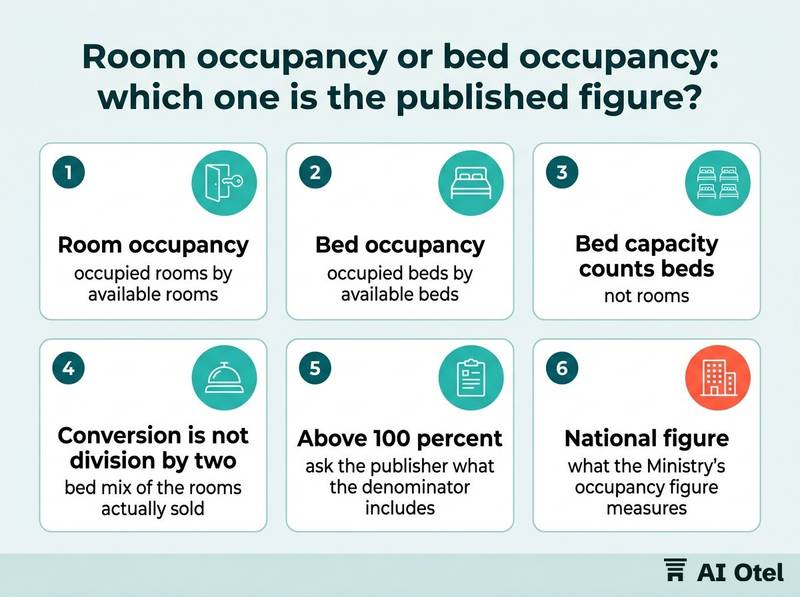
Write both formulas out before you quote either: occupied units divided by available units, over the same period, with the same closure rule on both sides. Bed capacity counts beds, not rooms: a double room carries two, a single carries one, and extra beds may or may not be inside the count. At the same number of sold rooms, a property with many doubles shows a higher bed-based rate than a room-based one.
Conversion is not division by two. You need the bed mix of the rooms actually sold in the period, which is why a bed-based rate and a room-based rate from the same hotel can move in different directions. Period matters too: a rate over a month is not the average of the nightly rates, and a property closed for part of the period changes the denominator without changing a single sale.
If a published rate comes out above 100 percent, treat it as a definition question rather than a typing error, and ask the publisher what the denominator includes. For the national figure, what the Ministry's occupancy figure measures matters more than the number itself. Never label a national bed-based figure as hotel occupancy: certified facility totals include pensions, apart and boutique facilities, so the population is wider than hotels.
Watch outThree questions before quoting an occupancy figure
Ask whether the denominator is rooms or beds, which facility types are in the population, and which period and closure rule apply. If the label does not answer all three, quote the figure with the publisher's own wording instead of your own.
How is average length of stay calculated, and why do two figures disagree?
Average length of stay is overnight stays divided by arrivals. Two figures disagree when they use different arrivals, different nights, or different periods.
Two common bases sit behind most disagreements. One divides nights at a set of facilities by arrivals at the same set. The other divides nights by departing visitors in a survey of travelers. They answer different questions and will not match.
Period handling is the second source of disagreement. Nights belonging to a stay that began before the period, and nights that fall after it, are handled differently by different publishers, so a monthly figure and an annual figure from the same source can differ. Unit discipline is the third: the result is in nights, not days. Rounding to one decimal is common; rounding to a whole number hides the difference between two bases.
Checklist
- Same base: arrivals or departing visitors
- Same facility set: certified facilities or a survey of travelers
- Same period, and the same rule for stays crossing the boundary
- Same rounding and unit: nights, not days
For your own number, compute it from your property management system with the same rule every month, from check-in records rather than reservation records, and write the rule down so it survives staff changes. The wider discipline of citing sources is covered in how to read and cite official tourism data.
Which facilities does each source cover?
Each bulletin has a coverage rule, and two figures are comparable only when their coverage matches. Coverage is the first thing to check and the last thing readers check.
Certified facility stock and operating stock are two different definitions of the same market. Never mix them on one page, and never subtract one from the other. Certificates differ in meaning: an investment certificate marks a facility that is not yet receiving guests, an operating certificate marks one that is, and simple accommodation is a separate category with its own rules.
Certified facilities are not all hotels. Pensions, apart and boutique facilities sit inside the same totals, which is why a national rate describes a mixed population. Border arrivals count people entering the country; facility arrivals count stays inside certified facilities. Different universes, no subtraction, no conversion. A national figure describes a population and your hotel is one member of it, so comparing your own rate with a national rate is a comparison of bases before it is a comparison of performance. Ask for the publisher's title and date before the number: the same series can be revised, and a figure quoted without its date cannot be defended later. The collection process behind these numbers is explained in how monthly facility data is collected.
| Source | Unit | Coverage | Question it can answer |
|---|---|---|---|
| Border bulletin | Person crossings | Foreign and citizen entries at border gates | How many entries |
| Accommodation bulletin | Arrivals, nights, rates | Certified facilities | How the certified stock performed |
| Facility stock statistics | Facilities, rooms, beds | By certificate type | How large the stock is |
| Departing-visitor survey | Visitors and spend | People leaving the country | What travelers spent |
How do I map my own report to the published terms?
Define each line once, in the same words as the published term, and keep the definition fixed and dated. Mapping is a writing task before it is a reporting task.
Count arrivals as check-ins that happened in the period, not reservations created in it. Cancellations and no-shows never become arrivals. Sum overnight stays by night date, not by arrival date, and split stays that cross the period boundary; a report that counts nights by arrival date will overstate some months and understate others.
For bed capacity, decide whether extra beds and out-of-order rooms sit in the denominator, and state the decision in one sentence next to the figure. For occupancy, use the same period and closure rule, and a numerator of the same type as the denominator: rooms over rooms, or beds over beds, never mixed. The formulas behind these lines are set out in RevPAR, ADR and occupancy rate formulas.
Checklist
- Arrival: term, formula, source report, owner, date
- Overnight stay: term, formula, source report, owner, date
- Available room: term, formula, source report, owner, date
- Available bed: term, formula, source report, owner, date
- Occupancy rate: term, formula, source report, owner, date
- Boundary rule for stays crossing the month
Test once by hand. Take one month, recompute the published-style figure from the room list, and compare it with the system report. A single month of manual work settles years of argument.
What are the three most common misreadings?
Each misreading swaps one counting base for another, and each is fixed by naming the base out loud.
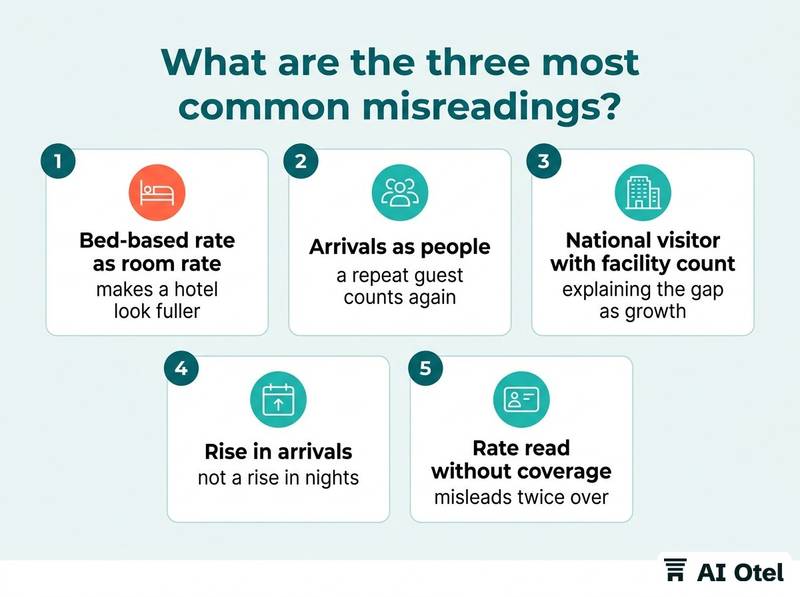
The first is reading a bed-based rate as a room rate, which makes a hotel look fuller than its rooms say, and makes two hotels with different bed mixes look comparable when they are not. The second is reading arrivals as people: a repeat guest counts again on every stay, a group counts once per person, and a traveler who stays at two facilities counts twice. The third is comparing a national visitor count with a facility count, or a monthly figure with a year-to-date figure, then explaining the gap as growth or decline.
Two close relatives deserve the same suspicion. A rise in arrivals is not a rise in nights; the two move together only while the average stay holds steady. And a rate read without its coverage misleads twice over: a figure for certified facilities is not a figure for hotels, and a figure for hotels is not a figure for the market.
Key pointOne sentence rule
Before you use a number, say its unit, its coverage and its base in the same breath. If you cannot say all three, you are quoting, not analyzing.
What should I check before quoting a number from a bulletin?
Four questions turn a number in a bulletin into a sentence you can defend a year later.
Ask who published it, with what title and what date; a figure without its source line is a rumor with a decimal point. Ask what unit it is in: person, night, room, bed or lira, because the unit decides which other figures it may be compared with. Ask what coverage it has: which facility types, which period, and whether the publisher marks the data as provisional or says nothing at all. Ask what base any rate uses: the numerator and the denominator, in words, before the percentage.
Checklist
- Publisher and title
- Date and provisional status
- Unit
- Coverage
- Base of any rate
- Citation sentence written before the number enters a slide
Then write the sentence with publisher, title and date, and add the house line: public data, no endorsement implied. Keep the quoted sentence in your own file with the link. The next person to ask will want the source, not the number.
What to do next
Build the one-page data dictionary this week, then read the next bulletin with the reading card beside it. The parts fit in that order: unit first, then denominator, then coverage, then your own report, because a published figure and a hotel figure can only sit side by side once both have been written down in the same words. For the wider picture of how Türkiye's tourism numbers are published, the Türkiye tourism data page is the place to continue.
Frequently asked questions
Does a guest who stays three nights count as three arrivals?
No. That stay is one arrival and three overnight stays. The arrival count records the person once at the start; the overnight count records each night. This is why arrivals and nights cannot be used interchangeably, and why a change in the average stay moves the two columns apart.
Why can bed occupancy and room occupancy differ at the same hotel?
They use different denominators. Rooms are counted as units; beds are counted per room and depend on the room mix and on whether extra beds are included. At the same sold rooms, a property with many double rooms shows a higher bed-based rate. Converting one into the other needs the bed mix of the rooms actually sold.
Can I compare my hotel's occupancy with a national occupancy figure?
Only after checking the base and the coverage. A national figure may be built on bed capacity and may cover certified facilities of several types, not only hotels. Compare like with like, or present your figure next to the national one with both definitions stated, rather than as a ranking.
What does geceleme mean in a Turkish accommodation bulletin?
It means overnight stay, counted in person-nights: one guest spending one night is one geceleme. It is not a room-night and not an arrival. When you translate it for a report, keep the unit visible, because the English word night alone can be read as a calendar night rather than a person-night.
Is a reservation the same as an arrival in my own reporting?
No. A reservation is a commitment; an arrival is a check-in that happened. Cancellations, no-shows and date changes sit between them. Count arrivals from check-in records, and keep reservation counts in a separate line so the two are never confused in a monthly pack.