AI-written commentary on the monthly profit and loss report: what it may say and what the finance manager must check
AI can draft describing sentences for your hotel P&L, but a person must supply the causes. This guide sets a safe workflow for checking figures and signing off reports.
AI draft · awaiting editorial review
Contents
Key takeaways
- The assistant drafts the describing sentences; the cause behind a variance is written by a person who has checked the transactions.
- Paste the report's variance lines with their period, currency and baseline, never the ledger or anything that carries a guest's or a staff member's name.
- Every figure in the draft is ticked against the report, and every percentage is recomputed, before the text leaves the finance office.
- Commitments, blame and anything that quotes a contract stay with a named person, because a draft that promises becomes the owner's promise.
- Keep the prompt, the pasted figures, the draft, the final text and the checker's name together with the report.
AI commentary on a hotel P&L is a draft of the sentences that describe how the figures moved, written from a variance table the hotel pastes in. The assistant describes movement; a person supplies the cause, checks every figure against the report and signs the text before it reaches the owner.
The month is closed, the variances are calculated, and the owner's cover note is still blank at nine in the evening. This is the moment an assistant looks most useful, and the moment a fluent wrong sentence does the most damage. This article sets a safe split of work: what the assistant drafts, what a person must write, what goes into the prompt, and a checking pass that runs before anything is sent. Read it once and you can write your hotel's one-page rule the same week.
What is an AI commentary on a hotel P&L actually for?
It turns a table of variances into the few sentences an owner will actually read, so the owner can ask one good question instead of decoding columns.
An owner report does three jobs: state the result, name the largest movements, and say what the hotel is doing about them. Commentary serves the second job and sets up the third. If you want a fuller picture of what belongs in the report itself, see what to ask your hotel operator for in the monthly owner's report.
Commentary describes movement. Analysis explains it. Keep the two apart on the page as well as in the workflow, because they have different authors and different evidence. The test of a sentence is whether it tells the reader something the column did not; a paragraph that repeats the table in words adds length and no information.
The reader is usually not an accountant. They want direction, size, and whether the line sits inside or outside the plan. Fluent wrong text is worse than a bare table, because the owner will quote it back at you in a meeting and treat it as the hotel's position.
Set the house rule before choosing any tool: which lines get a sentence, how long each sentence may be, and who signs the finished text.
Key pointThe one rule to write on the wall
Every figure in the commentary exists in the report, and every cause in the commentary exists in a person's confirmed note.
What should you give the assistant, and what must stay out?
Give it the report's own lines with their comparison columns; keep the ledger, the guest names, the staff names and the payroll detail out.
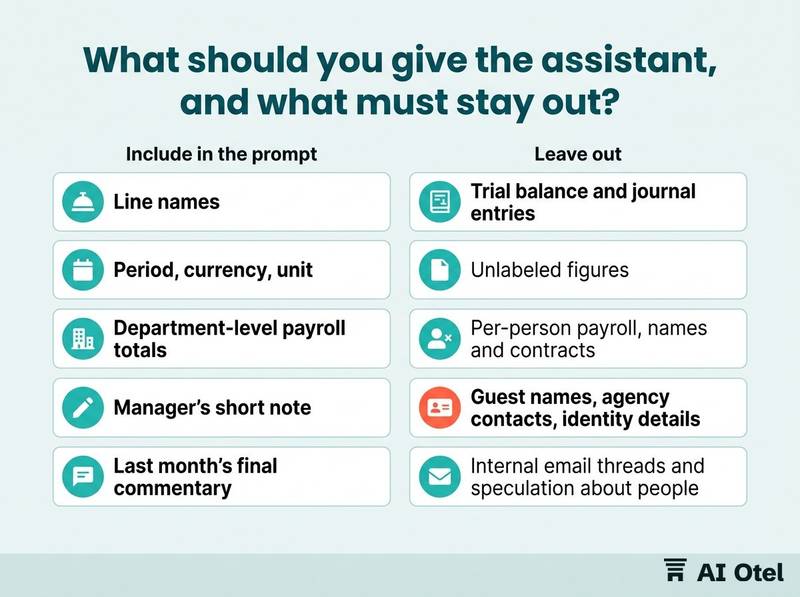
Paste a variance table, not a trial balance: line name, actual, budget or prior period, variance in amount and in percent. The assistant needs the comparison, not the bookkeeping. Label the period, the currency, the unit (thousands or units) and the baseline inside the pasted text, so the draft cannot supply its own version of any of them.
Strip personal data: guest names, agency contacts, staff names, per-person payroll, identity or passport details. Personal data means data about an identifiable person, and a prompt is a transfer of whatever it contains to another service. Aggregate payroll to a department total, and if a cause involves a person, describe the role, not the name.
Add a short note in your own words of what the hotel already knows: the boiler replacement, the rate agreement that started in March, the two floors closed for renovation. That note is the only source of cause the draft is allowed to use. Keep the assistant outside the accounting system: it reads what you paste and nothing else, it never queries the ledger, and it never sees a document you did not choose to send. If your back-office workflow already separates extraction from review, the same discipline applies here; see how reconciliation, extraction, exception and review queue work in practice.
| Include in the prompt | Leave out |
|---|---|
| Line names with actual, budget or prior period, variance in amount and percent | Trial balance and journal entries |
| Period, currency, unit and baseline label | Unlabeled figures |
| Department-level payroll totals | Per-person payroll, names and contracts |
| The manager's short note of known causes | Guest names, agency contacts, identity details |
| Last month's final commentary | Internal email threads and speculation about people |
What does an AI draft do well on a monthly report?
It writes the describing sentences: which lines moved, in which direction, by how much, and which of them account for most of the total movement.
Restating a variance in plain words using the hotel's own line names means the owner reads the same words in the note and in the table. Ranking the movers comes next: the three largest by amount and the largest by percentage, with the caveat that a small base makes a large percentage, and the two rankings answer different questions.
Grouping helps before detail: departmental revenue against departmental cost, rooms against food and beverage, so the reader sees where the movement sits before reading any single line. If your report follows the uniform system, reading the departmental profit and loss statement under USALI tells you which groupings owners expect.
Consistency matters most over time: the same term for the same line every month is what makes two reports comparable at all. A good draft produces two lengths from one input, three sentences for the cover note and one paragraph for the body, without the numbers drifting between them.
Marking the gaps is also a strength. A sentence that says a line moved and the cause is still under review is a legitimate and useful output, not a failure. Tone should stay neutral: no adjectives, no congratulations and no alarm. The owner supplies the judgment.
TipAsk for the describing draft, not the explaining draft
A prompt in the form "rewrite these variances as plain sentences, do not state a cause, do not add any figure that is not in the table" produces usable text. A prompt that asks why produces fiction.
What can the assistant not know about a variance?
The cause. It sees the lines you pasted and nothing behind them.
A variance has several possible parents: volume (more or fewer rooms sold, more covers served), rate or price, mix (which room types, which segments), timing and cut-off, a posting or reclassification error, and a one-off event. The assistant cannot separate these from the totals. The split is arithmetic done on the numbers by a person, and it is the actual work of variance analysis; budget vs actual in hotels covers that arithmetic in detail.
If you ask why a line moved, a language model will produce a plausible cause. Plausible is the danger, not obviously wrong. One line can carry two causes at once, fewer rooms at a higher average rate, and the commentary must not collapse them into a single explanation.
Reclassifications and accruals move a line with no business change behind it. Say that plainly instead of inventing an operational reason. Where the cause is genuinely unknown, the honest sentence names the owner of the question and the date the answer is due.
Watch outNever prompt for a cause
A draft that guesses reads exactly like a draft that knows, and the reader has no way to tell them apart.
How do you check the draft before it reaches the owner?
Tick every figure against the report, then every sentence against what the hotel actually knows, then read it once as the owner would.
The figure pass comes first: every number in the draft appears in the report with the same value, unit, currency and period. A figure that appears nowhere in the source is removed, not corrected. The derived pass recomputes every percentage and share yourself; a share of a negative or zero base is meaningless, and a draft will still print one.
The comparison pass checks that budget, prior year and forecast are not mixed in one sentence without saying which is which. The cause pass traces each causal clause to a named person who confirmed it, and to the note you supplied. The language pass matches line names to the hotel's own chart of accounts, and no department has been renamed by the draft. The consistency pass checks that the summary agrees with the body, and the body agrees with the table. Sign-off is one named person, with a date, before the text leaves the finance office.
If you already run a verification habit over spreadsheet work, checking the result of AI-assisted work in Excel reports uses the same idea: the machine drafts, a person proves.
ChecklistCheck the draft before it leaves the finance office
- Every figure matched to the report
- Every percentage recomputed
- Every comparison labeled budget, prior year or forecast
- Every cause traced to a named confirmer
- Line names matched to the chart of accounts
- Summary, body and table agree
- Named checker and date recorded
Which sentences must a person write?
Causes, commitments and anything that assigns responsibility.
Cause sentences come first: only a person who has looked at the underlying transactions can write "because". Commitments come second: a recovery expected next quarter, a rate agreement taking effect in March. A promise in a draft becomes the owner's promise the moment it is sent.
Blame is third. A sentence that names a department, a shift or a person as the reason belongs to the manager who will stand behind it, and often belongs in a separate conversation rather than the owner report. Contract and rate statements, anything quoting an agreement, a supplier term or a commercial condition, also stay with a person. So does anything that could later be read as an HR or legal record, which is most sentences that judge a person's work.
The mechanical fix is simple: have the draft leave a marked blank for each cause, with a line for the confirmer, so the person fills a gap instead of editing around a guess.
| Sentence type | Who writes it | Why |
|---|---|---|
| Movement description | Assistant, checked by a person | It is arithmetic restated |
| Cause | Person | It needs the transactions |
| Commitment | Person, with the owner informed | It becomes a promise |
| Blame | Person, usually outside the report | It is a judgment about people |
| Figure | Person, taken from the report | The report is the source |
| Gap or under review | Assistant, person confirms the date | An open question is honest |
What do you keep on file with the report?
The prompt, the exact figures pasted, the draft, the final text and the name of the person who checked it.
Why it matters: the owner asks where a sentence came from, a department disputes a cause, and next month's writer needs to know what was already said. Store the five items together, named by period, in the same place as the report itself.
The file is a working record, not the accounting record. The ledger and the signed report remain the record of the numbers. Retention follows the hotel's own practice for management reports; because the input was aggregated, the file should contain no personal data to retain.
One line at the top of the file records the tool used, the date, the checker, and whether the text was sent as drafted or edited. If the hotel changes tool or model, the old files still explain the old text, which is the point of keeping them.
NoteThe file answers one question
Where did this sentence come from? If the file cannot answer that in under a minute, it is missing one of the five items.
What to do next
Write the one-page rule this week: which lines get a sentence, what goes into the prompt, which sentences a person must write, and who signs. The split is the whole idea. Describing movement can be drafted; explaining it cannot; and a named person stands behind every figure and every cause before the owner reads a word.
Frequently asked questions
Can AI write the whole monthly owner report?
No. It can draft the describing sentences from a variance table the hotel supplies. The figures come from the report, the causes come from a person who checked the transactions, and a named person signs the text. The accounting record stays in the ledger.
Is it safe to paste hotel financial figures into an AI assistant?
It depends on the tool's terms and on the hotel's own data practice. Paste aggregated line totals, never guest or staff personal data, and treat the prompt as a transfer of whatever it contains to another service. Confirm the contract terms and your own obligations with your adviser.
How do I stop the draft inventing a reason for a variance?
Instruct it not to state causes, give it a short note of the causes you already know as its only permitted source, and have it leave a marked blank where a cause is missing. Then check every causal clause against a named confirmer before sending.
Does the commentary replace variance analysis?
No. The analysis is the arithmetic that separates volume, rate, mix, timing and reclassification, and it is done on the numbers by a person. The commentary sits on top of that work and puts it into sentences an owner will read.
How long should the commentary be?
As long as the owner's reading time allows: a few sentences on the cover and one short paragraph per major movement. Length is a decision the finance manager makes and writes into the house rule, not something the draft should decide.