An ice cream and dessert station at a resort: cost per portion, pricing and melting waste
Learn how to calculate the true cost per portion of ice cream, including waste and labor. Discover methods to control portion size and decide if the station should be free or paid.
AI draft · awaiting editorial review
Contents
Key takeaways
- Cost per portion is the tub cost divided by the portions a tub actually yields with the scoop you serve, not the portion printed on the pack.
- A level scoop from a fixed, numbered disher is the cheapest portion control at the station, and a packed scoop quietly gives away more ice cream per guest.
- Ice cream inside an all-inclusive package is a cost per guest night, so it is controlled by portion size and serving hours, not by a price.
- Melted ice cream is discarded and counted, and that discard count is the number that shows whether the cabinet and the serving window are right.
- Every flavor needs a legible allergen line taken from the supplier's specification sheet, not from staff memory.
Cost per portion is the price of a tub divided by the number of portions it actually yields with the scoop you serve. Measure the yield once per flavor, add the cone, toppings, labor, cabinet power and counted melt waste, then decide whether the station is free inside the package or paid at the pool.
At four in the afternoon the queue at the poolside freezer is six deep, the tubs have gone soft, and nobody can say what a scoop cost this week. Ice cream is the most visible extra of the summer and one of the quietest lines in the food and beverage result. After reading this you will be able to run a yield test, set a portion rule, price or budget the station, and read a daily count that tells you what to change.
Should ice cream be free in the package or paid at the pool?
Decide once, in writing, before the season: either the station sits inside the package as a cost per guest night, or it is a paid outlet with its own price and its own waste. Both work; drifting between them does not.
Inside an all-inclusive package, ice cream is a cost per guest night. Budget it as an allowance per guest night and control it through portion size and serving hours, not through a selling price. The same logic governs the rest of the package, as with all-inclusive cost per guest night and the price floor: the freezer belongs in the same calculation as the buffet, the drinks and the animation.
As a paid station, the price has to cover the portion cost, the waste you actually count and the labor the station adds. A price built from the tub cost alone loses money on the hottest days, when volume and melt both peak.
There are middle positions: free in fixed hours such as mid-afternoon, free for children, free basic flavors with paid premium ones, or a paid toppings bar. Each one is a written rule, not a decision the shift supervisor makes at the counter.
Think about how it reads. A paid freezer standing beside a free buffet dessert can look like an extra charge inside an all-inclusive. Judge it by your guest segment, and if you charge, say so at check-in and on the board. Whatever you choose, hold it for the season. Changing the model in July costs more in confused staff and complaints at the desk than it saves.
Key pointDecision rule
If the station is inside the package, manage it as a cost per guest night with a fixed portion and fixed hours; if it is paid, manage it as a revenue line whose price covers portion, counted waste and added labor. Write the choice down, name who owns it, and do not change it mid-season.
How do you calculate the cost per portion of ice cream?
Divide the cost of a tub by the number of portions that tub actually gives with the scoop you serve, then add the carrier, the toppings, the labor, the cabinet power and the waste you counted.
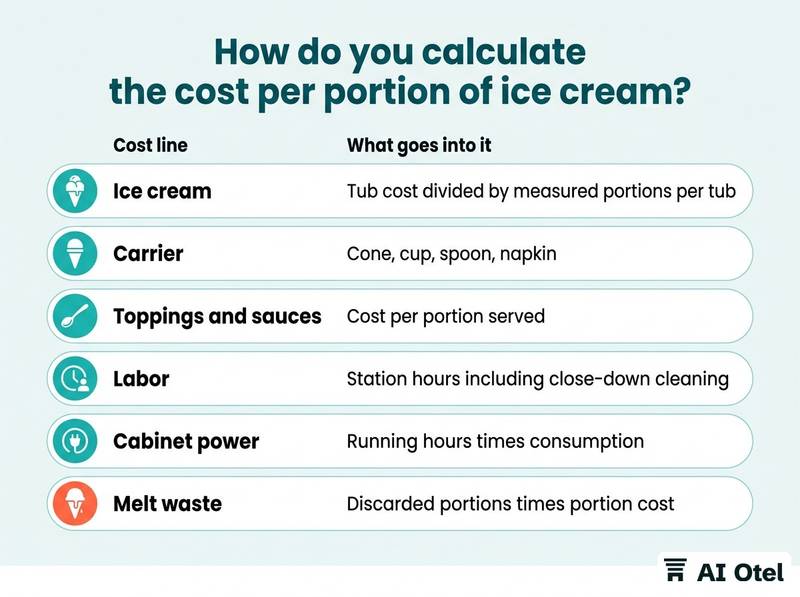
Run a yield test instead of trusting the pack. Take a full tub, scoop it level with the disher you serve with, and count portions until the tub is empty. Record the count on the recipe card for that flavor and that scoop size. Do it per flavor: products differ in density and in the air whipped into them, so two tubs of the same stated volume do not give the same number of portions.
Then add every line the guest receives: cone, cup, spoon, napkin, sauce, fruit, sprinkles. A topping can cost more per portion than the ice cream under it. Add the labor at the station, including the person who cleans the cabinet and the trays at close, and the electricity the cabinet draws around the clock. Add the counted melt waste, because waste is a cost per portion like any other, and leaving it out is how a station looks profitable on paper and disappears from the monthly result. This is the same method used for standard recipes and portion cost in hotel kitchens, applied to a freezer instead of a plate.
| Cost line | What goes into it | Where the number comes from |
|---|---|---|
| Ice cream | Tub cost divided by measured portions per tub | Yield test |
| Carrier | Cone, cup, spoon, napkin | Purchase invoice |
| Toppings and sauces | Cost per portion served | Standard recipe |
| Labor | Station hours including close-down cleaning | Rota |
| Cabinet power | Running hours times consumption | Rating plate and electricity bill |
| Melt waste | Discarded portions times portion cost | Daily count |
Recalculate when the purchase price changes or the supplier changes the product. A portion cost carried over from last summer is a guess. Keep the portion cost on the same card as the buffet desserts, so the pastry chef and the F&B manager compare like with like.
How do you keep portion size under control?
Fix the tool and the words. A numbered scoop sets the size, a level strike sets the fill, and a script sets what the guest is offered.
Use a numbered disher and know what the number means: it is the count of level scoops that size fills from a quart, so the portion is set by the tool rather than by the server's hand. Serve level, not packed. Strike the scoop against the inside edge of the tub. A packed scoop serves visibly more ice cream per guest, and the difference never appears in any report.
For soft serve, weigh portions on a scale for a week to learn what the machine actually delivers at each setting, then fix the rule as a weight or a timed portion. Watch the carrier: a cone can hold more than a small cup, so portion and price the carrier together, not the ice cream alone. The same pairing of tool and script governs pour size and bottle yield in a hotel bar, and it works the same way at a freezer.
Control the taste spoon. It costs little per unit and is unmanaged in count; keep the spoons behind the counter and count what leaves. Change the question. Ask "one scoop or two", never "how much would you like"; the open question invites the larger portion and puts the decision on the guest. Presentation does the rest: a smaller coupe filled properly and garnished reads as generous, and the guest remembers the garnish, not the gram.
ChecklistScoop discipline checks before each service
- The correct numbered disher is at the station and no other scoop is within reach.
- The scoop rests in a rinse cup, not in the product.
- The tub is level and not overfilled.
- The portion script is posted where the server stands.
- The taste spoons are behind the counter.
- The soft-serve setting is the one agreed for the day.
How does the freezer cabinet turn ice cream into waste?
Storage and serving are two different jobs. The deep freezer holds the product hard; the serving cabinet runs warmer so it can be scooped, and every minute a tub spends soft is a minute it is losing volume and quality.
Separate the two temperatures in practice, not just on paper. Keep back-up stock in the deep freezer and bring out only what the next serving window will use. Confirm the storage and serving conditions with the supplier's instructions and your food-safety plan.
Temper to a rule, not to a feeling. Tubs come out a fixed number of minutes before service, not "until they are soft"; early tempering is the most common cause of a soft, unscoopable pan at peak time. Never refreeze melted ice cream. Discard it, record the discard, and treat that record as a cost line, not as a reprimand.
Choose the cabinet for the site. A closed-lid display freezer keeps the cold in; an open well loses it and collects sun. A scooping cabinet with a cold plate holds the serving pan at the right texture through a busy afternoon. Place it well: in shade, away from the pool splash zone, and within sight of the bar or the station so one named person owns it.
Check the temperature twice a shift and sign for it. Where the cabinet stands far from staff, a logger is cheaper than the tubs it saves. Size the cabinet for the peak day, not the average one. An undersized cabinet is a waste decision taken in the purchasing office months earlier.
Watch outMelted ice cream
Melted ice cream is never refrozen and never returned to the pan. It is discarded at the moment it is found, recorded on the daily count sheet with the flavor and the quantity, and reviewed with the cabinet temperature log for that shift.
What belongs on the flavor and allergen labels?
Every flavor needs a readable name and an ingredient and allergen line copied from the supplier's specification sheet, in the languages your guests read.
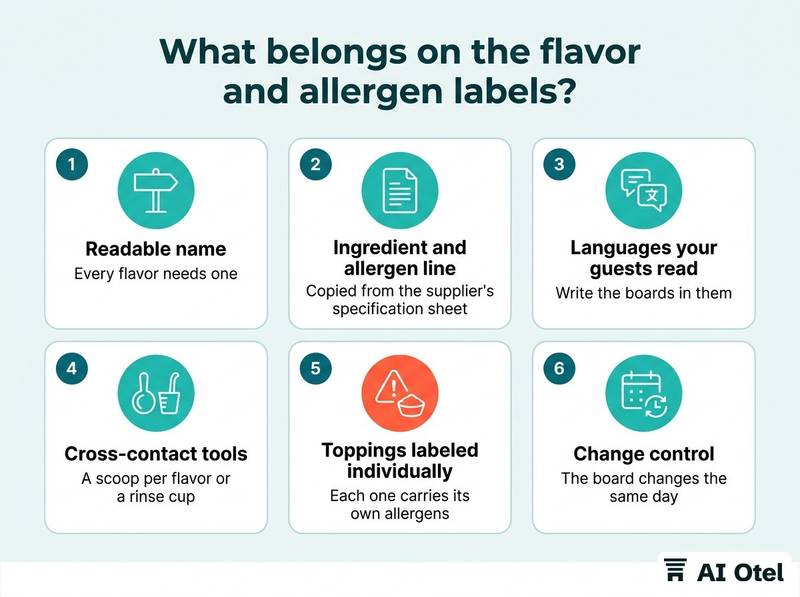
Source the line from the specification sheet, not from staff memory and not from the previous supplier's board. Keep the current sheets in a folder at the station. Cover the usual suspects at a dessert station: milk, nuts, gluten in cones and cookies, egg, soy, and sesame in toppings and sauces.
Handle cross-contact with tools: a scoop per flavor or a rinse cup between flavors, and separate tongs at the toppings bar. Label the toppings individually. A toppings bar is a set of small products, and each one carries its own allergens and its own sheet.
Write the boards in the languages your guests actually read. The exact labeling duty for your operation is a question for your food-safety adviser; the content of the label is not, it comes from the sheet. Run change control: when a supplier changes a recipe, the board changes the same day and the old sheet leaves the folder. Train the answer. A server must be able to reply to "does this contain nuts" from the sheet, and to say "let me check" when the sheet is not in front of them.
How do you count ice cream every day and every week?
Count in portions, not in tubs, once a day at close, and review the variance once a week against covers, weather and the cabinet log.
A tub is not a unit of control. Convert everything to portions using the measured yield for that flavor and scoop. The daily sum is simple: opening portions plus received, minus served, minus discarded, equals closing. Anything left over is variance, and variance is the number worth arguing about.
Name the counter and the time: the station supervisor at close, signed on the sheet. A count without a name is a guess with a form attached. Weekly, look at the waste ratio, discard divided by served, and at the yield again whenever a flavor or a supplier changes.
Read the count beside covers and the weather. The hot weekend with a full pool is exactly when the cabinet, the hours and the order quantity are tested, and the count will show it a week later. Make the count change something: the scoop size, the serving hours, the cabinet, the order quantity, or the tempering rule. A count that changes nothing stops being taken within a month. Use the same discipline you already apply to measuring buffet food waste in all-inclusive hotels, so the two waste numbers can be read together.
ChecklistDaily close at the ice cream station
- Count opening portions carried over.
- Add portions received.
- Subtract portions served, from the service tally.
- Subtract portions discarded, with flavor and reason.
- Count closing portions.
- Write the variance.
- Sign and time the sheet.
- Attach the cabinet temperature readings for both shifts.
What to do next
Run the yield test this week with the scoop you actually serve, and start the daily portion count on the same day. Those two numbers turn the station from a visible extra into a managed line: they set the portion cost, they justify the free or paid decision, they show whether the cabinet is right, and they tell you what to change before next summer. If you want the count, the recipe cards and the waste sheet to live in the same system as your restaurant and bar sales, look at our hotel operating system (built and working, ahead of launch) and the wider ecosystem around it.
Frequently asked questions
How many scoops does a 5-liter tub of ice cream give?
There is no fixed number: it depends on the scoop size and on how much air the product holds. Measure it once per flavor with the disher you serve with, count level scoops until the tub is empty, and write the result on the recipe card. Re-test when the flavor or the supplier changes.
Should poolside ice cream be free at an all-inclusive hotel?
Either model can work if it is chosen deliberately and held for the season. Free means it is a cost per guest night, controlled by portion and serving hours. Paid means the price must cover portion cost, counted waste and added labor. The mistake is a rule that changes with the shift.
Can melted ice cream be refrozen?
No. Melted product is discarded and recorded, because refreezing damages texture and puts quality and safety at risk. The discard is a cost line, and reading it beside the cabinet temperature log shows whether the problem is the cabinet, the tempering rule or the serving window.
How do I stop staff from serving extra scoops?
Fix the tool and the script: a numbered disher, a level strike, and the question "one scoop or two". Then count portions daily so the variance is visible. Measurement changes behavior faster than a warning, and it also shows when the real cause is an undersized cabinet or a queue at peak time.
What has to be on an ice cream label at a hotel?
A workable label carries a readable flavor name and an ingredient and allergen line taken from the supplier's specification sheet, in the languages your guests read, with toppings labeled individually. Keep the sheets at the station and update the board the day a supplier changes a recipe. Confirm your own labeling duty with your food-safety adviser.