Wine by the glass in a hotel bar: pour size, bottle yield and the price ladder
Calculate bottle yield and set pour sizes to reduce waste. Build a price ladder that covers costs and earns margin for open-bottle risk in your hotel bar.
AI draft · awaiting editorial review
Contents
Key takeaways
- A 750 ml bottle gives five 150 ml glasses on paper and four in practice, because the last pour is short and some wine goes to tasting and spill.
- Cost per glass is the bottle cost divided by the working yield, never by the number of glasses the label suggests.
- A wine belongs on the glass list only if the bar can sell its working yield inside the open-bottle window, roughly two to three days for still wine and about one for sparkling.
- On a four-step ladder, each glass price should be a visible step above the one below, and the glass price multiplied by the working yield should come out above the bottle price.
- Waste becomes visible only when the weekly stock variance is converted into glasses and priced at cost.
Bottle yield is the number of sellable glasses a bottle gives after pour size and spill: a 750 ml bottle pours five 150 ml glasses on paper, four in practice. Price each glass so that a full bottle's worth of glasses covers the bottle cost, the wine lost to open bottles, and service.
A guest orders the second red on the glass list, drinks half of it, and the bottle goes back on the shelf. On the cost sheet the wine made its margin. At the end of the week the count says something else. Wine by the glass pricing in a hotel bar fails in the gap between what the sheet assumes and what the shelf holds. After reading this you will be able to set a pour size, compute a working yield, cost a glass, build a four-step price ladder, and decide which wines are allowed on the glass list at all.
How many glasses does a bottle of wine give?
A standard 750 ml bottle gives five 150 ml glasses, four at 175 ml or six at 125 ml. The working yield is one glass lower, because the last pour is short and some wine is lost to tasting and spill.
Do the volume arithmetic first: 750 divided by the pour size, rounded down. Everything else in this article is built on that number. A pour size is a written standard, not a guess: mark the glass or fit a measured pourer, because the same wine poured at 150 ml on a quiet Tuesday and 180 ml on a busy Saturday destroys the yield calculation.
Subtract one glass per bottle for the working yield. That covers the short last pour, the taste given to a guest who asks, and the spill at the end of service. The last-glass problem deserves a written rule: a bottle holding 90 ml cannot be sold as a 150 ml glass. Either pour it as a short glass with the guest's agreement, or record it as a staff taste or a loss. Decide which, in writing, so the count stays honest.
Sparkling wine gives six 125 ml flutes at a push, but the fizz fades faster than the volume disappears, so the working yield is lower and the open-bottle window shorter. Sweet and dessert wines are poured at 60 to 75 ml, which gives more glasses per bottle and a longer open-bottle life; that is why they are good by-the-glass candidates. Print the pour size on the list: a guest who knows what a glass means is less likely to feel short-changed and less likely to send it back.
| Pour size | Glasses per 750 ml on paper | Working yield | Where it fits |
|---|---|---|---|
| 125 ml | 6 | 5 | Sparkling, dessert and tasting pours |
| 150 ml | 5 | 4 | The standard house pour |
| 175 ml | 4 | 3 | Premium reds, steak-house pours |
| 250 ml | 3 | 2 to 3 | Large casual pours at the bar |
How long does an opened bottle last, and how do you keep the waste visible?
A still wine stays saleable for about two to three days once opened if it is kept cold and closed properly, and sparkling wine for about a day. The exact window is set by your own tasting, not by a general rule.
Oxidation is a clock. The wine takes up oxygen, the fruit fades and the acidity sharpens. Cold slows the clock, so a white kept in the fridge overnight holds up better than a red left on the back bar. Know what each method buys: a stopper and the fridge gives hours to a day, a vacuum pump a day or two, a gas blanket two to three days, and a by-the-glass dispensing system the longest window, at a capital cost and a cleaning routine.
Apply the sell-through test before a wine goes on the list. Two bottles open with a three-day window means the bar must sell eight to ten glasses of that wine inside three days, or the remainder is waste. Date and time every opened bottle, keep open bottles in one fixed place, and require a taste check by the bar manager before the first pour of the next service.
Cost a dead bottle at what you paid for it, not at the menu price, and record only the unsold remainder. The whole bottle was not lost; the part nobody drank was. Never top an old bottle up from a fresh one: it hides the loss, makes the count meaningless, and eventually reaches a guest. Convert the weekly stock variance into glasses, because two bottles means nothing to a bar team while eight glasses of the house red means something. The variance sits inside the wider discipline of the monthly beverage count in hotel bars.
ChecklistOpened bottle routine
- Date and time written on the label
- Stopper or gas applied immediately after the pour
- Open whites, rosés and sparkling kept in the fridge
- Open reds kept in one fixed cool place, not on the back bar
- A taste check before the first pour of each service
- A written discard rule for anything past its window
- The discarded remainder entered on the waste sheet the same day
What does a glass of wine cost you?
Cost per glass is the bottle cost divided by the working yield, plus a small allowance for spill and the cost of service. It is never the bottle cost divided by the theoretical number of glasses.
The formula is simple: cost per glass equals bottle cost divided by working yield. For example, a bottle bought at 300 lira with a working yield of four gives 75 lira a glass before spill. Add the spill allowance: if the bar loses one glass in twenty to over-pour, breakage and comps, the real cost is about 5 percent higher. Build it in rather than discovering it at the count.
The cost target is the owner's decision, not a market rule. Pick a percentage, write it down, and apply it to every wine on the list so the ladder is built on one number. Compare the glass against the bottle: a bottle sold whole carries no open-bottle risk, while a glass carries all of it and should earn for it. Count the service cost too, the glass, the wash, the ice water and the staff time; on a cheap wine, serving can cost more than the liquid.
Do not price the glass from the bottle's menu price alone. The glass is a separate product with a separate risk and its own cost base. How tax and service charge are applied to the glass price is a question for your accountant, not a bar decision.
Key pointThe number on the bar wall
Cost per glass equals bottle cost divided by working yield, with the spill allowance added. Every price on the glass list is built from that number.
How do you build a price ladder for a short wine list?
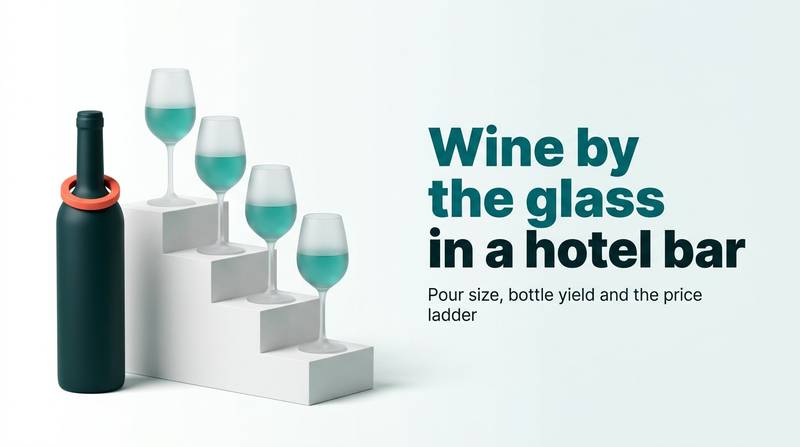
Put three or four glass prices on the list, each a clear step above the one below, and set each glass price so that a full bottle's worth of glasses earns more than the bottle itself.
The shape is an entry wine, a middle wine you actually want to sell, and one or two above it. Four steps is enough for a hotel bar; more steps blur the choice. The step rule: each step should be a visible jump, roughly a third to a half above the one below. Steps that are too close make the middle wine pointless; steps that are too wide push every guest to the bottom.
The middle of the ladder is where the margin lives. Price the entry wine keenly, the top wine for the guest who wants it, and the middle wine to be the obvious choice. Pick a rounding rule and keep it: prices that end the same way across the ladder read as a designed list, while mixed endings read as guesswork. The glass and the bottle price of the same wine must not contradict each other, because a guest who does the arithmetic should not find that four glasses cost less than the bottle. Review the ladder when a bottle cost moves, not when the menu is reprinted. The same ladder logic works for spirits; see pricing a cocktail list with a recipe card and a price ladder.
The bottle-to-glass check, worked
Multiply the glass price by the working yield. The result should sit clearly above the bottle price, because the glass carries the open-bottle risk. For example, on a four-step ladder:
| Step | Role | Bottle cost (TL) | Cost per glass (TL) |
|---|---|---|---|
| Entry, glass 260, bottle 900 | House white or red | 300 | 75 |
| Middle, glass 360, bottle 1,250 | The wine you push | 440 | 110 |
| Upper, glass 520, bottle 1,800 | Guest who wants more | 640 | 160 |
| Premium, glass 800, bottle 2,800 | Celebration and sparkling | 1,000 | 250 |
Cost per glass is at four glasses per bottle. Four glasses of the entry wine bring 1,040 lira against a 900 lira bottle, which is the margin the open bottle has to earn. The wine cost sits near 29 to 31 percent of the glass price on every step, which is what a single cost target applied consistently looks like.
Which wines belong on the by-the-glass list?
A wine earns a place on the glass list when the bar can sell its working yield inside the open-bottle window, at a price the guest reads as fair, without splitting demand with a similar wine one step away.
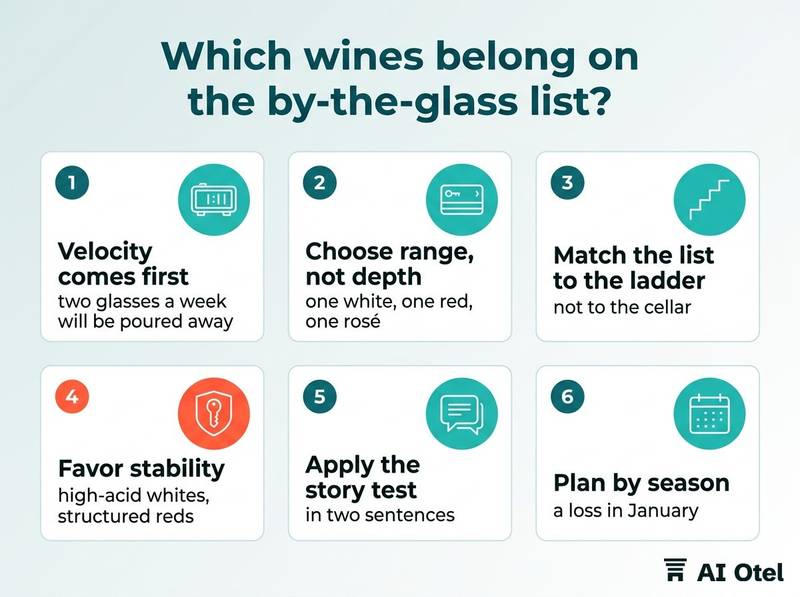
Velocity comes first. A wine that sells two glasses a week will be poured away however good the margin looks on paper. Choose range, not depth: one white, one red, one rosé in season, one sparkling, one sweet. Each answers a guest's question, while two similar reds at the same price slow each other down.
Match the glass list to the ladder, not to the cellar. The expensive bottle stays on the bottle list unless the bar has gas storage and a guest who orders it. Favor stability: high-acid whites, structured reds and sweet or fortified wines hold up better than delicate, low-acid wines. A fragile old white is a bottle-list wine.
Apply the story test: the team must be able to say in two sentences what the wine tastes like and what it goes with. If nobody can, the guest will not order it. Plan by season, because a rosé that carries the list in summer can be a loss in January. Treat each glass as a menu item with a popularity and a margin, and move it between the four groups as the counts come in, the same way menu engineering for hotel restaurants sorts dishes.
How do you brief the bar team to describe a wine in two sentences?
Give every glass-list wine a two-sentence script: one sentence on what it tastes like, one on what it goes with, both in plain words a guest can repeat to the table.
The structure is fixed: it is a certain style, with two flavours, and it works with a named dish. Nothing about the winery's history, the soil or the awards. One script per wine, written by the bar manager, approved by the F&B manager, and kept on the same card as the pour size and the price.
Taste the open bottle at the start of service, because a script is useless if the wine in the glass no longer matches it. Set an honest limit: if a guest asks for something the bar does not have, say so and offer the nearest step on the ladder, not the most expensive one. No upselling script: the second sentence helps the guest choose, and a guest who feels steered orders water next time. Five minutes at the start of service is enough, one wine a day, tasted and described, keeps the team sharp without a training day.
TipScript template
Fill in the blanks: "This is a light-bodied white with green apple and a mineral finish, and it goes with the sea bass on the menu tonight." Keep the same two-sentence shape for every wine on the glass list.
What to do next
Write down your pour size and your working yield this week, then rebuild the glass list from the cost per glass up. The yield sets the cost, the cost sets the ladder, the open-bottle window decides which wines are allowed on it, and the weekly count tells you whether the list is telling the truth. Start with one page: pour sizes, working yields, glass prices, bottle prices, and the sell-through test for each wine on the list today.
Frequently asked questions
How many 150 ml glasses are in a 750 ml bottle of wine?
Five on paper, four in practice. The working yield subtracts one glass for the short last pour, the taste given to a guest and the spill at the end of service. The pour must be measured, with a marked glass or a measured pourer, for the arithmetic to hold.
How long can you keep an open bottle of wine in a bar?
About two to three days for still wine kept cold and properly closed, and about one day for sparkling. The window depends on the wine and the storage, and it should be set by the bar's own tasting rather than a general rule. Every bottle should carry its opening date and time.
Should a glass of wine cost more than a fifth of the bottle price?
Yes, in most cases. Multiply the glass price by the working yield and compare it with the bottle price: the glass must earn more because it carries the open-bottle risk, the spill and the service cost. In the worked example, four glasses at 260 lira bring 1,040 lira against a 900 lira bottle.
Is it more profitable to sell wine by the glass or by the bottle?
The bottle carries no open-bottle risk; the glass earns more per millilitre but can end in the sink. The answer is a mix: a short glass list of fast-moving wines, a full bottle list behind it, and a weekly count that shows which glasses actually paid.
What pour size should a hotel bar use for wine?
150 ml is the standard house pour, 125 ml suits sparkling, dessert and tasting pours, and 175 ml suits premium reds. Whatever the bar chooses, it must be written down, measured with a pourer or a marked glass, and printed on the list.