Wine and drinks list terms for hotel staff: by the glass, corkage, vintage, neat and more
Clarify common wine list terms like by the glass, corkage, and vintage for hotel bar staff. Learn how to align list wording with table service to reduce complaints.
AI draft · awaiting editorial review
Contents
Key takeaways
- By the glass means a fixed measure from an opened bottle, so the list should print the measure and the price of that measure, not only the bottle price.
- Vintage is the harvest year, not the bottling year, and a non-vintage wine is a deliberate blend made to taste the same each year, not a lesser wine.
- Corkage is a charge for serving a bottle the guest brought in; whether a hotel allows it and how much it charges is the hotel's own written policy, stated before the bottle is opened.
- Neat, on the rocks and up describe what is in the glass: nothing added, poured over ice, or chilled with ice and strained into the glass without it.
- The words printed on the list and the words staff say at the table should be the same words, or the guest hears two different offers.
By the glass means a fixed measure poured from an opened bottle; vintage is the year the grapes were harvested; corkage is a charge for serving a bottle the guest brought; neat means nothing added to the spirit, on the rocks means poured over ice. A good list prints the measure, the price and the serving style.
A guest asks for the wine by the glass, the good one, not the house, and the waiter has three words for the same bottle and none of them is printed on the list. A common source of bar complaints is a word the guest and the staff used differently. After reading this article, hotel bar staff can explain every common wine list term with one plain sentence, and managers can write the list so the paper and the table say the same thing.
What does by the glass mean on a hotel drinks list?
By the glass means the bar opens a bottle and sells it in fixed measures, so the guest pays for one pour instead of the whole bottle. The list should state the measure and the price of that measure.
Fix the measure and keep it the same at the bar, at the table and on room service. For example, 150 ml for still wine and 125 ml for sparkling, written on the list. When the measure moves between outlets, the guest is buying a different product under the same name.
Separate the four ways to buy wine so the guest can choose between them: by the glass (one measure), a carafe (a stated volume, not a jug), a half-bottle (a sealed smaller bottle) and a bottle (the whole 750 ml). Explain the house pour as the wine the hotel chose as its default, not as the cheap one; the guest hears the difference in how it is said.
Give the guest the arithmetic. For example, a 750 ml bottle gives five 150 ml glasses, so the bottle is better value for two guests and the glass is better for one. Put the glass price and the bottle price side by side so the guest can compare without asking. For how the pour size drives the cost per drink, see pour size and cost per drink on a hotel bar list.
| Term on the list | What the guest is buying | What staff say |
|---|---|---|
| By the glass | One fixed measure from an opened bottle | The measure and its price |
| Bottle | The whole bottle, sealed, opened at the table | The bottle price and how many glasses it holds |
| Half-bottle | A sealed smaller bottle, usually half the volume | The volume in millilitres, not the word half |
| Carafe | A stated volume poured from the bar | The volume in millilitres |
| House pour | The hotel's chosen default wine | The grape, the style and the measure |
Decide and write down how long an opened bottle stays sellable by the glass, and what happens when it passes that point. The rule belongs in the bar's own notes, not in a waiter's memory.
What does vintage mean on a wine list?
Vintage is the year the grapes were harvested, not the year the bottle was filled or bought. A wine with no year on the label is non-vintage: a blend of several harvests, made to taste the same every year.
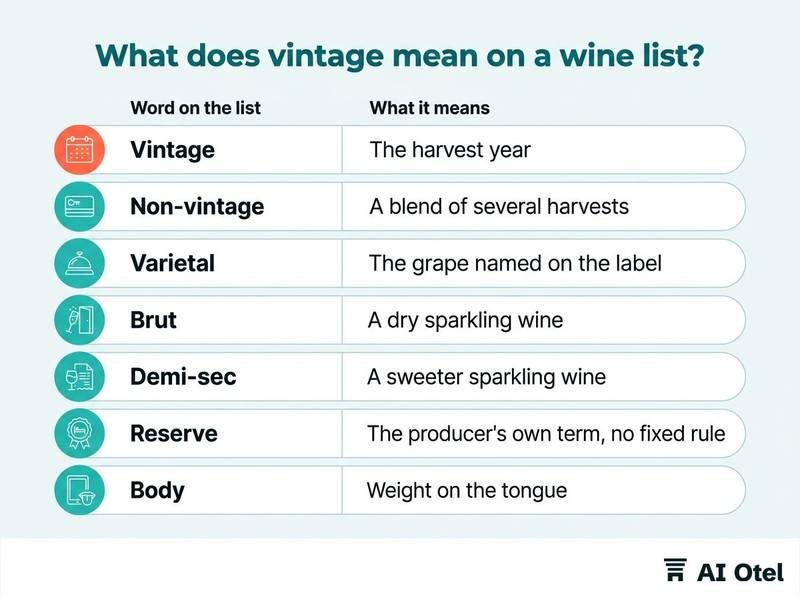
Treat non-vintage as a style decision, not a gap. Many sparkling wines and house wines are blended on purpose so that the guest gets the same glass in March and in October. Say what vintage does and does not tell you: it names the year's weather and picking, and it does not by itself make one bottle better than another.
Keep spirits separate from wine. A year printed on a spirit label is usually an age statement, meaning time spent in the cask, not a harvest, and staff should not describe it as a vintage. Translate the other list words into taste: varietal is the grape, brut and demi-sec describe how sweet a sparkling wine is, reserve is the producer's own label with no fixed meaning, body is weight on the tongue, tannin is the drying grip.
Show only what the cellar can pour; a vintage printed on the list that the bar cannot open is a complaint waiting at the table. Watch the money tied up in older vintages: a bottle that sits for years is stock that is not selling, and the list should reflect what moves. The same logic applies to beverage cost control and slow-moving stock in hotel bars.
| Word on the list | What it means | Sentence for the table |
|---|---|---|
| Vintage | The harvest year | The year and how it tasted |
| Non-vintage | A blend of several harvests | The house style, consistent every year |
| Varietal | The grape named on the label | The grape and what it tastes like |
| Brut | A dry sparkling wine | Dry, with very little sweetness |
| Demi-sec | A sweeter sparkling wine | Noticeably sweeter than brut |
| Reserve | The producer's own term, no fixed rule | What this producer means by it, if the team knows |
| Body | Weight on the tongue | Light, medium or full |
Give the team a comparison sentence: for example, the 2019 is the warmer, rounder year, the non-vintage is the fresher house style.
What is corkage, and how should a hotel handle a guest's own bottle?
Corkage is a charge for serving a bottle the guest brought in: the hotel opens it, provides glasses, ice and service, and adds a stated fee to the bill. Whether a hotel allows it at all, and how much it charges, is the hotel's own written policy.
The word comes from the cork: the fee is for the service around the bottle, not a payment for the wine the guest already owns. Write the rule down once: allowed or not, in which outlets, per bottle, wine only or also spirits, and whether the guest is expected to order something else as well.
State the amount before the bottle is opened. A fee discovered on the bill is a complaint; the same fee stated at the start is a service. Describe what the fee covers in the guest's own words: glassware, ice, decanting, service and washing up.
Give staff one instruction for the unclear case: do not invent a price at the table, hold the bottle, ask the manager, come back with one answer. Apply the same written rule to a celebration cake or any other food and drink brought from outside, so the team is not deciding case by case. Keep the argument off the floor: if the guest refuses the fee, the manager handles it away from the table.
Watch outState the corkage before the cork comes out
The amount and what it covers are said while the bottle is still closed, and the guest agrees before the bottle is opened. If the guest does not agree, the bottle goes back into its bag without discussion and the manager is called.
What do neat, on the rocks, up and with a mixer mean?
Neat means the spirit goes into the glass at room temperature with nothing added. On the rocks means poured over ice. Up, or straight up, means chilled with ice and then strained into the glass without ice.
Separate neat from up by the two steps that differ: chilling and straining, which change both the temperature and how much water reaches the drink. Explain ice honestly: ice melts and dilutes, a larger and colder piece melts more slowly, and the bar should say which ice it uses for which serve.
Fix the measure and the glass. Single and double are measures, not glass sizes, and a tall glass with the same measure and more mixer is a different drink at the same alcohol. Agree how much mixer goes in, so the guest is not paying for a glass of tonic with a little spirit in it.
Learn the garnish words as instructions: a twist is citrus peel, a wedge and a slice are different cuts, dirty means olive brine, dry means less vermouth. Teach the confirm-back sentence, said before the drink is made: neat, no ice, in a short glass, is that right? Glassware standards connect directly to the table setting and glassware standard for hotel service.
| Term | What is in the glass | What staff confirm back |
|---|---|---|
| Neat | The spirit only, room temperature, no ice | No ice, short glass |
| On the rocks | The spirit poured over ice | Which ice, short or tall glass |
| Up or straight up | Chilled with ice, strained, served without ice | Chilled, no ice in the glass |
| With a mixer | The stated measure plus the named mixer | Which mixer and how much |
| Single or double | One measure or two | The measure in millilitres |
| Dirty or dry | Olive brine added, or less vermouth | How much, since both change the taste |
Which list words help a guest choose, and which ones do not?
Words that describe taste, weight and how the drink is served help a guest choose; words that rank or judge the drink make the choice harder.
Describe in the guest's terms, one line per item: dry or sweet, light or full, oaky or fresh, sparkling or still. Put the practical facts next to the name: the measure, the glass price, the bottle price, the grape and the region. Group by taste or by grape rather than by price, so the guest is not reading the whole list to find one glass.
Decide the house rule on a small taste before the glass is poured, and say it on the list; it prevents both waste and complaints. Leave out rankings and vague praise: our best, premium, special and similar words ask the guest to trust a judgment instead of reading a description. Check the list against the cellar and the bar before it goes to print: every item must be pour-able that week.
ChecklistA pre-print checklist for a drinks list
- Every item has a one-line taste description
- Every by-the-glass item shows its measure and price
- Every bottle shows how many glasses it holds
- Items are grouped by taste or grape, not by price
- No ranking or vague praise words remain
- Every printed item is in stock this week
- The briefing card for staff uses the same words as the list
Which words should hotel staff avoid at the table?
Avoid words that judge the guest's choice, hide a charge, or describe the drink in a way the guest cannot check.
Do not apologize for the house pour; calling it only the house wine tells the guest the hotel does not stand behind its own choice. Do not say free for water, bread or a garnish that appears on the bill; say included or state the price.
Do not promise an effect with strong or you will like it; describe the drink and let the guest decide. Do not stop at we are out of it; name one alternative at the same price and the same style in the same breath. Do not use one product name as if it were the whole category; name the item the guest is actually paying for.
Do not say corkage at the table without explaining it in the same sentence, because the guest hears an unexpected fee. Do not describe health or effects; the bar serves a drink, not an outcome.
What to do next
Write a one-page glossary card for the bar: the house measure, the corkage rule, the serving-style table and one sentence for each term, then brief the team on it before the next shift. The list, the briefing and the words at the table are one system, and the guest only hears the version that reaches the table.
Frequently asked questions
Is corkage the same as a service charge?
No. Corkage is a fee for serving a bottle the guest brought in, and it is set by the hotel's own policy. A service charge is a percentage or amount added to the bill for service across the whole order. Both should be written where the guest can read them before ordering, and staff should be able to say which is which in one sentence.
What is the difference between neat and straight up?
Neat is the spirit poured into the glass at room temperature with nothing added. Straight up, or up, is the spirit chilled with ice and then strained into the glass without ice. The difference is temperature and dilution, and it changes how the drink tastes, so staff should confirm which one the guest means.
Does vintage matter for spirits as well as wine?
For wine, vintage is the year the grapes were harvested. On a spirit label a year is usually an age statement, meaning time spent in the cask, not a harvest. Staff should describe it as an age and not call it a vintage, because the guest may be comparing it with wine.
How should a by-the-glass price be written on a hotel drinks list?
Print the measure in millilitres and the price of that measure, next to the bottle price and the number of glasses the bottle holds. The same measure should apply at the bar, at the table and on room service. The guest can then compare the glass and the bottle without asking a member of staff.
What should staff do when a guest brings a bottle and the hotel has no written rule?
Do not set a price at the table. Hold the bottle, tell the guest the manager will confirm, and come back with one answer before anything is opened. The hotel then writes the rule down, covering outlets, the amount per bottle, what it covers and whether outside food and drink follow the same rule, so the next guest gets the same answer.