Draught beer in the hotel bar: line cleaning, keg changes and waste
Hotel draught beer loses money quietly through foam, stale lines, and unrecorded pours. This guide provides a signed cleaning calendar, a fixed keg-change routine, a step-by-step foam diagnosis order, and a monthly waste count that turns those losses into one actionable number.
AI draft · awaiting editorial review

Contents
Key takeaways
- A draught system is one chain, keg, coupler, gas and regulator, cooled line, foam detector and tap, and a fault anywhere in it arrives at the glass as foam or an off-flavor.
- The cleaning interval, the chemical dose and the gas pressure come from the supplier's technical sheet; the hotel's job is a written calendar with a signature for the person who cleaned and the person who checked.
- A keg change is a procedure, not a swap: settle the keg, close the gas, vent, disconnect, reconnect, then draw and discard until the pour is steady, and count that draw as waste.
- Foam is read in a fixed order, temperature first, then gas pressure and line balance, then the line and the tap; one foaming tap points to that line, every tap foaming points to the gas supply or the cooler.
- Draught waste is only controlled when the monthly count turns kegs into expected pours, compares that with the till, and books the gap under a named reason.
Draught beer is pushed from a keg to the tap by gas through a cooled line, so the bar controls three things: clean lines on a written schedule, a fixed keg-change routine, and a waste line in the monthly count. Foam is diagnosed in order: temperature, gas pressure, then the line and tap.
The bar is busy, the tap hisses, and the glass fills half with foam. The bartender pours it away and starts again, nobody writes it down, and at month end the keg count does not match the till. Hotel draught beer looks like the simplest item on the beverage list, and it loses money quietly through foam, stale lines and unrecorded pours. After reading this you will have a cleaning calendar with signatures, a keg-change routine, a fixed order for diagnosing foam, and a waste line in the monthly count that turns those losses into one number.
How does a draught beer system work?
A keg holds the beer, gas pushes it through a cooled line to the tap, and every part of that chain can put foam or an off-flavor into the glass.
The coupler is the fitting that seals onto the keg valve and lets gas in and beer out. A worn seal leaks gas, and the leak shows up at the glass as foam. The gas is usually carbon dioxide, or a nitrogen mix where the line is long or the beer style calls for it; the gas type is set by the supplier's specification for that installation, not chosen behind the bar.
The regulator sets the pressure of gas going into the keg. There is one setting per line, and it belongs in writing, not in a bartender's memory. The pressure also has to be matched by resistance from the line: its length, its inner diameter and the height it climbs to the tap. A line that is too short or too wide for its pressure pours foam however cold the beer is.
Cooling matters all the way, not just at the keg. The keg is kept cold, and in most bars the line is cooled as well, because beer that warms on the way to the tap releases its gas before it is poured. At the end of the chain sits the tap: the faucet, its spout and the seal inside it. A dirty spout, or a tap opened halfway, foams no matter how good the rest of the system is.
One small part is worth naming: the foam detector, a device on the line that stops the flow when a keg empties. It keeps the line from filling with gas, so the next keg does not start with a glass of air.
Key pointThe chain, in order
Keg, coupler, gas and regulator, cooled line, foam detector, tap. A fault anywhere in the chain arrives at the tap as foam or as an off-flavor, which is why the bar checks the chain and not just the glass.
What does a beer line cleaning schedule look like, and who signs it?
A written calendar that names the interval, the line, the chemical and the person, signed by whoever cleaned the line and countersigned by whoever checked it.
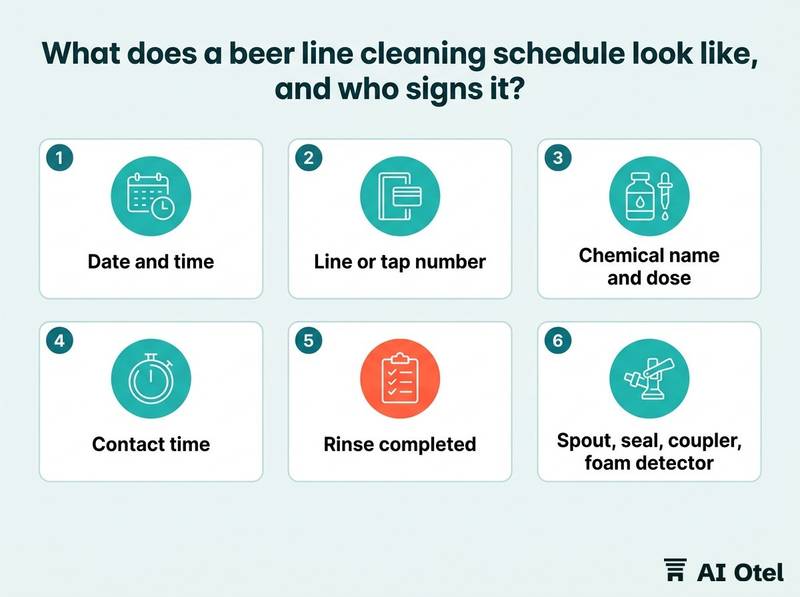
The interval is not a house habit. It comes from the line-cleaning chemical supplier and the brewery's technical sheet for that product, and the hotel's task is to write that interval into its own calendar and keep to it. The job itself is standard: a cleaning socket or adaptor at the tap, a pump or a pressurized cleaning pot, a water rinse, the chemical in contact for the time the supplier states, a second water rinse, then beer.
Clean the parts that touch the beer, not only the line. The tap spout and its seal, the coupler and the foam detector all carry beer, and a clean line behind a dirty spout still pours badly. Time the clean for the start of a quiet period, so the line settles before service, and never in the middle of one.
The signature is the control. A calendar with no name on it is a wish; a named person per shift plus a check by the bar manager is what makes the interval real. A missed clean announces itself eventually as a sour, buttery or simply wrong smell in the beer, and the guest usually notices before the bar team does.
ChecklistThe line-cleaning record
- Date and time
- Line or tap number
- Chemical name and dose, taken from the supplier's sheet
- Contact time
- Rinse completed
- Spout, seal, coupler and foam detector cleaned
- Fault found, if any
- Name of the person who cleaned
- Name of the person who checked
This record belongs with the rest of the bar's routine paperwork, alongside the hotel bar opening and closing checklist that covers stock, cash and handover.
How do you change a keg without foam or waste?
Treat it as a procedure: settle the keg, close the gas, vent, disconnect, reconnect, open the gas, then draw and discard until the pour is steady, and count that draw as waste.
Move the new keg into place early and let it stand. A keg rolled in a minute before tapping is agitated, and agitated beer pours foam. Before disconnecting the old one, close the gas at the coupler and release the pressure through the coupler's relief valve; a coupler pulled off a pressurized keg wastes beer and can injure the person doing it.
Read the date code and the batch on the new keg and write both in the log. A keg close to its end date may already pour poorly. Cap the empty keg and store it as the supplier requires: the empty is stock with a deposit value until it is collected.
After reconnecting, open the gas and compare the regulator reading with the setting written on the log. A setting that has moved is a fault to report, not a new normal to accept. Then purge the line by drawing beer into a jug until the pour is steady and clear, and record that volume as waste with the reason "keg change". Change between services rather than during one, and keep the change out of guests' sight where the bar layout allows it.
TipWrite the regulator reading every time
Recording the regulator reading on the keg change log costs nothing, and a setting that drifts is the cheapest early warning the bar has.
Why is my draught beer all foam?
Work through three causes in order: temperature, then gas pressure and line balance, then the line and the tap. The first check is always the same: is the beer cold all the way to the tap?
Warm beer cannot hold its gas, so check the keg temperature and whether the line cooling is actually running; a line that passes through a warm wall foams at the tap even when the keg is cold. Then pressure: too little lets gas leave the beer inside the line, too much drives turbulence at the tap. The correct figure is the supplier's, written down and compared at every keg change. Then balance: line length, inner diameter and lift are matched to the pressure, and a line replaced with a different diameter, or a tap moved upstairs, breaks that match.
The remaining suspects are mechanical: a kinked or half-closed line, a dirty spout, a worn coupler seal, a foam detector that has tripped and not been reset, or a keg that has just been delivered or is nearly empty and pushing gas. Pouring technique is the last link: hold the glass at an angle, open the tap fully in one movement, and keep the spout clear of the beer and the glass.
Scope tells you where to look. One foaming tap points to that line; every tap foaming points to the gas supply, the regulator or the cooler.
| What you see | Likely cause | First check |
|---|---|---|
| Foam on every pour at every tap | Gas supply, regulator or cooler | Regulator reading against the written setting |
| Foam at one tap only | That line, spout or coupler | Line for kinks; clean the spout |
| Beer flat, no head | Pressure too low or leaking seal | Coupler seal and the gas |
| Fine in the evening, foamy at opening | Line cooling or warm beer in the line | Cooler and the line run |
| Sour or buttery taste, normal foam | The line needs cleaning | The cleaning record |
How do you count draught beer waste in the monthly count?
Turn the kegs used into the pours they should have given, compare that with the pours the till recorded, and book the difference as waste with a reason against each line.
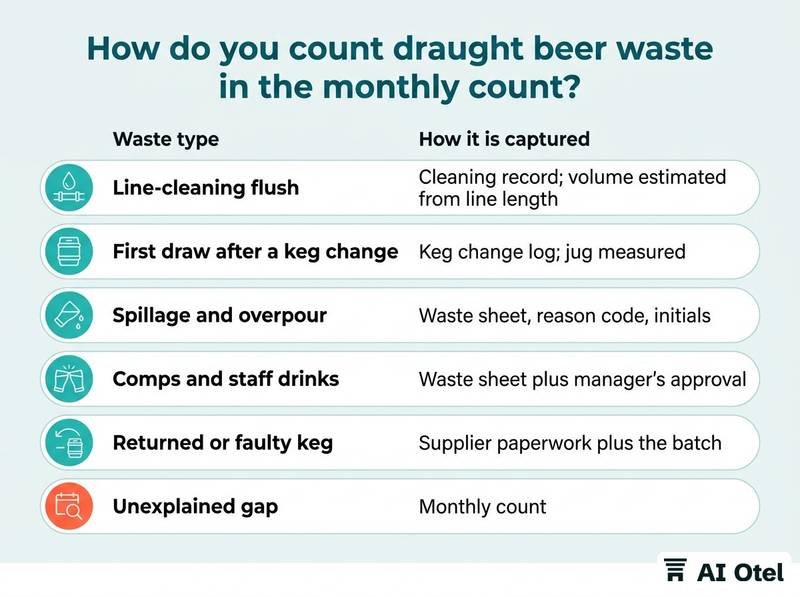
Know the yield before you count. The keg's stated volume and the pour size the bar serve give the expected number of glasses per keg, and that figure belongs on the count sheet. Count kegs, not guesses: full, part and empty, weighing a part keg or reading its level gauge, and doing it the same way every month so the numbers compare.
Give the gap named parts: the line-cleaning flush, the first draw after a keg change, spillage and overpour, comps and staff drinks, a keg returned as faulty, and pours that never reached the till. Record at the bar, not at month end, because nobody remembers a glass poured away three weeks ago. A waste sheet with a reason code and initials, filled in when the loss happens, is the only version that works.
Value it. Waste multiplied by the cost per pour gives a money figure the F&B manager can act on, and a percentage of an unknown base is not a control. Agree a tolerance and investigate above it; a tolerance that is never breached has been set too wide to mean anything. Keep draught separate from bottled beer in the count, because the two lose money in different ways and average out each other's signals. This count sits inside the wider discipline of beverage cost control in hotel bars, and the cost-per-pour figure it needs is the same one used when pricing a cocktail list or any drinks list.
| Waste type | How it is captured | Who records it |
|---|---|---|
| Line-cleaning flush | Cleaning record; volume estimated from line length and the supplier's sheet | Person cleaning |
| First draw after a keg change | Keg change log; jug measured | Person changing the keg |
| Spillage and overpour | Waste sheet, reason code, initials | Bartender |
| Comps and staff drinks | Waste sheet plus manager's approval | Bar manager |
| Returned or faulty keg | Supplier paperwork plus the batch in the keg log | Bar manager |
| Unexplained gap | Monthly count | F&B manager |
When should you call the supplier in, and what do you record?
Call when the cause sits outside the bar's hands: the gas supply, the regulator, the cooler, the line balance, or a batch fault that survives a clean and a settled keg.
Have the evidence ready before the call: the cleaning log, the keg change log, the waste sheet, the tap affected, the gas type, the regulator reading and the keg's batch. Ask the engineer to leave a record of what was found, what was changed, any new setting, the parts replaced and the next visit. Keep the supplier's technical sheet on file, because it is the source for the cleaning interval, the chemical dose, the gas and the pressure, and the bar's own figures should match it.
Settle the contract questions before an incident: who owns the cooler, the lines and the taps, who pays for a rebalance, what response time applies, and whether the supplier trains the bar team. Never let a setting be changed without the before and after written down, or the next foam complaint starts the diagnosis from zero. And a keg that pours well but tastes wrong is a product question, not an equipment one: keep the keg, note the batch, and raise it with the supplier before the keg is emptied.
NoteThe technical sheet outranks habit
Where the bar's setting and the supplier's sheet disagree, the sheet wins until the supplier says otherwise, and the change is written in the log.
What to do next
Write the three records this week and keep them in one place: a cleaning calendar with a signature, a keg change log that carries the regulator reading, and a waste sheet with reason codes. Read them together at the monthly count, because that is the moment when a foaming tap, a missed clean and a missing pour stop being three separate complaints and become one number the F&B manager can act on. If the bar's records live in the hotel's wider system, a hotel operating system built and working, ahead of launch, that carries restaurant and bar sales alongside billing and reports gives that number one home; the same idea sits behind a connected platform approach to hotel operations.
Frequently asked questions
How often should beer lines be cleaned?
The interval is not a house opinion: it comes from the line-cleaning chemical supplier and the brewery's technical sheet for that product. The hotel writes that interval into its own calendar, names a person per shift, and keeps a signed record per clean. If the bar changes chemical, the interval is re-read from the new sheet.
Can you serve beer straight after cleaning a line?
Only after the rinse the supplier's sheet calls for, and after drawing beer until the pour is clear and smells of beer rather than of cleaning chemical. That first draw is measured and recorded as waste, not treated as a free sample. Serving before the rinse is complete is a food safety question, not a taste question.
Is a slightly foamy pour really a cost?
Yes, because foam is beer that was bought and will not be sold. The size of the cost appears when the monthly count compares the pours a keg should have given with the pours the till recorded. A bar that never measures that gap is paying for foam without seeing the invoice.
Should the bar use carbon dioxide or mixed gas?
The choice depends on the line length, the pressure needed and the beer style, and it belongs to the supplier's specification for that installation. The bar's job is to use the gas the sheet names, record the regulator setting, and not switch gas without the supplier's instruction.
What belongs in a keg change log?
Date and time, the tap or line, the keg size and batch, who changed it, the volume discarded during the purge, and the regulator reading after reconnection. The log is what turns a foam complaint into a diagnosis, and what shows the supplier that the bar did its part.