Coffee in the lobby café: price per cup, milk cost and the payback of a machine
Calculate the true cost per cup by tracking beans, milk, and labor. Learn to set a simple menu, compare buying versus leasing, and check weekly waste.
Contents
Key takeaways
- A cup's cost is set by the recipe and the waste, not by the bean price: fix the grams per shot and the milliliters of milk in writing, then measure what leaves the bar.
- Milk is the swing item in a lobby café: it is the largest ingredient by volume, it spoils, and plant milks waste more when they are steamed badly.
- Three price points, not twelve drinks: every extra drink adds stock, training and one more way to get it wrong at seven in the morning.
- A machine pays back on paid cups per day, so calculate the break-even cups before choosing between buying, leasing and a service contract.
- Compare cups sold with beans and milk issued every week: the gap is waste, free drinks or theft, and each one has a different fix.
Cost per cup is the fully loaded cost of one served drink: beans, milk, cup and lid, the labor minutes to make it, and the waste behind the bar, divided by the cups actually sold. Price from that number, and judge a machine by the cups per day it needs to pay for itself. This is how hotel lobby café coffee pricing should work.
The lobby café looks like the easiest revenue in the building: a machine, a grinder, a short menu and one barista. Then the milk order arrives, the open cartons go down the drain at close, and nobody can say whether the flat white makes money. After reading this you will be able to build a cost-per-cup sheet, set a menu with three prices, run a payback sum on a machine, and put a weekly bean and milk check in place.
What does a cup of coffee actually cost in a hotel lobby café?
It costs the beans in the shot, the milk in the jug, the cup and lid, the labor minutes to make and serve it, and the waste behind the bar, divided by the cups actually sold. Build the sheet one page per drink, not per ingredient: the same bag of beans produces a cheap espresso and an expensive latte, and the difference is milk, cup size and time. The method is the same one kitchens use for standard recipes and portion cost, applied to the bar.
Beans come first. Cost per shot equals the bag price divided by the number of doses in the bag, and doses are bag grams divided by the dose in grams. Write the dose into the recipe the way a kitchen fixes a portion: 18 grams means 18 grams, weighed, not judged by eye. Without a written dose, bean cost drifts a few grams at a time and nobody notices for a month.
Milk is recorded in milliliters per drink by cup size. A cappuccino and a flat white differ in foam and often in total milk, and the pitcher you steam decides what you pour. Consumables are next: cup, lid, sleeve, stirrer, sugar sachet, napkin and any topping. Each is small per cup and large per month, so count them rather than estimate them.
The five lines on the sheet
| Line | What to measure | Where the number comes from | Illustrative figure (for example) |
|---|---|---|---|
| Beans per shot | grams per drink × cost per gram | bag price ÷ doses per bag | 18 g × 0.9 |
| Milk per drink | milliliters × cost per liter | marked pitcher × invoice | 160 ml × 1.5/l |
| Cup, lid, garnish | count × unit cost | consumables invoice | 2 units × 1.2 |
| Labor | minutes per drink × loaded hourly cost | timed on shift × payroll | 3 min × 0.8/min |
| Waste allowance | a set share added to the lines above | measured monthly | +10% |
| Total cost per cup | sum of the above | the sheet | 5.1 |
Labor deserves a note. Minutes per drink cover grind, extract, steam, pour, wipe and serve, multiplied by the loaded hourly cost of the person making it. A lobby café carries a high labor share because drinks are made one at a time, unlike a buffet or a batch brew. Waste covers purged shots, milk left in the pitcher, remade drinks and cartons open at close; add a waste allowance per cup and revisit it monthly.
What belongs outside the sheet
Divide by cups actually sold, not by what the machine could produce, and update the sheet whenever the price of milk or beans moves. Keep currency effects and tax treatment out of it: the accountant sets those, and mixing them in makes the sheet unusable for the barista and the F&B manager. Rent and lobby furniture belong to the hotel's fixed costs, not to the cup.
Why does milk cost more than the beans?
Because a milk drink is mostly milk by volume, milk spoils, and the milk you steam but do not pour is paid for twice: once at the supplier and once in the bin. Type matters: whole milk, lactose-free milk and plant milks each carry a different price per liter and behave differently under steam. Plant milks scorch and split more easily, so both waste and training time rise.
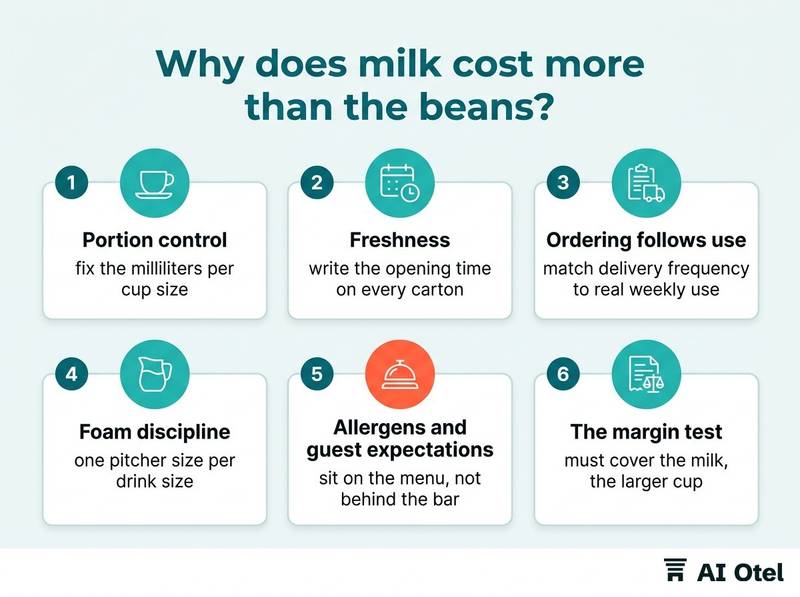
Portion control is the first fix. Fix the milliliters per cup size with a marked pitcher or a line on the jug, so the barista steams only what goes into the cup. Freshness is the second: write the opening time on every carton, keep opened cartons refrigerated, and set a discard window the hotel writes down and follows instead of leaving it to habit.
Ordering follows use. Match delivery frequency to real weekly use per milk type; a smaller or long-life pack for a rarely ordered plant milk beats a large carton that expires. Foam discipline is a pitcher discipline: one pitcher size per drink size and a rinse cycle between drinks, so milk is not over-aerated and thrown away.
Allergens and guest expectations sit on the menu, not behind the bar. Keep plant milk in a separate labeled pitcher, and state on the menu which milks are available and whether any carries a supplement. The supplement is a pricing decision, not a hidden cost.
The margin test closes the section: the price gap between a milk drink and a black coffee must cover the milk, the larger cup and the extra labor minutes, or the milk drink is the one losing money.
ChecklistMilk controls that pay for themselves
- A written milliliter figure for each cup size
- A marked pitcher for each size
- Opening time written on every carton
- A discard window the hotel sets and posts
- A separate labeled pitcher for plant milks
- Weekly liters issued compared with drinks sold
- A menu line stating which milks are available and any supplement
How many drinks should a lobby café menu carry?
Fewer than most hotels print: a menu one grinder and one machine can serve, built around three price points and makeable by the least experienced person on shift. The ladder gives guests a choice and gives the hotel a reason for each gap. Six drinks cover most demand: espresso, americano, cappuccino, latte, flat white and one sweet or iced option. Each extra drink adds stock, training and a way to get it wrong.
Every drink must sit in the same time band. A drink that takes three minutes at the breakfast rush is a queue, not a sale. Set a sales floor in advance: a drink that sells below the number the hotel sets for a month comes off the menu, and the rule is written before the argument starts.
Keep the café menu separate from the restaurant's dessert and drinks list, so cost sheets and sales reports stay clean. Price the ladder by cost difference, not by round numbers: the gap between points should reflect milk, cup size, labor and any supplement. Print sizes and milks on the menu; ambiguity at the counter is where free upgrades and remakes come from.
Key pointThe three-point rule
Every café menu has a base drink, a milk drink and one premium drink; each point carries one price, and the gap between points is set by the cost difference rather than by rounding. Anything that does not fit one of the three points is a special, tested for a month and then kept or dropped.
The same ladder logic works for wine by the glass in the bar: a base pour, a middle pour and one premium glass, with the gaps set by bottle cost and yield.
Should you buy, lease or service-contract the espresso machine?
Decide by the busiest hour rather than the daily average, and by who repairs the machine when it fails before breakfast. If you buy, you own the asset and pay for parts, labor and downtime; the capital cost is visible on the invoice, the service cost is not. A lease is a fixed monthly cost that usually includes service and often a grinder, a water filter and a minimum bean purchase; read the minimum and the exit terms before signing.
A service contract on an owned machine is the middle path, priced on machine type and response time. Check what counts as a call-out and what is excluded. Capacity decides the machine: a single-group machine suits a quiet lobby, a two-group machine is for a breakfast rush, and the deciding number is drinks in the busiest hour.
Water is the quiet cost. Filtration and softening protect the boiler, scale is the most common reason a machine fails early, and the filter is a monthly cost that belongs in the sum. People matter as much as hardware: name who may open, clean and descale the machine, and write the escalation path for a failure. A machine nobody is trained on sits idle at seven in the morning.
Judge the total cost over the term: machine, grinder, filter, service, training and the days the machine is down, not the sticker price.
ChecklistQuestions to settle before signing a machine contract
- Who responds to a failure, and within what time?
- Are the grinder, filter and installation included?
- Is there a minimum bean or consumable purchase, and what happens if you miss it?
- What is excluded from service: scale damage, misuse, water quality?
- Who trains the baristas, and how often?
- What are the exit and upgrade terms?
- What is the machine's capacity at the busiest hour?
What is the payback on an espresso machine? A worked example
Payback in months is the machine and installation cost divided by the monthly contribution: paid cups per day multiplied by days open and by price minus cost per cup, less the fixed monthly costs the machine adds. Define contribution per cup first: menu price minus the cost per cup from the sheet, before any fixed cost.
Count only paid cups. Complimentary in-room coffee, staff drinks and press coffees are costs, not revenue, and they belong on the cost side of the sum. Add the fixed monthly costs the machine brings: lease or depreciation, service, filter, extra labor hours and a small allowance for downtime.
Every figure in the example below is invented for illustration. For example, a machine, grinder and installation at 300,000 in the hotel's own currency, 40 paid cups a day over 30 days, a price of 90 and a cost per cup of 30. Contribution is 60 per cup, 72,000 a month, less 8,000 of service, filter and extra labor, leaving 64,000 and a payback near five months.
| Line | Illustrative figure (for example) | How to replace it with your own |
|---|---|---|
| Machine, grinder, installation | 300,000 | supplier quotes |
| Price per cup | 90 | your menu |
| Cost per cup | 30 | your cost sheet |
| Contribution per cup | 60 | price minus cost |
| Paid cups per day | 40 | till counts |
| Days open per month | 30 | your calendar |
| Monthly contribution | 72,000 | cups × days × contribution |
| Service, filter, extra labor | 8,000 | contract and payroll |
| Monthly net contribution | 64,000 | contribution minus fixed |
| Payback in months | about five | cost ÷ net contribution |
| Break-even cups per day | the figure you must hold | fixed costs ÷ contribution |
Stress the sum. At half the cups the payback doubles, so calculate the break-even cups per day: the cups needed to cover fixed costs plus capital recovery over a target period, and write that number on the wall. A lease turns the sum around: the question becomes whether the monthly contribution covers the lease with a margin, and how many cups a day that requires.
How do you check the café each week against the beans and milk you bought?
Compare what you sold with what you used: drinks sold by type from the till, beans issued from the store and milk liters issued from the fridge. The gap is waste, free drinks or theft, and each has a different fix. Expected beans equals drinks sold multiplied by the dose in the written recipe; a variance above the threshold the hotel sets sends someone to the bar for a shift to watch.
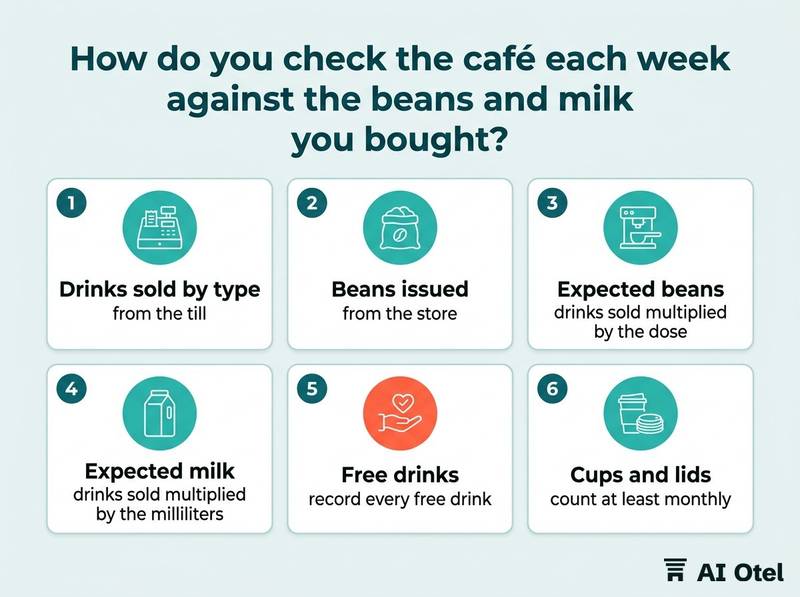
Expected milk equals drinks sold multiplied by the milliliters per cup size. The milk count catches over-pouring and pitcher waste that the bean count cannot see. Record every free drink: staff coffee, VIP guests, remakes and press visits. A free drink that is not written down looks like theft in the numbers and hides the real waste.
Count cups and lids at least monthly; a cup count running ahead of drink sales points to double-cupping or takeaway stock walking out. Hold a 20-minute weekly review with the barista and the F&B manager on one page: cups sold, beans used, milk used, waste recorded, and the one thing to change this week.
Read the café with the same terms as the restaurant, covers, check average and sales per available seat-hour, so it is compared with the rest of the hotel on equal terms. The definitions are in restaurant revenue terms for hotel managers. Change one thing at a time and give it two weeks; a café that changes recipe and price in the same week learns nothing from either.
ChecklistThe weekly café check
- Drinks sold by type from the till
- Beans issued from the store, in grams
- Expected beans from the recipe, and the variance
- Milk liters issued and expected milk
- Free and remade drinks written down
- Cups and lids counted monthly
- One change agreed for the coming week
Hotels that want the café's numbers to sit beside the restaurant's in one system, rather than in a spreadsheet, can look at how a hotel operating system, built and working, ahead of launch, handles outlet sales and reports, and at what a hotel growth and revenue consultancy reviews when it looks at small-outlet performance.
Where does the lobby café fit beside the room kettle and the dessert station?
It fits as a small outlet with a high labor share: it earns its place by covering its own costs and by what it adds to the stay, not by matching the restaurant's margin. The room kettle, the capsule machine and the lobby station are three answers to the same guest need, compared in a kettle in the room, a capsule machine or a lobby station. The café is the paid, staffed version, and that choice sets how many cups the café can realistically expect to sell.
The welcome drink and the café share a cost line and a service moment; decide which one carries the hotel's signature and price the other as a cost. Adjacent small outlets, a dessert or ice cream station or wine by the glass in the bar, follow the same three steps: cost per portion, three price points, weekly check against stock issued.
Keep the café's hours honest: an outlet open from morning to late night with two cups an hour after eight is a labor cost, not a service. Decide before opening whether the café is a guest amenity, a revenue outlet or a lobby feature, because the price, the menu and the staffing all follow from that answer.
NoteOne page per outlet
The recipe with grams and milliliters, three price points with the cost behind each, the break-even cups per day, and the weekly check sheet. The same page works for the café, the dessert station and the bar.
Write the café's own one-page rule: the recipe, the three prices, the break-even cups per day and the weekly check. A rule that lives only in the barista's head leaves with the barista.
What to do next
Build the one-page cost sheet this week, with the barista, for the drinks you actually sell. Then set three prices from it, calculate the break-even cups per day for the machine you are considering, and put the weekly bean and milk check on the calendar. The sheet, the menu, the machine decision and the weekly check are one loop, and each part is only as good as the numbers the others feed it.
Frequently asked questions
How much milk should a cappuccino use in a hotel café?
The hotel sets the figure, not the supplier: fix milliliters per cup size in the written recipe, mark the pitcher, and use the same figure in the weekly milk check. The exact number depends on cup size and foam style, so choose one and hold it. Consistency matters more than the number itself.
Is an espresso machine worth it for a small hotel?
Only if paid cups per day clear the break-even: fixed monthly costs plus capital recovery, divided by the contribution per cup. Below that line, a leased machine on a service contract, or a filter machine with a kettle in the room, is the cheaper answer. Calculate the break-even before choosing the machine.
How should a flat white be priced against an americano?
The gap must cover the milk, the larger cup and the extra labor minutes, and it must fit the same ladder as the rest of the menu. Price the ladder by cost difference, then round for the printed menu. A gap set by habit is where the milk drink quietly loses money.
Should staff coffee be free in a hotel?
It can be, but it must be recorded: a free drink that is not written down appears as waste or theft in the bean and milk check. Put staff drinks on a cost line, count them in the weekly sheet, and set a written rule for how many and when.
How often should the lobby café menu change?
Review it monthly against sales and quarterly against costs; drop any drink below the sales floor the hotel set, and re-price when milk or bean costs move. Keep the three price points even when the drinks inside them change.