Restaurant revenue terms for hotel managers: covers, check average, table turn and RevPASH
Master restaurant revenue terms including RevPASH, covers and check average. Learn how to calculate each metric and build a one-page report that owners can act on.
AI draft · awaiting editorial review
Contents
Key takeaways
- Covers count guests, check average divides revenue by covers, and table turn counts table uses; each number is only as reliable as the written counting rule behind it.
- RevPASH divides an outlet's revenue by its available seat hours, so outlets of different size and opening hours can be compared on one line.
- In a half-board dining room the check average is an internal allocation of the room package, not a price a guest agreed to, so it should never be read as a market price.
- RevPAR and RevPASH share a logic but not a denominator, and adding them produces a number that means nothing.
- The one page an owner needs shows revenue, covers, check average, seat hours and RevPASH per outlet, with the definitions printed at the foot.
RevPASH is revenue per available seat hour: an outlet's revenue in a period divided by its sellable seats multiplied by the hours those seats were open for service. Covers are guests served, check average is revenue divided by covers, and table turn counts how many times one table is used in a service.
The owner asks why restaurant revenue fell, and the report answers with a room occupancy figure. Restaurant revenue has its own vocabulary, and borrowing the room's words hides the actual cause. This article explains the restaurant revenue terms, including RevPASH, that every hotel report needs: what each one counts, how to calculate it, and where it misleads. After reading, you can build a one-page outlet report the owner can act on.
What do covers, check average and table turn actually measure?
Covers count the guests served in a meal period, check average divides that period's revenue by those covers, and table turn counts how many times one table is used. Each number is only as good as the counting rule the hotel writes down.
A cover is one guest served in one meal period. A guest who eats lunch and dinner is two covers. A child eating from an adult's plate is a counting decision the hotel must fix in writing rather than settle differently each shift.
Check average is net revenue divided by covers. Decide once whether value added tax, a service charge, complimentary meals and staff meals sit in the numerator, and print that decision on the report. Table turn is covers divided by seats, or sittings per table per service. A four-seat table used three times in an evening has three turns, whatever the party sizes were.
Seat occupancy is a different thing again: it measures the room at an instant, seats in use divided by seats available right now. It is not table turn, which covers the whole service.
The most common counting error is taking covers from the number of checks in the point of sale. One check can hold four guests, and one guest can open two checks. The second most common error is comparing check averages across outlet types, where one figure is a real price and the other is an internal allocation.
Write the rule for each outlet on one page and keep it unchanged for a year, so a trend means a change in the business and not a change in the counting.
| Term | What it counts | Formula | Where it misleads |
|---|---|---|---|
| Cover | Guests served in a meal period | Count at the door or by party size | When checks are counted instead of guests |
| Check average | Revenue per guest per meal | Net revenue ÷ covers | When tax, service charge, comps or staff meals are inconsistently included |
| Table turn | Uses of one table in a service | Covers ÷ seats | When seats are blocked or combined tables are ignored |
| Seat occupancy | Share of seats in use at one moment | Seats in use ÷ seats available | When read as a whole-service figure |
| RevPASH | Revenue per seat per hour | Revenue ÷ available seat hours | When hours staffed are used instead of hours selling |
How is RevPASH calculated, step by step?
RevPASH divides an outlet's revenue in a period by its available seat hours: the seats that could be sold, multiplied by the hours the outlet was open for service.
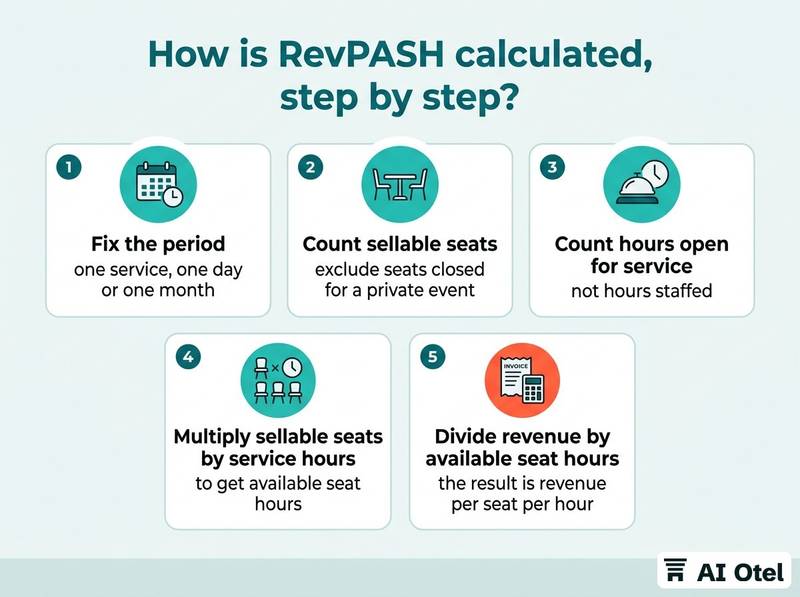
Step one: fix the period, one service, one day or one month, and fix the revenue definition. Use the same net revenue figure that feeds the check average, so the two numbers can be read together.
Step two: count sellable seats. Exclude seats closed for a private event, taken by a buffet line or blocked by a service station, because they could not earn.
Step three: count hours open for service, not hours staffed. A kitchen that preps from three in the afternoon does not create seat hours until the first guest can sit down.
Step four: multiply sellable seats by service hours to get available seat hours. Step five: divide revenue by available seat hours. The result is revenue per seat per hour, and it can be compared across outlets, days and seasons.
The logic is the same as RevPAR: revenue per unit of capacity per unit of time. A restaurant cannot store a seat or an hour, so the seat hour is the unit that disappears unused. Use RevPASH to choose between two changes: opening earlier adds seat hours, adding seats adds seat hours, and both show up as a lower or higher RevPASH depending on what the extra capacity actually earns. The same logic applies to dinner seatings in a half-board hotel, where waves replace turns.
NoteA worked example with invented numbers
For example, an outlet with 80 sellable seats open four hours for dinner has 320 available seat hours; with revenue of 9,600 for the service its RevPASH is 30. The same kitchen opens 40 seats for a two-hour lunch, 80 available seat hours, and takes 1,600, a RevPASH of 20. The dinner service earns more per seat hour, so the question is not whether lunch makes revenue but whether those 80 seat hours could earn more in another use.
Which terms fit a la carte, buffet and half-board dining?
A la carte outlets can use all five terms as they stand. A half-board dining room can use covers, seat occupancy and RevPASH for planning, but its check average is an internal allocation of the room package rather than a price a guest chose.
In an a la carte outlet the guest chooses dishes, so the check average moves with menu mix and price, and table turn is a service decision the manager controls. In a buffet the covers are counted at the door and the check average is nearly fixed per guest; the levers are cost per cover and waste, not price.
In a half-board dining room covers follow the in-house guest count, so the outlet's revenue is a share of what the guest paid for the room and board together. The allocation is a management decision for internal reporting. Table turn in half-board is set by seating waves rather than by guest behavior; the useful question is how many seats and how many waves the room needs for the guests it must serve.
Banquet and event space sells seat hours in booked blocks, so a RevPASH comparison with the restaurant misleads. Report it separately. Whatever the outlet type, keep one counting rule per outlet for the year. Changing the rule mid-year makes every comparison across the change meaningless.
| Outlet type | Check average | Table turn | RevPASH | Good for |
|---|---|---|---|---|
| A la carte | A real price | A service lever | Compares services and seasons | Pricing and menu decisions |
| Buffet | Nearly fixed per guest | Set by seating | Shows if the room is too large | Cost and capacity decisions |
| Half-board | An allocation of the package | Set by waves | Useful for sizing seats and waves | Capacity planning, not pricing |
| Banquet | Per event contract | Not meaningful | In booked blocks only | Report separately |
How do restaurant metrics sit next to room metrics?
They run in parallel, not in one total. RevPAR divides room revenue by available rooms, RevPASH divides outlet revenue by available seat hours, and neither denominator converts into the other. For the room side of the ledger, see RevPAR, ADR and occupancy rate: formulas and common mistakes.
Do not add RevPAR and RevPASH into a single hotel number. The units differ, and the sum cannot be compared with anything. Do not use room occupancy to explain restaurant covers in a hotel whose outlets also serve outside guests, and do not use covers to explain room demand.
A guest staying three nights eats several times, so the restaurant's covers and the hotel's room nights move on different clocks. Cross-selling shows up in covers long before it shows up in room rate.
The number that survives the comparison is departmental profit: the outlet's revenue minus its direct costs and its own payroll. Revenue per seat hour says how well capacity is used; departmental profit says whether using it was worth it. Check average and room rate are both prices, but of different things: one is revenue per guest per meal, the other revenue per room night. Never present them as a pair moving together.
Watch outDo not add RevPAR and RevPASH
Reporting a single "total revenue per available unit" produces a figure with no denominator and no comparison. Keep room and outlet metrics on separate lines and join them only at departmental profit.
What goes wrong when hotel reports mix room and restaurant terms?
The usual failures are a check average that quietly includes tax, a cover count taken from checks instead of guests, and a RevPASH built on hours the kitchen was open rather than hours the room was selling.
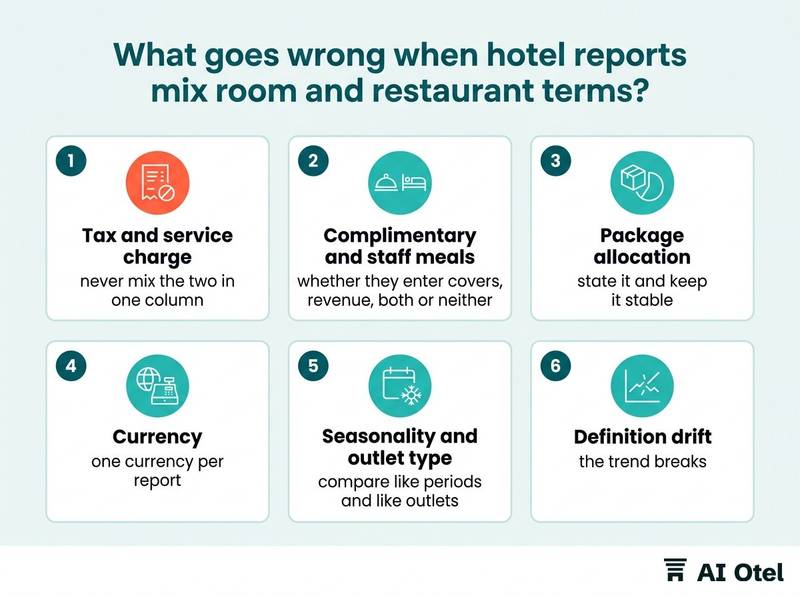
Tax and service charge: fix whether every figure is gross or net, label it on the report, and never mix the two in one column. Complimentary and staff meals: decide whether they enter covers, revenue, both or neither. If they enter covers only, the check average falls with no change in selling.
Package allocation: a half-board dinner has no market price. The share assigned to the outlet is a management decision, so state it and keep it stable. Currency: one currency per report, with the conversion rule written next to it.
Seasonality and outlet type: compare like periods and like outlets. A summer terrace and a winter lobby bar do not belong in one trend line. Definition drift: when a new manager changes how covers are counted, the trend breaks. Put the definitions on the report itself so the rule travels with the number. For the wider vocabulary of kitchen and bar control, see food and beverage control terms: a glossary for hotel teams.
ChecklistBefore the outlet report leaves the office
- Revenue figure labelled gross or net
- Covers counted by guests, not by checks
- Comps and staff meals treated the same way as last period
- Seat hours taken from service hours, not staffed hours
- Package allocation stated and unchanged
- One currency, with the conversion rule noted
- Outlet type and period named on the page
- Definitions printed at the foot
What should the F&B manager bring to the owner on one page?
One page: revenue, covers, check average, available seat hours and RevPASH for each outlet, next to the same figures for the same period a year earlier, and the one decision being asked for.
One row per outlet, never a single restaurant total for the hotel. A terrace, a lobby bar and a half-board dining room answer different questions. Show available seat hours on the page: without them the owner cannot see whether the constraint is seats, hours or demand. Show the outlet mix, so a change in the a la carte share is not read as a change in the whole food and beverage operation.
Name one decision: add a seating, change opening hours, reprice part of the menu, or close a service. A page with five requests gets no decision. Carry the definitions at the foot of the page, so the owner reads the same numbers the manager does. Follow the money past revenue: the outlet's direct costs and payroll belong on the same page, or the discussion stays at the top line. The deeper question of whether the outlet earns its keep is covered in does the hotel restaurant make money? Reading departmental profit properly.
TipKey layout for the one page
Header with outlet name, period and currency. Then, line by line: revenue (gross or net stated), covers, check average, sellable seats and service hours, available seat hours, RevPASH, the same six figures for last year, direct costs and outlet payroll, and the single decision requested. At the foot, the definitions of cover, check average, table turn and RevPASH as this hotel counts them.
What to do next
Write the counting rules for each outlet on one page, keep them unchanged for a year, and read the outlet through departmental profit rather than through a single revenue line. The terms in this glossary only work as a set: covers and check average explain the guest, seat hours and RevPASH explain the capacity, and the room's metrics stay on their own line. If you want software that keeps restaurant sales, billing and reports in one place, look at what a hotel operating system covers, or read how a revenue consultancy for hotels approaches outlet performance.
Frequently asked questions
What does covers mean in a hotel restaurant?
A cover is one guest served in one meal period, so a guest who eats twice in a day counts twice. Count covers at the door or from party size, not from the number of checks in the point of sale, because one check can hold several guests. Fix in writing how children, staff meals and complimentary meals are counted.
Is check average the same as average spend per guest?
In most hotel usage the two mean the same thing: revenue in a period divided by covers in that period. What changes the number is what sits in the numerator, so state whether tax and service charge are included and whether comps and staff meals are counted. Keep the definition identical between periods, or the trend is not a trend.
Why use RevPASH instead of total restaurant revenue?
Total revenue rewards size and opening hours, so a large outlet always looks better than a small one. RevPASH divides revenue by available seat hours, which puts outlets of different size and schedule on one line. It also shows whether the constraint is seats, hours or demand, which total revenue cannot.
Can a half-board restaurant use RevPASH?
Yes, for capacity planning: it shows how well the seats and service hours are used across the seating waves. What it cannot do in half-board is act as a price signal, because the guest paid for room and board together and the dinner's revenue is an internal allocation. Use it to size seats and waves, and use departmental profit to judge the outlet.
Should restaurant revenue be added to RevPAR?
No. RevPAR divides room revenue by available rooms and RevPASH divides outlet revenue by available seat hours, so the two have different denominators and different units. Keep them on separate lines and join them only at departmental profit, where each outlet's revenue meets its own direct costs and payroll.