Announcing a price rise: how to tell agencies and repeat guests, and when
Announce a price rise to agencies first, then channels, then direct guests. This guide provides a letter skeleton, a method for setting notice dates, and a switch-day checklist to prevent pricing errors.
AI draft · awaiting editorial review
Contents
Key takeaways
- Order matters more than wording: the accounts that must re-quote the hotel's price to their own clients hear first, and direct guests hear when the new rate is actually bookable.
- Notice is counted backwards from the effective date through the contract's notice period, the account's own season lock and each channel's loading time, never picked as a round number of days.
- A rate increase letter carries four things: the reason in one repeatable sentence, the effective date, what stays the same, and the one action the account must take.
- The letter explains a price; the signed agreement decides what happens to bookings already confirmed, so read it before writing the sentence.
- The switch day is a check, not a hope: one list of channels, one owner, one timestamp, and a sample date priced on every channel.
A hotel price increase notice for agencies is the written message that gives an account the new price, its effective date and the bookings it covers. Send it to contracted agencies first, check every channel on the switch day, then tell direct repeat guests as the new rate goes live. Confirmed bookings keep the price in their contract.
The rate sheet is signed off, the new prices are loaded, and then the phone rings: an agency is holding a quote it built on last season's rate. The rise was decided in a meeting; the announcement was never planned. This happens every season, and it is avoidable. After reading this you will have a send order, a method for setting the notice date, a letter skeleton, a rule for confirmed bookings and a switch-day check you can run with one person and one sheet.
In what order should a hotel announce a price rise?
Agencies first, channels second, direct guests third, and the internal decision before all of them. Each audience needs the new price in a different form, and the group that has to re-quote it to its own clients needs it earliest.
The internal step nobody schedules
The rate sheet is agreed, dated and versioned before any message goes out, because every later message quotes it. A letter sent before the sheet is final produces a second letter, and after the second letter nobody trusts the first. Date the sheet, give it a version, and write the send date into it so the announcement is part of the pricing decision rather than an afterthought once the price is live.
Why agencies cannot be last
Contracted agencies and corporate accounts hold a signed rate agreement and must re-key the price into their own systems and re-quote it to their clients. A late notice makes them sell a price they can no longer honor, which puts them in front of their own client explaining a mistake the hotel made. Channel and OTA (online travel agency) rate loading follows the letter, not the other way round: the price must be in each extranet and in the connected system before the effective date, and checked after it.
Direct repeat guests should hear the number from the hotel, not discover it in the booking engine. The message lands when the new rate becomes bookable, so the letter and the screen never disagree. The wider direct audience needs no letter at all: a correct live price, a dated season page and consistent metasearch feeds are enough.
The rule behind the order: whoever carries the hotel's price to a third party is told before whoever sees the price directly, because the first group has to explain it on the hotel's behalf.
| Who | What they need in hand | What goes wrong if they hear late |
|---|---|---|
| Contracted agencies and corporate accounts | The new rate sheet, the effective date, the bookings it covers, the reason sentence | They re-quote last season's price and ask the hotel to absorb the difference |
| Channel and OTA rate loading | New prices per room type and date range, loaded and then checked | One channel keeps selling the old rate and the hotel honors it or cancels |
| Direct repeat guests | A short personal message with the new rate and its start date | They learn the price from the booking engine and book elsewhere first |
| Website and metasearch visitors | A correct live price and a dated season page | The hotel's own site contradicts the agencies |
How much notice should agencies get before a rate change?
Count backwards from the effective date, not forwards from today. The signed agreement's notice period, the account's own season lock and each channel's loading time together set the day the letter goes out.
Working backwards from the effective date
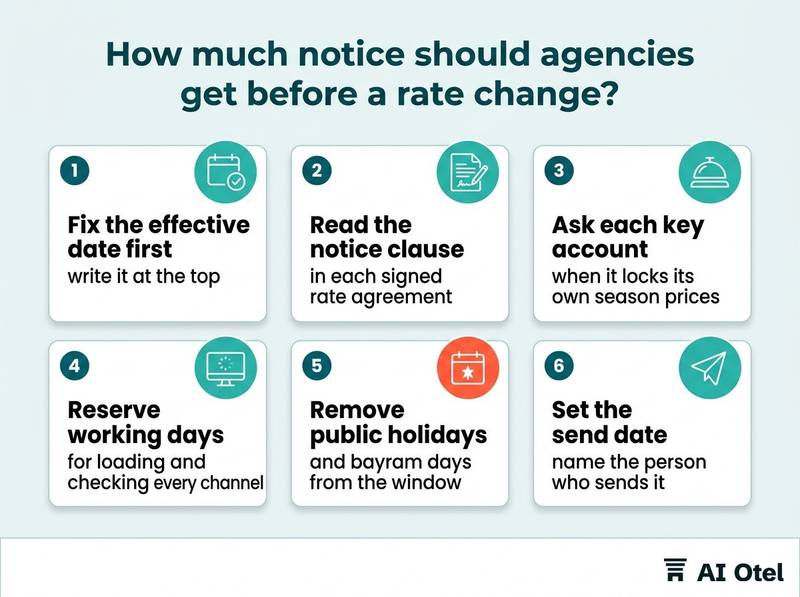
Start with the signed rate agreement: many name a notice period, or a date before which rates are fixed. That clause sets both the earliest and the latest the hotel can send. Then look at the account's own cycle: an agency that prints a brochure or signs client contracts for the season needs the price before that work starts, not after it is finished. Then channel loading: reserve working days to load and check every channel, and place the effective date after the last channel is ready.
Then the calendar. A bayram or public holiday inside the window removes working days and slows the reply, so the send date moves earlier rather than the effective date moving later. If you plan your seasonal rates and restrictions around bayram and public holidays at the same time as the price itself, these collisions are visible months ahead.
The trade-off is real: earlier is safer for the account and riskier for the hotel, because a price shared early can travel to competitors and invites negotiation before the sheet is final. Record the send date and the receipt per account. When an agency later says it was never told, the record ends the argument in one line.
Checklist
- Fix the effective date first and write it at the top of the rate sheet
- Read the notice clause in each signed rate agreement and note the date it sets
- Ask each key account when it locks its own season prices
- Reserve working days for loading and checking every channel
- Remove public holidays and bayram days from the window
- Set the send date, name the person who sends it, and record the date each account received it
What should a rate increase letter to an agency say?
Five parts: the account and period it covers, the reason in one sentence the agency can repeat, the effective date and the bookings it applies to, what stays the same, and the action you need plus a named contact.
The reason sentence
The reason sentence must be true, short and repeatable, because the agency will paste it into its own email to its client. If the hotel gives no reason, the account supplies its own, usually a worse one. If the real driver is cost, say cost, without inventing a market comparison the hotel cannot stand behind.
What stays the same
Say what stays the same before what changes: commission terms, allotment, payment terms, cancellation policy and the account manager. That is the part that keeps the relationship steady. Name the bookings precisely: new bookings from the effective date, and confirmed bookings handled by the rule in the signed agreement.
Ask for one action with a date: confirm receipt, re-key by a given day, or take a short call. Two requests in one letter usually produce neither. Keep it to one page with a subject line that names the season and the change; a price hidden inside an attachment reads as a price the hotel is ashamed of. Send it from a person, not a no-reply address, and copy the account manager who will take the follow-up call. Corporate accounts take the same skeleton, but the reason and the notice period come from their agreement rather than from the season, which is worth reading alongside our guide to agreeing corporate rates with companies.
Key pointA one-page skeleton for the letter
1. Subject line naming the season and the change. 2. The account and the period covered. 3. One sentence of reason. 4. The effective date and which bookings it applies to. 5. What stays the same. 6. The action and its date. 7. A named contact with a phone number.
What happens to bookings that are already confirmed?
They keep the price they were confirmed at unless the signed agreement says otherwise. The notice covers future bookings, and the letter should say so in one line so no account has to ask.
Separate two questions that get mixed in the same email: the price of a booking already confirmed, and the price of a booking made after the effective date. The letter answers the second; the agreement answers the first. Read the rate agreement and the booking's own terms before writing the sentence.
Decide commercially whether to use a right the agreement gives. Re-pricing a confirmed group usually costs more in the relationship than the difference it recovers, and the account remembers which hotel did it. Allotment and group blocks need their own line: rooms already taken from the block, rooms still held, and the date the held rooms return to the hotel at the new price. State the rule even when it favors the guest; an account that has to ask is an account that is already worried about what else changed. Apply the same rule to direct guests holding a future booking. Two different answers on the same day become a screenshot.
Watch outThe letter explains a price; it does not change a confirmed booking
What a confirmed booking costs, and whether an agreement allows a change, comes from the signed contract and, where the wording is unclear, from the hotel's legal adviser. Write the sentence only after reading it.
How do you tell repeat guests about a price rise?
Tell them yourself, in one plain message, at the moment the new rate becomes bookable, and give the guests who already hold a booking a separate and earlier answer.
Segment three ways. Guests with a future booking need one short reassurance that their price holds. Guests who come every year at the same time need a personal message before the season opens. The wider list needs one clear email with the new rate and its start date.
Do not bury the number. A new-season email that hides the rise reads as a trick and produces exactly the reply the hotel was avoiding. If the hotel decides to let guests book at the current rate until the effective date, fence it: a booking-by date, a stay-date range and a room-type limit, all written down. The same fences that govern discount campaigns govern a last chance at the old rate.
Give a reason a guest can accept: what the rate now includes, what changed in the property, what the coming season looks like. Avoid comparisons the hotel cannot support. The loyalty point is not the discount, it is the order. A repeat guest who hears the price from the hotel before it appears on a screen is being treated as an account, not as traffic. Keep the message short, personal and from the person who usually writes. One link to the booking page, no attachment, no second call to action.
How do you check that every channel changed on the same day?
With one list, one owner and one timestamp: a named person prices a sample date on every channel on the morning the new rate starts and records what they saw.
The failure mode is not a wrong price, it is two prices at once: the hotel's own site shows the new rate while an agency portal still sells the old one, and the guest has a screenshot. Build the list from the rate sheet, not from memory: the hotel's own website, each OTA, each agency portal, the metasearch feeds and the reservation desk's own screen.
Price a sample date in each season rather than one date. A rise that lands in high season can leave a shoulder date stale for weeks. Check the derived prices too: packages, supplements, child and extra-bed rules, and corporate codes that carry their own discount on top of the new rate. Record channel, date, time, price seen and who checked. A shared sheet is enough; the point is that the check leaves a trace.
If one channel cannot move in time, the effective date moves for everyone rather than for that channel alone, because a split date is what creates the screenshot. Watch the first 24 hours. Bookings taken at the old price in that window are the ones that return as a complaint.
Checklist
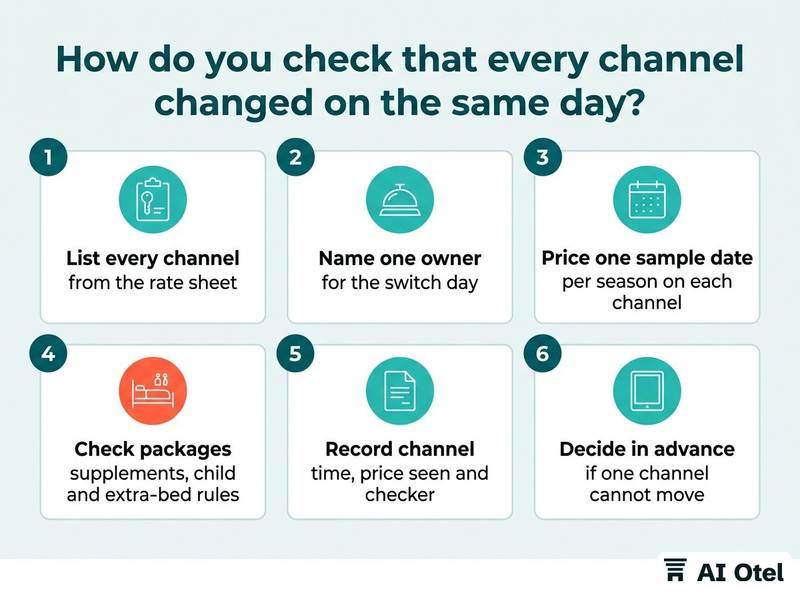
- List every channel from the rate sheet, including ones nobody has booked through for a year
- Name one owner for the switch day
- Price one sample date per season on each channel
- Check packages, supplements, child and extra-bed rules and corporate codes
- Record channel, time, price seen and checker
- Decide in advance what happens if one channel cannot move on time
How do you answer the agency that calls to ask why?
With the same one-sentence reason that went into the letter, and a short list of things the hotel can offer that are not a lower rate.
Brief the person who answers the phone before the letter goes out: the reason, the effective date, the rule for confirmed bookings, and what may be offered without a second approval. The reason must be true and repeatable, and identical to the letter. A different explanation on the phone than on paper restarts the whole conversation.
Prepare the alternatives in advance. A quiet discount given to the loudest account breaks the published rate for every account reading the same sheet. If the hotel concedes, concede in writing and record it in the account's file the same day.
Separate the two complaints. "The price is too high" is a negotiation; "you told me too late" is a service failure the hotel can still fix by extending the old rate to a named date. End the call with a date: what the account will do, what the hotel will send, and when.
TipOffer value, not a lower rate
More allotment, longer payment terms, a shoulder-date price, a longer-stay price, or a package that adds something at the same rate. Choose in advance which of these the hotel will give, and write any concession into the account's file the same day.
What to do next
Open the signed rate agreement of your largest agency account and find the notice clause. Write the date it sets at the top of next season's rate sheet, count backwards through the account's season lock and your channel loading days, and put both dates, the send date and the switch-day check, into a named person's calendar. Do this before the rate sheet is signed, not after it is loaded.
The order is the whole method: agencies and corporate accounts first, channels second, repeat guests as the new rate becomes bookable, and one written rule for bookings already confirmed that every audience hears in the same words.
Frequently asked questions
Can a hotel raise the price of a booking that is already confirmed?
The signed agreement and the booking's own terms decide, not the notice letter. The letter should state the rule in one line so the account does not have to ask. Where the clause is unclear, the hotel takes it to its legal adviser before writing anything to the account. The commercial cost of re-pricing a confirmed group usually exceeds the difference it recovers.
How far in advance should a price increase be announced?
There is no universal number of days. Count backwards from the effective date through the notice period in the signed agreement, the point at which each account locks its own season prices, the working days needed to load and check every channel, and any public holiday or bayram inside the window. The earliest of those constraints sets the send date.
Should a rate increase letter give a reason?
Yes, one true sentence the agency can repeat to its own client. Without it the account fills the gap with a worse explanation. The reason should describe the hotel's own situation, such as cost or what the rate now includes, rather than a market comparison the hotel cannot support.
Do repeat guests get the old rate if they book before the new rate starts?
That is the hotel's decision, and it should be made before the message is written. If the answer is yes, fence it with a booking-by date, a stay-date range and a room-type limit, and state it in writing. The same rule then applies to every guest who asks, including the ones who ask after the deadline.