Bed type requests: twin or double, how to record them and how to keep the promise on arrival
Record bed requests in structured fields, not free notes, to prevent errors. Learn how to promise bed types honestly and ensure the right configuration is ready at arrival.
AI draft · awaiting editorial review
Contents
Key takeaways
- A bed request stays a preference until the hotel writes "guaranteed" on it; the word on the confirmation is the promise the front desk has to keep.
- Record the bed in its own field with fixed values (twin, double, either, no preference) and a second flag for requested or guaranteed, never in a free note.
- Assign rooms by bed type first and by floor, view or quiet side second, because the bed is the one thing the desk cannot fix in a minute at check-in.
- Converting a twin to a double is housekeeping work with a cut-off time and a second pair of eyes, not a line the night auditor leaves for someone.
- When the bed is wrong, say what is true in one sentence, offer a fix with a time, and log the cause so the same room block does not repeat it.
A hotel bed type request twin double is the guest's choice between twin beds (two separate single beds) and a double bed (one bed for two). Record it in a structured field with a requested or guaranteed flag, print it on the room list, and make the wording on every channel match what the hotel can actually deliver.
A guest books a double, reaches the desk at 23:40, and the room holds two single beds pushed apart. Nothing in the file says who promised what, or whether anyone promised anything at all. The fix starts weeks earlier, in a field most hotels never created. After reading this, you will be able to record bed requests so they survive every handover, word the promise honestly on every channel, convert rooms the night before with a check, and answer the guest when it fails.
What is a bed type request, and where does it get lost?
A bed type request is the guest's choice of bed configuration inside the room: twin, meaning two separate single beds, or double, meaning one bed for two people. It gets lost because it passes through several handovers and only one of them usually writes it where the next person looks.
Two more cases complete the definition. "Either" means the guest has no preference and the hotel may assign freely. "No preference recorded" is not the same thing: nobody asked, and that gap must be visible as a gap, because it changes what the desk may promise at check-in.
Bed configuration is separate from room type. A room type such as "standard" can exist in both configurations, so a reservation that records only the room type has already lost the request. If you need the vocabulary of room types first, see hotel room types explained: double, twin, triple, family and connecting rooms.
Trace the chain out loud: booking page, agency or channel, confirmation, reservation record, arrival list, housekeeping sheet. Each handover is a place where a remark line is dropped, truncated or overwritten. The request usually dies at one of these points, not at the desk.
Noting and committing are different acts. A note says the hotel saw the wish; a commitment says the hotel will move the guest if it cannot meet it. The guest only experiences the second. Name the owner at each step: reservations records it, front office assigns it, housekeeping executes it, a supervisor checks it. Without a named owner, every step assumes another step did it.
Accept that the failure is usually silent. Nobody calls the desk to say the double was not prepared; the guest simply arrives, and the hotel learns at the worst possible moment.
Where do bed requests come from, and which ones reach the room list?
Requests arrive from the hotel's own website, agencies and booking sites, email, phone calls and the desk itself, and only the ones written into the reservation record reach the room list.
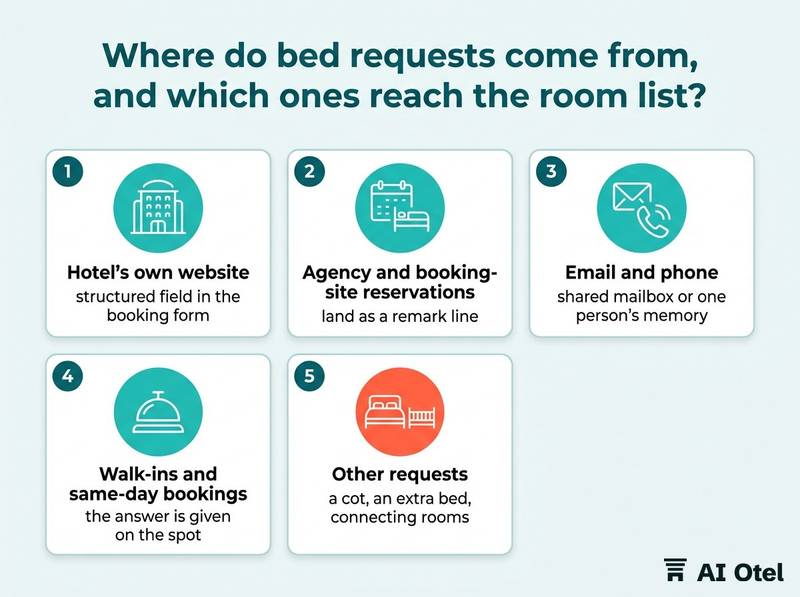
On the hotel's own website, the request can be a structured field in the booking form, so the answer arrives in a usable shape and needs no translation by a person. This is the cheapest source of correct data a hotel has.
Agency and booking-site reservations often land as a remark line, sometimes abbreviated or written in another language. Someone must read it and move it into the field, and that reading is a task with an owner, not a habit. Email and phone are worse: the request sits in a shared mailbox or in one person's memory. The working rule is that a request is not recorded until it is in the reservation, and the person who took the call writes it before the next call.
Walk-ins and same-day bookings are different, because the desk can see the room and the answer is given on the spot. Record it anyway: the same reservation may be extended, and the next shift needs the fact.
Decide who may re-open a room assignment after it is made, and until what hour, so a request arriving at 18:00 does not sit unread until the guest appears. Finally, separate requests that are really other requests: a cot, an extra bed, connecting rooms, a quiet room. These belong in their own fields, because they consume different resources and fail in different ways. A quiet room request has its own chain, described in recording a quiet room request and choosing the room.
Should a bed request live in a field or a free note?
In a field. A free note is read by whoever happens to open the reservation; a field with fixed values can be counted, printed on the room list and checked at assignment.
Define the field with fixed values: twin, double, either, and blank for not recorded. Blank is information, because it tells the desk that nobody asked rather than that the guest does not care. Add a second flag beside it: requested or guaranteed. The two are different promises and must be countable separately.
Use the count. The number of doubles needed tonight compared with the number of rooms the house can set as doubles is the only figure that prevents the failure. A field gives that number; a note never does.
Keep the note for context the field cannot hold, such as a guest who needs a longer bed or an anniversary setup. Context supports the request; it must never be the only place the request exists. Print the field in three places: the arrival list the desk works from, the housekeeping sheet, and the guest's own confirmation. A field nobody prints is a note with extra steps.
Record who took the request and when. If a guest later says the promise was made, a timestamp and a name turn an argument into a lookup.
Watch outThe note that never printed
A request typed into a remarks box that does not appear on the housekeeping sheet is invisible at the exact moment it matters. The guest discovers it before the hotel does.
Requested or guaranteed: what should each channel promise?
Promise a guarantee only where the hotel can hold a specific bed configuration and move the guest if it cannot deliver it; everywhere else say "requested, subject to availability" and mean it.
Define a guarantee in operational terms: a room of that configuration is held for that reservation, and if it fails, the hotel moves the guest to another room or another property under its own written policy. If nobody can describe the fallback, the hotel is not guaranteeing anything. Define a request in operational terms: the hotel will try, will check before arrival, and will tell the guest before arrival if it cannot. Silence is what turns a request into a complaint.
Make the wording identical on the booking page, the confirmation, the agency's screen and the sentence the desk says. The strongest word used on any one channel becomes the promise the hotel is judged against. Name the role that may upgrade a request to a guarantee, and keep it narrow. A guarantee given casually by one agent at 09:00 is a room move paid for by the hotel at 23:00.
Match the wording to the room type. A guarantee is easy where the room type is defined by its bed and impossible where the type mixes both configurations; in the second case, sell the request, not the guarantee. For example, a hotel might guarantee doubles in a room type that only exists as a double, and treat the same request in a flexible room type as a request with a same-day conversion.
| Channel | What usually arrives | What to promise | Who confirms |
|---|---|---|---|
| Own website | Structured field | What the room type supports | Booking engine shows the wording |
| Agency or booking site | Remark line | "Requested, subject to availability" | Reservations team, in writing |
| Free text from the guest | Promise after a person reads it | Reservations team replies with exact wording | |
| Phone | Verbal | Read back from the same wording | The agent who took the call |
| Walk-in | The desk sees the room | What is in front of them | Agent on duty records it |
How do you convert beds the night before, and who checks?
Housekeeping converts the rooms on a written list by a cut-off time, and a second person checks each room against that list before the arrival list is finalized.
Build the list from the field, not from memory: every reservation arriving tomorrow that asks for a double in a room currently set as a twin, and the reverse. Set a cut-off time and publish it. Conversions take time, and a room already occupied cannot be converted, so the list must close while the floor still has room to work.
Describe the physical job precisely: zip-linked beds joined or separated, a topper where the beds do not link, the right duvet and linen, and the room reset so it reads as one bed rather than two pushed together. The full standard is its own discipline, covered in hotel bed making standard: turning twins into a double. Assign the work to a named room attendant with the room number on the sheet, and ask for the time each room was finished, so a later question has an answer.
Separate doing from checking. A supervisor or duty manager walks the list and looks at each room; a tick on the sheet proves the intent, not the bed. Record the state of the room afterwards. A room left set as a double must be marked as a double, or the next assignment will promise a twin to someone else and undo the work.
How do you assign rooms by bed type on arrival day?
Assign the bed first, then the floor, view or quiet side, because the bed is the one thing the desk cannot fix in a minute while the guest waits.
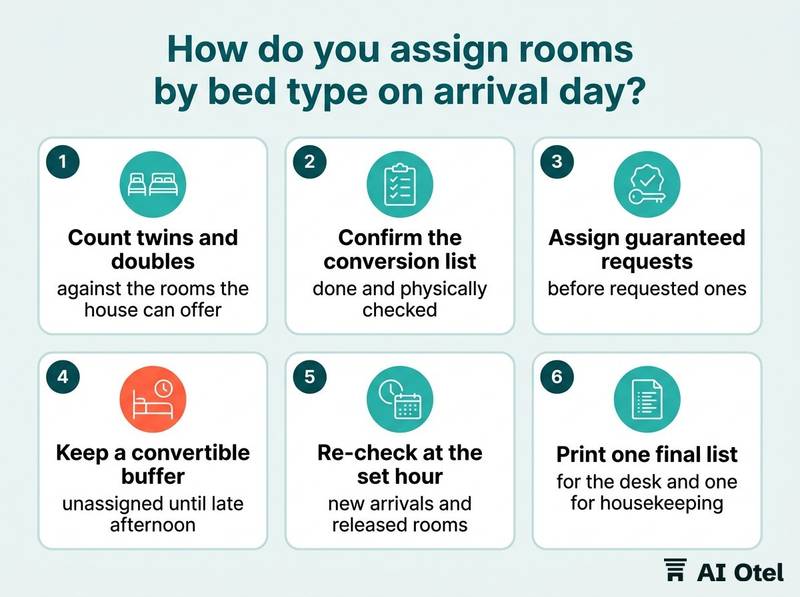
Start with the count, not the list: how many twins and how many doubles the arrivals need tonight, against what the house can actually offer after conversions and out-of-order rooms. Assign in order of promise: guaranteed requests first, then requested ones, then everyone else. A guest who was promised a bed outranks a guest who asked for a view. The wider rules of blocking and upgrades are covered in assigning rooms before arrival: blocking, upgrades and special requests.
Hold a small buffer of convertible rooms unassigned until late afternoon, so a late arrival or a failed conversion has somewhere to go. Re-check at a fixed hour: arrivals are added during the day, no-shows release rooms, and a room can leave the count for a maintenance reason in the middle of the afternoon.
Watch groups, families and long stays, where mixed bed needs inside one block break the count first. A group rooming list with bed needs is a separate check, not part of the general list. Print the final version for the desk and for housekeeping at the same time, so both work from one document rather than two.
ChecklistArrival-day bed check
- Count twins and doubles needed against the rooms the house can offer.
- Confirm the conversion list is done and physically checked.
- Assign guaranteed requests before requested ones.
- Keep a convertible buffer unassigned until late afternoon.
- Re-check at the set hour for new arrivals and released rooms.
- Print one final list for the desk and one for housekeeping.
What do you say and offer when the bed is wrong?
Say what is true in one sentence, offer a concrete fix with a time, and let the guest choose; an apology without a time is not an answer.
Open with the fact, not the story: the room is set as a twin and the reservation asked for a double. Explanations about which channel dropped the request belong in the log, not at the desk. Offer the fixes in order of cost to the guest: convert this room now with a stated time, move to another room, move with an upgrade, and only then a goodwill gesture under the hotel's own written policy.
Check the confirmation before saying the request was only a request. If the paper says guaranteed, the guest is right, and the conversation is about the fix, not the wording. Give a time and keep it. A conversion promised in twenty minutes and delivered in an hour is a second failure, and the guest counts both.
Log the cause in one of four buckets: not recorded, not printed, not converted, not assigned. Over a month the buckets show which step to repair, which is more useful than counting complaints. Follow up once, after the guest has settled, and close the loop in the record so the next shift knows how it ended.
TipA four-line recovery script
Say what is true: "The room is set as a twin and you asked for a double." Say what you can do now: "We can join the beds within twenty minutes, or move you to a double on the third floor in ten." Hand the choice to the guest. Say what happens next, in one sentence.
What to do next
Open tomorrow's arrival list tonight and count how many reservations carry a bed preference in a field rather than in a note. That number is the size of the problem, and the four steps that fix it are already in this article: a field with fixed values, one honest wording per channel, a conversion list with a cut-off and a checker, and an assignment order that puts the bed before the view. If your software cannot hold the field, the same logic can be run on printed lists until it can; a hotel operating system that records requests as structured data is built to make this chain print itself, and the same idea sits behind a guest app that carries the guest's requests in one place.
If you are reading this as a traveler rather than a hotelier, you can use the same test when you book: look for the confirmation that states the bed, and find a hotel in Türkiye (opens in a new tab) that answers in writing.
Frequently asked questions
Is a twin or double bed request guaranteed when I book?
It depends on what the confirmation says, not on what was asked. A request means the hotel will try and should tell the guest before arrival if it cannot; a guarantee means a configuration is held and the hotel moves the guest if it fails. Read the confirmation wording and, if it is unclear, ask the hotel to confirm in writing.
What is the difference between a twin room and a double room?
Twin means two separate single beds; double means one bed for two people. The confusion comes from hotels that use "double" to mean a room for two people rather than a bed, which is why a reservation should record the bed configuration separately from the room type and the number of guests.
Can a hotel turn a twin into a double on the day of arrival?
Often yes, if the beds link or a topper is available, but it is housekeeping work with a time cost, and it cannot be done in an occupied room. It needs a written list, a cut-off time and a second person checking the room, which is why the answer at the desk should always carry a time.
How should a hotel record a bed request in its reservation system?
In a dedicated field with fixed values (twin, double, either, blank) plus a separate flag for requested or guaranteed, a timestamp and the name of the person who took it. The field must print on the arrival list, the housekeeping sheet and the guest confirmation; the free note is for context only.
What should a hotel offer when the bed is not what the guest asked for?
State the fact in one sentence, then offer a conversion with a time, a room move, or a move with an upgrade, in that order, and let the guest choose. Check the confirmation first, keep any promise of time, and record the cause so the same failure can be traced to the step that produced it.