Booking requests through Instagram messages: a routine that turns a chat into a confirmed reservation
An Instagram DM is an inquiry, not a booking. Learn how to turn chats into confirmed reservations with a first-reply template, written offers with validity dates, and a daily inbox routine.
AI draft · awaiting editorial review
Contents
Key takeaways
- A direct message is an inquiry: nothing is held and no rate is fixed until the request exists in the reservation system with a name, dates, room type and rate.
- The first reply should ask for dates, guests and room or board preference, and send one booking link rather than a price list.
- A written offer with a validity date is what turns a chat into a decision; without the date you have given a price that never expires.
- Never type a rate you cannot reproduce on your own website for the same dates, room and board.
- One inquiry log and three fixed inbox checks a day keep chat requests from dying in the inbox.
An Instagram DM is an inquiry, not a booking: nothing is held and no rate is fixed until the request exists in the reservation system. Answer within minutes with dates, guest count and one booking link; if the guest hesitates, send a written offer with a validity date, log it, and check the rate against your own website.
A guest asks for a price for two nights in a direct message at 22:40. Someone answers from a phone with a number, the guest says thank you, and the room is still unsold three days later. This happens in small and boutique hotels every week, and it is rarely the price that loses the booking: it is the missing routine. After reading this guide you will have a first-reply template, a written offer structure, an inquiry log and a daily inbox check that together turn Instagram DM hotel booking requests into confirmed reservations.
Why is an Instagram DM an inquiry and not a booking?
Because a chat holds no room and fixes no rate. Until the request is written into the reservation system, the hotel has a conversation, not a sale.
A direct message takes nothing out of the room pool, so the same room can be sold to someone else while the thread is still open. The front desk has no way to see that a promise was made in an app, and the guest has no confirmation number to bring to the desk. The inbox is not a record: it has no guest name in a searchable form, no payment, no confirmation and no audit trail.
A number typed in a chat is a statement, not a rate. The price depends on date, room type, board and length of stay, and a figure given without those four is a promise the hotel may have to break. Most threads are one of four things: a price question, an availability question, a complaint or a supplier pitch. Only the first two can become bookings, and sorting them takes seconds once the routine names them.
Remember also that the guest is often messaging several properties at once, so the first useful reply usually decides the booking, not the cheapest one. Write the moment of conversion down and give it to everyone who touches the account, so nobody confirms a room from a phone in the evening.
Key pointThe conversion definition
A direct message becomes a booking only when the reservation exists in the reservation system with a name, dates, room type, rate and a confirmation the guest has received. Until then it is an inquiry.
What should the first reply to a hotel DM contain?
Three facts, one link and one question: the dates and guests the hotel understood, one sentence on what is available, the booking page with those dates, and a single question about board or room type.
Ask for the three things that decide the price, dates, number of guests and room or board preference, in one message rather than a chain of five. Send one link, to the booking page with the dates already filled in where the booking engine allows it, not a PDF rate list that goes out of date. If you quote a number, quote the number the website shows for the same dates and room; if you cannot check it in the moment, send the link instead.
Keep the reply to about six lines. A long message on a phone reads as a brochure and gets closed. Use a saved reply for the structure and rewrite the first line with the guest's own dates, so it does not read as a robot. Answer in the language the guest wrote in when someone on the team can; otherwise answer in English, keep it short and lead with the link. State the reply hours in the profile and in the auto-reply, so a guest writing at midnight knows when an answer will come.
| Part of the reply | English line | Turkish line |
|---|---|---|
| Greeting, dates repeated back | "Hello! Two nights for two guests, 14 to 16 June, is that right?" | "Merhaba! 14-16 Haziran, iki kişi, iki gece, doğru mu?" |
| Availability in one sentence | "We have a double room available for those nights." | "O geceler için çift kişilik odamız müsait." |
| Booking link with dates | "You can see the exact rate and book here: [link]" | "Güncel fiyatı görüp rezervasyonu buradan yapabilirsiniz: [bağlantı]" |
| One question | "Would you like bed and breakfast or half board?" | "Oda kahvaltı mı, yarım pansiyon mu tercih edersiniz?" |
| Close | "We answer messages between 09:00 and 21:00. Ayşe, reservations." | "Mesajları 09:00-21:00 arasında yanıtlıyoruz. Ayşe, rezervasyon." |
For more on making the page behind that link convert, see our guide on how to increase direct bookings on your hotel website.
When should a chat become a written offer?
When the guest names dates but keeps asking questions, asks for a discount, asks about a group, or asks for extras that are not on the website. At that point the chat stops being a conversation and becomes a document.
An offer has seven parts, and the validity date is what makes it an offer. Without it the hotel has published a price that never expires and cannot be defended later. Send the offer as a document or an email, not a screenshot of the conversation, so the guest can forward it and the hotel can find it in a month. Put the offer in the inquiry log the moment it is sent, with its deadline, so the follow-up is not left to memory.
ChecklistThe seven parts of a written offer
- Room type
- Board
- Total price for the stay
- What is included
- Validity date
- How to accept
- Cancellation terms
If the guest accepts in the chat, the chat is still not the confirmation: create the reservation, take payment through the normal channel and send the system's confirmation. Never take card numbers, identity documents or passport photos in a direct message; the guest enters payment on the booking page or at the desk. Keep one currency per offer, state the rate and the date it was set, and say which currency the guest will be charged in. On currency choices for the booking page itself, see showing prices in euro and lira on a hotel booking engine.
Which prices and promises must never be made in a chat?
Any price the hotel cannot reproduce on its own website for the same dates, room and board, and any promise about a specific room, view, upgrade or extra that the operation cannot guarantee on the day.
The working rule is simple: the website rate is the rate. If a chat price is lower or higher, one of the two is wrong and the guest will find out. A hold is real only if the system holds the room with an expiry time; otherwise say plainly that the hotel cannot hold a room without a booking and send the link. Promise the room type, not the room: floor, view, quiet side and room number are assigned at the desk, and a chat promise becomes a complaint at check-in.
Do not promise extras the operation cannot deliver on that night, such as a late check-out at a fixed hour on a full house, or a transfer nobody has booked. Do not discuss another guest, another booking or a colleague in the thread, even to explain a problem. Do not quote group, agency or contracted rates in a message; those belong in a written contract with the party that holds them.
Decide in writing what the hotel does when a confirmed guest cannot be accommodated, and follow it. The guest will hold the hotel to the confirmation it sent, so the confirmation has to be accurate. When a guest sends a screenshot of a lower price elsewhere, check the hotel's own website first, then the channel, and answer with what each price includes rather than with an argument. A weekly rate parity check for direct and OTA prices prevents most of these conversations before they start.
Watch outSay this instead
"I will hold the room for you" becomes "I cannot hold a room without a booking; here is the link with your dates." "Sea view guaranteed" becomes "You are booking a standard double; we note requests and assign rooms at check-in." "I can do a discount" becomes "The rate for these dates is the one on our website, and that is the rate I can confirm."
How do you record an Instagram inquiry so it is not lost?
The reservation system records bookings; a single inquiry log records everything that has not become one yet, with a status, an owner and a next action date.
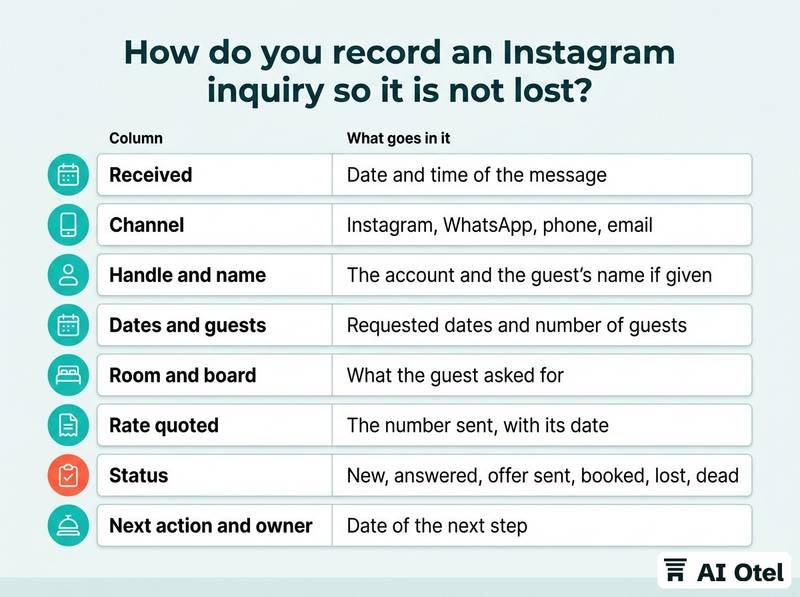
One log, one row per inquiry, kept where reservations staff can see it. The inbox label is a second copy, never the only one, because an account can be locked or a person can leave. Use a few fixed statuses: new, answered, offer sent, booked, lost, dead. Free text turns a log into a diary nobody reads.
Never create a fake reservation to hold a room. It corrupts availability, the night audit and every report built on them. Follow up once before the offer expires and once after, then close the row: two unanswered follow-ups make a thread dead, and saying so keeps the log honest. Put other channels in the same log, so a guest who writes on Instagram and then calls is one row and not two. The same structure works for phone, email and WhatsApp booking requests.
| Column | What goes in it |
|---|---|
| Received | Date and time of the message |
| Channel | Instagram, WhatsApp, phone, email |
| Handle and name | The account and the guest's name if given |
| Dates and guests | Requested dates and number of guests |
| Room and board | What the guest asked for |
| Rate quoted | The number sent, with its date |
| Status | New, answered, offer sent, booked, lost, dead |
| Next action and owner | Date of the next step and who does it |
Review the log weekly for two counts only, inquiries received and inquiries that became bookings, plus the time to the first reply. That is enough to see whether the routine works.
What does a daily Instagram inbox routine look like?
Three fixed checks a day with the same three steps, plus a named backup and a short handover note, so the inbox runs whether or not one person is at work.
Check at opening, around midday and before the evening handover. Each check does three things: answer every new thread, chase offers that expire today, close threads that are dead. The account belongs to the hotel, not to a person: use a business account with more than one admin and keep the login in the hotel's password manager. Name a backup for every day the main person is off, weekends included, and give the backup the log, not just the password.
Leave a handover note at the end of each shift: open offers with their deadlines, guests waiting for an answer, and anything promised that the front desk must know. Anything promised in a message that affects the stay goes into the reservation notes, not only into the chat. Set an auto-reply outside hours with the reply window and the booking link, so a guest is never met with silence.
ChecklistDaily items
- Answer new threads at opening, midday and before handover
- Chase offers expiring today
- Close dead threads
- Write the handover note
ChecklistWeekly items
- Read three threads aloud
- Compare quoted rates with the website
- Update saved replies
- Confirm the backup still has access and the log is current
Hold a weekly fifteen-minute review: read three threads aloud, compare every quoted rate with the website, and fix the saved replies that caused a mistake. If your hotel runs on a hotel operating system that keeps reservations, notes and reports in one place, the log and the reservation notes live next to each other, and a chat promise recorded once is visible to the desk. Where a hotel also sells through agencies and booking sites, the same inquiry discipline feeds a distribution setup designed so that one room inventory feeds the hotel's own website, booking sites and travel agencies.
What to do next
Write the first-reply template and the inquiry log today, then put the three daily checks in the team calendar. The pieces hold together because each one closes a gap the others leave: the first reply asks three things and sends one link, the written offer fixes a price with a deadline, the log keeps it alive after the chat goes quiet, and the daily check makes all of it a routine rather than a good intention.
Frequently asked questions
Can a hotel hold a room for a guest who asked on Instagram?
Only if the reservation system can hold the room with an expiry time, and then the guest should be told when the hold ends. A message is not a hold. If the hotel cannot hold, say so in one line and send the booking link with the dates filled in.
Should we move the conversation from Instagram to WhatsApp or email?
Yes when the guest needs a document, a payment link or a longer exchange, because those channels carry attachments and a record more comfortably. Keep the same rules about prices and promises, note the move in the inquiry log, and never run two threads with two different prices.
How quickly should a hotel answer an Instagram DM?
Set a reply window the team can actually keep, publish it in the profile and the auto-reply, and meet it every day. A consistent window beats a fast answer that stops after a busy week. The out-of-hours auto-reply carries the night with the hours and the booking link.
What if the guest asks for a discount in the DM?
Decide the discount policy before the conversation, not inside it. If the answer is no, say what the rate includes and send the link. If the hotel can discount, the same rate should appear on the booking page for those dates, otherwise the chat has created a price the website cannot defend.
Who should own the hotel's Instagram inbox?
One named owner and one named backup, on an account the hotel controls, with the inquiry log visible to reservations. The owner answers and keeps the log current; reservations confirms and takes payment. Nobody confirms a room from a personal phone.