The phone number on your website: call tracking, click-to-call and who answers
A call button measures intent, not revenue. Learn how to count calls from your hotel website, who should answer them, and how to log outcomes so you can compare phone bookings with online ones fairly.
AI draft · awaiting editorial review
Contents
Key takeaways
- A call button measures intent, not revenue: the tap can be counted, but only a written outcome at the desk turns a call into a comparable booking.
- Choose one counting method and keep the guest's path simple: a dedicated website number, a click event, or a tracking service, never all three at once.
- The hours a person answers the phone are a promise the website makes, so write them down before printing them.
- Phone and online bookings can only be compared on the same definition of a booking, over the same period, with staff time counted as a cost.
Call tracking is the practice of counting and labeling the calls a hotel receives from its website, usually by showing a different phone number to visitors from that source. Click-to-call is a link that opens the guest's dialer with the number already filled in. Neither tells you anything unless someone logs what the call produced.
A guest opens your site at 21:40, taps the number, hears it ring six times and hangs up. The next morning the site report shows a visit, the front desk remembers nothing, and no one knows a booking was almost made. After reading this you will know how to count the calls your website sends you, who should answer them and when, and how to record outcomes so the phone channel can be compared fairly with online bookings.
What actually happens when a guest taps the call button?
The tap hands the number to the guest's phone and the call leaves your website entirely. Everything after that happens on a line, not in a browser.
Click-to-call is a link that tells the handset to open its dialer with the number filled in. There is no app to install and no account to create, which is why it works for a guest standing on a street with one bar of signal. On a computer the same link usually opens a calling app or simply shows the number to copy. Plan for both: the number must be readable as text, not baked into an image.
Write the number in full international form with the country code, so a guest calling from abroad does not have to guess the prefix, and use the same format everywhere it appears. The website can count the tap as a page event. It cannot see whether the call connected, how long it rang, or who spoke. That gap is the whole reason the desk needs a log.
What sits next to the button shapes the call. An hours line, a language note or a WhatsApp alternative changes whether a guest taps at 22:00 or waits until morning. Decide which channel is the default: a call button, a WhatsApp button and a contact form side by side split the same intent three ways and make each one harder to count.
NoteThe tap and the call are two different events
The website records the tap. Only a person at the desk can record the call, its outcome and its value. Treat them as separate measurements and never read one as the other.
How do you count the calls your website sends you?
Pick one method and accept its blind spot. Four methods exist, and they differ in what they count, not in how accurate they are.
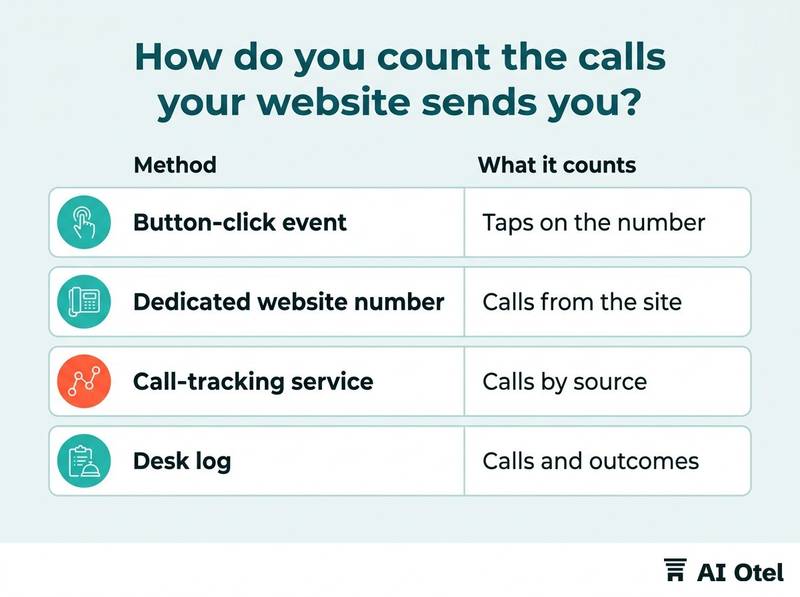
A button-click event lets the site analytics record each tap on the number or the call button. You get a count of intent, with no idea how many calls connected or what they were worth. A dedicated website number is a second line printed only on the site, so every call to it is a website call by definition. Simple and honest, provided someone answers it and the number is kept off other channels.
A call-tracking service shows a different number depending on where the visitor came from, and the service logs the call. It costs money, puts a third party in the guest's path, and a guest who saves the displayed number saves the wrong one. The desk log is the cheapest method and the only one that captures the outcome. It depends entirely on the discipline of the person who picks up.
| Method | What it counts | What it costs you | Where it breaks |
|---|---|---|---|
| Button-click event | Taps on the number | Nothing | No call or outcome data |
| Dedicated website number | Calls from the site | A second line | Leaks if printed elsewhere |
| Call-tracking service | Calls by source | Fees, a third party | Guest saves the wrong number |
| Desk log | Calls and outcomes | Staff discipline | Depends on who fills it in |
Whatever you choose, the number the guest dials must reach a person. A tracking number that rings an empty desk counts calls and loses bookings at the same time. Keep the number on your listing profiles, invoices and contracts stable: changing the number a guest already has in their phone costs more than the counting is worth. Count the call, not the conversation. Keep the log to what you need to follow up, and write down who may see it.
For the wider picture of what to measure, see the events worth measuring on a hotel website.
Who answers, at which hours, and what happens to a missed call?
Write down the hours a person answers the phone, separately from the hours the hotel is staffed, and name one owner per shift. Everything else follows from that sentence.
Set the ring time and the overflow route: how many rings before the call moves to a second desk, a duty mobile, or a recorded message. "Everyone answers" means no one does. Give each shift one named owner of the phone, and a named backup for breaks and handover.
The front desk is serving in-house guests at the same moment. A call standard that covers both the walk-up guest and the caller is the only one staff will actually follow, and a call standard for a hotel phone is worth writing down once rather than improvising per shift.
Missed calls need a rule: who calls back, within how long, from which number, and what they say. A missed call with a number on it is a lead with a timestamp, not a failure. Decide what an after-hours caller hears and how quickly they hear back. A recorded message that promises a morning callback is a commitment, so staff it.
Log every missed call in the same place as the answered ones, with the time. The pattern of when calls are lost is more useful than the total. If most lost calls sit between 21:00 and 23:00, the answer is a staffing or hours decision, not a better button.
How do you record what a call produced?
Record the outcome the same day, in one place, using the same words every time, or the call cannot be compared with anything.
The minimum fields are few, and the form must be short enough that a busy desk fills it in. A form with twenty fields gets filled in for a week. Use a fixed list of outcomes, for example booked, quote sent, not a fit, no answer, wrong number. Free text cannot be counted at the end of the month.
One place only. Put the note on the reservation in the hotel management system, or keep one sheet, but never both: two records mean neither is trusted. Tie the call to the reservation by putting the caller's number or the source in the booking record, so the booking can be traced back to the call that produced it.
ChecklistThe checklist for each call
- Date and time
- Caller number
- Source (website, listing profile, WhatsApp, walk-in)
- Arrival and departure dates
- Number of guests
- Outcome from the fixed list
- Value
- Person who took the call
- Whether a follow-up is owed, and by when
Review weekly, not monthly: how many calls, how many answered, how many became quotes, how many became bookings. Weekly is close enough to remember the individual calls. The same discipline applies across channels; a routine like turning phone and WhatsApp inquiries into reservations or the chat-based version in a routine for turning an Instagram chat into a confirmed reservation works only if the outcome is written down.
How do you compare phone bookings with online bookings fairly?
Compare a booking with a booking, over the same period, on the same definition, with the cost of the person's time included on the phone side.
Fix the definition first: a confirmed reservation with dates and a name counts, an inquiry does not. Apply that definition to both channels or the comparison is meaningless. Treat cancellations the same way on both sides. A channel that books and cancels at a higher rate is not the better channel.
Count staff minutes as a cost. A phone booking carries no commission but it carries a salary, and ignoring that flatters the phone. Set one attribution rule and keep it: a guest who sees the site on a phone, calls from the car and books at the desk belongs to one channel, and you decide which before the month starts.
Compare value, not only count: length of stay, room type, extras taken. Two channels can produce the same number of bookings and very different revenue. At low volume a difference of a few bookings is noise. Look at a quarter before drawing a conclusion about a channel. For the broader goal these channels serve, see how to increase direct bookings on a hotel website.
What should the website say about the phone number?
State the hours a person answers, what happens outside them, and how quickly the guest will hear back. Nothing else on the page matters if that promise is wrong.
Print the answering hours, and add the time zone for guests booking from another country. Say what happens outside those hours: a recorded message, a WhatsApp line, an email address, and when a reply comes. Do not print round-the-clock availability unless a person answers round the clock. A guest who calls at 02:00 and reaches silence does not call again.
Put the number in text so it can be tapped and copied, and repeat it in the confirmation email and on the pages a guest reaches late in the decision. Keep one number in one format across the site, the listing profiles and the documents a guest receives, so the number they save is the number that works.
Watch outA promise the desk cannot keep costs more than no promise
The guest who is told to call and reaches no one has been let down by the site, not by the phone line. Print only the hours you can staff, and review them whenever the roster changes.
What to do next
For the next seven days, log every call that comes from the website with the outcome fields above, then put that log next to the online bookings for the same week. The count of taps tells you the button works; only the log tells you whether the phone is worth the person answering it.
Frequently asked questions
Does a call button on a hotel website bring more bookings?
It removes a step for the guest who would rather talk than fill in a form, and it costs almost nothing to add. Whether it produces bookings depends on who answers, how fast, and what they say. Measure it with the desk log, not with the number of taps.
Can a hotel count calls from its website without buying software?
Yes, in two ways: a second phone number printed only on the site, or a click event in the site analytics combined with a desk log. The first counts calls, the second counts intent, and only the log records the outcome. Choose one and accept its blind spot.
Should the phone number be clickable on a desktop browser too?
Yes. On a computer the link usually opens a calling app or shows the number to copy, and neither harms the guest. The important part is that the number is real text on the page, not part of an image.
What should a hotel do with calls that arrive after the reservations desk closes?
Decide the route in advance: a recorded message, a duty mobile, or a WhatsApp line, and state it on the site with the time a reply will come. Log the call, call back in the promised window, and review the pattern of after-hours calls to see whether the hours themselves should change.