Showing prices in euro and lira on a hotel booking engine: which to show, when to convert and what to say
Display currency is what the guest reads; charge currency is what the card is debited in. Learn to set your hotel booking engine currency display to prevent disputes and align channels.
AI draft · awaiting editorial review

Contents
Key takeaways
- A converted price is an estimate, not a second price: it needs a rate source, a date and a refresh rule, or it turns into a dispute at the desk.
- The currency a guest is charged in is a separate decision from the currency a rate is shown in, and it belongs in the booking record and next to the pay button.
- Store the rate, its source and its date on every converted booking; that record is the only answer you will have when the card statement arrives.
- If you publish converted prices to channels, each channel keeps the last figure you sent, so direct and channel prices drift apart between refreshes.
- A refund reverses at the rate of the refund day, not the booking day, so the guest can get back a different amount than they paid; say so before payment.
Display currency is what the guest reads; charge currency is what the card is debited in. Price in the currency you are paid in, show the other as a converted estimate with a named rate source, a refresh schedule and the rate stored with the booking, and say plainly which currency is charged.
A guest books at the euro price on your site and later sees a different lira figure on the card statement. The call reaches the front desk, and the answer was decided months earlier in the booking engine settings. After reading this, you will be able to set the hotel booking engine currency display deliberately: choose a base currency, choose a rate source and refresh rule, write the wording that keeps the estimate honest, and handle a dispute from the record rather than from memory.
Which currency should a hotel price in: euro, lira or both?
Price in the currency you are paid in and can cover your costs in, and show the other currency as a conversion rather than as a second price.
Start by naming the base currency of each rate plan. The base currency is the amount the cancellation rule, the deposit and the invoice all refer to. Every other figure on the page is derived from it, and the guest's rights attach to it, not to the conversion.
If your costs are in lira and you sell in euro, your margin moves with the rate even when the euro price never changes. That is a pricing decision, not a display decision, and it belongs with your wider pricing work, not in the booking engine settings screen. For the cost side of that question, see pricing hotel rooms in Türkiye when costs are in lira.
Two real prices means two rate plans, each with its own payment and cancellation terms. One price with two labels is a single rate plan with a conversion, and it is easier to explain at the desk. Decide what a converted figure means when the guest pays days after booking: a reference at the time of booking, or the amount that will be charged. The two need different wording.
| Setup | What the guest sees | Where it usually goes wrong |
|---|---|---|
| One currency only | One figure, no conversion | Foreign guests must convert mentally and may leave |
| One price plus a converted estimate | Base figure and a second figure labelled approximate, with rate source and date | The estimate is not dated, or is read as a promise |
| Two real prices | Two rate plans, each with its own terms | The two sets of cancellation and payment rules disagree, or only one is maintained |
Write down which rate plans are in which currency and who is allowed to change that, so the desk and the website do not answer the same question differently. Then check the guest's path end to end: search results, room page, payment step and confirmation should all name the same base currency.
Which exchange rate should the booking engine use, and how often should it update?
One named, published rate from one source, refreshed on a fixed schedule, with the rate and its date saved on the booking.
Three sources work in practice. The central bank's indicative rate is published once each business day, which makes it easy to cite and easy to date. A commercial bank's buying or selling rate reflects what a bank actually does with the money. A rate the hotel sets itself and reviews on a schedule is also workable, if it is written down. Choose one and record it in the settings note.
Buying, selling and midpoint rates differ. Whichever you use, any margin on top should be stated once, in the same place, and never applied silently. Update frequency is a trade-off: frequent updates track the market but change every displayed price and every channel feed, while infrequent updates drift and look wrong to a guest who checks the same day.
Set one rounding rule, for example rounding to the whole lira in one direction, and apply it everywhere so two pages never show two figures for the same room. Know your refresh window: web pages, channel feeds and cached search results keep the old figure until they are refreshed, and a guest can screenshot the version you no longer show.
ChecklistWhat to record with every converted price
- The base-currency amount
- The converted amount shown
- The rate value used
- The rate source
- The date and time of the rate
- The rounding rule applied
- Whether the figure was labelled as an estimate
The rate source can be the Türkiye Cumhuriyet Merkez Bankası's indicative rate, which is published daily, not hourly, at 15:30 on each business day. That single fact makes it the easiest source to defend: it is public, dated and stable for the whole day.
What is the guest charged, and what will the card statement show?
The guest is charged in the currency the payment is taken in; the statement then reflects whatever the guest's own bank does with that amount.
Charge currency is set at the payment step, not at the price display. State it next to the card form, before the guest types anything. If the price is in euro and you charge in lira, the guest's bank converts at its own rate and may add a foreign transaction fee. The hotel never sees that number and cannot quote it.
If you charge in euro, the guest's bank may still convert to the card's own currency, so a euro charge can also produce a different statement figure. Conversion offered at the card terminal is a separate choice the guest makes at the desk, and it is not the same decision as the one made in the booking engine; see dynamic currency conversion at the hotel card terminal for what the guest is actually choosing there.
Deposits and pre-authorizations should use the same currency as the final charge, otherwise the release and the charge never quite match. Refunds are the hard case: a reversal at a later rate returns a different amount, and the guest can lose or gain on the movement without either side doing anything wrong.
Watch outThe refund gap
A booking charged in one currency and refunded weeks later reverses at the rate of the refund day. The guest may receive more or less than they paid, the hotel cannot control the bank's rate, and the only fair moment to say this is before payment.
What should the booking page and the confirmation say?
Four facts in the same words in both places: the currency of the price, the currency of the charge, the rate source and date of any conversion, and the fact that the converted figure is an estimate.
Label the converted figure: approximately, for reference, or converted at the rate of a named date. An unlabelled second figure reads as a promise. Name the charge currency next to the pay button; a statement buried in the terms and conditions is not read at the moment it matters.
Repeat the same sentence in the confirmation email, because the guest will quote the confirmation back to the desk, not the website. Say what happens if the rate moves between booking and payment, in one sentence, without conditions stacked on conditions. Never put guaranteed or fixed next to a converted figure; it is an estimate by construction, and the wording should not fight that. Keep one sentence per fact: a long disclaimer is skipped, and a skipped disclaimer protects nobody.
TipTwo model sentences, for example
"The price of this room is 120 euro. Your card will be charged in euro." "The lira figure is an estimate converted at the central bank rate of 24.09.2026 and is for reference only; your card will be charged in euro." Both keep the base currency and the charge currency in the same breath.
How do you keep direct and channel prices aligned when the rate moves?
Keep one base price per rate plan and convert at display time; if you must publish converted prices, refresh them on one schedule everywhere and check the result weekly.
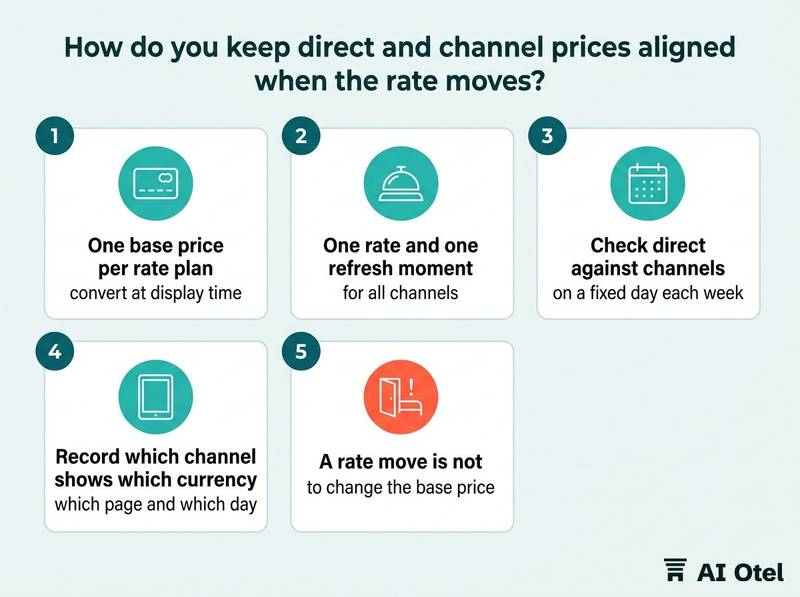
Channels keep the last figure you sent them. A converted price pushed to a booking site stays there until the next push, whatever your own website shows. Sending the base currency and letting each channel convert moves the conversion problem to the channel, but keeps your own numbers consistent and explainable.
If you publish converted prices, use one rate and one refresh moment for all channels so the figures move together instead of one at a time. Check direct against channels on a fixed day each week and write down what you saw, so a difference can be dated and explained; a weekly rate parity routine gives the structure for this.
Record which channel shows which currency. When a guest sends a screenshot, the first question is which page and which day. And remember that a rate move is not a reason to change the base price: it changes the display, and the base price should move only when you decide it should.
A guest disputes the amount: what do you do first?
Open the booking record and read back the rate, its date and the charge currency; the record settles most disputes before anyone decides on goodwill.
Identify the cause before responding. The guest's bank converted, the hotel converted, or the guest chose conversion at the terminal. Each has a different answer. Show the guest the numbers they saw: the confirmation, the rate date and the charge currency. Agreement is easier when both sides look at the same document.
Decide the policy in advance, for example absorbing small differences and explaining large ones, and write it down so the desk does not improvise case by case. Keep the guest's confirmation copy as the reference document, and attach the rate and date to the case note. Log every case with the rate and the date, so a repeated pattern becomes visible before it becomes a review. If the guest's bank is the cause, the hotel can explain but not fix it: say what happened and point the guest to the bank, without guessing at the bank's rate.
Key pointThe three causes of a currency dispute
The guest's bank converted the charge and added its own fee; the hotel converted at a rate the guest did not expect; the guest accepted conversion at the card terminal. Name the cause first, then the answer follows.
For the desk-side version of this, choosing and recording an exchange rate for cash and card payments, see foreign currency at the hotel desk.
What to do next
Write the four sentences once: base currency, charge currency, rate source and date, and what a converted figure means. Put them on the booking page, in the confirmation and in the desk's script, then check the direct-channel display on the same day each week. The pricing decision, the rate rule, the charge step, the wording, the channel check and the dispute routine are one chain, and the weakest link is the one the guest will find. If you are evaluating software, test exactly this chain: how a hotel operating system records the rate with the booking, and how a distribution setup pushes prices to channels.
Frequently asked questions
Should a hotel show prices in euro or lira to foreign guests?
Show the currency most of your guests think in, but price in the one you are paid in. A converted figure is acceptable when it is labelled as an estimate with the rate source and date, and when the charge currency is stated next to the payment step. The mistake is showing two unlabelled figures that look equally final.
Is a converted price on a booking engine binding?
The amount that matters is the one in the currency of the rate plan, charged in the currency stated before payment. A figure labelled as an estimate is a reference, and the confirmation wording is what the guest will quote back. Decide this in writing before the first dispute, not during it.
Which exchange rate should a hotel use for a refund?
The same source and the same rule as the charge, applied on the day of the refund. That means the returned amount can differ from the amount paid, in either direction, and the hotel cannot control the guest's bank rate. Say this before payment, not after the refund.
Does the guest pay in the currency shown on the website?
Not necessarily. The charge currency is set at the payment step and should be visible before the card form. Even then, the guest's bank may convert the charge into the card's own currency and add a fee, so the statement can show a third figure that the hotel never sees.