Checking Turkish AI drafts for guests: the formal 'siz', hotel terms and the mistakes to look for
Fluency is not correctness. This guide shows how to check Turkish AI drafts for the formal siz, accurate hotel terms, and correct numbers. A two-minute pass catches what fluency hides.
AI draft · awaiting editorial review
Contents
Key takeaways
- Fluency is not correctness: a Turkish AI draft can read smoothly and still address the guest with the wrong level of formality halfway down the page.
- Pick the address form once, at the top of the message, and hold it to the last line: siz with -iniz endings, warm but never intimate, and no mixing.
- Hotel terms are where drafts fail quietly: kapora is not depozito, fatura is not the guest bill, and half board must be written as yarım pansiyon, not as a hybrid like yarım board.
- Long English sentences come back as long Turkish ones; split them before the model writes, not after.
- A two-minute read-aloud pass over address form, terms, sentence length, numbers and names catches most of what a guest would notice.
Check a Turkish AI draft in four passes: the address form (siz, the polite second person, with -iniz endings held from greeting to sign-off), hotel terms, sentence build, then numbers, dates and names. Read it aloud once. Two minutes of checking catches what fluency hides.
The draft reads well. The guest reads it twice and cannot say why it feels off: it opens with "Merhaba" and "siz", slips into "odanı hazırladık" in the third line, and calls the board basis "yarım board" in the fourth. Nothing is ungrammatical, and nothing is obviously wrong to a non-native eye. This article shows how to check a Turkish AI draft for a guest message: what to look for, in what order, and how to keep the check alive across a season.
Why can a fluent Turkish AI draft still be wrong for a guest?
Because the model is built to produce the next plausible word, not the correct one for your guest, your rate or your house style. Fluency is its default; correctness is your job.
A guest message has to be right in four separate places: who it addresses and how, what the hotel words mean, how each sentence is built, and which numbers and names it carries. A draft can pass three of these and fail the fourth, and still read beautifully.
The model has no signal for formality in Turkish, because English "you" is one word. It will drift between siz and sen inside one paragraph without any warning. The errors are small and grammatical-looking, so a reader who is not a native speaker sees nothing wrong, and a native speaker reads past them because the message sounds polite.
A wrong term is not a style problem. A guest who reads "depozito" where you meant "kapora" arrives expecting a refundable hold, and the argument happens at the desk. The draft is a draft: the person who sends it owns it, and the check is a control step, not a proofreading courtesy.
Treat the check as fixed and short. A long approval ritual gets skipped on a busy morning; a two-minute pass survives the season. The same discipline applies when you draft reservation emails with AI: the faster the draft, the more the send check matters.
Key pointFluency is the model's job, correctness is the hotel's
A guest message must be right in four places: the address form, the hotel terms, the sentence build, and the numbers and names. The model guarantees none of them.
How do you keep the formal 'siz' consistent from greeting to sign-off?
Choose one register before the first word and check every verb and possessive ending against it. Siz is the polite second person; it needs -iniz, -sınız and -nız endings throughout, and it does not have to sound cold.
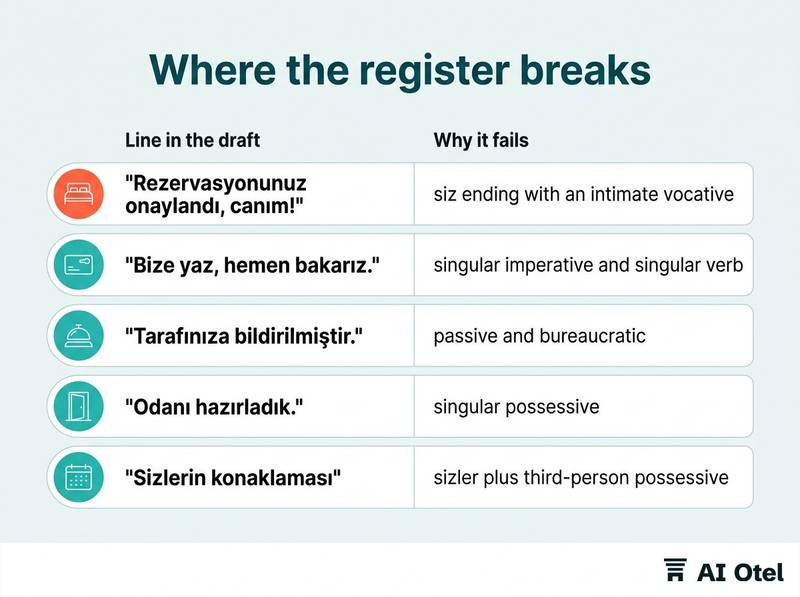
Siz is a pronoun; the register lives in the endings. "Odanızı hazırladık" is siz; "odanı hazırladık" is sen, and the model can produce both in one message. Imperatives are the usual break: "yazın" and "ediniz" belong to siz, "yaz" and "et" do not. Scan the message for bare verb stems.
Where the register breaks
| Line in the draft | Why it fails | Write instead |
|---|---|---|
| "Rezervasyonunuz onaylandı, canım!" | siz ending with an intimate vocative | "Rezervasyonunuz onaylandı. Sizi aramızda görmekten memnuniyet duyarız." |
| "Bize yaz, hemen bakarız." | singular imperative and singular verb | "Bize yazabilirsiniz; hemen ilgileneceğiz." |
| "Tarafınıza bildirilmiştir." | passive and bureaucratic | "Sizi bilgilendirmek isteriz: ..." |
| "Odanı hazırladık." | singular possessive | "Odanızı hazırladık." |
| "Sizlerin konaklaması" | sizler plus third-person possessive | "Konaklamanız" |
Formal but not cold
Formality is not distance. "Tarafınıza bildirilmiştir" is grammatically polite and reads like a tax notice; "Sizi bilgilendirmek isteriz" is equally formal and warmer. Avoid "sizler": it stacks a plural on a plural and reads overdone in a service message.
Watch the borrowed line. A warm sentence copied from the hotel's social media caption usually carries sen, and pasting it into a siz message splits the register. Greetings set the promise: "Sayın misafirimiz" opens a formal message, "Merhaba" opens a warm one. Both work with siz; the sign-off has to match the greeting you chose.
Which hotel terms does AI get wrong in Turkish?
The ones with a near neighbor: rate against amount against charge, advance payment against security deposit, the guest bill against the invoice. The model picks a word that fits the sentence and not the operation.
Money words
Keep three money words apart: "oda fiyatı" is the rate, "tutar" is the amount on the bill, "harcama" is a charge posted to the guest's account. Mixing them confuses the guest about what they will pay. Kapora is an advance payment counted toward the stay; depozito is a refundable security deposit held against damage or extras. Swapping them creates a billing dispute at check-out.
Board basis and stay words
Board basis has fixed Turkish names: "oda kahvaltı", "yarım pansiyon", "tam pansiyon", "her şey dahil". A draft that writes "yarım board" or "her şey dahil paketi" is translating, not writing. Check-in and check-out are "giriş" and "çıkış" in a guest message, with the hour attached: "giriş saati 14.00". "Fatura" is the fiscal document only; what the guest settles at the desk is the "misafir hesabı", or folyo in hotel shorthand.
| Concept | What the draft may say | What a Turkish hotelier writes |
|---|---|---|
| Room rate | "ücret", "tarife", "fiyat" used interchangeably | "oda fiyatı" for the rate, "tutar" for the bill amount, "harcama" for a posted charge |
| Board basis | "yarım board", "her şey dahil paketi" | "oda kahvaltı", "yarım pansiyon", "tam pansiyon", "her şey dahil" |
| Advance payment | "depozito" | "kapora (ön ödeme)" |
| Security deposit | "kapora" | "depozito" |
| Guest bill | "fatura" | "misafir hesabı (folyo)"; fatura only for the fiscal document |
| Housekeeping | "housekeeping ekibi" | "kat hizmetleri" |
| Day room | "dinlenme odası" | "günübirlik oda" |
The fix is a one-page house glossary kept next to the templates, so the model is given the right word rather than asked to find one. The same terms matter when staff work in other languages too; the counter card of front desk phrases in English, German and Russian is built on the same idea.
Why do Turkish AI drafts sound like translated English?
Because the sentence plan was made in English and carried over. Turkish puts the verb at the end, builds with suffixes rather than prepositions, and prefers one clear clause to a chain of "and".
Word order survives translation. An English sentence that opens with the reason and closes with the request comes back in the same order, which reads as an announcement rather than a reply. Long sentences get longer: English joins clauses with "and", Turkish drafts join them with "ve", and the guest loses the request somewhere in the middle.
Noun stacks are the clearest tell: "misafir memnuniyet anket sonuçları" instead of "misafir memnuniyeti anketinin sonuçları", or a phrase with the right words and the wrong joints. Light-verb calques appear where a single Turkish verb exists: "onay yapmak" for "onaylamak", "kontrol etmek" where "denetlemek" or "bakmak" is meant. Passive constructions with "tarafından" and heavy "konusunda" phrases read like a translated notice; a guest message is better with a named subject: "Resepsiyon ekibimiz ...".
The repair is upstream: ask for short sentences and one idea per sentence in the instruction, then split anything you run out of breath on when you read it aloud. If you want to know when machine translation alone is enough, see when AI translation is good enough for a guest message.
TipRead the draft aloud
A sentence you cannot finish in one breath is a sentence the guest will read twice. Split it at the first "ve" or the first comma, and check that each half still has a verb.
What should you check in numbers, dates and names?
Every one of them, against the reservation record, character by character. Numbers and proper nouns are where a fluent draft turns into a wrong promise.
Turkish number format is the reverse of English: 1.250 is one thousand two hundred fifty, and 1,250 reads as a decimal. A draft converted halfway is worse than one not converted at all. The percent sign goes first: %15, not 15%. Currency follows the amount: "1.250 TL", "1.250 avro". Dates are written 24.09.2026 or "24 Eylül 2026", with the month capitalized. Times use a dot: 14.00. A model that leaves 09/24/2026 in the text has not finished the job.
The model tidies names. For example, a guest who writes "Şükrü" may come back as "Şukru", and a room number "1208" can reappear as "12.08". Check every proper noun against the record. Flight numbers, confirmation codes, addresses and phone numbers are copied, never composed: if a code is not in the source you gave the model, it does not belong in the draft.
Policies are the quietest error: a cancellation window or a breakfast hour the model produced from habit. Compare every stated condition with the reservation and the hotel's own rule before sending. This is the same failure behind why AI assistants invent facts and how to catch them, and it is why the check is against the record, not against the sentence.
Watch outThe model tidies what should stay untouched
Every proper noun and every figure in the draft is checked against the reservation record, not against the sentence it sits in. A neater-looking name, room number or date is still a wrong one.
What is the two-minute check before you send?
A fixed six-item pass, always in the same order, done by the person whose name goes at the bottom. It takes about two minutes and it does not depend on how good the draft looks.
Checklist
- Read it aloud once, start to finish, without stopping to fix anything; mark what snags.
- Check every second-person ending against the chosen register.
- Check hotel terms and money words against the house glossary.
- Check numbers, dates, times, names and codes against the reservation record.
- Split any sentence carrying two ideas.
- Read the greeting and sign-off together for register match.
Make the next draft start closer
Every failure you find is a lesson for the instruction, not just for this message. If the register drifted, strengthen the register note; if a term was wrong, add the wrong variant to the glossary as "do not use". Drafts that start closer make the check shorter.
How do you make the check repeatable across a season?
Write the rules down once, in one page, and give the same page to the model and to the staff. A check that lives in someone's head leaves with them in September.
The page has three parts: the register note (siz, warm, endings held throughout), the glossary of hotel terms with the wrong variants listed next to them, and the six-item check. Paste the register note and the glossary into the instruction you give the model, so drafts start closer and the check gets shorter.
Keep five approved messages as models: a confirmation, a change, an apology, an upsell offer and a check-out note. New drafts are compared against them, not against taste. Name one person who signs guest messages per shift, and let anyone hold a draft that fails the check. The hold is not an escalation; it is the process working.
Review the glossary at the start of each season, when rates, board names and offers change, and delete the terms the hotel no longer uses. If your hotel runs on a hotel operating system, the reservation record the check runs against is the same system your team works in; the wider platform overview shows how the pieces connect.
What to do next
Write the one-page house note this week: the register, the glossary and the six checks. Then run the next guest draft through it before it goes out. The parts fit together as one control: fluency comes free from the model, and the address form, the terms, the sentence build and the facts are what the hotel still has to verify. A fixed two-minute pass is what makes that verification survive a busy morning.
Frequently asked questions
Is it enough to tell the AI to write in formal Turkish?
It sets the starting point, not the consistency. English "you" gives the model no signal for siz against sen, so it can drift inside one message even after a clear instruction. Keep the instruction, add the house glossary, and still check every second-person ending before sending.
Should a guest message use "siz" or "sizler"?
Plain "siz". "Sizler" stacks a plural on a plural and reads overdone in a service message. What matters more than the pronoun is that the endings match it from the greeting to the sign-off.
What is the difference between "kapora" and "depozito"?
Kapora is an advance payment counted toward the stay; depozito is a refundable security deposit held against damage or extras. They are not interchangeable, and a draft that swaps them sets up an argument at check-out.
My own Turkish is not strong. Can I still check the draft?
Yes, on structure. Read it aloud, count the ideas in the longest sentence, compare every hotel term with the glossary and every figure with the reservation record. Have a native speaker approve the glossary and the five model messages once, and the daily check becomes a comparison rather than a judgment.
Does a draft that reads well need checking at all?
Yes. Reading well is what the model is good at, and it is exactly what hides a mixed register, a translated board basis or a tidied room number. The check is short because the draft is fluent, not because it is correct.