Comparing supplier quotes with AI: a clean table, a check of the arithmetic and the decision with a person
An AI tool can turn three differently formatted supplier quotes into one draft table and recompute the arithmetic. A person must then check every figure against the original, score the offers against criteria set in advance, and sign the decision.
AI draft · awaiting editorial review
Contents
Key takeaways
- An AI tool turns quotes into a draft table; only a person turns a draft table into a decision.
- Strip supplier names, contact details and bank identifiers before a quote goes into any tool, and keep the key in a separate file.
- A comparison table needs unit, pack size, VAT basis, delivery, lead time, warranty, payment terms, validity and exclusions, or the price column compares nothing.
- Check cell by cell against the original: a matching total can still hide a dropped line and a misread unit.
- Write the criteria and weights before the quotes are opened, and record the reason and the approver on the sheet.
An AI tool can pull three differently formatted supplier quotes into one table with fixed columns and recompute every line, which saves the typing but not the checking. A person then reconciles each figure against the original document, scores the offers against criteria set in advance, and signs the decision.
Three quotes for the same item arrive as a PDF, a photographed printout and a paragraph pasted into an email. Before anyone can compare them, someone has to make them look alike, and that is the part an AI tool does well and the part it can quietly get wrong. This guide shows how to use AI to compare supplier quotes at a hotel: build one clean table, check every figure against the original pages, and keep the choice, the reason and the signature with people.
What can an AI tool actually do with three supplier quotes?
It can turn three differently laid-out documents into one draft table with the same columns, and it can redo the arithmetic on every line. It cannot know what a quote leaves out, and it cannot be trusted to have read a number correctly until a person has checked it against the page.
Extraction is the first step. The tool reads text from a PDF, an email body or a spreadsheet and returns rows. A photographed or scanned page has to be turned into text first, which is optical character recognition, and that step introduces its own misreads of digits. If you want to understand that step in more depth, read about how OCR works when invoices and delivery notes are read into hotel systems.
Normalization is the second. The tool rewrites each supplier's wording into one unit, one currency and one VAT basis, so that a price per case of twelve and a price per piece finally sit in the same column. Then comes arithmetic: it recomputes quantity times unit price for every line and flags the lines where the supplier's own stated total does not match.
Gap detection is often the most useful output. The tool lists which columns are empty for which supplier, and the missing warranty term is frequently the real difference between two offers. What the tool cannot do is understand scope from prose. Whether delivery includes unloading, whether a warranty covers the part or the labor, whether a price holds if the order doubles: all of that lives in sentences the tool will summarize but not interpret for you.
NoteName the draft so nobody mistakes it
The tool's first output is a draft table, not a comparison. Save it under a name that says so, for example "draft, unchecked, 12.03", and never send it to a supplier or an approver without the checked version beside it.
What should you remove from a quote before it goes into an AI tool?
Supplier names, people's names, contact details, bank and tax identifiers and any negotiated discount schedule. Replace each supplier with a letter and keep the key in a separate file that never leaves the hotel.
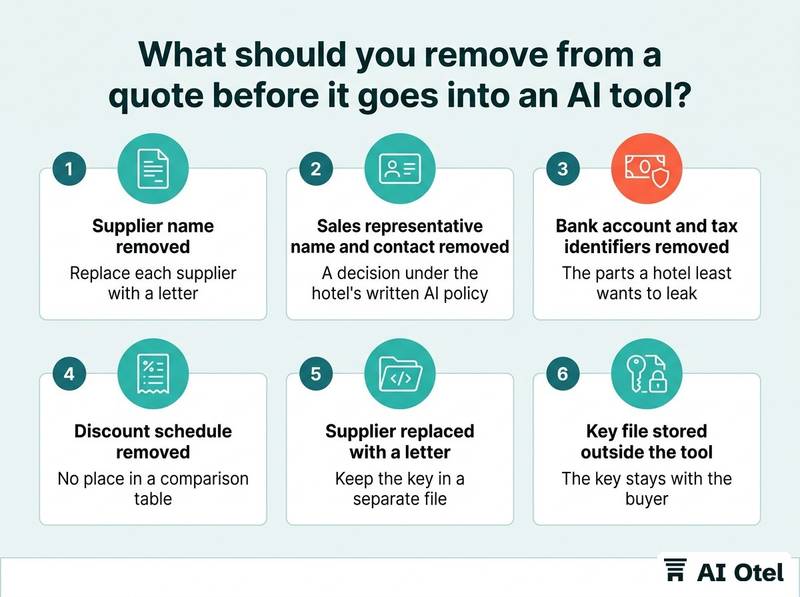
Identity is not needed for a price comparison. Removing it also removes the chance that a summary quietly favors a name it recognizes. A quote usually carries a sales representative's name, phone and email; whether that may be shared with a tool is a decision under the hotel's own written AI policy and its data protection rules, taken with the person who advises the hotel on those rules. If your hotel has not written that policy yet, start with what staff may share with AI chat tools.
Bank account details, tax numbers and volume discount schedules are the parts a hotel least wants to leak, and they have no place in a comparison table. Keep the mapping key offline: Supplier A is the file in the folder, Supplier B is the other one, and the key stays with the buyer, not in the tool. Decide which tool is allowed at all before the first quote is opened, and write the answer down, so the decision is not remade by whoever is at the desk that day.
Blind comparison has a second benefit. Scoring against fixed criteria is more honest when the scorer cannot see whose offer is on the row.
ChecklistBefore pasting anything in, run this list
- Supplier name removed
- Sales representative name and contact removed
- Bank account and tax identifiers removed
- Discount schedule removed
- Currency and VAT basis stated in the header
- Supplier replaced with a letter
- Key file stored outside the tool
- Draft labelled as unchecked
Which columns must the comparison table have?
One row per line item, one column per supplier, and a fixed set of attributes that every quote is forced into: unit, pack size, unit price, line total, VAT basis, delivery, lead time, warranty, payment terms, validity and exclusions.
Unit and pack size come first. A price per piece and a price per case of twelve cannot be compared until one of them is converted, and the conversion belongs in a visible column, not in someone's head. Keep unit price and line total apart, because a low unit price behind a minimum order quantity is not a low price for the hotel. State whether each price is net or gross and at what rate; mixing the two inside one column distorts the whole ranking.
Delivery needs four answers: cost, who unloads, lead time counted from the order, and whether partial deliveries are accepted. Warranty needs duration, what is covered, who pays for the part and who pays for the labor, and the response time when something fails. Payment terms and validity matter too: days of credit, currency, and how long the offer holds. A price that expires in a week is a different offer from one that holds a quarter.
The columns that decide the ranking
| Column | What it holds | Why it matters |
|---|---|---|
| Item and unit of measure | The thing bought, in the unit the storeroom counts | Makes rows comparable |
| Pack size | Pieces per case, weight per bag | Basis of any conversion |
| Unit price | Per the stated unit, net or gross | The number everyone looks at |
| Line total | Quantity times unit price, recomputed | Catches arithmetic errors |
| VAT basis | Net or gross, and the rate | Mixing bases distorts ranking |
| Delivery cost and unloading | Cost, who unloads | Real landed cost |
| Lead time in days | Counted from order | Affects operations planning |
| Warranty | Duration, parts, labor, response | Often the real difference |
| Payment terms | Days, currency | Fits the cash cycle or not |
| Offer validity | Date the price stops holding | An expiring price is a risk |
| Exclusions | What the supplier says is not included | Where offers truly differ |
An exclusions column, filled from the supplier's own sentences, is where the real difference between two offers usually sits. If your hotel does not yet have a standard sheet, compare it against a purchase request form and quote comparison sheet for hotels to see what each must hold.
How do you check every figure against the original?
Reconcile cell by cell, not total by total. Read each figure in the table back to the page it came from, recompute every line total and the column sum yourself, and mark each row as checked with initials and a date.
Three totals have to agree: the tool's sum, your recomputed sum, and the total the supplier wrote on its own quote. If they do not, the difference is explained on the sheet before anything moves forward. Unit conversion is the commonest error: a case price entered as a piece price multiplies the mistake by the pack size, and the line still looks plausible.
Count the lines. Compare the number of items in the original document with the number of rows in the table; a dropped line is invisible in a total and invisible in a ranking. Look for filled cells with no source. A number that appears where the supplier wrote nothing is the failure mode people fear most, and it is found by reading the page, not by reading the table.
Fix the format as you go: two decimals, one currency, and the date of any exchange rate used for a conversion. On the first pass, check every price cell. On later passes, check every cell that changed since the last pass, and say on the sheet which pass you are on. Record the check on the sheet itself, with initials and date, not in an email that will be lost by the time someone asks. The same discipline applies to any figure a tool produces; the habit of checking an AI or spreadsheet result against the source is what makes the rest of the workflow safe.
Watch outA matching total is not a right table
A dropped line and a misread unit can cancel each other out and leave the sum looking correct, which is why the check runs line by line against the original page.
Who makes the decision, and what goes on the sheet?
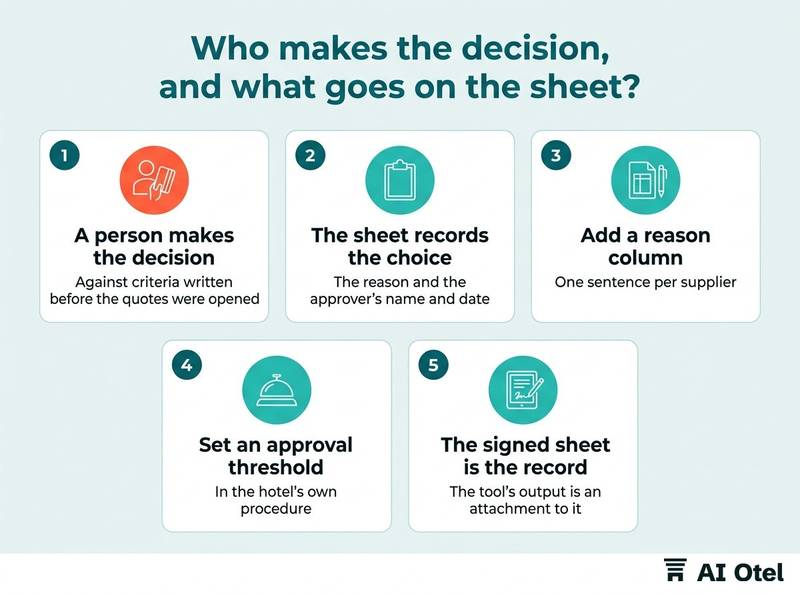
A person makes the decision, against criteria written before the quotes were opened, and the sheet records the choice, the reason and the approver's name and date.
Agree the criteria and their weights first: price, lead time, warranty, payment terms, and the supplier's record with the hotel. Written before opening, they cannot be fitted to the answer afterwards. The tool may compute the weighted score, and it should show its arithmetic so the score can be checked like any other figure. It must not be asked to choose.
Add a reason column: one sentence per supplier saying why it was not chosen. This is what protects the buyer a year later when someone asks why the cheaper offer lost. If the cheapest offer is not chosen, the sheet says what outweighed price: a delivery the hotel cannot take, a warranty that excludes labor, a payment term that does not fit the cash cycle.
Set an approval threshold in the hotel's own procedure, and keep the person who prepared the table from being the only person who approves above it. The signed sheet is the record. The tool's output is an attachment to it, and the original quotes are attachments too.
Key pointThree signatures of thought, not one
The comparison sheet carries the person who checked the figures, the person who recommends, and the person who approves. The AI tool appears nowhere on the signature line.
How do you keep the file so next year's comparison is easier?
Store four things together in one folder: the original quotes exactly as received, the checked table, the criteria and weights, and the signed decision. Next year that folder becomes the hotel's own price history.
Name by item, date and round, for example "minibar water, 03.2026, second round", so that a later reader knows which version they are holding. Keep the originals unedited. The table is a derived document and must always be traceable back to the page it came from.
Keep the criteria sheet with the decision. Next year's negotiation starts from what the hotel said mattered, not from a memory of who was cheapest. A price history per item per supplier shows movement over time without any need for a market statistic, and it makes an unexplained jump visible. How long to keep the folder is set by the hotel's own retention rule and confirmed with its accountant, not by habit.
Place the comparison where it belongs in the procedure: between the purchase request and the order, before anything is committed to a supplier. The wider flow, from order to storeroom, is covered in a hotel purchasing and receiving procedure.
What to do next
Take the last three quotes you compared by hand, rebuild them in the fixed columns, and check every price cell against the page before anything is signed. The tool saves the typing and the arithmetic; the criteria, the check and the signature stay with people, and the folder you build this time is the one that makes next year's comparison faster.
Frequently asked questions
Can AI compare supplier quotes automatically?
It can extract the lines into one table and recompute the arithmetic, which is the slow part. It cannot judge scope, it can drop a line or misread a unit, and it does not carry responsibility for the choice. The working pattern is automatic extraction, manual verification, human decision.
Is it safe to upload supplier quotes to an AI chat tool?
A quote often carries a sales representative's personal details, bank identifiers and negotiated discounts. Remove names, contacts and bank details, replace suppliers with letters, and let the hotel's own written AI policy and its data protection adviser decide which tool is allowed and what may go into it.
What if two suppliers quote in different units?
Convert both to the unit the storeroom actually counts in, and show the conversion in its own column with the pack size. Never let the tool convert silently: an invisible conversion is the error that survives every total check.
How do I know the AI did not invent a price?
Every filled cell must have a source on the original page. Read the table back to the documents line by line, count the lines, and recompute the totals yourself. A number in a cell where the supplier wrote nothing is the signal to check the whole row.
Should the AI recommend which supplier to choose?
No. Criteria and weights are agreed by people before the quotes are opened, the tool may compute the weighted score and show its working, and a named person records the reason and signs the decision. The recommendation and the responsibility stay in the hotel.