Do Not Disturb signs: when staff may knock, when a welfare check is due and how to log it
A Do Not Disturb sign stops service but never blocks safety checks. Learn the staged routine from a desk call to manager entry, and how to log every step.
AI draft · awaiting editorial review
Contents
Key takeaways
- A DND sign governs disturbance, not access: it stops service, and it never removes the hotel's duty to make sure the person inside is well.
- The clock starts at the first sighting, so the log needs a time next to every room number, not a tick.
- Escalation is staged: a desk call, a note under the door, a knock by two staff, then a manager's entry under the hotel's own written rule.
- A sign still hanging after check-out time is a departure question first and a welfare question second, so read the departure list before knocking.
- Every DND room closes with one line: what was found, who entered, when, and what the guest was told.
A Do Not Disturb (DND) sign is a guest's instruction not to be disturbed, not a bar to safety. Staff may knock when the hotel's own written rule triggers a check: an agreed late departure ending, a missed check-out, an unanswered call, or a concern about the guest's wellbeing. Each step is logged with room, time and outcome.
The sign has been on the door since yesterday morning. Housekeeping has skipped the room twice, the sheet says DND, and nobody can say when it first appeared. By mid-afternoon the question is no longer about cleaning. This article gives you a hotel do not disturb sign policy you can write on one page: what the sign means, how to log it, when to review it, and the staged routine from a desk call to a manager's entry.
What does a Do Not Disturb sign actually promise the guest?
It promises quiet and privacy for as long as it hangs, and it tells staff the room is occupied and not to be serviced. It does not promise that nobody will ever knock.
The sign is a standing instruction about service, given by the guest. It is a service instruction, not a contract, and it does not transfer the hotel's responsibility for the person inside. Treating it as an absolute would mean a hotel could never check on anyone, which is not what the sign is for.
The sign covers service rounds: housekeeping, minibar and turndown, linen changes, and maintenance visits that are not emergencies. It does not cover an emergency, a check-out time that has passed, or a check the hotel's own written rule calls for. A fire alarm, a call for help or a reported emergency overrides it without discussion, and the hotel's emergency procedure governs what happens next.
The sign is also only one channel. A no-service request at the desk, a message from the guest's phone, a note at booking: all of them must land on the same list, or the floor works from three different truths. If the desk knows the guest asked for no service until 15:00 but housekeeping only sees a sign, the log is already wrong.
The promise has to be written down because the night shift applies the rule the same way as the morning supervisor only if the rule exists on paper. And the tension this article resolves is real: the longer a sign hangs, the more the hotel owes the guest a check, and owes itself a record of it.
Key pointThe promise in one sentence
"We will not disturb you, and we will still make sure you are safe." Every DND procedure in the hotel should read as a footnote to that sentence.
A sign hanging for hours is not the same as a sign hanging for days. The same logic applies when the disturbance comes from the guest's room rather than their door: if another guest reports noise, the hotel still has to act, and answering the night call when a guest reports noise has its own routine.
How should a hotel log a DND room?
Log the room number, the minute the sign was first seen, who saw it, and every action taken afterwards, in one list that the floor supervisor and the duty manager both read.
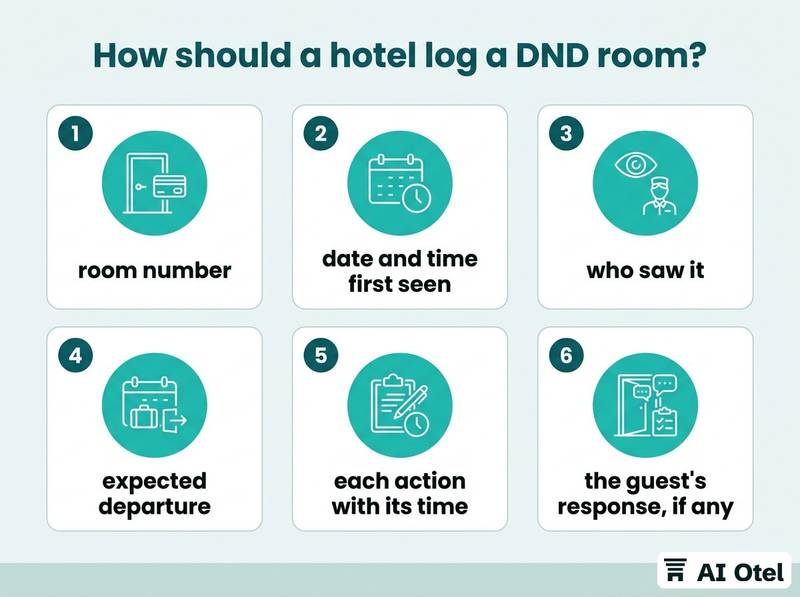
The first sighting is the trigger. A sign noticed at 09:10 and written down at 14:00 has already lost five hours of the hotel's own interval. Whoever sees the sign writes the time, not a tick at the end of the shift.
ChecklistOne list, not three. A housekeeping sheet, a room note in the hotel system and a paper shift log drift apart within a single day, and the drift is what a guest complaint is made of. The log fields that carry the record
- room number
- date and time the sign was first seen
- who saw it
- expected departure, from the arrival list
- each action with its time
- the guest's response, if any
- who closed the entry, and when
Name an owner per shift: the floor supervisor during the day, the duty manager at night, with a spoken handover at changeover and the list in the incoming person's hand. Write facts, not judgments. "Sign on door, call at 14:20 not answered" is usable at 22:00 by someone who was not there; "guest probably sleeping" is not.
Keep personal data to what the file needs. Health details and guesses about why the guest is inside do not belong in a log that many people read. The same discipline applies to the wider security picture: organizing hotel security from the entrance to the night shift works only if the records it produces are factual and minimal.
When should the supervisor review the DND list?
At mid-shift and again at handover, because a sign nobody reviews is a sign nobody owns.
At the mid-shift review, compare each first-seen time with the hotel's own interval and mark which rooms move to the next stage before the shift ends. The review catches more than DND: rooms due to depart today, rooms with an agreed late check-out, and rooms where housekeeping has had no access since the previous morning.
Keep it short. A list of room numbers with one decision written next to each takes minutes; a meeting about it does not happen twice. Give the reviewer the authority to start the next stage: a review that can only note a problem produces a note, not a check.
At handover, the incoming supervisor reads the list before the outgoing one leaves. A verbal handover alone loses the times, and the times are the whole record. The duty manager is brought in the moment any room passes the interval. That is the point where the hotel decides what happens next instead of discovering it later.
What is the staged routine: call, note, knock, manager?
Each stage adds a person and a record, so the hotel never moves from a hanging sign straight to a master key.
Stage one is the desk call. Ring the room, say who is calling and why in one sentence, and record the time and whether the phone was answered, busy or silent. Stage two is the note under the door: a written message with the time, the reason in neutral words and a number to call, copied into the log so the wording does not change between shifts.
Stage three is the knock by two. Two staff, an announcement of who they are, a wait long enough to be heard, and no entry. Record the attempt even when the guest answers. Stage four is the manager's entry: the duty manager plus security or a second colleague, entry under the hotel's own written rule, a witness present, and a record of what was found.
| Stage | Trigger | Who acts | What is recorded |
|---|---|---|---|
| 1 Desk call | sign seen and logged | front desk | time, answered or not |
| 2 Note under door | call unanswered | floor supervisor | time, copy of the wording |
| 3 Knock by two | no response after the hotel's interval | floor supervisor plus a colleague | time, who knocked, response |
| 4 Manager entry | interval passed or a concern reported | duty manager plus security | time, who entered, what was found, what the guest was told |
Set the trigger for the welfare check inside the hotel: elapsed time since first sighting, a missed check-out, an unanswered call after the agreed interval, or a concern reported by another guest or a staff member. Two rules hold the routine together: never enter alone, and never let the entry be the first contact with the guest.
What should the note under the door say?
It says who knocked, when, why, and how to reach the desk, in the guest's language, without alarm and without accusation.
Three lines are enough: the time and the fact of the attempt, the reason in neutral words, and the desk number with its hours. Add one practical line: housekeeping could not service the room, and when it can return. Sign with a role such as front desk manager, not a personal name, and keep the room number off the outside of the note so the corridor cannot read it.
Language matters. Turkish and English at minimum, plus the guest's own language where the desk has it, with every version kept in the log so the wording stays identical across shifts. Avoid words that frighten: no "urgent", no "security", no "we were worried". The note is an invitation to call, not an incident report.
TipExample wording, clearly illustrative
"Sayın misafirimiz, bugün saat 14:20'de odanıza ulaşmaya çalıştık ve sizi bulamadık. Her şeyin yolunda olduğundan emin olmak istiyoruz. Resepsiyon 24 saat ulaşılabilir: [numara]. Kat hizmetleri ekibimiz odayı saat [xx]'te servis edebilir." The English version carries the same three lines: "Dear guest, we tried to reach you at 14:20 today and could not. We would like to make sure everything is all right. The front desk is available 24 hours: [number]. Housekeeping can service your room at [time]." Store both in the log.
If the hotel runs a guest app, the same words should reach the guest's phone there. The paper note and the screen must never contradict each other, which is one reason hotels put requests and messages in the hotel's own guest app, which carries the bill and the guest's requests rather than relying on paper alone.
What changes when the sign is still out after check-out time?
The stay has ended, so the sign stops being a service instruction and becomes a departure question: read the list, then knock.
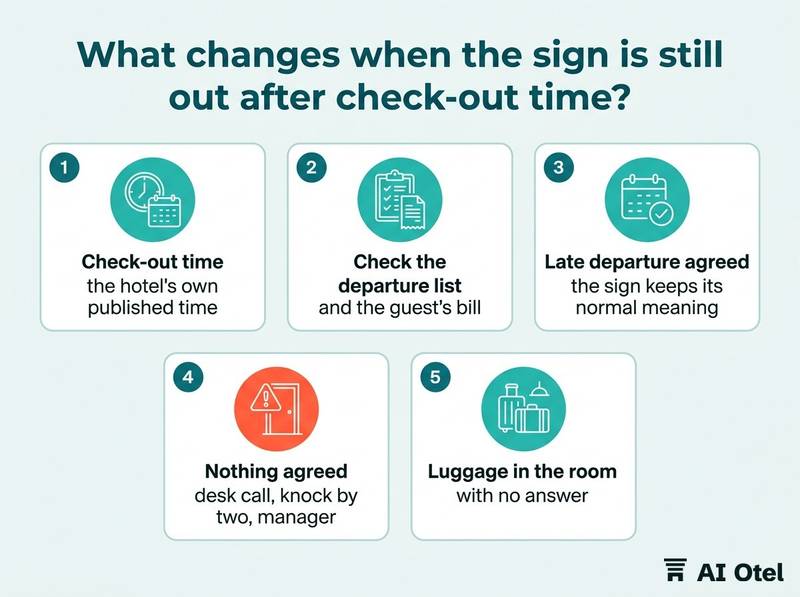
Check-out time is the hotel's own published time. Write it into the rule so the desk and the floor work from the same hour. Before anyone knocks, check the departure list and the guest's bill: an agreed late check-out, a delayed flight, an extension that was promised but never entered in the system. If a late departure was agreed, the sign keeps its normal meaning until the agreed time, and the log records that time next to the room.
If nothing was agreed, the routine compresses: desk call, knock by two, manager. The hotel does not wait out its usual interval for a stay that has already ended. Luggage in the room with no answer is a different case from a room that looks unused; record which one it was, because the next decision depends on it.
Any charge for a late departure is the desk's decision under the hotel's own published rule. Keep that decision out of the welfare log.
Watch outA passed check-out time changes the timetable, not the routine
Call first, knock with a witness, then bring in a manager. It is never permission to walk in.
How do you close the log and record what was found?
Every DND room ends with one line: what was found, who entered, at what time, and what the guest was told.
Record one of three outcomes: the guest answered, the room was empty, or entry was made and the guest was present. Write what was seen in plain words and nothing more: no diagnosis, no speculation, no detail the next reader does not need.
Checklist
- outcome: answered, empty, or entry made with guest present
- time of entry, if any
- who entered
- what the guest was told, and by whom
- service still owed: cleaning, minibar, linen
- whether the interval or the wording needs to change
Handle the guest's return at the desk: a short explanation, an apology for the disturbance where one is due, and the offer of the service that was missed. If the room needs work before it goes back into sale, that follows the normal route, starting with the supervisor's room inspection before the room goes back into sale.
Review the closed log at the end of the day: which rooms crossed the interval, how long each stage took, and whether the interval produced false alarms. Change the hotel's own interval from that review, in writing, and tell the next shift. A rule that is never revised is a rule staff learn to work around. Keep the closed log for the hotel's own review period and treat it as a record, not a diary.
Write the rule this week
Put the rule on one page: one log, one interval, one note wording, and one person who signs off at the end of each shift. The stages only work in order, and the log is what makes the order visible to whoever is on duty at three in the morning. If you want the same routine to run across several properties from one place, a hotel operating system can carry the log, the departure list and the guest's messages side by side; the platform overview describes how these pieces fit together.
Frequently asked questions
Can housekeeping skip a DND room for the whole day?
Yes for service, no for the log. The room stays on the list, the supervisor reviews it at mid-shift, and the hotel's own interval decides when a check is due. A skipped room is still a room the hotel is responsible for.
Who should knock, housekeeping or security?
It depends on the stage. Early stages belong to the floor supervisor or the front desk; the entry stage needs the duty manager plus security or a second colleague. Nobody knocks or enters alone.
Does a DND sign stop staff entering in an emergency?
No. A fire alarm, a reported emergency or a call for help overrides the sign, and the hotel's emergency procedure governs what happens next. The sign is an instruction about service, not a barrier to safety.
What if the guest sleeps through the knock?
Record the attempt with its time, leave the note, and return at the next interval the hotel's rule sets. A silent room after a recorded attempt is exactly the case the escalation stages exist for.
Should a resort and a city hotel use the same DND rule?
No. The interval depends on stay patterns, staffing and how the property is laid out, so each hotel writes its own and reviews it against its own closed logs. What must not differ is the order of the stages.