Emailing travel agencies and tour operators: what the commercial message rules say about messages to businesses
This guide explains the commercial message rules for emailing travel agencies in Türkiye. It covers Article 6(3) and 6(6), İYS checks, and how to separate promotion from business correspondence.
AI draft · awaiting editorial review

Contents
Key takeaways
- Article 6(3) removes the prior approval step for messages to merchants' and tradesmen's electronic addresses; it does not remove their right to refuse.
- Article 6(6) places the check on the sender: register the agency's address in İYS and confirm its refusal status before the message goes out.
- A confirmation for a booking the agency already made and a seasonal rate sheet are different messages, and only one of them is promotion.
- One record per address, carrying its source, capture date, recipient status and every refusal, is what makes an agency list explainable a year later.
- A refusal is a stop signal for that address; the usual failure is a colleague re-importing last season's export.
In Türkiye, a commercial email to a merchant or tradesman at their business address is generally treated more lightly than a message to a consumer: prior approval is often not the starting point, but a refusal must be respected and the message must stop. İYS, the central permission registry, is where permissions and refusals are managed, and checking a recipient's status before sending is good practice. Whether your own messages fall under the lighter B2B rules, and what registering business addresses in İYS requires of you, depends on your case: confirm the current article numbers, scope and enforcement dates with a legal adviser before you build a campaign around them.
Every season the sales office exports the agency list, attaches the new rate sheet and presses send. That list mixes company inboxes, personal addresses, contracts signed three years ago and one reservations manager who asked to be removed last spring. After reading this article you will be able to sort that list by recipient status, run the İYS check with evidence, separate promotion from correspondence, and keep records that still make sense next season. This is the B2B marketing email routine for travel agencies in Türkiye, built from two articles of one regulation.
Who on your agency list is a merchant or a tradesman?
The lighter rule follows the address, not the industry: it covers electronic addresses of merchants and tradesmen, so an address qualifies because the recipient is a business acting in its trade, not because the word agency appears in the company name.
The address is not the company
In plain meaning, a merchant is a business registered in the trade registry; a tradesman is a small business registered with the tradesmen's and craftsmen's chamber. A travel agency set up as a company is normally a merchant. A one-person agency can be a tradesman.
The address decides as much as the company. A message to the agency's own domain address is one thing; the same message to the reservations manager's personal inbox is another, because that address may belong to an individual rather than to the business. Shared inboxes are the common case in contracting teams and the easiest to evidence: the address belongs to the company, and the person behind it changes.
Addresses collected from a trade show badge or a business card prove a contact, not a status. Keep them on a separate list until the status is established. When you cannot establish it, leave the address out of the campaign. A missing recipient costs one email; a wrong classification costs the record you would need later. Messages to guests follow a different track with different rules, covered separately in this blog on marketing messages to hotel guests and İYS consent.
What to ask for when the contract is signed
Establish status at contract stage, not at campaign stage. Ask for the trade registry number or tax number, file it with the signed contract, and write the date you confirmed it. That single habit answers the status question for every later campaign.
| Address on your list | Likely status | What to do before sending |
|---|---|---|
| Company domain of a contracted agency, trade registry number on file | Merchant | Send after the İYS check |
| One-person agency, tax number, no trade registry entry | Tradesman | Send after the İYS check |
| Personal inbox of an employee at a large operator | Unclear, likely an individual | Keep off the campaign list |
| Shared contracting inbox at a tour operator | Business address | Send after the İYS check |
| Trade show badge, no record | Unknown | Separate list until status is confirmed |
| Inherited from last season's export, no source | Unknown | Confirm source or delete |
What does the regulation say about prior approval for merchants and tradesmen?
Article 6(3) says prior approval is not required for messages sent to the electronic addresses of merchants and tradesmen, and adds that once they have exercised their right to refuse, they cannot be messaged without approval (Ticaret Bakanlığı, Madde 6, 15 November 2026 (opens in a new tab)).
What prior approval normally means
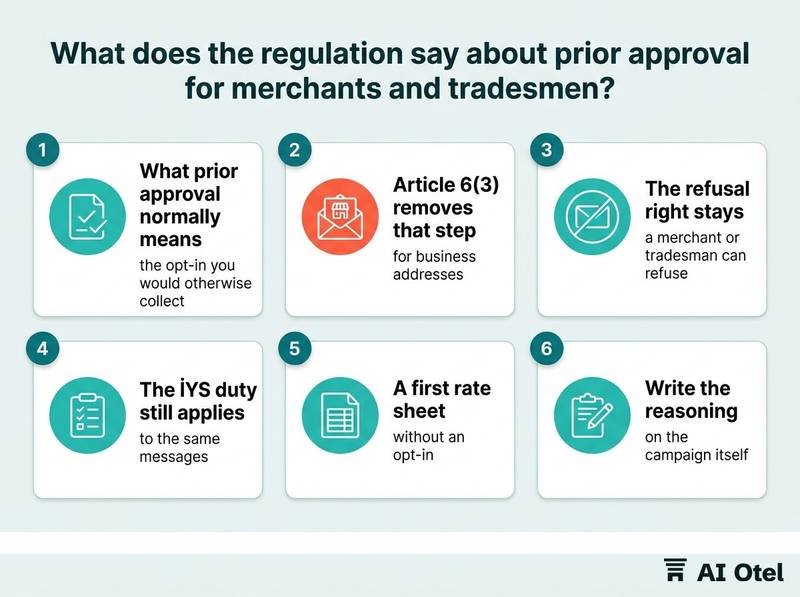
Prior approval is the opt-in you would otherwise collect before the first message. Article 6(3) removes that step for business addresses, so a first offer to a new agency does not need a signed permission first. This is what makes B2B marketing email to travel agencies in Türkiye lighter than the consumer side.
It removes one step, not the obligation around it. The refusal right is the part that stays with the reader: a merchant or tradesman can refuse at any time, and after that the address can only be messaged with approval. The İYS duty in Article 6(6) still applies to the same messages.
What Article 6(3) leaves in place
The practical consequence for the sales office: a new agency can receive a first rate sheet without an opt-in, provided the address belongs to a merchant or tradesman and the İYS check has been done. Write the reasoning on the campaign itself: which article you relied on, which addresses qualified, and who confirmed the status.
Key pointThe two rules in plain words
Article 6(3): no prior approval is needed for messages to merchants' and tradesmen' addresses, but after a refusal the address cannot be messaged without approval. Article 6(6): register those addresses in İYS and check refusal status there before sending. Source: Ticaret Bakanlığı, Ticari İletişim ve Ticari Elektronik İletiler Hakkında Yönetmelik, Madde 6.
The regulation also sets content and format duties for commercial electronic messages, and those are not restated here; confirm the current text for them, and for your own case, with a legal adviser.
What is İYS and what do you check there before sending?
İYS (İleti Yönetim Sistemi) is the central registry where recipients manage permissions and refusals, and Article 6(6) requires the sender to register the merchants' and tradesmen's addresses there and check whether they have used the right to refuse before sending.
Register once, check every time
A central register exists because a refusal recorded once follows the recipient across senders; the check is not something each hotel can keep privately. Register the address once, then check before each campaign. A check done last January says nothing about the list you are about to mail in June.
The check has three outcomes. The address is unknown, so register it. No refusal is recorded, so send. A refusal is recorded, so do not send and update your own list. The check is per address: two contacts at the same operator can produce two different results.
Keeping the evidence
Export or screenshot the result with the date and time, and file it with the campaign. The record is what you show if the send is questioned. Name the person who runs the check: "the team does it" means nobody does it in the week the season opens.
ChecklistPre-send İYS checklist
- The address is confirmed as a merchant's or tradesman's business address
- The address is registered in İYS
- Refusal status checked for this campaign, not an earlier one
- Result exported with date and time, filed with the campaign
- Addresses showing a refusal removed from the export before sending
- One named person signs off the check
- The sign-off is repeated for every later campaign
Is a rate list to an agency a commercial message, or just business correspondence?
It depends on purpose: a message that advertises or promotes the hotel's rooms is a commercial electronic message, while correspondence that only carries out a booking the agency has already made is not.
Three questions that classify a message
Ask three questions. Does the message promote something the agency has not bought? Is it going to a list rather than to the contact handling one booking? Would the recipient describe it as advertising? For example, correspondence: a confirmation of a FIT booking, a rooming-list query for a group arriving on Tuesday, an invoice with its e-document attached, a question about a name spelling. For example, promotion: the January rate sheet, an early-booking offer, a note that twenty rooms are free in August, an invitation to a trade fair stand.
The mixed message
The mixed message is the real problem. A confirmation with a paragraph promoting the spa is doing two jobs; either send the promotion separately or leave it out. The distinction earns its keep because the refusal record and the İYS check attach to the commercial message: sending promotions down the transactional path hides them from the record you keep.
Keep the two on separate sending paths: operational mail from the reservations system, campaigns from the marketing tool. Authentication and domain reputation belong to the operational path and are worth their own attention; see SPF, DKIM and DMARC for hotel confirmation emails.
| Message | Purpose | Sending path |
|---|---|---|
| Booking confirmation | Carries out an existing deal | Operational |
| Rooming-list chase for an arriving group | Carries out an existing deal | Operational |
| Invoice with e-document | Carries out an existing deal | Operational |
| Contract renewal letter with new season's rates | Mixed | Split before sending |
| Seasonal price list to the whole agency list | Promotion | Campaign |
| Last-minute availability note to fifty agencies | Promotion | Campaign |
| Spa offer appended to a confirmation | Promotion inside correspondence | Split before sending |
How do you build an agency list you can defend next season?
One record per address, carrying where it came from, when it was captured, what the recipient's status is and every refusal, is what turns an export into a list you can explain.
What each source proves
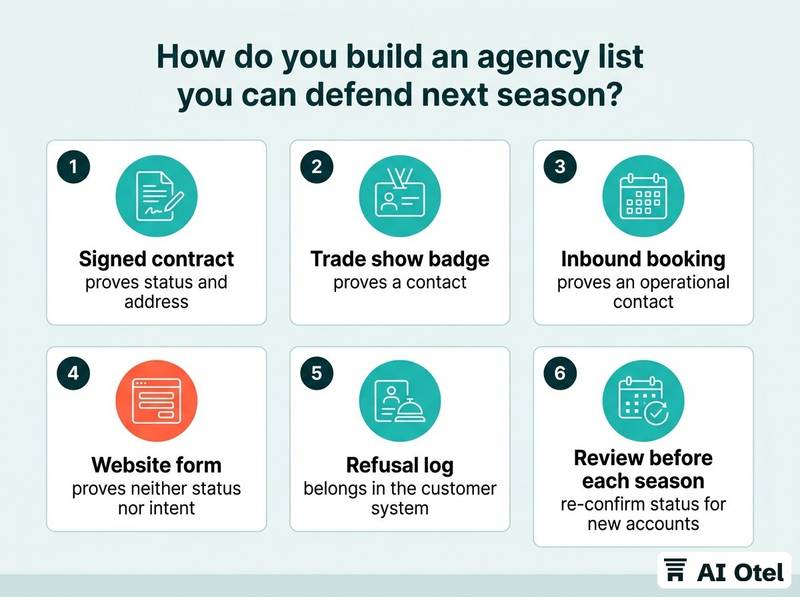
Sources differ in what they prove. A signed contract proves status and address. A trade show badge proves a contact. An inbound booking proves an operational contact. A website form proves neither status nor intent.
Fields that make a record defensible
Role changes are the quiet failure. A contracting inbox survives a departure; a personal address does not, and the person who replaces the manager never agreed to anything. The refusal log belongs in the customer system, not in one person's mailbox: if the only copy of a refusal is an email thread, it will be lost by the next hire.
Review before each season rather than continuously: re-confirm status for new accounts, re-check İYS for all of them, and delete addresses whose source cannot be named. This list is the raw material for the yearly plan described in a yearly B2B plan for agencies, tour operators and corporate accounts, which is a commercial exercise on top of a clean record.
ChecklistRecord fields checklist
- Address
- Company legal name
- Trade registry or tax number
- Recipient status with the date confirmed
- Source of the address
- Date captured
- Date of the last İYS check
- Refusal date and channel
- Owner inside the hotel
- Whether the address is shared or personal
What do you do with a refusal or a complaint?
Treat a refusal as a stop on that address: record it the day it arrives, remove the address from every list, and let the İYS check confirm it before any future send.
The shapes a refusal takes
A refusal arrives in several shapes: the unsubscribe route in the message, a reply to the sales representative, a phone call to the reservations desk, a complaint addressed to the company rather than to a person. Route every shape to one log with the date and the channel. The representative who received it must not be the only holder of the fact.
A complaint is a signal to review the whole list, not just the one address: check the other recipients from the same source and the same season. Some agencies would rather pull rates than receive them; an agency booking portal answers that preference and keeps the rate conversation out of the inbox.
Why old exports are the risk
Never rebuild the list from an old export. If the customer system is the only source, a refusal cannot quietly return with a spreadsheet.
Watch outA refusal in one inbox is not recorded
If a refusal lives only in a representative's mailbox and the address reappears in next season's export, the hotel has no evidence of the refusal and no explanation for the send. One log, one owner, checked before every campaign.
What to do next
Open the agency export this week and add four columns: status, source, date captured and refusal. Then run the İYS check before the next send. The pieces fit in one order: establish who the recipient is, apply Article 6(3) to that address, run the Article 6(6) check, classify the message as promotion or correspondence, and keep the record that proves all four.
Frequently asked questions
Do I need consent to email a travel agency in Türkiye?
Article 6(3) of the Regulation on Commercial Communication and Commercial Electronic Messages says prior approval is not required for messages to the electronic addresses of merchants and tradesmen. The address must genuinely belong to a merchant or tradesman, the right to refuse still applies, and Article 6(6) requires registering the address in İYS and checking refusal status before sending. This is the core rule behind B2B marketing email to travel agencies in Türkiye.
How often should a hotel check İYS before a B2B campaign?
Before each campaign, not once a year: a check made in January does not describe the list in June. Register the address once, check refusal status each time, and file the dated result with the campaign so the check can be shown later.
Is a seasonal rate sheet to agencies a commercial electronic message?
If its purpose is to advertise or promote the hotel's rooms to a list, yes. Correspondence that only carries out a booking the agency already made, such as a confirmation, a rooming-list query or an invoice, is not promotion. Mixed messages should be split so the promotional part stays on the campaign path.
What if the address on my list is the reservations manager's personal inbox?
The status question moves from the company to the person, and the Article 6(3) reasoning may not hold. Keep personal addresses off the campaign list until the status is established, and prefer the agency's own domain address or a shared contracting inbox, which also survives staff changes.
Does a refusal from one person at an agency cover the whole company?
The check is made per address, so record the refusal against the address that refused and remove it from every list. Flag the account in the customer system so a colleague does not re-add the same address from an old export, and review the other addresses from the same source.
Sources
- Ticari İletişim ve Ticari Elektronik İletiler Hakkında Yönetmelik, Madde 6 (opens in a new tab)Ticaret Bakanlığı / mevzuat.gov.trmevzuat.gov.tr
- Ticari İletişim ve Ticari Elektronik İletiler Hakkında Yönetmelik, Madde 6 (opens in a new tab)Ticaret Bakanlığı / mevzuat.gov.trmevzuat.gov.tr