Happy hour at a hotel bar: does it fill the bar or only cut the price of the evening?
A happy hour fills the bar only if it adds covers that would not otherwise have been sold. Learn how to set a baseline, design the offer, and run a four-week test to see if you are adding trade or just moving it.
AI draft · awaiting editorial review
Contents
Key takeaways
- A happy hour earns its place only if the whole evening's covers and drinks rise, not just the discounted hour.
- Count covers, drinks and revenue for every hour of the evening for four weeks before you change a price.
- Discount a short list of drinks whose cost per serve you know, never the whole menu, and set a limit per guest.
- Write the stop rule before the first night, so the decision is not made by the busiest Friday of the month.
- A discount that leaks outside its window, through voids, staff drinks or loose pours, is a cost with no promotion attached.
A hotel bar happy hour is a fixed window in which named drinks sell at a lower price. It fills the bar only when it adds covers or drinks that would not otherwise have been sold at that hour; if the same guests would have paid full price later, it moves revenue rather than adding it. Test it with a four-week hourly count.
The bar is quiet at six and full at nine. A happy hour is meant to pull some of that nine o'clock trade forward, but it also cuts the price of every drink sold to guests who were coming anyway. Only a count tells you which of the two happened. After reading this you will be able to set a baseline, design the offer so its cost is calculable, run a four-week test and read the result honestly.
What is a happy hour meant to do, and who is it for?
It is meant to add trade in an hour that would otherwise be empty, not to lower the price of an evening that was going to happen anyway. The first decision is who the offer is for: guests already staying in the hotel, or people who are not.
Define the tool plainly. A happy hour is a fixed window in which a named list of drinks sells at a lower price. The discount is what the bar pays to buy demand at that hour, and it should be judged like any other cost.
Two mechanisms are at work, and they look identical from behind the bar. Added demand means people who came because of the offer, or ordered a second drink because of it. Shifted demand means the same guest ordering at 18:30 what they would have ordered at 20:00.
Shifted demand is not automatically a failure. Moving trade earlier can smooth a peak, free tables at the busiest hour and use staff time that is already paid for. What it cannot do is add margin, because the drink was going to be sold at full price.
Residents are already on site, so a discount aimed at them usually lands on a sale the bar already had. The honest argument for it is a longer stay in the bar and a higher spend per cover, not new covers. Outside guests add covers, but they need a reason to walk in, and the hotel has to handle access, seating for residents and the effect on the room's atmosphere.
Pick one primary target for the test and write it down before the price is set. A test with two targets cannot fail, and a test that cannot fail teaches nothing.
What baseline do you need before you discount anything?
Four weeks of hourly counts from the same evenings, taken before the offer starts, so that any change has something to be compared with. A nightly total is not a baseline: it hides the hour the offer is meant to fix.
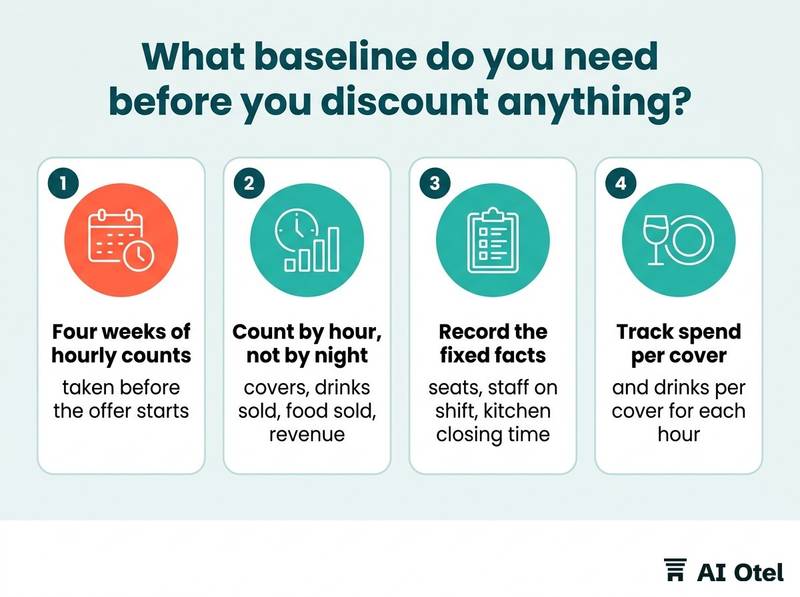
Count by hour, not by night: covers, drinks sold, food sold, revenue and how many of those covers were in-house guests. Use the till's own time stamps. A tally at the door counts people, not spend, and cannot tell you what they ordered.
Record the fixed facts of the room alongside the numbers: seats, staff on shift, kitchen closing time, whether the terrace was open. A rainy Tuesday is not a comparison for a warm Friday. Keep the same days of the week in the baseline and in the test; a week with a wedding group in house is not a comparable week.
Track spend per cover and drinks per cover for each hour. These move before total revenue does, so they show the effect earlier. Write the baseline down and share it with the bar team, so the test is judged on the sheet rather than on memory.
For example, if the 18:00 to 19:00 hour shows 12 covers and 18 drinks across four Tuesdays, that is the number the offer has to beat. The figures are illustrative.
ChecklistBaseline count sheet, one row per hour band per night
- Date and day of week
- Hour band
- Covers
- Drinks sold
- Food items sold
- Revenue
- In-house covers and outside covers
- Staff on shift
- Notes: weather, in-house group, event, terrace open or closed
How do you design the hours, items and limits?
Put the offer in the hour the baseline shows is weakest, on a short list of drinks whose cost per serve you know, with a limit per guest and a written rule on who may buy. Every one of those four choices changes the result you will read later.
Start with one hour, or ninety minutes at most. A longer window raises the share of sales that are discounted and blurs the comparison with the baseline. Choose items by margin and by speed of service, not by what is slow to sell: a drink with a low cost per serve and a simple build protects the margin while the price is down. Build that cost per serve from the pour, the mixer, the glass and the garnish before the price is set, and use the same margin logic you use for the rest of the list.
Never discount the whole menu. A fixed list makes the cost calculable and the pour standard enforceable, and it gives the bar team one clear rule. Set a limit per guest, and decide whether the offer applies at the bar, at the table, or both; the service point changes how fast the drinks go out and how easy the price is to control.
Food deserves a decision in advance. A small, high-margin food item sold alongside the drinks raises spend per cover and slows the drinking; decide whether it is part of the offer or sold at full price. Check seats, glassware and one bartender's throughput before promising a full room a fast pour: a queue at the bar costs more goodwill than the discount buys. The same thinking behind choosing which items to feature comes from menu engineering for hotel restaurants.
| Design choice | Narrow option | Broad option | What it changes |
|---|---|---|---|
| Window length | One hour | Three hours | Share of evening sold at the lower price |
| Item scope | Named list | Whole menu | Whether the cost is calculable |
| Eligibility | Residents only | Open to walk-ins | New covers vs earlier covers |
| Limit per guest | One drink | No limit | Cost ceiling per cover |
| Food | Paired item | Drinks only | Spend per cover, pace of drinking |
| Service point | Bar only | Bar and table | Throughput and price control |
How do you run a four-week test?
Run the offer for four weeks on the same evenings as the baseline, change nothing else in the bar, and count the same columns every night. Four weeks covers a roster cycle and gives enough evenings to see past one good Friday.
Keep other changes out of the bar for the duration: no new menu, no new seats, no change in opening hours. Two changes at once make the result unreadable. Brief the team before the first night on what the offer is, what it is not, and what to say when a guest asks for the price outside the window; the structure of that briefing is the same as in the restaurant pre-service briefing.
Count every night, including the quiet ones. A test that records only good nights proves nothing about the offer. Check at the halfway point for operational problems only: stock, glassware, queue at the bar, kitchen timing. Do not read the result at halfway. Keep the count sheet identical to the baseline sheet; a new column or a changed hour band breaks the comparison you spent four weeks building.
TipWrite the stop rule before the first night
Three example rules in plain sentences: stop if the evening's total revenue falls for two consecutive weeks; stop if discounted drinks pass a set share of all drinks sold; stop if voids in the window rise above the baseline level. The figures are illustrative, the rule is not optional. Agree it with the bar manager and the general manager, and sign it before the test starts.
How do you read the result: added covers or moved covers?
Compare the whole evening, not the discounted hour. If total covers and total drinks rose, the offer added trade; if only the discounted hour rose while the hours after it fell, it moved trade.
Four outcomes are possible. Added means the evening total is up. Shifted means the evening total is flat and the hours are rearranged. Mixed means some added and some shifted. Lost means the evening total is down.
Look at the hours after the window first. A dip there is the clearest sign of shifting, because it is where the full-price drinks went. Then look at spend per cover inside the window: if covers rose while spend per cover fell, the bar bought traffic at a price, and you decide whether that traffic is worth having. Separate in-house and outside covers; if every new cover is a resident, the offer changed the timing of a decision, not the decision itself.
Check the food line too. Drinks-only traffic can lower the average spend of the evening even when the bar looks busier. Judge on the four-week totals for the same days of the week, not on the best night.
For example, evening revenue flat, the 18:00 hour up by a third, the 21:00 hour down by a fifth and food flat reads as shifted trade, not added trade. The figures are illustrative.
Key pointThe four outcomes and what each implies
Added: keep the offer and set a review date. Shifted: decide whether the peak relief is worth the margin. Mixed: change one variable and re-test. Lost: stop.
What controls keep the lower price from leaking?
A happy hour price is only as controlled as its pour, its button on the till and its voids report. Without those three, the discount spreads to drinks that were sold at full price.
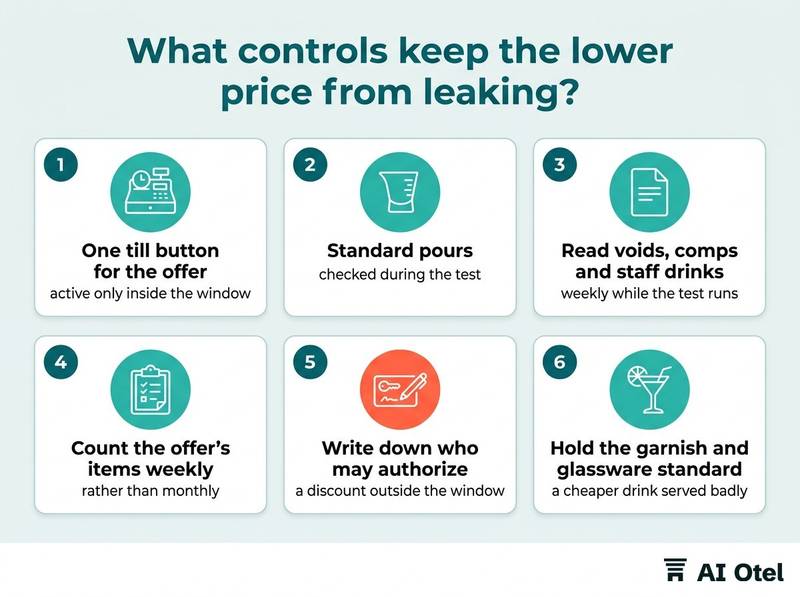
Use one till button for the offer, active only inside the window. The price should not depend on a person's judgment at the bar. Standard pours, by jigger or measured pourer, should be checked during the test and not only at month end: a short pour is a complaint, a long pour is a discount nobody approved.
Read voids, comps and staff drinks weekly while the test runs. A rise in voids inside the discounted hour is the usual way a promotion leaks. Count the offer's items weekly rather than monthly, so a gap between stock used and drinks sold shows up while the test is still running. Write down who may authorize a discount outside the window and what happens when someone does; a rule with no consequence is a suggestion. Hold the garnish and glassware standard, because a cheaper drink served badly is a complaint at a discounted price. These checks sit inside the wider discipline of beverage cost control in hotel bars.
Watch outThe three leak points
The pour, the till and the voids report. Check all three weekly for the length of the test, not at the end.
Stop, change or keep: what does the test decide?
Keep it if the evening total rose and the controls held; change one variable if the offer added covers but lost margin; stop if the evening total fell or the trade only moved.
Keep means evening covers and drinks up, spend per cover held, controls clean. Set a review date and keep counting at the same hours. When you change something, change one thing at a time: the window, the item list, the eligibility or the limit. Changing two makes the next four weeks unreadable as well.
Stop when the evening total is down, or when a shift completes itself with the after-window hours never recovering. But remember that a shift is not always a failure: if the peak hour was turning guests away, moving trade earlier can raise the evening total even though the discount cost something.
Record the decision and the numbers behind it, so the next bar manager does not re-run the same test from memory. Review the offer inside the monthly beverage cost count rather than as a separate exercise, so the discount is always read next to the cost it created.
What to do next
Take the count sheet from the baseline section, fill it for four weeks before you change a price, and write the stop rule on the same page. The parts fit in that order: the target decides who the offer is for, the baseline decides which hour it goes in, the design decides what it costs, the test decides what you can conclude, and the controls decide whether the number you read is real. If you want the counts to come out of one system instead of a spreadsheet, a hotel operating system that records restaurant and bar sales alongside rooms can hold the hourly data, and the wider platform describes how those pieces connect.
Frequently asked questions
Does a happy hour increase hotel bar revenue?
It can add trade or move it, and the difference shows only in an hourly count of the whole evening. A busy discounted hour with a quiet hour after it is moved revenue, not new revenue. No general figure applies, because the result depends on the hour, the guest mix and the price cut.
Should a hotel bar happy hour be open to outside guests?
It depends on where the gap is. Residents are already on site, so a discount aimed at them often reduces the price of a sale the bar already had. Outside guests add covers but need a reason to come, and the hotel has to manage access, seating for residents and capacity at the bar. Pick one target for the test.
How long should a happy hour last?
Start with one hour, or ninety minutes at most, placed in the hour the baseline shows is weakest. A longer window raises the share of the evening sold at the lower price and makes the comparison harder to read. Extend it only after a test shows the added trade is real.
Should the discount apply to every drink on the list?
No. A named list of drinks with a known cost per serve keeps the cost calculable and the pour standard enforceable. Discounting the whole menu makes the cost of the promotion unknown and spreads the lower price to drinks that would have sold at full price.
How do you stop staff from giving the happy hour price outside its hours?
One till button active only inside the window, a written rule on who may authorize anything else, and a weekly read of voids, comps and staff drinks during the test. Add a weekly count of the offer's items so a gap between stock used and drinks sold appears while the test is still running.