Hotel reporting data terms: data warehouse, ETL, data mart, dashboard and report
A data warehouse stores copies, not originals, while dashboards and reports are just views. Learn what each term means, why two reports often disagree, and when your hotel actually needs this infrastructure.
AI draft · awaiting editorial review
Contents
Key takeaways
- A data warehouse holds copies, not originals: the hotel system stays the record of what happened, and the warehouse is rebuilt from it.
- ETL means extract, transform, load, and the transform step is where two reports of the same month start to disagree.
- Ask any supplier three questions: where the data comes from, how often it refreshes, and who may change a definition.
- Most single hotels do not need a warehouse; they need one written definitions sheet and reports built on closed business days.
- A dashboard is a display, not a source: the number on it is only as good as the definition behind it.
A hotel data warehouse is a separate store that copies data out of the systems that run the hotel and organizes it for questions rather than transactions. A report is one fixed answer, a dashboard is a screen of current numbers, a data mart is one department's slice, and ETL is the process that moves and cleans the data.
Two reports reach the same desk on the first of the month, and the room revenue figures differ by an amount nobody can explain. One came from the hotel system, one from the accountant's spreadsheet, and neither is wrong: they were built on different definitions. The words a supplier uses when selling reporting decide which of these you end up with. After reading this you will know what each term means, which layer a supplier is actually selling, and whether your hotel needs any of it. More terms sit in our hotel technology glossary.
What is a hotel data warehouse?
A hotel data warehouse is a separate database that copies data out of the systems that run the hotel and stores it in a shape built for questions, not for transactions.
The systems that run the day, the front desk, the restaurant till, the channel connections and the accounting, are built to record one event quickly. Asking them for a year of history across several of them is slow or impossible. A warehouse keeps that history. The hotel system may hold only the current state of a reservation, while the warehouse holds each version, so you can ask what the booking looked like when it was made.
The warehouse is read-mostly. Staff do not type into it, and nothing in it is the legal record. If the warehouse and the hotel system disagree, the hotel system is right and the warehouse is rebuilt from it.
It is not a report and not a dashboard. Those are outputs that sit on top of it, and you can have them without it. It also costs attention as well as money: someone must keep the copies flowing and the definitions current, or it turns into a stale second truth that people stop trusting.
The useful question is not whether you have a warehouse but which questions you cannot answer today, and whether joining several systems would answer them.
Report, dashboard, warehouse and data mart: how do the words differ?
They sit at different layers: the warehouse stores, the mart narrows, the dashboard displays, and the report answers one fixed question in a file or on paper.
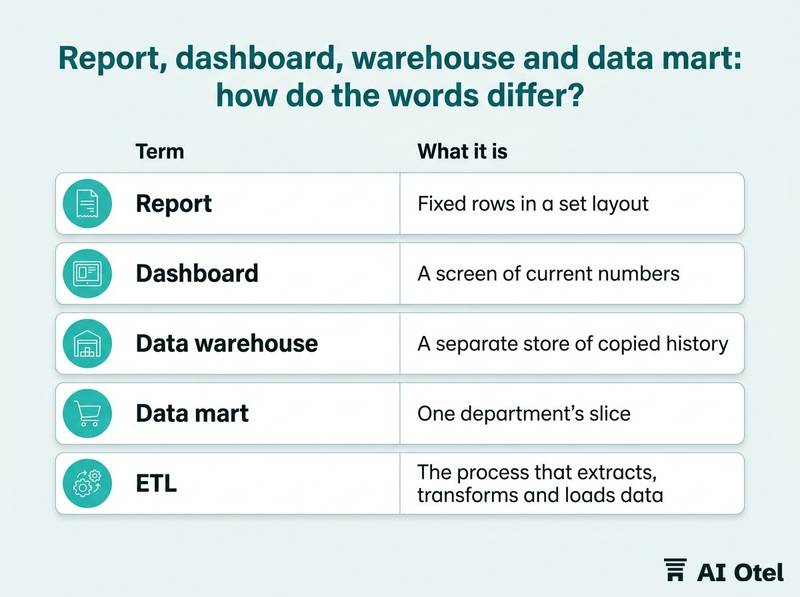
A report has a fixed layout and a defined reader, and it is usually produced on a schedule. Its strength is that it can be checked line by line and filed. A dashboard is read at a glance and refreshed on a timer; its strength is speed, its weakness is that nobody reconciles a screen. The warehouse is the store underneath both. A data mart is a slice of that store, cut for one team, and ETL is a process, not a place: it is how data gets from the sources into the warehouse or mart.
Suppliers often use these words interchangeably in a sales meeting. Ask which layer they are actually selling, because the answer changes the price, the work and who is responsible when a number is wrong.
| Term | What it is | Question it answers | Who usually owns it |
|---|---|---|---|
| Report | Fixed rows in a set layout, on a schedule, for a named reader | What happened in this period, in the agreed format | Finance or the department head |
| Dashboard | A screen of current numbers, refreshed on a timer | What is happening now | The manager who reads it daily |
| Data warehouse | A separate store of copied history from several systems | What happened across systems and over years | Whoever runs the reporting stack |
| Data mart | One department's slice of the warehouse | What does my team need, without the rest | The department, on shared definitions |
| ETL | The process that extracts, transforms and loads data | How did this number get here | The technical owner of the pipeline |
Where does hotel data live before it reaches a report?
Mostly in the systems that run the day, and a meaningful share of it sits outside your building, on the systems of the parties you trade with.
The hotel system holds reservations, guest bills, charges, night audit and guest records; it is the record of the stay. A separate restaurant or bar till holds covers and menu sales, and the link back to the guest bill is by room number and date. That link fails whenever staff post to a house account instead.
Channel connections and the agencies' own extranets hold the booking record, the commission, the cancellation and much of the guest messaging. What reaches your system depends entirely on the connection. Accounting holds invoices, electronic documents, payments and the ledger; revenue in the ledger and revenue in the hotel system are two different measurements and rarely equal. Housekeeping and maintenance hold room status and out-of-order rooms, which change the number of rooms you can sell.
Compliance records, including guest identity notifications and personal data consent, sit under their own retention rules and are not free reporting material.
Check: write down each source, who owns it, and whether the number you need is captured there at all. A field nobody fills in cannot be reported on. Cleaning those fields comes first, as we cover in cleaning hotel data before any reporting project.
What does ETL mean for a hotel?
ETL is extract, transform, load: copy the data out of each source, make it consistent, and put it where questions can be asked.
Extract means pulling from each source on a schedule, ideally asking only for what changed since the last pull so the job stays small and repeatable. Transform is the step that decides what things mean: which exchange rate and for which date; date of stay versus date of booking; a cancelled booking versus a no-show; a rate that includes breakfast versus one that does not; a room move; a split bill. Load writes the result into the warehouse or mart, and keeps the raw copy as well, so a transformation can be corrected and re-run without going back to the source.
The transform is where the argument lives. Two reports of the same month differ because one counted a no-show as a cancellation and the other did not, not because either system lost data.
The practical rule: keep the raw extract, version the transformation, and be able to walk from a total back to a single guest bill. A supplier who cannot show the transformation, or say how a cancelled booking is treated, is selling a number you cannot audit.
Watch outIf the transform cannot be explained in plain words
The report cannot be defended in a meeting with an owner, an accountant or an investor. Ask for the transformation in writing before you rely on the number.
What is a data mart, and when does a hotel need one?
A data mart is one department's slice of the warehouse: the same data, narrowed to the tables and definitions that team uses.
Typical marts cover rooms revenue, food and beverage, finance and payables, and housekeeping workload. The gain is speed and focus: fewer tables to query, and one team that can be given control of its own area.
The risk is drift. Each mart grows its own version of revenue, and the numbers stop matching across departments, which is the exact problem the warehouse was meant to solve. The control is one shared definitions layer underneath every mart, and one named owner per metric, not one owner per mart.
A single hotel with one main source rarely needs marts at all. The split earns its keep when several teams query different things every day. For a group, the harder question is which definitions are shared across properties and which stay local, and that decision comes before any mart is built, as we discuss in one report across several hotels.
How fresh is the data, and who decides what a room night is?
Freshness and definitions are the two questions that decide whether a number can be trusted, and both have a plain answer you can ask for.
Live, hourly or nightly
Nightly refresh matches the night audit: the business day is closed, corrections are voided and reversed rather than deleted, and the totals stop moving. Most reporting should run on closed days. Hourly suits pickup, availability and same-day decisions, where being slightly wrong is cheaper than being late. Live usually means the screen in front of the receptionist, not a warehouse; a live warehouse is expensive and rarely needed.
Ask three things: what time the refresh runs, what happens to a booking changed after it, and whether the refresh time is printed on the report itself. What moves at day end, and how to check it, is covered in what moves at day end.
One written definition per metric
Definitions decide the rest. A room night, an available room, room revenue and a cancellation each have more than one reasonable meaning, and the report is only as good as the one written down. The occupancy rate is sold rooms divided by available rooms, and the argument is always about which rooms count as available. Average room rate and revenue per available room move with the same choices: whether breakfast, city tax, service charge and discounts sit inside room revenue.
ChecklistBuild a one-page definitions sheet, one line per metric
- Room night: does a day-use room count, does a stay crossing midnight count once per night, does a complimentary room count
- Available rooms: are out-of-order rooms, house use and rooms held for maintenance removed from the denominator
- Room revenue: are breakfast, city tax, service charge and discounts inside or outside
- Cancellation: at what date does a booking leave the count, and is a no-show a cancellation
- Segment: which source of business is credited when a booking changes
- Currency: which rate, on which date, for a conversion
- Owner and version: who may change a definition, and from which date the current version applies
When does a single hotel not need a data warehouse?
Most single hotels do not need one: when the questions are known in advance and the data lives in one system, the reports inside the hotel system are enough.
Signals that you might need one: several source systems that must be joined, history longer than your system keeps, new ad hoc questions every week, more than one property, or an investor or legal reporting need that must be reproducible months later. Signals that you probably do not: one property, one main system, a fixed monthly pack, and nobody asking questions the pack does not answer.
What to do instead costs almost nothing: one written definitions sheet, a fixed monthly pack built only from closed business days, and a named owner for each number. The cheap middle is an export from the hotel system into a spreadsheet on a schedule, with the definitions sheet beside it, and an honest acceptance that it is manual and will break when the person who built it leaves.
Data quality comes before any of this. A warehouse copies bad data faithfully and faster, so fix the fields nobody fills in first.
If the reporting you already have is built into the system that runs the hotel, check what it covers before buying another layer. The hotel operating system (AI Otel PMS) is built: reservations, front desk, housekeeping, billing, restaurant sales, reports and compliance in one place, with 150+ built-in reports (June 2026). It is built and working, ahead of launch; you can read what the platform covers and how we state what is built and what is not on our own pages.
What to do next
Before you buy any reporting layer, write two pages: the list of systems your numbers come from, and one definition per metric with a named owner. Those two pages decide whether a warehouse, a mart or the reports you already have is the right answer, and they are the first thing to ask a supplier to work from. If you want to see how we approach this, you can request a briefing.
Frequently asked questions
Is a data warehouse the same as the database inside a hotel system?
No. The hotel system's database records each event as it happens and holds the current state of a reservation; a warehouse holds copies of history from several systems, shaped for questions. If the two disagree, the hotel system is the record and the warehouse is rebuilt from it.
Why do two reports show different room revenue for the same month?
Almost always because of a definition, not lost data: whether breakfast, city tax, service charge or discounts sit inside room revenue, whether a no-show is treated as a cancellation, or whether the period is the calendar month or the closed business days. Find the transform, compare the definitions line by line, and agree one version in writing.
How often should a hotel dashboard refresh?
Match the refresh to the decision. Nightly on closed business days for revenue, finance and owner reporting, because the numbers stop moving after the night audit. Hourly for pickup and availability. Live is usually the reception screen, not a reporting layer, and it costs more than it returns for most hotels.
Does a small hotel need a data mart?
Rarely. A mart is a slice cut for one team, and it pays off when several teams query different things daily. With one property and one main system, a written definitions sheet and a fixed monthly pack do the same job with less to maintain.