Barcode and QR labels for hotel stores and linen: a simple stock-control setup
This guide explains how to set up a simple hotel barcode inventory system for stores and linen. It covers label design, phone counting methods, and when to switch from spreadsheets to a property system.
AI draft · awaiting editorial review
Contents
Key takeaways
- Label the place before the item: a shelf code is what lets two people count the same store the same way.
- A label carries an identifier, a plain name and a location, never a price or a quantity, because those change and the label should not have to be reprinted.
- A phone count works when the store is frozen, the walking route is fixed and the counter does not see the expected figure.
- Linen is counted by item type and bundle at the laundry door in both directions; the gap between dirty out and clean in is the loss for that cycle.
- Move from a sheet to the property system when more than one person edits it, when the count must carry a value, or when a receipt has to match an order and an invoice.
A barcode or QR label is a printed code carrying a fixed identifier for one place or one item. Label store locations first, then linen bundles, then equipment. Each label holds a code, a plain name and a location; a phone scans it, a person types the quantity, and one sheet receives the result.
The storekeeper counts the main store on Monday and the cost controller counts it again on Thursday. The two sheets disagree, and neither person can say which shelf was counted twice or skipped. The labels on the shelves, where they exist at all, were printed years ago and half of them point to products the hotel no longer buys. This article is a hotel barcode inventory setup that fixes that: what to label first, what a label should say, how a phone count runs, how linen moves through the laundry, and when the spreadsheet has to go.
What should a hotel label first: stores, linen or equipment?
Start with store locations, then linen bundles, then equipment. Location labels make every later count possible; item labels without locations produce a list nobody can walk.
Why location comes before item
Label the place before the thing. A shelf code lets any person find and count the same stock in the same order, which is the whole point of the exercise. Second come the fast-moving consumables in the main store: they are counted most often, and their errors reach cost of sales first.
Third, linen by item type and bundle, never by room. Linen is pooled stock that moves between floors, the laundry and possibly an outside plant, so a room number on the tag is wrong within a week. Fourth, equipment: minibar fridges, hairdryers, irons, pool furniture, technical spare parts. It is counted once or twice a year, so each tag also needs a location and a condition note. A sample fixed asset list by room, lobby and kitchen gives a starting point for that last group.
What to leave unlabeled in the first month
Leave out the things that will be consumed before the next count: cleaning chemicals in daily use, a small minibar store, anything bought and used within the week. Labeling them now buys nothing and slows the first print run.
The test of a finished set: hand the sheet to a person who has never worked in that store and get the same count back. Print in batches rather than in one run. For example, a 120-room hotel might settle at roughly 40 shelf labels, 300 item labels and 60 asset tags, and printing them all at once guarantees half are wrong by the time the stock settles.
What should a label actually say?
Three things, in this order: a code that never changes meaning, a plain name a person can read, and the location where the item is kept.
The code is an identifier, not a description. It carries no price, no quantity, no date and no supplier name, because every one of those changes and a label that carries them has to be reprinted. Use a short prefix by class: ST for a store item, LN for linen, AS for an asset, LOC for a location, then a sequence number. Never reuse a number for a different item, even years later.
Print the human-readable name under the code, in the language the store team reads, at a size readable from arm's length without a phone. The location string on the item label and on the shelf label must be the same string, character for character; a mismatch here is the most common reason a count fails.
Barcode or QR: what the difference means in practice
A one-dimensional barcode holds a single identifier and prints small and cheap. A QR code holds a short text string, so it can carry code, location and a check character together. Choose one per class and keep it for years.
Choosing the material for the place
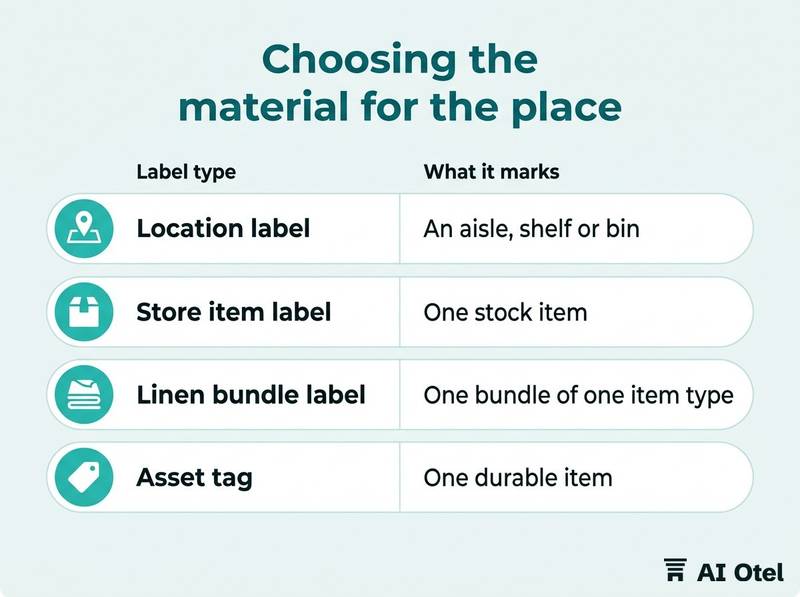
Match the material to the place: laminated or synthetic for a dry store, sew-in or heat-transfer for linen that goes through an industrial wash, engraved or metal for equipment left outdoors or washed down. Contrast and size decide whether the scan works in a dim store room at seven in the morning. A code the camera cannot read is worse than no code, because people stop trusting the scan and go back to the clipboard.
| Label type | What it marks | Code pattern (illustrative) | What a scan returns |
|---|---|---|---|
| Location label | An aisle, shelf or bin | LOC-01-03-02 | The location string only |
| Store item label | One stock item | ST-00412 | Item code, name and unit |
| Linen bundle label | One bundle of one item type | LN-TOW-BATH | Item type and bundle size |
| Asset tag | One durable item | AS-00087 | Asset code, name and area |
How should locations be named so a scan means something?
Use one fixed string, read from the largest place to the smallest, with no spaces: building, floor, store, aisle, shelf, bin.
Order matters. Largest to smallest means a sorted sheet groups stock the way a person actually walks the room. Use numbers, not words that will change meaning: a store called MAIN becomes STORE-2 the day a second store opens, and every old count becomes ambiguous. Never reuse a location code for a different place; retire it and issue a new one, so last year's counts stay readable.
One location can hold many items; one item sits in one location at a time. If a fast mover is split between the store and a floor pantry, that is two lines with two labels, not one label with two places. Write the same string on the shelf edge and in the sheet; when they differ, the counter scans one thing and writes down another.
The places hotels forget
Cover the awkward places in the first pass, not the third: the minibar store, the pool and garden store, the technical workshop, the clean and dirty sides of the laundry, the banqueting store, the off-site container. The location is where the item lives, not where it was delivered; a pallet in the corridor waiting for shelf space has no location yet, and the count should say so.
Retiring a location without breaking history
When a shelf is removed or a store is reorganized, retire the code rather than reassigning it. A retired code keeps old counts interpretable, and the new location starts with a clean history of its own.
TipWalk before you print
Walk the store with a notepad before printing anything, and write down every place stock actually sits, including the floor, the corridor and the locked cabinet. Only then assign codes. Labels printed from a plan rather than from a walk are the ones that get ignored.
How does a phone count actually work?
Freeze the store, walk one fixed route, scan the label and type the quantity, then count only the exceptions a second time.
Freeze the store first: no issues and no receipts while the count runs. Note the time it closed and the time it reopened, because anything that moves in between is a permanent argument. Count blind: the counter does not see the expected quantity, so the number is a count and not a confirmation of what the sheet already says. The scan identifies, the person counts; the phone never guesses a quantity, and no setting should let it.
Keep the route fixed and identical every time, so a skipped shelf shows up as a gap in the sequence rather than as a mysterious shortage. Put two people on the high-value lines and one on the rest: the second person counts, the first records, and neither signs off alone. Every exception goes on a short list with a photo: no label, damaged label, two products in one bin, a part-used pack. That list is what the next print run and the next layout change are built from. Sign and time the result; the person who counts and the person who approves the difference are not the same person.
Before, during and after the count
Checklist
- Store closed and time noted
- Phone charged and camera lens clean
- Printed route sheet in hand
- Blind count confirmed on the device or sheet
- Every scan followed by a typed quantity
- Exceptions photographed and listed
- Second count done on exceptions only
- Sheet signed by counter and approved by a second person
- Store reopened and the time noted
- Differences explained in one line each before anything is adjusted
How do you match a delivery to the order at the door?
Scan the item at the door, compare the delivered quantity to the order line, and put the label on before the goods reach the shelf.
The order line is the reference, not the delivery note on its own. The delivery note is the supplier's claim about what left their warehouse. Scan the item code, type the received quantity, and record short delivery, substitution and damage on that same line while the driver is still standing there. A purchasing and receiving procedure from order to storeroom covers the full flow this belongs to.
Goods that arrive without a code get a temporary label at the door, marked as temporary, and the permanent code is confirmed at the next print run. An unlabeled box on a shelf is invisible at the next count. Label before shelving, always; once the box is on the shelf, the label becomes a job for a person who is already doing something else. Sign the delivery note for what was counted, not for what was listed, and keep the receiving record, the order and the supplier invoice together, matching all three before payment runs, as the three-way match of order, delivery note and supplier invoice describes.
Where receiving usually breaks
The break happens at the signature. A signature given for an unopened pallet moves the loss onto the hotel, and no later count can undo it.
Watch outDo not sign before counting
Signing a delivery note before counting is the single most expensive habit in the receiving bay. The signature is the hotel's acceptance of the supplier's figure, and no later count can undo it.
How do you count linen in and out of the laundry?
Count by item type and bundle at the laundry door, in both directions, and reconcile the gap against the par level.
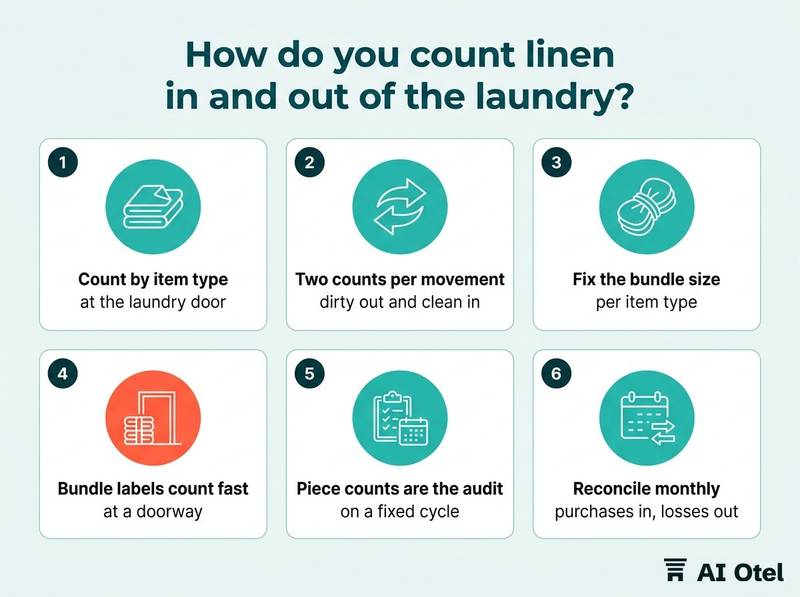
Linen is pooled stock. It belongs to the hotel, not to a room, so the label marks the item type and the bundle size and never the room number. Two counts per movement: dirty out and clean in. The gap between them is the loss for that cycle, and it is the only figure that tells you whether the problem is in the wash, the transport or the floor pantries. The wider context of par levels, laundry flow and linen losses explains how these figures feed the reorder decision.
Fix the bundle size per item type, so a bundle count converts to pieces without weighing anything. A bundle of twenty bath towels is a number two people can agree on at a doorway. Where linen leaves for an outside laundry, the bundle label is the handover document: both sides count the same bundles at the same moment, and both sign.
Bundle labels versus piece counts
Bundle labels count fast at a doorway; piece counts are the audit that confirms the bundle size is still honest. Do the bundle count every movement and the piece count on a fixed cycle, not the other way round.
What the monthly reconciliation must show
Reconcile monthly: purchases in, losses out, stock on the shelves and stock in circulation. Store linen and circulating linen are two different numbers and should never be added into one. Set a par level per item type and compare the count against it; without a par level the count tells you nothing actionable. Treat a missing bundle as a loss with a date, not as a rounding difference, because losses that are never dated are never investigated.
When should a hotel stop counting on a spreadsheet?
Move when more than one person edits the sheet, when the count has to carry a value, or when the same item must be visible to stores, purchasing and accounting at once.
The triggers, in the order they usually appear: a second store; a second editor; a month-end valuation by department; a need to see who changed a quantity and when; purchase orders that must match receipts; counts more often than monthly. A spreadsheet cannot hold a change history, cannot stop two people overwriting each other, and cannot tie a count to an order and an invoice without someone retyping it.
What a property system adds is one item record used by stores, purchasing, cost control and accounting; a count that posts a difference instead of a typed adjustment; and reports by department and by period. A hotel operating system keeps billing and reports on one record, built and working ahead of launch. Before choosing any system, read how its vendor treats data handling and change records, on pages such as the trust and data handling notes.
What you keep when you move
Migrate in a fixed order: the item list first, then the locations, then the opening quantities, then the count routine. Doing it in any other order means counting twice. Keep the codes you have printed; a system that cannot accept your existing label codes will cost you a reprint of every shelf in the building.
Choosing the cutover date
The year-end count is the natural cutover point, because the stock is already frozen and the valuation is already being done; the year-end inventory count, step by step is built around that moment. Before any of this, write the count routine down. A system automates a procedure; it does not invent one.
Key pointThe labels outlive the software
The labels, the location codes and the count routine are the hotel's own property and survive any software change. The spreadsheet is the part that gets replaced.
What to do next
Print location labels for the main store this week and run one blind count with them, using the route sheet and the exception list. That single routine is the foundation: item codes, linen bundles, asset tags and any later move to a property system all stand on the same habit of scanning a place and counting what is in it.
Frequently asked questions
Can a phone camera read store labels, or do we need a dedicated scanner?
A phone camera reads both a one-dimensional barcode and a QR code, and for a few hundred labels per count it is enough. What decides success is the print quality, the contrast and the light in the store, not the reader. Test the actual printed label in the actual store room before ordering a batch, and only consider a dedicated reader when the volume makes holding a phone impractical.
Should we use barcodes or QR codes on hotel shelves?
A barcode holds one identifier and prints small and cheap, which suits a shelf or a bin. A QR code holds a short text string, so it can carry code, location and a check character in one scan. Pick one per label class, print it consistently and keep it for years; switching symbology later means reprinting every label and retraining every counter.
What do we do with stock that has no label at all?
Give it a temporary label at the point it is found or received, marked as temporary, record it on the exception list, and confirm the permanent code at the next print run. Never leave it unlabeled on a shelf, because an unlabeled item is invisible at the next count and becomes a permanent unexplained difference.
Can we label linen by room number?
No. Linen is pooled stock that moves between floors, the laundry and possibly an outside plant, so a room number is wrong within days. Label by item type and bundle size, count bundles at the laundry door in both directions, and reconcile the gap against a par level set per item type.
How often should the store be counted?
Set the frequency from how fast the stock moves and how much the error costs, not from habit. Fast-moving consumables in the main store usually justify a count more often than slow equipment, and equipment can be counted on a fixed annual cycle. Whatever the interval, keep the route, the blind count and the exception list identical every time, so two counts can be compared.