Paid visibility on booking sites: the break-even sum before you opt in
Paid visibility buys placement, not bookings. This guide shows how to calculate the break-even sum for selected dates, identify qualifying inventory, and set a stop rule before you opt in.
AI draft · awaiting editorial review

Contents
Key takeaways
- Paid visibility buys placement for chosen dates, not bookings, so the decision is arithmetic about those dates rather than a judgment about the product.
- The break-even sum is the extra cost divided by the net revenue of one room-night, which gives the number of extra room-nights the dates must sell.
- Buy visibility only where the room-night would otherwise go unsold, because an extra booking on a night you would have sold anyway replaces a booking you already had.
- Count only the bookings you would not have received, by comparing the promoted dates with the same dates under the same rate and the same booking window.
- Write the stop rule before you opt in, and review after the booking window for those dates closes, not after the last guest leaves.
A paid visibility product on a booking site raises where your property appears, or how prominently, for the dates you choose, in exchange for an extra cost on those dates. The break-even sum is the extra net revenue those dates must produce to cover that cost: extra cost divided by net revenue per room-night. Whether the offer is called a booking.com visibility booster or something else, the arithmetic is the same.
The offer arrives with a deadline: extra visibility on a set of dates, at an extra cost, confirmed by Friday. Weeks later the dashboard shows more views. It will not show whether the extra bookings paid for the extra cost. After reading this article you will be able to fill in one sheet, before the deadline, that answers the only question that matters: how many extra room-nights must these dates sell, and do they have that many empty?
What is a paid visibility product on a booking site, and what does it change?
It is paid placement: the booking site shows your property higher, more often or more prominently for the dates you select, and charges extra for those dates. It changes where you appear, not whether travelers want those dates.
The common shapes are a higher position in a search result, a label or badge on the property, inclusion in a campaign page or an email the site sends, and a place in a deals area. Each site packages and names these differently, so the contract in front of you is the only description that counts. The offer may be labeled a visibility booster or something similar; treat the category rather than the label, because the mechanics are shared while the terms are not.
The product does not change your rate, your availability, your photos, your review score or your cancellation policy. If the rate is not competitive, more views convert at the same low rate. What moves a hotel up the list on a booking site is mostly a separate question, and the ranking factors are worth fixing before renting placement on top of them.
The extra cost usually attaches either to the selected dates or to the bookings that come from them. Those are two different contracts and they produce two different break-even sums. The offer is time-limited, and a deadline is a sales device, not evidence that the dates are good. Ask the site whether the placement is capped for those dates.
The one lever almost every hotel controls is date selection. Most of the decision in this article is really a decision about which dates to name.
NoteTwo questions before any calculation
Which dates does the extra cost attach to, and does it apply to bookings made during the campaign or to stays that fall on those dates? Write both answers down in the contract's own words.
What is the break-even sum, and how do you calculate it?
The break-even sum is the extra net revenue the promoted dates must produce to cover the extra cost. Divide the extra cost by the net revenue of one room-night, and you have the number of extra room-nights those dates must sell.
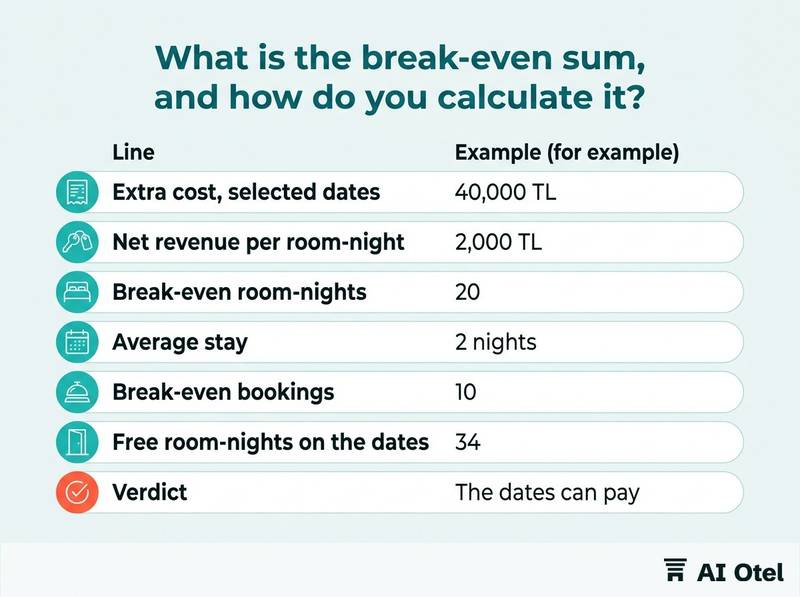
Start from net revenue per room-night: the rate, minus the agency's cost on that booking, minus the extra visibility cost, minus the variable cost of hosting one more guest for one night, meaning housekeeping, breakfast if it is included, laundry and utilities. The variable cost is the line hotels most often leave out. If you are unsure how to move from a gross rate to a net one, the same steps apply as when converting a rate from gross to net after agency commission.
Use the lowest net rate among the selected dates, not the average. The extra bookings will not all arrive at your best rate. Then convert room-nights into bookings with the hotel's own average stay: if guests stay two nights on average, twenty extra room-nights means ten bookings, and you should round up rather than down.
Compare the break-even with the free capacity on those dates. If it needs more room-nights than the dates have empty, the product cannot pay for itself there however well it performs. Run the displacement test as a second break-even: on a night that would have sold anyway, the extra booking replaces one you already had, so the gain is only the difference in net revenue, not the whole room-night.
Recalculate for each campaign. A change in rate, in the extra cost or in the variable cost moves the break-even, and last season's number is not this season's.
| Line | Example (for example) | Where the number comes from |
|---|---|---|
| Extra cost, selected dates | 40,000 TL | The offer |
| Net revenue per room-night | 2,000 TL | Rate minus agency cost, extra cost, variable cost |
| Break-even room-nights | 20 | Extra cost divided by net per room-night |
| Average stay | 2 nights | The hotel's own figures |
| Break-even bookings | 10 | Room-nights divided by stay, rounded up |
| Free room-nights on the dates | 34 | The hotel's availability |
| Verdict | The dates can pay, if the extra bookings arrive | The comparison above |
Which dates qualify for paid visibility?
Dates with rooms that would otherwise go unsold, soft demand and a rate that is already competitive against the properties listed around yours. If any of the three is missing, the extra cost buys views that do not become net revenue.
Check date by date, not by month. A month at moderate occupancy can contain sold-out weekends and empty Tuesdays, and the product is sold by date. On a night with free capacity, the cost of hosting one more guest is the variable cost, not the full rate; that is why an unsold night is the only night where a lower net still adds to the total.
Compare the rate you show for those dates with the properties the site lists near you. If your rate sits above that set and your review score does not, more views convert poorly and the placement is wasted. Look for soft demand, not absent demand: a date with no demand at all does not convert however visible you are, while a date where the destination has demand and your share of it is low is the target. The dashboard tells you part of this, if you know how to read views, conversion and ranking on a booking site.
Dates where capacity was released also qualify: a group block that came back, a cancelled allotment, a floor reopened after renovation. Visibility can convert there because the rooms are genuinely spare. Exclude holiday weeks, weekends you expect to sell out, and dates carrying a large confirmed group. On those dates the extra booking displaces one you already had and you pay the extra cost for the privilege.
Watch outNever buy visibility on a date you expect to sell out
The extra booking replaces a booking you already had, and the extra cost is paid on top of a room-night you were going to sell anyway.
How do you count the bookings that would have come anyway?
You cannot attribute them perfectly. Use a baseline and a comparison, and count only the difference: the bookings above what the same dates produced under the same rate and the same booking window.
Set the baseline as the same dates a year earlier, at a comparable rate, with a booking window of the same length. If last year is not comparable because of a renovation or a new rate structure, use a set of similar dates in the same season and say so in the record.
Respect the booking-window problem. Visibility often moves bookings earlier rather than adding them: a booking made in March for August may be one that would have arrived in June. Compare at the end of the window, not in the middle. Separate guests who searched the hotel's name from guests who arrived from the list; only the second group can be attributed to the placement, and even then only partly.
Run a control where you can: the product on some dates, nothing on comparable dates, then compare. For a single hotel this is the cleanest test available. Watch the stacking question too. If other promotions run on the same dates, part of the extra bookings belongs to them, and the visibility product is being credited with someone else's work. The same arithmetic applies as when you work out what a hotel keeps after each stacked promotion.
Write the campaign down before it starts. A campaign without a written record is a story afterwards, not a measurement.
ChecklistWhat to record before opting in
- The selected dates
- The rate shown on each date
- Free room-nights on each date
- The extra cost, and whether it attaches to dates or to bookings
- Whether cancelled bookings return the extra cost
- Whether the extra cost stacks with other promotions
- The baseline dates and their result
- The review date
- The stop rule
When do you stop? The review after the dates
Review after the booking window for those dates closes, compare net revenue per available room-night against the baseline, and apply the stop rule you wrote before you started.
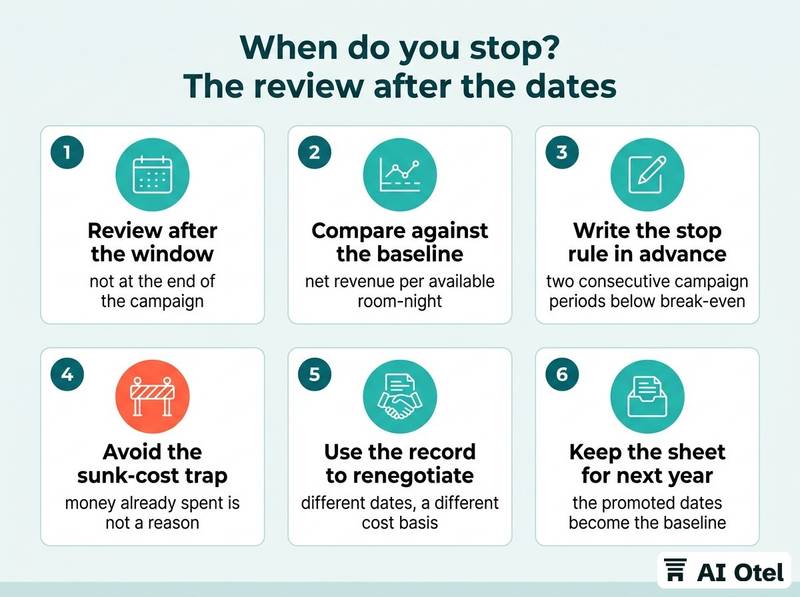
Review after the window, not at the end of the campaign. Reviewing when the campaign ends measures the campaign; reviewing when the window closes measures the bookings. Compare net revenue per available room-night on the promoted dates with the baseline dates, alongside room-nights sold, average rate and the share of bookings that came from the placement.
Write the stop rule in advance. For example: stop if two consecutive campaign periods come in below the break-even sum, or if the extra cost per extra room-night exceeds the net revenue per room-night. Avoid the sunk-cost trap: money already spent is not a reason to continue, and the next campaign is a new decision on new dates with a new break-even.
Use the record to renegotiate. Two periods of results let the hotel ask for different dates, a different cost basis or a narrower selection, and the record is the argument. Keep the sheet for next year, because the promoted dates become the baseline for the same dates in the following season.
Key pointStop rule template
We stop when the extra cost per extra room-night exceeds the net revenue per room-night on the promoted dates, measured after the booking window closes, for two consecutive campaign periods.
What can you do instead of paying for visibility?
Fix what the ranking depends on and what the hotel controls, and test rate and offer changes on the same dates before renting placement.
Availability and rate completeness come first. A closed date, a missing rate plan or a minimum-stay rule that blocks a one-night search removes the hotel from results, and no placement repairs that. Content converts the view once it arrives: photos, room descriptions, facilities and policies. Paid placement in front of weak content buys views that leave.
The direct offer to past guests, the hotel's own website and its guest app cost nothing per view. The audience is smaller, the net is higher, and the hotel keeps the relationship. Run a rate test on comparable dates before buying placement: change the rate or the offer, compare against the baseline, and use the same sheet. The cheaper test comes first.
Publish the same rates from one inventory to the booking sites and to the hotel's own channels, so a rate test is one change rather than a manual update in five places. A distribution setup that publishes one room inventory to several channels is built for exactly this, with seed data and no agency connected yet, and a hotel operating system built and working, ahead of launch, keeps the availability, rates and reports in one place while you run the test.
Be honest about what paid visibility is: rent. It stops when you stop paying. The ranking factors, the content and the guest relationship are the parts that stay with the hotel.
What to do next
Before the next offer's deadline, fill in the sheet for the dates it names: extra cost, net revenue per room-night, break-even room-nights, free capacity. If the break-even needs more room-nights than those dates have empty, decline and spend the hour on the rate instead. The parts fit together as one loop: choose the dates, calculate the break-even, set the baseline, write the stop rule, and review when the booking window closes.
Frequently asked questions
Does paid visibility guarantee more bookings?
No. It changes placement for the dates selected, and conversion still depends on the rate, availability, content and review score. A hotel that buys placement without a competitive rate pays for views that do not become net revenue.
Should I buy visibility on dates I am nearly sold out?
Usually not. The extra booking most likely replaces one you already had, and the extra cost is paid on top. The exception is a date where the booking being displaced would have come at a clearly lower net revenue.
Does the extra cost apply to bookings made during the campaign or to stays on the dates?
It depends on the contract, and the two produce different break-even sums. Get the answer in writing before opting in, together with what happens to the extra cost when a booking is cancelled.
How far ahead of the dates should I decide?
While the booking window for those dates is still open. A campaign that runs after most bookings for a date have already been made cannot move much, however visible it makes the property.
Can I select only a few dates?
Ask whether the date selection belongs to the hotel. Where it does, a narrower selection makes the measurement cleaner because the baseline is easier to match. Ask for the selection in writing and keep it in the record.