Reading a booking site dashboard: views, conversion and ranking, and what to change
Read views, conversion, price position and cancellations together to diagnose performance. Learn how to run one measurable change per week to improve results.
AI draft · awaiting editorial review

Contents
Key takeaways
- Views and conversion are two different funnels: a hotel can gain views and lose bookings in the same week, and the fix for each is not the same.
- Price position means nothing until the hotel writes down the five to eight properties a guest would actually compare, with the same room type, board and cancellation terms.
- Cancellations and no-shows belong in the weekly read, because a channel with strong gross bookings and heavy cancellation can return less than a quiet one.
- Ranking is the site's ordering for one search on one date, not a single position, so it is checked with the same search each week rather than watched daily.
- One change per week, in one channel, against one number, written down before the change, is the only way to know which edit worked.
A booking site dashboard, the extranet where a hotel manages its listing, is read best as four numbers a week: views, conversion, price position against your own competitive set, and cancellations. Each answers a different question and points to a different change. Read them together, never one alone.
The extranet opens with a wall of numbers and the team reads the one at the top. A week later the same number is lower, someone changes the price, and nobody can say whether the price or the season did it. The dashboard is not short of data. It is short of a routine. After reading this you will know which four numbers to read, what each one does and does not tell you, and how to run one change a week so the result can be attributed to something.
Which numbers on a booking site dashboard deserve a weekly look?
Four: views, conversion, price position against your own set, and cancellations. Everything else on the dashboard is either an input to these or a detail you read when one of them moves.
Know which column is which before you compare anything. Most extranets separate impressions, meaning your property appeared in a list of results, from property page views, meaning a traveler opened your page. They behave differently, and only the second is usually called a view. Conversion is bookings divided by whatever denominator the site uses, and that denominator varies between sites: write it down once, on paper, because a week can look healthy on views-based conversion and weak on search-based conversion.
| Number | The question it answers | What it does not tell you | The one change it points to |
|---|---|---|---|
| Views | Did travelers find and open the listing | Whether the page persuaded anyone | Availability, restrictions, content completeness |
| Conversion | Did the page turn views into bookings | Why a single guest left | Price shown, photos, room type names, policy |
| Price position | Where the hotel sits against its own recorded set | Whether the price is right for the market | Rate shopping against like-for-like terms |
| Cancellations and no-shows | How much booked revenue stayed | Why the guest cancelled | Guarantee type, deadline, lead time |
Ranking position is a display of the site's ordering, not a lever. It moves after availability, content and history move, so it is a result to check, not a dial to turn.
Fix the reading ritual: same day, same hour, same date range, same currency. A Monday morning read compared with a Friday afternoon read of a different range tells you nothing. And read the count next to every percentage. A booking site extranet conversion rate dashboard figure built on a handful of views is noise, and acting on noise is how a team ends up changing three things at once.
Impressions, views, bookings: the three-step funnel
The funnel has three steps. The property appears in a list, the traveler opens the page, the traveler books. Impressions measure the first, views the second, bookings the third. When you read the weekly numbers, walk them in that order: if impressions fell, the problem is visibility. If impressions held and views fell, the list entry, usually price or review score, is the problem. If views held and bookings fell, the page is the problem.
Why the same week can look good and bad at once
Views and conversion can move in opposite directions because they measure different decisions. A price drop can widen visibility and weaken the page, if the new price signals a property less like the one the guest wanted. A content improvement can lift conversion while views stay flat, because the page now persuades a larger share of the same audience. Read both numbers, then decide which one to work on; never let one stand in for the other.
What moves views on a booking site, and what does not?
Availability and filters move views. Most content edits do not. A hotel that is closed, restricted or filtered out of a search cannot be viewed, however good its page is.
Availability is the first cause to check. A sold-out date, a closed rate plan or a stop sale removes the property from results for those dates, and the views drop with no other explanation. Length-of-stay restrictions work the same way: a guest looking for two nights never sees a property that only sells three.
Occupancy and child-age settings are the quietest filter. A hotel with no rate for two adults and one child disappears from that search entirely, and the team reads it as falling demand. Board type and room type coverage matter similarly: a search for a specific board or a specific room category only returns properties that sell it.
What moves views less than teams expect: rewriting the description, reordering the photo gallery, small wording changes in the property name. These are conversion edits wearing a views costume. Demand, by contrast, moves views more than anything the hotel does, so compare week to week inside the same month and note holidays, school breaks and local events next to the number. And check the search conditions behind the number before you act: a week with a different default date window in the extranet is not a week of falling interest.
The four settings that hide a hotel from a search
Run down the four in order. First, availability: is the property sellable on the dates being searched? Second, restrictions: does a minimum stay or a closed arrival day exclude the search length? Third, occupancy and guest mix: is there a rate for the exact combination of adults and children being searched? Fourth, product coverage: does the property sell the board and room category the filter asks for? A hotel that passes all four and still loses views is looking at demand or at the site's own layout, not at its own settings.
Seasonality versus your own changes
Before you attribute a view drop to your own actions, ask what changed outside the hotel. A holiday week, a school break or a local event can move views by more than any setting. Keep a one-line note of these next to each weekly reading, so that when you look back at three months of numbers, the season is written beside them and not remembered wrongly.
Why is conversion low when views are high?
Because the decision happens on the property page, and the page is judged against the price and terms the guest saw one click earlier. High views with low conversion is a page problem, not a traffic problem.
Check the price the guest saw in the list against the price on the page. Taxes, resort or service fees, and mandatory extras that appear only at the last step are the most common cause of a healthy view count with weak bookings. The guest does not experience this as a small increase; they experience it as a changed price after they had already decided.
Photos work at room level, not gallery level. A guest choosing between room types needs a photo of the room type being sold, not a generic set that could be any of them. Room type names carry information too: a name that states size, view and bed setup answers a question the guest would otherwise leave to ask elsewhere. The cancellation deadline is a price. A free-cancellation window that ends earlier than the set's is a cost the guest pays in risk, and it shows up in conversion rather than in the rate. Payment terms, prepayment, deposit at the desk, or card guarantee at booking, decide as much as price for some segments.
Open the page on a phone before changing anything, and read your own extranet's device split, because a page that reads well on a laptop can hide the price or the book button on a small screen. And change one of these at a time. A week with a new price and new photos produces a number nobody can attribute.
Watch outThin weeks make ratios lie
Conversion is a ratio, and a ratio built on very few views is not a signal. Read the count beside the percentage; if the week is thin, read the month, or read the room type or channel with the most traffic instead of the property average.
The four elements of the property page
The page is four things in sequence: the price the guest lands with, the photos by room type, the room type names, and the policy terms. Audit them in that order, because that is roughly the order the guest weighs them. Most failed conversion fixes target the photos when the gap is the price shown after fees.
Reading conversion by room type, not only by property
The property-level conversion figure averages strong and weak room types together, and the average hides the problem. Read conversion by room type in the same weekly sitting. A property can convert well on the standard double and poorly on the suite, and the fix, a photo, a name or a cancellation term, belongs to the suite alone.
How do you read your price position against your own set?
Write the set down first: five to eight properties a guest would realistically compare, then compare like for like on the same dates. Position is a range you interpret, not a rank you react to.
Build the set on what a guest compares: same area, same facility type, same board, similar size and service level. A set chosen to flatter the hotel produces a flattering, useless number. Compare the total for the stay, not the nightly headline, because a property that is cheaper per night but adds a mandatory fee is not cheaper.
Match the terms: same room type, same board, same cancellation policy, same currency. A flexible rate compared with a non-refundable one is not a comparison. Record the date and time of every check, because rates move during the day, and a position recorded without a timestamp cannot be compared with last week's. For the mechanics of checking competitors' prices by hand each week, a fixed routine matters more than the tool; the same applies to a weekly rate parity check for direct and booking site prices.
Choosing the set and keeping it stable
Write the set in a file the whole team can see, with the reason each property is in it. Review the set twice a year, not weekly: a set that changes every week produces positions that cannot be compared with anything. When a property in the set closes or changes category, replace it and note the date, so the reading before and after the replacement is interpreted with that change in mind.
Like-for-like: the four terms that must match
The four terms are room type, board, cancellation policy and currency. If any one of them differs, the comparison is not a price position, it is two different products. A deluxe double with breakfast and free cancellation against a standard double, room only and non-refundable, is a gap of two products, not a gap of ten percent. Two useful signals once the terms match: cheapest by a wide margin with strong conversion suggests room to move up; most expensive with weak conversion suggests the content is not carrying the price.
Keep the shopping routine separate from the change routine. Shop on one fixed day, change on another, so the two readings do not contaminate each other.
What do the cancellation and no-show columns tell you?
They tell you how much of the booked revenue stayed. Gross bookings flatter a channel; net bookings describe it. Read the two columns together, by lead time.
Separate gross from net in your own reading, even if the dashboard does not. Bookings minus cancellations minus no-shows is the number the week is actually about. Read cancellations by lead time: a cancellation sixty days out returns inventory the hotel can still sell; a cancellation two days out is revenue that is gone.
The no-show column depends on the guarantee behind the booking: a card, a deposit or an agency voucher. Without a guarantee, a no-show is a cost, not a statistic to file. A policy change is a conversion lever and a cancellation lever at the same time: tightening the deadline may lift the net rate and lower conversion in the same week. Test policy changes in one channel or one rate plan first, so the comparison has a control. For a fuller method, see measuring cancellation rate by channel and lead time.
Lead time as the useful cut
Lead time is where the pattern usually sits. A channel whose bookings arrive ninety days out will cancel differently from one whose bookings arrive five days out, and the difference is in the booking window, not in the site. Look at cancellation rate by source market and by lead time, not only by channel, before drawing a conclusion about any channel.
Guarantee type and what it protects
A card guarantee protects the room revenue against a no-show up to the policy the hotel wrote; a deposit protects it up to the amount collected; an agency voucher protects it up to what the agency contract says. Read the no-show column with the guarantee type beside it, or the number describes exposure the hotel does not actually have.
What does ranking position on a booking site actually measure?
It measures the site's ordering of results for one search, on one date, under one set of filters. There is no single position for a hotel, only positions per search.
Fix the search before you compare: same dates, same occupancy, same filters, logged out of your own account, so personalization does not move the result. Record the page you appear on rather than a precise slot. Page-level movement is a signal; a one-place shift within a page usually is not. For what sits behind the ordering, see what moves a hotel up a booking site's list.
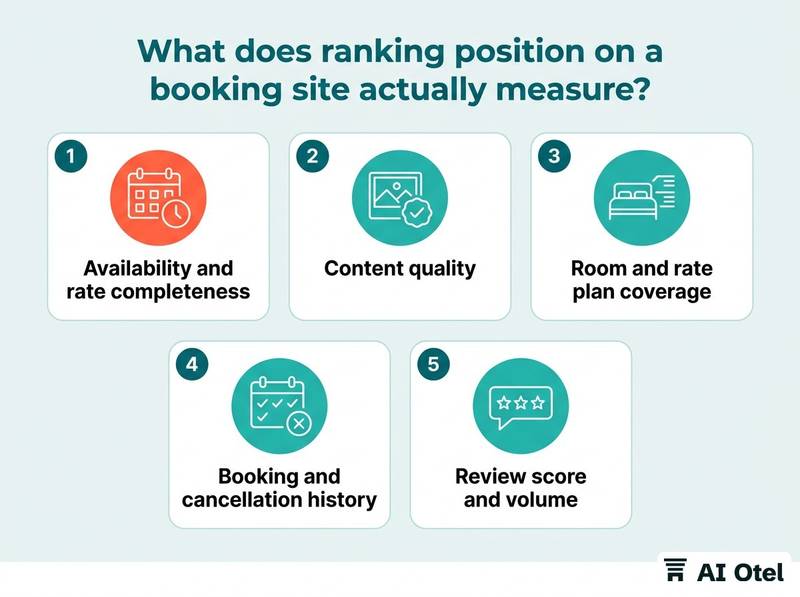
What the hotel controls: availability and rate completeness across the calendar, content quality, room and rate plan coverage, the booking and cancellation history the site holds, and review score and volume. What the hotel does not control: the site's own ordering changes, the searcher's filters, and the personalization applied to that searcher.
Treat ranking as an output. When availability, content and conversion improve, the ordering tends to follow; chasing the ordering directly usually means buying visibility instead. Before paying for visibility, run the break-even sum, because a paid slot and an organic slot are read in the same dashboard and confused in the same meeting.
Running the same search every week
Put the fixed search in the weekly log: the dates, the occupancy, the filters, the device, the logged-out browser. Run it on the same day as the four-number read, or on a fixed day of its own. What you are watching is the page, and the page only, week over week.
What the hotel controls and what it does not
Split your ranking notes into two columns. In one, the things you changed: availability, content, coverage, policy. In the other, the things that changed around you: the site's layout, the set's behavior, the season. When the page moves, check your column first; most of the time the explanation is there, and most of the time it is availability.
How do you run one change a week and keep a test log?
Write the hypothesis first, change one thing in one channel, and record the reading before and after. The log, not the change, is what makes the next decision easier.
State the hypothesis as a sentence with a direction: if the deluxe room gains free cancellation to the same deadline as the set, conversion on that room type rises without a price change. Name the single number you will watch and the date you will read it. Two numbers means two explanations. Record the baseline before the change, from the same day of the week and the same date range you will use afterwards.
Give the test enough volume. If the property or the room type is thin, run the test on the segment with the most traffic, or read the month instead of the week. Close every line with a decision: keep, revert, or repeat with a different variable. An open line is a change nobody owns. Keep one shared file for the whole team; the value is in comparing this week's line with the lines above it, not in any single entry. And do not stack changes. A price move, a photo change and a policy change in the same week produce a result that cannot be repeated on purpose.
A hypothesis that can fail
A hypothesis is only useful if it can fail. "Improve the page" cannot fail, so it teaches nothing. "If the room type photo matches the room type sold, conversion on that room type rises within four weeks" can fail, and the failure tells you the photo was not the constraint. Write hypotheses you would be willing to see fail, because those are the only ones that produce knowledge.
Closing the line: keep, revert, repeat
Every line in the log ends with one of three words. Keep, if the number moved in the stated direction with enough volume behind it. Revert, if it moved against you or did not move. Repeat, if the result was ambiguous and the next variable is worth one more week. No line stays open past its read date.
ChecklistWeekly test log checklist
- The four numbers read on the same day, same range, same currency
- One hypothesis written as a sentence with a direction
- The single number being watched, named
- The baseline reading, with its date
- The change made, with its date, channel and scope
- The follow-up reading, on the stated date
- The decision: keep, revert or repeat
- The next hypothesis, if the line is closed
What to do next
Pick one of the four numbers this week, read it on the same day and range you will use next week, and write the baseline line before you touch anything. Views, conversion, price position and cancellations are not four separate reports; they are one loop, where availability decides who sees the page, the page decides who books, the set decides whether the price is defensible, and cancellations decide what the week was worth. If the routine itself is the problem, because the numbers live in several systems that never agree, that is a different question: how a hotel operating system built and working, ahead of launch, keeps reservations, rates and reporting in one place, and how a distribution setup built with seed data, no agency connected yet, publishes contracted rates to travel agencies from a single inventory.
Frequently asked questions
What is a good conversion rate on a booking site?
There is no universal figure, and any number quoted without the market, the price position and the site's own denominator is meaningless. Compare the hotel with its own previous weeks and with its recorded set. Read the count beside the percentage, because thin traffic makes the ratio jump.
Why did my views drop when I changed nothing?
Check availability and restrictions first: a sold-out date, a closed rate plan, a minimum-stay rule or a missing child rate removes the property from searches. Then check filters and the date range the extranet is showing. Demand and the site's own layout changes come after that.
How often should I check my ranking on a booking site?
Once a week, with the same dates, occupancy and filters, logged out. Ranking is per search, so a daily check produces movement that is mostly noise. Record the page rather than the exact slot.
Should I change price or photos first?
Let the number decide. High views with low conversion points to the page: photos, room type names, the price shown against the price in the list, and the policy. Low views points to availability, restrictions and filters, where no page edit will help.
Do cancellations affect where I rank?
Booking sites publish little about what their ordering weighs, so treat the effect as unknown rather than assume one. Manage cancellations for the revenue reason first: read them by lead time and guarantee type, and test policy changes in one channel.