Preparing a hotel for sale: the data room a serious buyer asks for
A hotel sale data room is one indexed folder of documents and numbers that answers a buyer's questions before they are asked. Learn what to include, how to release it in stages, and how to keep control.
AI draft · awaiting editorial review

Contents
Key takeaways
- A data room is one indexed folder, not a pile of PDFs: every summary number must lead to the document a buyer can check.
- Release in stages, a short teaser before the NDA and the full folder only in confirmatory due diligence, so a failed deal costs you little.
- Buyers test monthly results by segment and channel before any annual total, because a hotel's value sits in the pattern of its months.
- Contracts, certificates and the staff list decide whether a deal closes on time; a missing original costs weeks.
- Guest personal data and staff personal files stay out of the folder; share aggregated figures and role-level payroll instead.
A hotel sale data room is one indexed, access-controlled folder of documents and numbers that answers a buyer's questions before they are asked: several years of monthly results by segment and channel, contracts, staff, property condition, certificates and a plain description of the hotel. You build it in stages and release more only as the buyer commits.
The buyer's first question is rarely about the price. It is about the night audit from fourteen months ago, the agency contract that renews in spring, and who is holding the fire certificate. This article shows you how to build the folder that answers those questions before they arrive: what goes in it, what each stage of a sale releases, and how to keep control of it.
What is a hotel sale data room, and what goes in it?
A data room is one indexed folder, usually online, holding every document and number a buyer will ask for, arranged so a stranger can find an answer without emailing you. Its test is simple: a buyer's question should be answered by a document, not by a conversation.
Build the index before the documents. A folder tree of seven top-level sections tells you what is missing before you have collected anything. Give the folder one owner, usually the finance lead or an external adviser, who decides what enters and who sees it. Two owners means two versions of the truth.
Name every file to one convention: section, subject, period, version. A buyer searching for the 2024 agency contract should not have to open twelve files. Open the folder with a two-page plain description of the property: location, rooms by type, outlets, seasonality, positioning, reason for sale, written in sentences rather than adjectives.
Tie every summary sheet to the document behind it, so a number on page one can be walked back to a ledger line, a bank statement or a signed contract. Keep out guest personal data, staff identity and personal files, and any draft you would not defend in a meeting. Under KVKK (the personal data protection law) personal data has its own rules; share aggregated figures and confirm your own position with counsel. Archive replaced documents instead of deleting them, so a question about an earlier version still has an answer.
ChecklistThe seven folders, one line each
- Performance: monthly profit and loss, segment and channel mix, night audit, reconciliations
- Contracts: distribution, operation, suppliers, software, finance
- People: org chart, roles, payroll bands, tenure
- Property: rooms, plans, condition, repair history, planned works
- Certificates and compliance: certificates in force, expiry dates, who holds originals
- Corporate and title: ownership, deeds, permits, loans, insurance
- Questions and answers: the log of every question asked and answered, with dates
What does a buyer need at each stage of a sale?
Each stage buys the buyer a little more certainty, so each stage should release a little more: teaser, NDA and information memorandum, indicative offer, confirmatory due diligence, then signing and closing. Releasing the full folder at the first meeting gives away your information and tells the buyer you have not done this before.
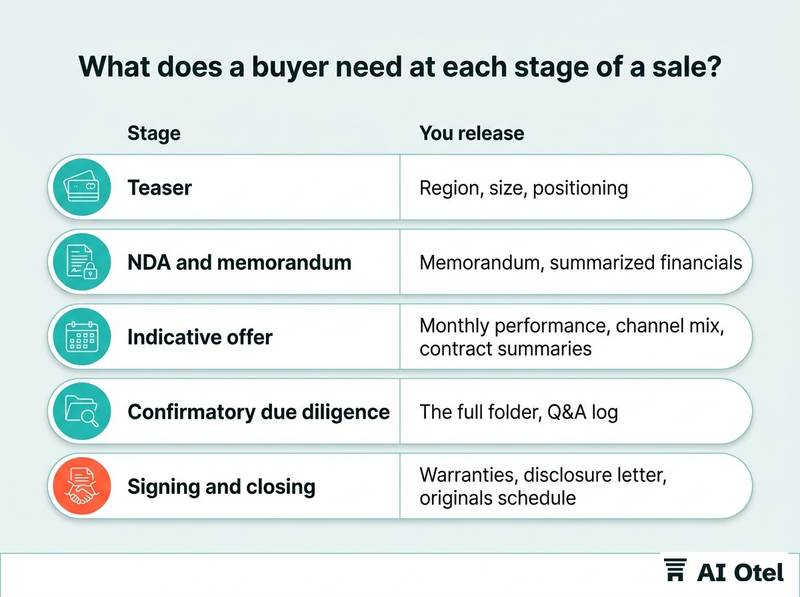
The teaser, sent before any NDA, carries region, room count, positioning, the shape of trading and the reason for sale. No hotel name, no address, no staff names, no contracts. After the NDA comes the information memorandum and a summarized financial pack, enough for the buyer to form a price view without seeing a single supplier agreement.
At the indicative offer stage, release monthly performance, channel mix and contract summaries, and arrange a site visit so the buyer sees the operation, not only the lobby. Confirmatory due diligence opens the full folder, with originals available on request at a set time and the questions and answers log opened and dated. At signing and closing, the warranties and the disclosure letter are drawn from the same folder: anything you disclosed late becomes a negotiation, and anything you did not disclose becomes your risk.
| Stage | Buyer is deciding | You release | What stays back |
|---|---|---|---|
| Teaser | Whether to look | Region, size, positioning | Name, address, contracts, staff |
| NDA and memorandum | Whether to spend time | Memorandum, summarized financials | Detailed contracts, staff list |
| Indicative offer | Whether to bid, at what level | Monthly performance, channel mix, contract summaries | Originals, personal files |
| Confirmatory due diligence | Whether the price holds | The full folder, Q&A log | Nothing relevant withheld |
| Signing and closing | What it signs and inherits | Warranties, disclosure letter, originals schedule | Nothing |
One rule across every stage: never release a document you cannot explain in a single sentence, because the buyer will ask that sentence back to you.
Which numbers does a buyer test first?
Monthly results by segment and channel, tied to bank statements, are tested before any annual total, because a hotel's value sits in the pattern of its months rather than in its year. A strong summer and a dead February is a different business from a flat twelve months at the same annual revenue.
Give several completed years plus the current year to date, all on one chart of accounts. If the chart changed, add a bridge page showing which line moved where. Split revenue by segment (transient, corporate, group, tour operator, agency, direct) and by channel, with room nights, average daily rate, revenue per available room and occupancy defined in plain words on the first page.
State which base your occupancy figure uses, rooms or beds, and keep it identical in every year and every chart. A buyer comparing your figures with a published market figure needs to know the base before comparing. Reconcile each month's revenue to bank deposits and to the fiscal documents issued, and keep the night audit trail plus the void and reversal log available. Corrections that were reversed rather than deleted are a sign of control, not of trouble.
Show the cost lines a buyer will re-price: payroll, energy, commissions, food and beverage cost, maintenance, per month and per occupied room. List one-off items and add-backs explicitly, each with the document behind it; an add-back without a document reads as an opinion. Show rate integrity too: your published rates, your contracted agency rates and the rates given to groups, because a buyer will look for the discount that quietly never ended.
TipThe rule that saves weeks
Every number in the summary pack carries a file name or a ledger reference beside it, so the buyer's accountant can walk from the summary to the source without asking you a question. The format to copy is the monthly owner's report a buyer will expect to see.
Which contracts belong in the data room?
Every contract that survives the sale, and every contract that would cost money to end, belongs in the folder, because the buyer is buying the obligations as much as the building. Start with a one-page contract register and put the documents behind it.
Distribution comes first: agency and OTA agreements, allotments with their release rules, tour operator agreements and corporate rate agreements, each with its renewal date and notice period. Operation comes next, and the structure matters more than the numbers: whether the hotel runs under an ordinary lease, a hasılat kirası or a management agreement decides who carries which risk and cost.
Outsourced services (housekeeping, laundry, security, technical service, food and beverage concessions) belong in the folder with their notice periods and exit costs. So do suppliers: energy, water, internet, television, elevator maintenance, pest control. Small contracts with long notice periods delay closings more often than large ones.
Software and systems deserve their own line: the property management system, channel manager, point of sale and accounting tools, with licence terms, data ownership and the export clause that decides whether your history leaves with you. Finance and insurance close the list: loan agreements with their covenants and security, and every policy with its renewal date.
ChecklistThe contract register, one line per contract
- Counterparty
- What it covers
- Start date and end date
- Renewal rule and notice period
- Change-of-control clause
- Annual value
- File name
What should the property and people files contain?
The property file proves what the building is and what it will need next; the people file proves who runs it and what it costs to keep them. Both are read closely, because both are where a buyer finds the work that starts on day one.
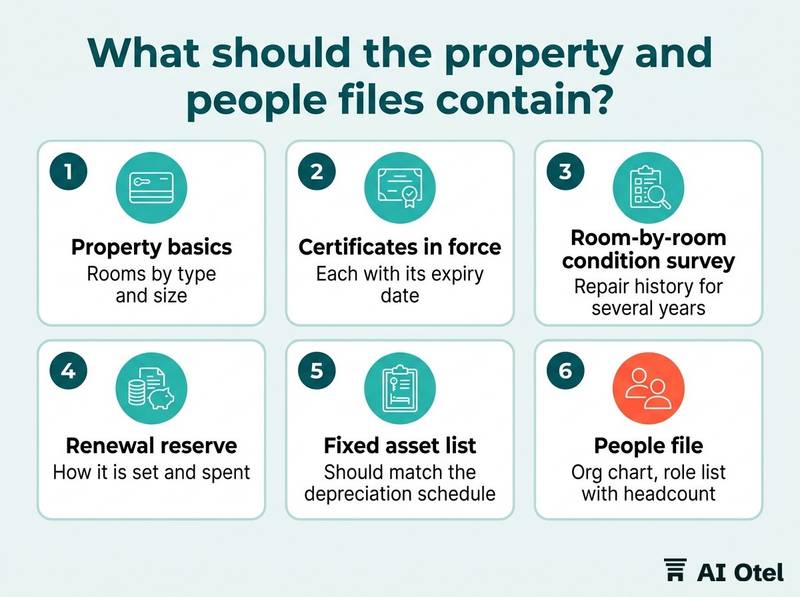
Property basics: rooms by type and size, outlets and their cover counts, total area, site plan, title and permits. Then the certificates in force, each with its expiry date and the name of whoever holds the original: tourism establishment certificate, fire, elevator, pool and water hygiene, food safety. A room-by-room condition survey, the repair history for several years and a planned works list with an opinion of cost let the buyer price the future instead of guessing it.
Show how the renewal reserve is set and spent, and what was deferred and why, following the logic of how a hotel sets aside money for renewal. A buyer treats deferred work as a deduction and an unexplained reserve as a warning. The fixed asset list should match the depreciation schedule: counted and tagged, as in a fixed asset list by room, lobby and kitchen, not copied from an old purchase list.
The people file holds the org chart, role list with headcount, salary bands and total payroll burden, tenure and notice periods, key-person dependencies, the seasonal staffing pattern and the training records you keep by role. What stays out: identity documents and personal files. Give role, band and tenure instead, and let the buyer see the shape of the payroll without seeing the people in it.
How do you share a data room without losing control?
Release in stages, log every access, and treat the questions and answers log as part of the data room, because the answers you give become the record the buyer relies on. Control is not secrecy; it is knowing who has seen what, and when.
No named document goes out before the NDA. A teaser that carries the hotel's name, address or staff names is already a disclosure. After that, use named users, one folder per stage, watermarked files, download limits and an expiry date on every grant. Redact narrowly: black out personal data and unrelated commercial terms, not whole pages, because a redacted page still has to be readable and honest.
Keep one questions and answers log with the question, the answer, the date and who answered. Two people answering the same question differently is the fastest way to lose a buyer's confidence. Keep an originals schedule too: which original document exists, who holds it, and when it can be produced. Scans live in the folder, originals appear at an agreed time. At the end, revoke access, record what was returned or destroyed, and keep that record with the deal file.
Watch outAn own goal to avoid
A summary sheet that does not match the ledger. Once a buyer finds one number that does not tie, every other number in the folder is re-tested, and the timetable moves.
What to do next
Appoint one owner for the folder this week and build the index before you collect a single document. Then start with the monthly performance file, because it takes longest and a buyer reads it first. The index shows what is missing, the stages decide who sees it, and the documents behind each number decide whether the deal closes on the timetable you set.
Frequently asked questions
How many years of financials should a hotel sale data room include?
Plan for several completed years plus the current year to date, all on one chart of accounts, with a bridge page wherever the chart changed. Older years can be summarized if the detail no longer exists, but say so in the folder rather than letting the buyer discover the gap. Your accountant confirms how each year was prepared and how tax items were treated.
Can an owner prepare a hotel data room without a broker or an accountant?
The index, the property file, the contract register and the questions and answers log can be built by the owner or the hotel's own team. The reconciliation of revenue to bank statements and the notes on tax treatment need an accountant, because those are the pages a buyer's adviser tests hardest. Splitting the work this way keeps cost down without weakening the file.
What should never go into a hotel data room?
Guest personal data, staff identity documents and personal files, unrelated personal information, and any draft you would not defend in a meeting. Personal data has its own legal regime under KVKK, so share aggregated figures and role-level payroll instead, and confirm your retention and transfer position with counsel. A document that leaks personal data damages the deal more than a missing document does.
Does a management agreement change what a buyer asks for?
Yes. The agreement becomes the operating manual: its term, fee structure, budget approval, reporting duties, termination and change-of-control clauses decide how the buyer can run the hotel and what it costs to exit. The buyer will model the property inside that contract rather than around it, so put the agreement and the operator's monthly reports near the front of the folder.
What if the original certificates and contracts are held somewhere else?
Build an originals schedule: what the document is, who holds it, its expiry or renewal date, and when it can be produced. Scans go in the folder and originals appear at an agreed point in the process. A certificate that expires during the deal should be flagged with its renewal plan, not left for the buyer to find.