The owner's brief for a new general manager: what to hand over and what to ask in the opening 90 days
A successful hotel handover requires a complete document pack, named system access and clear introductions. This guide details the owner's role in the first 90 days.
AI draft · awaiting editorial review
Contents
Key takeaways
- The handover pack is documents, system access and named contacts on one indexed page; if it takes more than a day to assemble, it was never ready.
- At day 30 the owner asks what the manager has found, not what the manager plans, because a plan written before the diagnosis is a template.
- By day 60 the manager should be bringing the owner choices to fund or refuse, not reports of decisions already taken alone.
- Authority limits belong on one signed page by day 90: money, people, contracts, guest compensation and legal matters, each with a limit and a name.
- The owner's job in the first quarter is to remove obstacles and hold the checkpoints, not to run the hotel through the new manager.
A general manager handover is a planned transfer of a written pack of documents and contracts, working access to every system in the manager's own name, and introductions to the people who can say no. The owner holds three checkpoints: findings at day 30, first decisions and the budget at day 60, authority limits in writing at day 90.
The outgoing manager left on a Friday. On Monday a new one arrives, and the owner is holding a folder of contracts, a set of passwords nobody wrote down, and a list of names the new manager has never heard. That gap is the handover, and it decides how the first year goes. This article sets out the owner's side of the new general manager hotel 90 days owner sequence: what to hand over before day one, who to introduce in week one, what to ask at each checkpoint, and what to refuse to do while the appointment settles.
What should an owner hand over to a new general manager before day one?
Three things: a written pack of documents and contracts, working access to every system the hotel runs on, and a named contact for each outside relationship. Everything else can wait a week; these cannot.
The documents are the hotel's memory. The budget and the last twelve monthly reports show what the owner has been told and what has actually been true. The management agreement or employment contract, with any schedule of authority, defines the job before anyone improvises it. Licenses and certificates, insurance policies, leases and a list of open legal matters complete the record. A manager who discovers a disputed lease in month four has learned that the owner keeps surprises.
Contracts need their own review, because they constrain the year ahead. Every supplier, agency and tour operator agreement should be listed with its start date, end date, notice period, any minimum volume or exclusivity, and who signed it. The manager needs to know which agreements cannot be changed this year before touching anything else.
Access must be in the manager's own name, never a shared password: the property management system (the software holding reservations, rooms and bills), the channel manager, the booking engine, payment accounts, the hotel's email and domain, and the review platforms. Named access leaves a record of who did what, which protects both sides when a question arises later.
Then the people outside the building: the accountant, the lawyer, the insurance broker, the bank, the three largest travel agency or tour operator contacts, the technical service companies, and the municipal and neighborhood contacts the hotel actually uses. A name and a phone number for each.
Finally, the honest file: what is broken, what is disputed, and what the owner has already promised staff or guests. Withholding it does not prevent discovery; it only schedules the discovery for the worst possible week. The whole pack is the same discipline a sale demands: the data room a serious buyer asks for is, item for item, the handover pack a manager needs.
Checklist
- Budget and last twelve monthly reports
- Employment contract or management agreement, with the authority schedule
- Licenses and certificates
- Insurance policies
- Leases
- Supplier and agency contracts with expiry and notice dates
- Staff list with roles, start dates and contract types
- Open legal and guest complaint files
- System access list, with the name of the person who grants each
- Outside contacts, a name and a phone number for each
- The honest file of what is broken or promised
- The index that ties it all together, with a name against every item
If the owner cannot produce the pack in a day, the missing items are the first finding of the new appointment. Treat that as useful information, not as an embarrassment to be papered over.
Week one: which introductions matter, and what should the property walk cover?
The first week is for meeting the people who can say no and walking the building with the people who run it. The manager should change nothing except a safety issue.
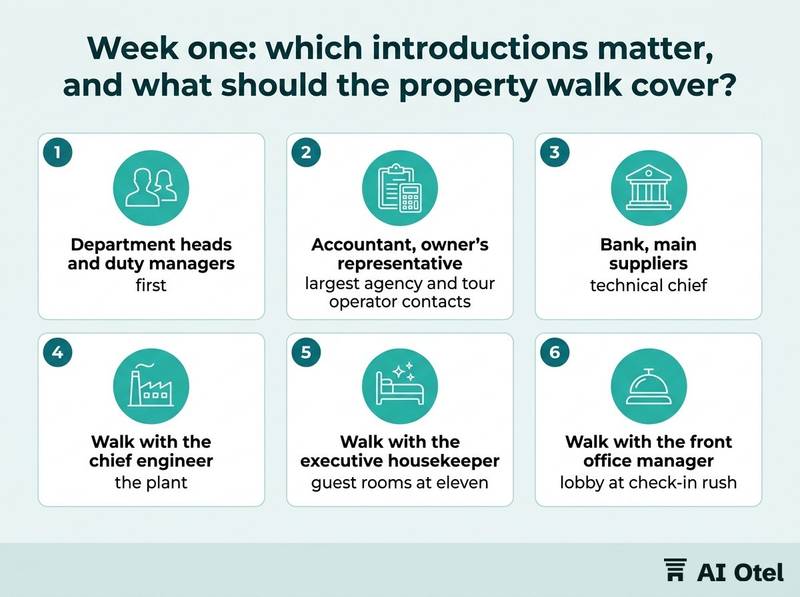
Introductions run in order of consequence: the department heads and duty managers first, then the accountant, the owner's representative, the largest agency and tour operator contacts, the bank, the main suppliers, and the technical chief. Each of these people can stop something the manager wants to do, so each should know the manager's face before the first request arrives.
Walk the property three times, separately: with the chief engineer, with the executive housekeeper, and with the front office manager. Each shows a different building, and none of them shows what the reports show. The engineer's building is the plant; the housekeeper's is the guest rooms as they actually are at eleven in the morning; the front office manager's is the lobby at check-in rush. Reading the last ninety days of the duty manager's log, complaint records and night audit exceptions before reading the budget tells a manager what the hotel is like on a bad night, which is the night that matters.
Meet the team without the owner in the room, at least once. Staff say things to a new manager that they will not say in front of the person who signs the salaries. The manager should also draw the organization as it is, not as the chart says: who reports to whom, who has been there fifteen years, who is related to whom, and where a department has no deputy. If the role boundaries inside the hotel are unclear, what the operations manager role covers and where it ends is a useful reference for the same reason.
The owner's own introduction should be one short meeting with the whole team, stating in plain words what the manager decides and what comes to the owner. That is the first draft of the authority schedule, to be settled at day 90.
TipThe three questions for every department head
Ask each department head in week one, and keep the answers in the file for the day-60 review: what breaks most often, what would you fix first with money we already have, and what have you needed for years that nobody gave you.
What should the owner ask at day 30?
Ask what the manager has found, not what the manager will do. Findings come first, plans second, and a plan written before the diagnosis is a template with the hotel's name on it.
Ask for a one-page findings note in three groups: what is costing money, what is costing guests, and what is costing neither but worries the staff. The grouping forces the manager to sort observations by consequence rather than by department, which is how an owner reads.
Ask for the evidence behind each item: which report, which log entry, which guest comment, which invoice. A finding without a document behind it is an opinion. Ask what surprised the manager, too; surprise is the clearest measure of how much the previous arrangement kept out of sight.
Ask what the manager still cannot answer, and what access, introduction or document is missing. Removing those obstacles is the owner's main job in the first quarter. A blocked introduction to the bank or a missing contract file is the owner's to fix, quickly and without argument.
Ask for a first view on the team: who the manager would keep, who needs coaching, and where a role may not be needed. Do not ask for names in writing yet. A manager with a full list by day 30 is guessing, and one with no view is not looking.
Refuse a turnaround plan at this meeting. Say plainly that the plan comes at day 60, built on the findings, and that the owner will judge it on its assumptions rather than its ambition. This refusal is a service to the manager as much as to the owner: it buys thirty days of listening.
What should the owner expect by day 60, and how does the budget fit?
By day 60 the manager should have taken the first small decisions, opened next year's budget, and brought the owner two or three choices that need money or authority. The owner funds or refuses; the manager decides the rest.
First decisions should be small, reversible and written down: rosters, supplier renewals, the guest complaint that has run for months, the capital item under the threshold. The point is to see how the manager decides, not to see a transformation. How a person handles a small reversible decision predicts how they will handle a large irreversible one.
The budget belongs to the manager, the assumptions belong to the owner. Ask which three assumptions move the result most, and what happens to the year if each one is wrong. A budget presented without its assumptions is a number, not a plan.
Ask for the commercial picture in the manager's own words: how the hotel sells today through direct bookings, travel agencies, tour operators and the online travel agencies, which channel the manager would change first, and why that one. Ask for a ranked capital list for the next twelve months with the consequence of waiting written against each item; a list without consequences is a wish list. Ask about the first people decision, whether a hire, a promotion or an exit, with the reasoning and the timing. This is where an owner learns whether the manager will carry an uncomfortable conversation.
Check the direction of travel: is the manager asking the owner for decisions, or making them and reporting afterwards? By day 60 the balance should be moving toward the second, within the limits the owner has already stated. If every decision still comes back for approval, either the limits were never stated or the manager will not carry risk, and the two require different responses.
What should the day-90 report contain, and how are authority limits settled?
The day-90 report is a short written account of what the manager found, changed, stopped and needs, and the meeting that follows puts the authority limits on one page, signed by both sides, for the year ahead.
The report has five parts: what I found, what I changed and what it cost or saved in the hotel's own numbers, what I stopped, what I need from the owner, and what I will be judged on next quarter. The middle part matters most. A manager who cannot say what changed in ninety days has either changed nothing or cannot count.
The authority schedule covers five areas: money (spending alone, spending with a quote, spending that needs the owner), people (hire, exit, salary change), contracts (sign, renew, terminate), guest compensation, and legal matters. Each line carries a limit and a name. Agree three to five measures the owner will actually look at each month, and say plainly which of them the manager controls and which the market controls. Set the rhythm: a written monthly report and a quarterly meeting, with extra contact only while a named issue is open. For what that report should contain month by month, the monthly owner's report and what to ask for in it is the companion piece.
| Checkpoint | What the owner asks | What the owner should receive | The owner's decision |
|---|---|---|---|
| Day 30 | What have you found? | A one-page findings note, a document behind each item | Which gaps to unblock: access, introductions, money |
| Day 60 | What have you decided, and what does the budget assume? | First decisions, a budget draft with three key assumptions, a ranked capital list | Which choices to fund and which to refuse |
| Day 90 | What are you accountable for, and inside what limits? | A report of found, changed, stopped and needed, plus a one-page authority schedule | Sign the schedule and the measures for the next quarter |
For an owner with more than one property, the schedule must also say what is decided at the property and what at the center, or the group will be governed by whoever calls first; the governance checklist for a multi-property owner covers that split in detail. Both sides sign the page. An authority limit that lives in a conversation is renegotiated every time somebody tests it.
What should the owner not do in the first 90 days?
The owner should not run the hotel through the new manager, reverse the manager's decisions in front of staff, or change the terms of the job quietly. Each of these teaches the team that the manager's word is provisional.
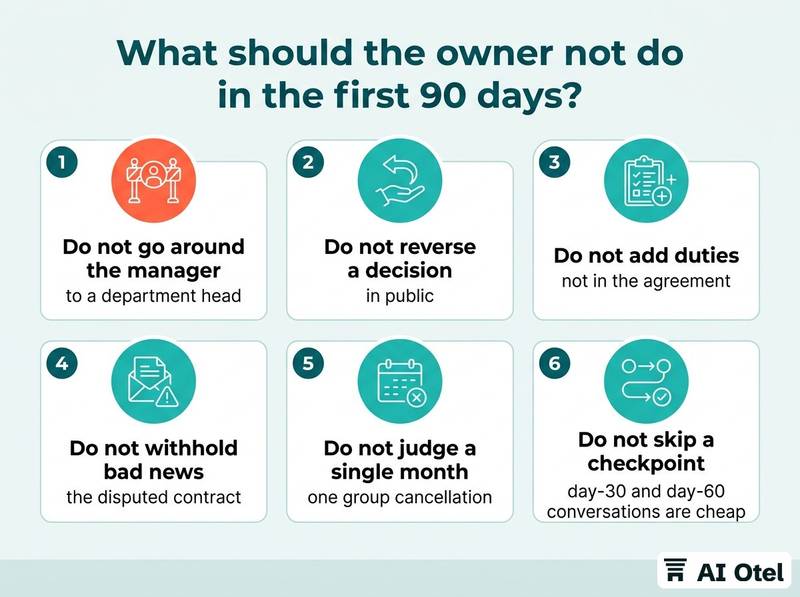
Do not go around the manager to a department head. Every instruction given directly tells the team where the real authority sits, and it will be remembered long after the reason is forgotten. Do not reverse a decision in public; if it must be reversed, do it in a conversation and let the manager announce the change. Do not add duties that were not in the agreement without saying so, and do not quietly move the target after the manager has hit the old one.
Do not withhold bad news: the disputed contract, the promised renovation, the staff member who is a relative of the owner. All three surface eventually, and the delay costs more than the fact. Do not judge on a single month; one group cancellation, one weather week or one festival calendar can move a month without saying anything about the manager. And do not skip a checkpoint because things look fine. The day-30 and day-60 conversations are cheap; the one held after a bad season is not.
Watch outThe coordinator trap
An owner who gives instructions directly to department heads in the first quarter has not appointed a general manager, only a coordinator. The team will route around the role within weeks, and the day-90 authority schedule will describe powers the manager does not actually hold.
Which warning signs mean the appointment is not working?
Three patterns matter more than any single number: problems stop arriving at the owner, the same problem appears in two consecutive reports, and every decision comes back for approval.
Silence is the first. The manager stops bringing problems, and either they are genuinely solved or the manager has learned that bringing them is punished. The owner controls which of the two it is, by how the previous problems were received. Repetition is the second: the same issue in two monthly reports with no change of approach means the second appearance is a decision problem, not an information problem. Dependency is the third: every decision escalated means either a missing authority schedule, which the owner can fix, or a manager who will not carry risk, which the owner cannot.
Staff departures in the first quarter, especially among long-serving department heads, are worth a direct question in the next scheduled meeting rather than a conclusion. And if the manager's account of the hotel never changes while the guest reviews do, one of the two is not being read.
Handle it inside the rhythm already set: name the pattern at the next checkpoint, ask what the manager needs, and if nothing changes by the following one, treat it as a hiring question rather than a coaching one. Ending an appointment is governed by the contract and by employment law, and that step belongs with the owner's legal adviser.
What to do next
Write the handover pack this week, before the next appointment is even advertised, and put the three checkpoints in the calendar on the day the manager signs. The pack, the introductions and the day-30, day-60 and day-90 conversations form one sequence: each one gives the next its evidence, and the signed authority schedule at the end is what turns a promising appointment into a working one.
If part of the reason the handover is hard is that the hotel's information lives in disconnected systems, that is worth fixing before the next change of manager, not during it. An owner evaluating a hotel operating system that keeps reservations, billing and compliance in one place, or a hotel growth consultancy for the commercial side of the handover, is doing the same work this article describes: making the hotel legible to the next person who runs it.
Frequently asked questions
How long should a general manager handover take?
One working day to hand over the pack and the access, one week for introductions and the property walk, and ninety days to settle authority in writing. The documents are a week-one task; the working relationship is a quarter.
Should the owner sit in when the new general manager meets the team?
Not in the department meetings, because staff will not speak freely. Do attend one short all-staff introduction where the owner states the manager's authority in plain words, then leave the room.
What belongs in a general manager's authority schedule?
Five areas on one page: money, people, contracts, guest compensation and legal matters. Each line needs a limit and a name, and both sides sign it at day 90.
What if the hotel has no written handover pack?
Build it during week one with the accountant and the department heads, using the index above as the list. The items nobody can produce are the first risks the new manager has found.
How often should the owner and the general manager meet after the first 90 days?
A written monthly report and a quarterly meeting, with extra contact only while a named issue is open. More frequent meetings usually mean the authority schedule is not being used.