Pricing your hardest rooms: next to the lift, the kitchen or the car park
Hard-to-sell rooms need a deliberate pricing decision, not a guess. This guide explains how to identify problem rooms, set the right price gap, and describe them honestly to avoid guest complaints.
AI draft · awaiting editorial review
Contents
Key takeaways
- A room earns its discount from its location, not its size: two rooms with the same furniture can need different rates because one sits over the kitchen extract and the other over the garden.
- Decide between a separate room type, a last-sold rule and a physical fix before you set any number, because a discount applied without that decision leaks into rooms that never needed it.
- Name the location in the room type and the first line of the description, so the guest chooses the room with the fact in hand.
- Keep discounted rooms out of complimentary upgrades and out of any promise that assumes the guest will be pleased by the move.
- Review the list once a season and retire the discount on the day the cause is fixed.
A hard-to-sell room is one whose location reliably produces complaints or move requests. Price it by choosing one of three routes: a separate room type with its own rate, a room sold last at a defined discount, or a physical fix. Whichever you choose, describe the location in the listing before the guest books.
Two rooms, same size, same furniture, same photograph on the website. One sells in a day. The other comes back as a complaint about the lift motor at two in the morning. The difference is not the room. It is the address inside the building. Pricing hard to sell rooms starts with finding those addresses, then making one deliberate decision per room: name it, sell it last, or fix it. This article gives you the evidence to collect, the three routes to choose between, how to size the gap, and how to describe the room so the guest books it knowingly.
Which rooms are hard to sell, and how do you find them?
Start from evidence you already hold: complaints, move requests and the room numbers still free when the rest of the house is full.
Three sources of evidence
Pull twelve months of guest complaints and requests to change rooms, sorted by room number. A number that appears repeatedly is a candidate; a number that appears once is usually a guest having a bad night. Then read the pickup order in the reservation system: which room numbers are still unsold a week out while identical rooms have gone. Last, ask front office and housekeeping which rooms they avoid giving to light sleepers, families with small children and guests staying several nights. Their list is usually accurate and never written down.
Discount history is a fourth source. Rooms sold below the standard rate without a documented reason are rooms the team already knows about.
What counts as hard to sell
Name the cause precisely, because the cause decides the fix: outside noise (street, car park, extract fan), inside noise (lift motor, plumbing riser, housekeeping store), light, smell, view, walking distance, or privacy lost to a corridor or a neighboring balcony.
Separate location from maintenance. A broken window seal is a repair ticket. A room whose bathroom wall is the lift shaft is a pricing decision, because the cause stays where it is.
ChecklistRun the audit as a checklist, one line per room number
- Complaint count over twelve months
- Move requests
- Nights unsold seven days out
- Discounts applied without a recorded reason
- Named cause
- Location cause or maintenance cause
- Decision owner
Should you create a separate room type, sell the room last, or fix the cause?
All three work, and they answer different problems: a separate type prices the room honestly, a last-sold rule protects the rest of the house, and a fix removes the problem for good.
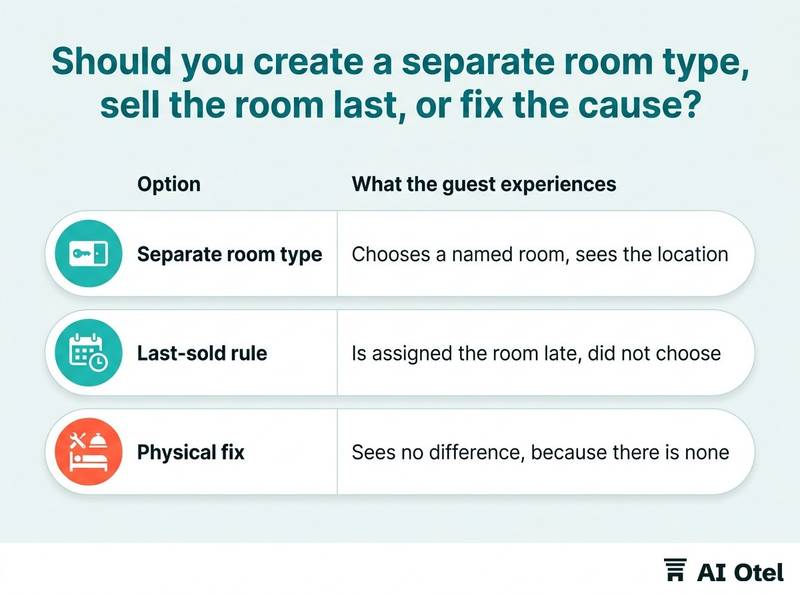
A separate room type gives the room its own name, rate and inventory, so the guest chooses it deliberately. The cost is administrative: one more type to map on every channel and one more rate to maintain all season. A last-sold rule keeps the room inside the standard pool and releases it late, with the discount applied at the desk or by a rule. It is cheap to run, but the guest who ends up in it did not choose it, and that is where the complaint comes from. A physical fix removes the discount permanently; it costs money and takes the room out of sale while the work happens, so it competes with the discount over a defined period, not on principle.
| Option | What the guest experiences | What it costs you | When it fits |
|---|---|---|---|
| Separate room type | Chooses a named room, sees the location before booking | Channel mapping, a maintained rate | A permanent cause on a room you still want to sell |
| Last-sold rule | Is assigned the room late, did not choose it | Desk discretion, complaint handling | Overflow nights, a cause you are about to fix |
| Physical fix | Sees no difference, because there is none | The work, plus nights out of sale | A cause that can be removed |
The usual answer is a combination: fix what can be fixed before the season, name what cannot, and keep a last-sold rule only for the overflow nights when the house is full. A simple decision rule: if the work costs less than the discount would cost over a couple of seasons, fix it. If the cause is structural and permanent, name it and price it. Never run two of the three at once for the same room without writing down which one is in force, or the desk will invent a third.
How big should the price gap be?
Set the gap from what the room reliably delivers, not from how much you dislike it: start at the standard room rate and subtract the amount that lets the room sell on its own merits.
Anchor on the standard room rate and hold the gap steady through the season, as a fixed step in the ladder, so the guest can read the difference between rooms without doing arithmetic. The gap must pass two tests: wide enough that a guest who reads the description still chooses the room sometimes, and narrow enough that the discounted room does not start taking sales from the standard room. If you want a fuller treatment of ladders, read how big the gap between room types should be and pricing three room types so guests choose the middle one.
Watch what the room earns, not what it costs. If the discounted room sells first and the standard room then sits empty, the gap is too wide and you have moved demand rather than created it. Do not let the gap widen automatically with occupancy: a hard-to-sell room at a full house is still the same room, and at that point the gap can narrow, because the alternative for the guest is no room at all.
For example, if the standard room is the second step of a four-step ladder, the hard-to-sell room can sit one step below it. Two steps below and it starts competing with the entry category instead of the room it belongs to.
Watch outOccupancy is not a reason to widen the gap
A gap that grows with occupancy turns a location problem into a pricing problem. If the room only sells when the house is full, you are not discounting a room, you are discounting the last room in the building, and the standard room pays for it.
How do you describe a hard-to-sell room honestly?
Put the location in the room type name and in the first line of the description, so the guest books the room knowing what it is.
Name the location, not the mood. A room type called "standard room, courtyard side" or "standard room, lift side" reads as information. A type called "economy room" reads as a warning with the reason removed. State the mechanism instead of the judgment: saying that the lift shaft runs behind this room's bathroom wall tells the guest what to expect. Calling it a quiet room when it is not is the sentence that produces the complaint.
Say what the room gives in exchange: direct access to the car park, a shorter walk from the lift, a larger bathroom, a window that opens. Photograph the actual room, not a standard room; a guest who recognizes the room on arrival is not surprised by it. Repeat the fact once in the pre-arrival message, without apology, and say what to do if it is not what the guest expected. Use the same wording on the hotel's own website, the channels and the confirmation email. Three descriptions of one room is three promises.
TipA worked example, labelled as an example
Weak: "Economy double, comfortable and quiet, ideal for short stays." Stronger: "Standard double, lift side. The lift shaft runs behind the bathroom wall, so you may hear the lift in the early morning. The room is a few steps from the lift and has the larger bathroom of the standard rooms." The second version sells less often and returns less often.
How do you keep these rooms out of upgrade promises?
Treat the room as a type with its own assignment rules and exclude it from every promise that assumes the guest will be pleased by the move.
Never move a guest into a hard-to-sell room as a complimentary upgrade. The guest reads it as a downgrade, and the review will say so in the guest's own words. If you sell paid upgrades, the target room must be better on the dimension the guest cares about, not simply larger or higher in the building. For the rules that sit around this, see assigning rooms before arrival: blocking, upgrades and special requests.
Route special requests by rule, not by memory: light sleepers, families with a baby and long-stay guests go to the quiet side automatically, and the rule is written where the desk can see it. Check group blocks and allotments too. If the same room is the one left in the block every time, the group notices the pattern and the organizer hears about it. Map the room type to the same category on every channel, or a guest books standard and receives the lift side, which is a description failure rather than a room failure. Keep repeat and loyalty guests out of these rooms by default; a returning guest in the worst room in the house costs more than the discount.
ChecklistWrite the assignment rules down
- Which room numbers are excluded from complimentary upgrades
- Which are excluded from paid upgrade inventory
- Which guest profiles are never assigned to them
- How the block is rotated so the same room is not always the remainder
- Who may override the rule, and how the override is recorded
When is fixing the cause cheaper than the discount?
When the discount over the nights the room would otherwise sell at full rate exceeds the cost of the work, and the work can be done without closing the room for long.
Trace the path before buying anything. Sound arrives through gaps, ducts and structure, and the fix depends on which of the three is carrying it; tracing the sound path between rooms comes before any soundproofing invoice. Start with the cheap fixes: a door seal, a rubber pad under a motor, a second glazing panel, a shelf moved off a shared wall, a blind that stops light coming in from the car park lamp.
Cost the work against the discount over a defined period, and count the nights the room is out of sale while the work happens. A fix that closes the room for a month in high season can cost more than two seasons of discount. Accept that some causes cannot be removed: the lift shaft is where it is and the kitchen extract is where it is, so those rooms keep their name permanently and the gap stays. Test the result before retiring the discount: sleep in the room, or have a staff member sleep in it, on a normal operating night rather than an empty one. Record the work and the date, so the next review knows which room was fixed and which was only made better.
| Cause | First check | Fix that removes it | Fix that only reduces it |
|---|---|---|---|
| Lift motor noise | Mounting, shaft wall | Isolation mounts, separated wall | Sealed door, soft furnishings |
| Kitchen extract | Duct route, fan position | Rerouting | Silencer, a schedule |
| Street and car park noise | Window, gap under door | Secondary glazing | Heavy curtains, white-noise unit |
| Plumbing riser | Where the pipe runs | Boxing with acoustic insulation | Service cupboard door seal |
How do you review the list each season?
Once a season, re-measure the same evidence you used to build the list, and retire the discount on any room whose cause has gone.
Re-run the complaint and move count by room number. A room that has dropped off the list has probably been fixed, and the discount is now a gift. Check whether the room still sells in the last week: if it now goes earlier, either the gap is too wide or the description is doing the work, and both are worth knowing. Retire the discount formally, changing the room type, the rate and the channel mapping on the same day, so no channel keeps selling the old name at the old price.
Add new rooms as causes move: a renovation, a new lift, a new extract fan or a changed car park entrance all change the list. Write the decision down: which rooms, which of the three options, which gap, and the date of the next review. A list that lives in one manager's memory disappears when that manager does.
NoteThe review is a rate action, not a report
Put it in the revenue calendar for the same week every year, before next season's rates are loaded, and give it an owner by name.
What to do next
This week, pull the room numbers from last season's complaints and move requests, and decide for each one: name it, sell it last, or fix it. Then write the gap and the description down before next season's rates go out, so the desk, the channels and the website all sell the same room in the same words. If you want that record to sit next to your rates rather than in a spreadsheet, a hotel operating system built and working, ahead of launch, can hold room types, rates and channel mapping in one place. If you want a second pair of eyes on the ladder itself, OtelCiro's revenue review is where a hotel's pricing and distribution performance gets examined.
And if you are reading this as a traveler rather than a hotelier, the same logic works for you: read the room description before you book, and choose a hotel in Türkiye (opens in a new tab) with the facts in hand.
Frequently asked questions
Should a room next to the lift be cheaper than the same room on a quiet side?
Yes, if the cause is permanent, because the gap reflects what the room actually delivers. If the cause can be removed with a door seal or an isolation mount, fixing it is usually better than carrying a discount for years. The gap should be a fixed step in the ladder, not something that grows with occupancy.
Is it better to call it an economy room or to name the location?
Name the location. Economy tells the guest there is a problem without saying what it is, so the guest invents something worse. A room type that names the side of the building, followed by one plain sentence about what the guest may hear, sets the expectation the room can actually meet.
Can we give these rooms to guests as a free upgrade?
No. A guest who is moved into a room next to the lift as a gift reads it as a downgrade, and the complaint arrives with the word upgrade in it. Keep these rooms out of complimentary upgrade inventory, and use them as a paid upgrade only when they are genuinely better on something the guest cares about.
How do we stop a channel from selling the room as a standard room?
Map the room type to the same category on every channel and check the mapping after each rate load, because a mismatch sends the guest a standard room confirmation for a lift-side room. Keep the description identical everywhere: the hotel's own website, the channels and the confirmation email.
How long should a discount on a hard-to-sell room stay in place?
Until the cause is fixed or the evidence changes, with a review date written down at the start. Review it once a season against complaints, move requests and how early the room sells. When the cause is gone, retire the type, the rate and the channel mapping on the same day.