Replenishing the breakfast buffet in waves: timing, quantities and who watches the counters
Discover how to plan refill rounds, set batch sizes and assign zone owners to keep your breakfast buffet full at peak and tidy at close. This guide covers timing, quantities and weekly reviews.
AI draft · awaiting editorial review

Contents
Key takeaways
- A buffet has three states, top-up, reset and run-down, and each counter needs a written rule for all three.
- Refill at about one third full, never at zero: a tray that reaches empty has already failed a guest.
- One named person owns each zone per shift, with the round times on a board, because a buffet watched by everyone is watched by nobody.
- Hot items are cooked in the quantity the counter will take before the next batch is ready, not the quantity the pan holds.
- Leftovers weighed at close and reviewed once a week are the honest input for next week's batch sizes.
Breakfast buffet replenishment is the planned cycle of topping up, resetting and running down each counter so trays are full when guests arrive and nearly empty at close. It works when a hotel knows its arrival waves, sets refill rounds per counter, names one owner per zone and cooks hot items in small batches.
At 9:15 the scrambled eggs are gone and a guest is standing over an empty tray. At 10:30 the same tray is full and the kitchen is scraping it into the bin. Both are the same failure: nobody decided when that tray should be full. This guide shows you how to find your arrival waves in three mornings of observation, set refill rounds counter by counter, name an owner for every zone, cook hot items in the right batch size and close the line without it looking empty.
What does breakfast buffet replenishment mean in a hotel?
Replenishment is the planned cycle that keeps every counter in the state it should be in at that hour: full at the peak, thinning at close, never empty and never overflowing. It starts with naming the three states and using the same words every day. Top-up means adding to a tray that is partly used. Reset means replacing the tray, wiping the rim, restoring the label and giving it a clean serving spoon. Run-down means deliberately consolidating and stopping the refill.
Key pointThe three states of a tray
Top-up: add to a partly used tray before it empties. Reset: replace the tray, wipe the rim, restore the label and a clean spoon. Run-down: consolidate and stop refilling on a planned schedule before closing.
Separate production from replenishment. The kitchen cooks; the counter decides how much goes out and when. When the two are the same decision, the cook sends a full pan because it is ready, not because the room needs it.
Two failures cost the most. An empty tray at the peak reads as neglect, and a full tray at close reads as waste. Both come from the same missing rule: a trigger and an owner per counter. A guest judges the kitchen by the tray in front of them, not by the recipe behind it, so the tray is a communication surface as much as a serving surface.
Every counter needs four written things: the trigger that starts a refill, the batch size, the round times, and the name of the person who owns it. Without them, replenishment defaults to whoever happens to notice. Keep one vocabulary across the team: wave, trigger, top-up, reset, run-down, batch, buffer. Half the arguments about a buffet are two people using different words for the same tray.
How do you find your breakfast peak waves in three mornings?
Stand at the door for three mornings and count arrivals in short blocks, then note which trays empty and when. The pattern is usually stable enough to plan rounds from.
Count arrivals, not seats. A tally at the host stand for each short block of the morning, on the same printed sheet every day, gives you the shape of the wave without any software. Record the empty time per item: when a tray first hits empty, and roughly how quickly it went from half to empty. That speed, not the clock, is what a refill trigger is built on.
Record what is left at close, item by item, by count or by weight. This is the other half of the picture and the input for next week's batch sizes. Separate the days before you draw conclusions: a weekday, a weekend, a group departure morning and a group arrival morning are four different buffets in the same room, and a coach group can move the whole wave.
Plot it simply: one bar per block of the morning, with the five fastest-emptying items marked on it. That single sheet is the wave chart the whole routine runs on. Plan for the busiest block, not the average. Averaging a peak away is how a buffet ends up comfortable at 8:00 and empty at 9:15. Repeat the observation after a menu change, a season change or a change in the group mix. The wave is a property of your guests, and your guests change.
ChecklistThe observation sheet, one per morning
- Date and day type
- Arrivals counted per short block
- The five items that emptied first, and the time each hit empty
- Items that ran low but never emptied
- What was left at close per item, by count or weight
- Anything unusual: a group, a late opening, a broken oven
The same counting habit applies at dinner, and the same wave logic drives dinner seatings and table turns in a half-board hotel.
What should a refill round look like, counter by counter?
Each counter gets its own trigger, batch and round time, because a cheese tray and a tray of scrambled eggs fail in completely different ways. Divide the buffet into zones: hot line, cheese and olives, bakery, fruit, salad, beverages, desserts. A zone is a unit of ownership, so keep it small enough for one person to watch properly.
Set the trigger at about one third full rather than at empty. A tray that reaches zero has already been seen by a guest as a failure, and the refill then happens under pressure. Match the batch to the item: hot items go out small and often from the cook line, while cheese, olives, cold cuts and pastries can go out in larger, less frequent batches because they hold well and are taken more slowly.
| Counter or zone | Refill trigger | Batch guidance | Round pattern |
|---|---|---|---|
| Hot line (eggs, sausages, potatoes) | One third full | Small, from the cook line | More rounds in the peak block |
| Cheese, olives, cold cuts | One quarter full | Larger, holds well | Fewer, fixed rounds |
| Bakery and bread | Half full | Moderate, refreshed often | Rounds tied to the peak |
| Fruit | One third full | Moderate | Fixed rounds, peak-weighted |
| Salad bar | One third full | Moderate | Fixed rounds |
| Beverages and hot drinks | Half full | Full, steady | Frequent checks |
| Desserts | One quarter full | Small | Few rounds, mostly reset |
Post a timing card at each counter: the round times for that zone, the trigger, the batch guidance and who to call. A laminated card lets a new starter run a counter correctly on their first shift. Rounds follow the wave, not the clock alone: more rounds inside the peak block, fewer outside it, and a different pattern again in the last half hour before close.
Reset, do not just top up. Wipe the rim, replace the spoon, straighten the tray and restore the label. The label is not decoration: it is how a guest with an allergy decides whether to take the item, and the whole routine around food allergies in hotel restaurants and buffets depends on labels staying where they belong. Never refill a full tray: stacking fresh food on old food looks careless, mixes holding times and hides how much is really being eaten.
Who watches which counter?
One named person per zone per shift, written on a board with the round times, plus a runner who carries. A buffet watched by everyone is watched by nobody.
Put the zone board where the team passes it: zone, name, round times, relief, and the name of the person covering the break. A board that is updated every shift is worth more than a long procedure nobody reads. Split three jobs. The zone owner watches and decides, the runner carries and fetches, the cook line produces. When one person does all three, the watching stops first.
Use the floor manager or host as the second pair of eyes. They see the guest standing at the empty tray before the zone owner does, and their only job in that moment is to tell the owner, not to fix it themselves. Hand over by walking the line together at shift change: what is low, what is coming, what has been changed today. A verbal handover at the door loses the detail.
Make watching active. A check means walking the line with a cloth, a thermometer and spare spoons; a glance from the door is not a check and should not be counted as one. Anyone may flag a problem, but only the zone owner changes the plan mid-service. Otherwise three people move the same tray in three directions. At close, ownership changes from keeping the line full to running it down, and the same person should own both halves so the plan is one plan.
TipBuilding the zone board
Write it for the shift, not for the file. Four columns: zone, name, round times, relief. Photograph it at the start of each shift so the handover has a record.
What batch size should hot items be cooked in?
A batch should be the amount the counter will take before the next batch is ready, not the amount the pan holds. Derive the batch from the wave chart: how many guests arrive in the next block and how much of that item they take. Two mornings of observation usually give a workable figure.
Small and often beats large and rare. A fresh small batch looks like a kitchen that is paying attention, and it holds better on the line than a large one sitting under heat. Keep the buffer in the kitchen, not on the counter. A full tray on the line is a display decision, not a stock decision, and the stock belongs where it can still be used for something else.
Key pointThe buffer rule
The counter carries what the next block of guests will take; the kitchen carries the next batch. If the counter needs a second tray before the kitchen can send one, the batch was too small or the call came too late.
Agree the signal. The zone owner calls for a batch at the trigger point, and the cook line answers with a time. An unanswered call is how a tray stays empty for ten minutes. Treat cook-to-order stations differently: eggs and omelettes are a queue problem, not a batch problem, so the station is staffed to the wave rather than stocked to it.
Take holding times and temperatures from the hotel's own food safety plan, set with the person responsible for food safety. Replenishment schedules must fit inside those limits, not the other way round. Remember that batch size is a cost lever as well as a quality lever: every batch that goes back at close was bought, cooked and carried for nothing. The money side is covered in food and beverage cost control in hotels.
How do you close a buffet without it looking empty?
Plan the run-down backwards from closing time, so each item has a last cooking time and a consolidation step and the buffet thins on purpose instead of emptying by accident.
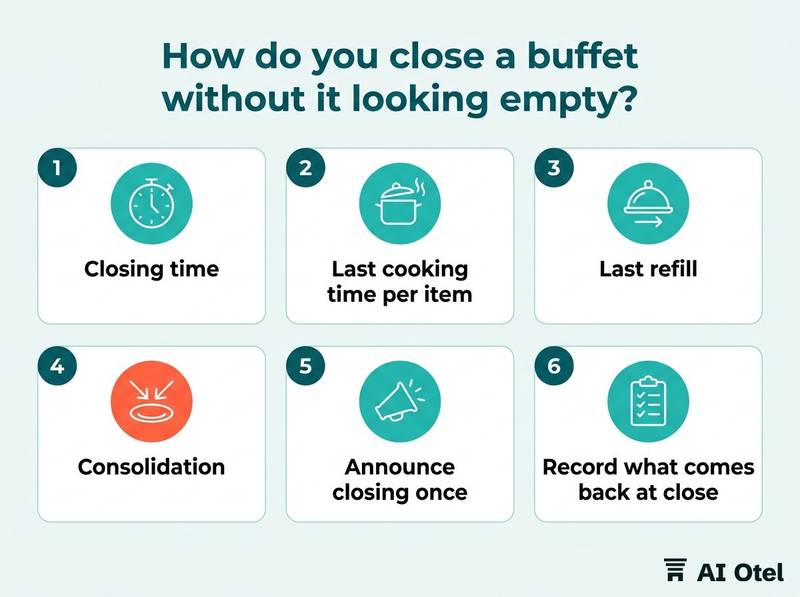
Work backwards in four steps: closing time, then the last cooking time per item, then the last refill, then the consolidation. Write the four times on the same timing card the counter already uses. Consolidate rather than empty: two half trays become one full tray, so the line still looks stocked while the quantity on offer falls in a controlled way.
Keep the last wave generous. A guest who arrives shortly before close should still see a proper breakfast, because that guest is judging the same buffet as the one who arrived at 8:00. Announce closing once, at a set time, calmly, at the door and at the counter. One clear announcement is hospitality; stacking chairs around a seated guest is a request to leave.
Watch outEarly clearing
An empty, wiped station at 10:15 tells every guest still in the room that the meal is over. Clearing is a signal, and it should be sent once, at closing, not gradually from an hour before.
Never clear a station while guests are still eating from it. Move to the far end, clear what is genuinely finished, and leave the last items until the room is done. Record what comes back at close, item by item, on the same sheet as the morning observation: the morning and the close are two halves of one record. Hand the close numbers to the chef the same day. Tomorrow's first batch is decided by today's last tray.
How do you review buffet leftovers every week?
Weigh or count what comes back at close, item by item, and review it once a week against the wave chart. The number tells you whether to change the batch, the position or the item itself.
Use the same sheet, the same scale and the same time every day. A rough count done consistently every morning beats a precise measurement done twice a month. Read a high leftover three ways before changing anything: the batch was too large, the rounds were too frequent, or the item sits where guests do not see it. Each has a different fix.
Accept that some leftovers are display. A full cheese board at close may be the price of a buffet that looks generous, and that is a decision to take deliberately rather than discover by accident. Watch the opposite signal too: low leftovers combined with complaints about empty trays means the batch is too small or the round is too late, not that the buffet is efficient.
Keep the meeting short and fixed: fifteen minutes, the same day each week, the F&B manager, the chef and one supervisor, ending with three written decisions. Change one thing at a time: two changes in the same week teach you nothing about which one worked. Keep this review separate from the cost review. This one is about how the line looks to a guest; the cost review is about what the line costs, and mixing them ends with the guest losing.
ChecklistThe weekly review agenda
- The week's leftover record by item
- The wave chart for the same week
- The three items with the highest leftover
- The three items that emptied fastest
- One batch change, one position change, one item to keep as display
- Who does what before next week
Many of the terms in this routine are defined in food and beverage control terms: a glossary for hotel teams. A hotel operating system built to cover restaurant and bar sales alongside rooms can keep the observation sheets and the review decisions in one place (built and working, ahead of launch), and the same system is built to hold the reservations and front-desk data the kitchen needs before service; a guest app is built to give each guest the bill, room service, spa bookings, requests and offers in one place.
Where to start
Start with the observation sheet, not with a new schedule. Three mornings of arrivals, empty times and close counts give you the wave chart, and the wave chart gives you the triggers, the batch sizes, the timing cards and the zone board. Everything else in this guide is a decision that follows from that one sheet, and it can be running before the next weekend.
Frequently asked questions
How often should a breakfast buffet be replenished?
There is no single interval that works for every counter. The interval comes from the wave chart, the item's trigger point and how fast that item empties, so the hot line is refilled in small batches more often than the cheese and olive counter. Set the trigger at about one third full and let the round times follow the peak rather than the clock.
How do you stop empty trays at peak breakfast?
Three things together: a named zone owner per shift, a refill trigger at one third rather than at empty, and a kitchen buffer so the next batch is ready before the counter needs it. Add the floor manager as a second pair of eyes who flags a low tray to the owner instead of fixing it personally.
How do you cut breakfast buffet waste without looking mean?
Reduce batch sizes rather than variety, consolidate trays during the run-down instead of letting them empty, and review weighed leftovers once a week. Decide deliberately which items are there for display and keep them generous; cut where the leftover record shows nobody was taking the item anyway.
Should one person be assigned to watch the buffet?
Yes, one named person per zone per shift, on a board with the round times and the relief. Split the watching, the carrying and the cooking into three roles, because one person doing all three stops watching first. Anyone may flag a problem, but the zone owner decides what changes mid-service.
What should happen to buffet leftovers after breakfast?
The hotel's own food safety plan decides, written with the person responsible for food safety and checked against the rules the hotel must follow. The review meeting should record what came back per item, so the decision about reuse or disposal is made once, in advance, and not under pressure at the end of service.