Rooms per attendant: how a hotel sets a daily workload without guessing
Set a fair daily workload by timing your own rooms instead of copying another hotel's norm. This guide explains the arithmetic for check-outs, stay-overs, and walking time.
Contents
Key takeaways
- A rooms-per-attendant figure is the output of your own timing sample, not an input copied from another property.
- Check-out rooms and stay-over rooms are different jobs and must be timed and counted separately.
- Walking, linen and restocking time belongs inside the calculation, or the shift absorbs it and rooms finish late.
- Plan in minutes per room type and let the room count fall out of the arithmetic; a flat count breaks on a suite-heavy floor.
- Keep the sample file with its dates and assumptions, and re-time when the room mix, layout or linen system changes.
Rooms per attendant is the number of rooms one attendant can clean in a shift. A hotel sets it by timing a sample of its own check-out and stay-over rooms, adding walking and restocking time, fixing a shift length, and dividing the minutes available by the minutes the day needs. No number transfers between hotels.
A new executive housekeeper arrives with a norm from her last hotel and applies it on Monday. By Wednesday the suite floors are finishing late, the standard floors are finishing early, and nobody can say which number is wrong. This article gives you the method that prevents that week: how to time your own rooms, how the arithmetic works, and how to present the result so the team treats it as fair.
Why does copying another hotel's rooms-per-attendant norm mislead?
Because the number is the end of a calculation, not a starting rule: it reflects that hotel's room mix, layout, linen system and service standard, and none of those travel with the figure.
The room mix changes the minutes. A property with large rooms, balconies and terraces carries more work per key than one with compact standard rooms. Two hotels can quote the same rooms per housekeeper per day and mean two entirely different workloads.
Layout is time. Corridor length, lift waiting, separate blocks, stairs and the distance to the linen room change walking minutes without changing the room itself. The linen system changes the job too: an on-site laundry, floor pantries or a central store decide how many trips an attendant makes in a shift. The service standard adds its own minutes: turndown, a second bathroom set, a welcome amenity, a balcony clean or a minibar check each add work the borrowed figure never counted.
Quoted figures usually describe cleaning only. Walking, restocking, fault reporting and the end-of-shift trolley are left out, so the figures look achievable and are not. And occupancy mix matters more than occupancy: a day at 70 percent with many departures is harder than a fuller day with few.
Watch out
A borrowed norm fails in both directions at once: it overworks the suite floors and leaves slack on the standard floors, and neither problem shows until rooms are late at the time the front desk needs them.
What are the four room states, and what work does each one carry?
Four states cover almost every room an attendant touches in a day: check-out, stay-over, re-service and deep clean. Each is a different job with its own time, and they must be counted apart.
A check-out room is a full reset: the guest has left, and the room must be stripped, remade, fully cleaned and inspected against the room standard. A stay-over is a refresh. A re-service is a room already cleaned once and used again the same day, such as a day-use room or a short stay: lighter than a check-out, heavier than a stay-over. A deep clean or out-of-order room is blocked for extra work such as mattress turns, curtains, grout or carpet, and it is scheduled as its own block, never folded into the daily norm.
Room status and work state are different things. A room marked clean can still need a re-service, and a room marked occupied can be a check-out by noon. Status codes are hotel practice and differ between systems, so use your property's own list and write it down once for everyone. The housekeeping module of a hotel operating system is built to track each room's state. You can also read about the room report and attendant sheets that show each room's state.
| Room state | What the work includes | What the timing must capture |
|---|---|---|
| Check-out | Strip, remake, bathroom, restock, floor, final check | The full reset |
| Stay-over | Beds, bathroom refresh, bins, towels, restock, floor pass | The refresh only |
| Re-service | Second towels and amenities, bathroom pass, bed straighten | The shorter reset |
| Deep clean | Scheduled extra tasks | Recorded separately, kept out of the daily norm |
How do you run a one-week timing sample?
Time real rooms, in real rounds, across a normal week, and record the state and the room type of every observation.
Choose a normal week: not a holiday peak, not a renovation week. If the hotel has two very different seasons, sample both and keep the two files apart. Time the whole round rather than the room: start the clock when the trolley stops at the door and stop it when the room is ready for inspection. The difference between round time and cleaning time is your walking and restocking time.
Record what each observation is: state, room type, floor, attendant, and any interruption such as a guest returning, a maintenance fault or a missing linen delivery. Separate the states from the first day, because a combined average hides the cost of a check-out behind the cheapness of a stay-over. Keep sampling until adding another day stops moving the average; a sample that swings with every new day is not finished.
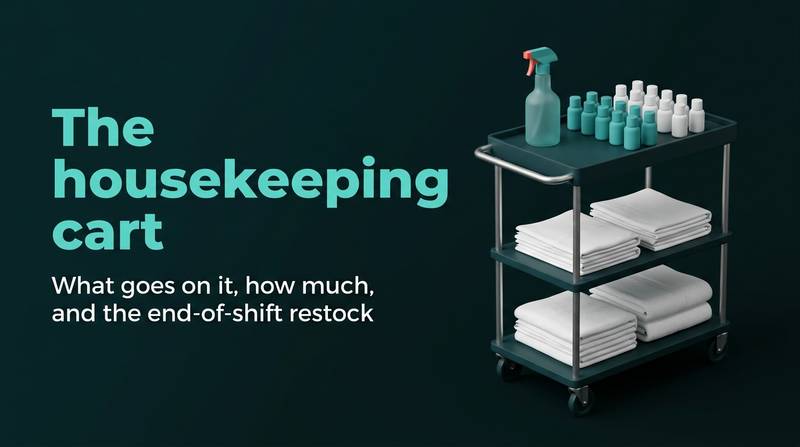
Time more than one attendant, and the same attendant more than once. Individual pace is real, and the norm needs a range rather than one person's speed. Note the outliers by name: the room at the end of the corridor, the room with the faulty window, the floor with no pantry. For what sits on the trolley and how long the restock takes, see what goes on the housekeeping cart and how long the restock takes.
ChecklistYour timing kit for the week
- A stopwatch and one simple sheet per day
- State and room type written on every line
- The same start and stop definition used all week
- Interruptions recorded next to the observation
- Walking measured as round time minus cleaning time
- Outliers noted by room number
- The sample week chosen and written down with its dates
- Averages recalculated at the end of each day
From minutes to a norm: how does the arithmetic work?
Multiply the measured minutes by the number of rooms in each state, add walking and restocking, then divide by the cleaning minutes one attendant actually has in a shift.
For example, take an invented 120-room hotel on a normal day: 78 rooms occupied, 44 check-outs timed at 34 minutes and 34 stay-overs timed at 19 minutes, with 5 minutes of walking and restocking per room. Cleaning comes to 44 times 34, which is 1,496 minutes, plus 34 times 19, which is 646, so 2,142 minutes. Walking and restocking adds 78 times 5, which is 390, for a day total of 2,532 minutes.
Available time: a shift the hotel sets at 8 hours is 480 minutes. Take out briefing, breaks, linen collection, end-of-shift restock and fault reporting, say 60 minutes, leaving 420 cleaning minutes per attendant.
| Line | Calculation | Minutes |
|---|---|---|
| Check-out cleaning | 44 x 34 | 1,496 |
| Stay-over cleaning | 34 x 19 | 646 |
| Walking and restocking | 78 x 5 | 390 |
| Day total | sum | 2,532 |
| Cleaning minutes per attendant | 480 minus 60 | 420 |
| Attendants needed | 2,532 divided by 420 | 6.03 |
Every figure in this example is invented.
2,532 divided by 420 is 6.03, so six attendants cover the day with 12 minutes to spare, which is no cushion at all. Seven leaves room for one re-clean and one late check-out. The rooms-per-attendant figure falls out at the end: 78 divided by 6 is 13 rooms each on average, but the attendant with 12 check-outs cleans fewer rooms than the one with 8. Round up first, then decide the cushion deliberately; the cushion is a management decision about risk, not something the arithmetic hands you. Run the same calculation for a peak day and a quiet day: the norm is a line, not a single point.
How do suites, connecting rooms and deep cleans change the norm?
They change the minutes, so they must change the count: weight each room type against the standard room using your own measurements, and keep deep cleans out of the daily figure.
Build the weight from your own sample. If a suite check-out takes 1.7 times a standard check-out, its weight is 1.7, and the norm is then expressed in standard-room equivalents. Connecting rooms cut both ways: one trolley stop for two rooms saves walking but adds a second bathroom and a second set of linen, so time a pair and compare it with two separate rooms. Balconies, terraces and private pools carry a task list of their own; time them once and attach those minutes to the room type rather than to the average.
Deep cleans, carpet shampooing and mattress turns are scheduled blocks with their own allocation, not slack hidden inside the daily norm. Out-of-order rooms come out of the day's room count and go onto a separate maintenance list, so the norm is never credited with work nobody did. Late check-outs compress the working window without reducing the work; plan the round order so the rooms that must be ready first are cleaned first.
Tip
Express the norm in standard-room equivalents and publish the weight of each room type next to it. An attendant who knows a suite counts as 1.7 rooms can plan her own round; one who is told a flat room count cannot.
How do you show the norm to staff so it is fair?
Publish the minutes and the arithmetic, not just the room count, and keep the norm separate from the inspection standard.
Post the minutes per room type and state on the housekeeping board, with the weights, so any count can be explained in one sentence. Say what the norm includes and what it excludes: linen collection, restocking, fault reporting and the end-of-shift trolley are inside; deep cleans are outside. Walk the first round with a new attendant and time it together; a norm learned in a different building is not the same norm.
Give the round an order: rooms the front desk needs first, rooms on the same corridor together, suites batched rather than scattered across floors. Treat the norm as a planning figure, not a disciplinary threshold; a room that consistently runs over is a finding about the room, not about the person. Ask attendants which rooms run over and why: they know the corridor, the tap that needs a second pass and the lift that stops on every floor. Review the norm with the team whenever it changes, and say what changed and why. To see how the norm connects to the numbers a general manager reads, see room-ready time and the other housekeeping KPIs worth tracking weekly, or look at how housekeeping sits inside a hotel's wider systems, where the hotel operating system we are building, built and working ahead of launch, keeps reservations, front desk, housekeeping, billing, restaurant sales, reports and compliance in one place.
Key point
The norm is a planning tool. When a shift runs short, the useful question is which rooms took longer than the sample said, not who was slow.
What should you log so next season's norm is better?
Log the same things you timed, every day, so the next sample starts from evidence instead of memory.
Record rooms by state and room type per day, with the minutes actually taken wherever the shift allows them to be recorded. Log rework: rooms that failed inspection and went back, and the minutes that cost the day. Log rooms not ready at the time the front desk needed them, and which room types they were. Log faults found during cleaning, which explain a slow room and feed the maintenance list.
Also log restocking time at the trolley, and how often an attendant had to go back for supplies. Log changes to the building or the service: a new room type, a new linen supplier, a new amenity, a refurbished floor. Keep the sample file with its dates and assumptions; a norm without its arithmetic cannot be defended to the team or revised next season. The daily paperwork that feeds this log is described in the attendant sheets and discrepancy report that feed the daily log.
What to do next
Pick a normal week in the next month and time one full day of rounds before committing to the whole week: check-outs and stay-overs separately, walking measured as round time minus cleaning time. If the first day's numbers look usable, run the rest of the week, do the arithmetic, and take the resulting norm, with its minutes and weights, to the housekeeping team.
Frequently asked questions
Is there a standard number of rooms per housekeeper per day?
No single figure transfers between hotels, because the number depends on room mix, layout, linen system, service standard and the share of check-outs. Any figure quoted elsewhere is another property's output. The only defensible number is one measured in your own building with your own rooms.
Should walking and restocking time be inside the norm?
Yes. If it is left out, the shift absorbs it and rooms finish late. Measure it as round time minus cleaning time: start the clock when the trolley stops at the door and stop it when the room is ready for inspection.
How often should a hotel re-time its housekeeping norm?
Re-time when the room mix, layout, linen system or service standard changes, and once a season as a check. Keep the earlier sample with its dates so the new one can be compared rather than simply replacing it.
Does the norm hold on peak days?
The norm is an average, so a peak day needs its own arithmetic with that day's check-out count and room mix. Recompute rather than scaling the number, then decide deliberately what to do about the gap between the minutes needed and the minutes available.
What is the difference between a check-out clean and a stay-over clean?
A check-out is a full reset: strip and remake the bed, full bathroom clean, restock, floor and a final check. A stay-over is a refresh: beds, bathroom, bins, towels, restock and a quick floor pass. They must be timed and counted separately, or the average hides both.