Rota and staffing terms for hotel managers: roster, split shift, off day, swap and cover
Confusing split shifts with double shifts or off days with leave causes scheduling errors. This guide defines essential hotel rota terms to align your team and prevent payroll disputes.
AI draft · awaiting editorial review
Contents
Key takeaways
- A rota is the shift plan; a roster is either the same plan under another name or the list of people, and a hotel has to decide which one it means.
- A split shift is two blocks with a long gap, a double shift is two blocks back to back, and close-open is a late finish followed by an early start: three shapes with three different costs.
- An off day is planned on the rota, leave is approved against an entitlement, and mixing the two columns is how leave balances go wrong.
- A swap changes who works, cover fills the gap, and standby is reachable but not working until the call comes.
- Every rota needs three totals: planned hours per person, the department total against its hours budget, and the number of shifts with no name.
A hotel rota is the plan that says who works which shift, on which day, in which department. Roster, schedule and vardiya listesi name the same object. Split shift, double shift, off day, swap, cover and standby are separate ideas, and staffing arguments usually start when two of them share one word.
A new hire reads next week's rota and asks three questions: what does the blank cell mean, who do I call if I cannot come, and is a double a shift or a room. The sheet answers none of them, because the hotel never agreed on its own words. This article fixes that. It defines the hotel rota terms that carry the most confusion, shows where two words collide across departments, and ends with a one-page term sheet you can publish with next week's rota.
What is a hotel rota, and is it the same as a roster?
A rota is the plan of who works which shift, on which day, in which department. A roster is either the same plan under a US word or the list of people on it, and that ambiguity is the first thing to settle.
Four words point at one object: rota and roster in English, vardiya listesi and vardiya çizelgesi in Turkish. Choose one for the shift plan and write it on the document, in the software field and in the message that announces it. The trap is the second meaning. A document called a roster often lists people, with contract hours, skills and department, while the rota lists shifts. When both carry the same name, a swap request lands on the wrong document and nobody notices until payroll.
In Turkish, çizelge on its own is any table: a cleaning chart, a menu plan, a training program. Say vardiya çizelgesi or vardiya listesi so the word cannot drift. Schedule is the widest of the four. It also means a timetable of events, such as a shuttle schedule or a meeting schedule, so a guest-facing schedule and a staff schedule should never share a heading.
A rota has states: draft, published and changed. Name them, because a swap against a draft is a proposal and a swap against a published rota is a change with a record. Write the start of the rota week at the top of the sheet, with the day and hour it is published. Without it, next week means the calendar week to one person and the hotel's business week to another.
| English term | Turkish term | What it names | Where it goes wrong |
|---|---|---|---|
| rota | vardiya listesi, vardiya çizelgesi | the plan of who works which shift on which day | also used for the list of people |
| roster | same as rota | the same plan in US English, or the list of people on it | two different documents under one name |
| schedule | çizelge, program | any plan of times, including guest-facing ones | read as the shift plan when it is a shuttle or events timetable |
| shift | vardiya | one block of working time | used for the place a person stands during it |
| post | mevki, nokta | the position a person covers during a shift | called a shift, so the place has no name of its own |
Once the words are fixed, the planning itself is a separate job: hotel shift planning across the desk, floors and nights is where the coverage decisions get made.
What do split shift, double shift and close-open mean?
A split shift is one working day cut into two blocks with a long gap between them. A double shift is two shifts back to back, and close-open is a late finish followed by an early start the next morning.
Split shift (kesintili vardiya) means two blocks, for example 07:00 to 11:00 and 17:00 to 23:00. The gap is not a break. The break (ara dinlenmesi) sits inside a block, and confusing the two makes the day look shorter than it is. The gap also carries a cost the rota does not show: a commute, a meal, a place to sit. Designing the break and the commute around a split shift is part of designing the shift, not an afterthought.
Double shift (çift vardiya) means two consecutive shifts, usually written as double on the sheet. Write it in full, because double alone means a double room in housekeeping and a double booking at the desk. Close-open (kapatma-açma) means the same person closes the bar or the desk and opens it the next morning. On paper it is two shifts; in the body it is one long day with a short night. Mark it so it can be seen and counted.
Two more shapes deserve names. A short shift is a block shorter than a standard shift, used for a peak such as a checkout morning or a banquet; it needs its own name, or it gets counted as a full shift in the hours total. A straight shift (düz vardiya) is one continuous block with its normal break; naming the normal shape is what makes the exceptions visible on the page.
Name the times of day too: early or morning (sabah), late (geç), night (gece). Turkish hotels often call night duty nöbet, so decide whether nöbet means the night shift or any duty on call, and keep it to one meaning.
Watch outTwo words that collide
On a rota, double means a double shift; in housekeeping it means a double room; at the desk it means a double booking. On a rota, cover means the person who fills a gap; in the restaurant it means one guest served at a meal (kuver). Write double shift and cover for a named person in full on the rota, and keep kuver for the meal count.
What is the difference between an off day, a rest day and leave?
An off day and a rest day are the same thing: the rest written into the rota. Leave is time away that comes from an entitlement or an event, and it is approved rather than assigned.
Off day, rest day and day off (haftalık izin günü, izin günü) are three names for one rota entry. Pick one and use it in the column heading. Leave (izin) is a family of records: annual leave (yıllık izin), sick leave (rapor), unpaid leave (ücretsiz izin). Each comes from an entitlement or an event and needs a named approver.
The common error is writing izin on the rota for a weekly rest day. The rota looks right, and the annual leave balance is short at the end of the year, because two different records were kept in one column. A rest day is a plan. If the person is called in, that day becomes work and the rest day moves; record the move, not only the call, or the second rest day disappears from the record.
A public holiday (resmî tatil) is a third category. It is neither an off day nor leave, and it changes what the day is worth, so give it its own column. Training days, orientation days and admin days are rota entries that are neither a shift nor rest; name them so their hours land in the right place in the total.
Keep one term for one record through the whole sheet. A column called izin that sometimes holds a rest day and sometimes holds a holiday is a column nobody can total.
Key pointA rest day is planned, leave is approved
The rota assigns a rest day to a person; leave comes from an entitlement or an event and is approved by a named person. Two columns, two records. A rest day moved by a call-in is a moved rest day, not a day of leave used.
What does cover mean, and how is it different from a swap and standby?
A swap is two people trading shifts. Cover is the person who fills a gap. Standby is someone reachable but not working, who becomes cover only when called.
Swap (takas, vardiya değişimi) is an exchange between two people, with the same skills and either the same shift length or an agreed difference. It changes who works, not how many hours the department needs. Cover (yerine bakma, yedekleme) is the act of filling a shift after someone drops out. The question who is covering asks for a name, so an answer that describes a plan is not an answer.
Standby or on-call (çağrıya hazır, yedekte) is a person off the rota but reachable, who comes in if called. It is not a shift, and it is not cover until the call happens. Write how standby is recorded and what it is worth into the contract and the rota note, so the answer does not depend on who is asked.
A swap needs three things: a named approver, a written record and a deadline. A verbal swap is invisible to payroll and to the next rota, which is how the same gap reopens a week later. A one-page approval rule and log for shift swaps is enough. Check skills before approving: a swap between a waiter and a bartender is not a swap, it is a training gap with a service risk attached.
The night shift needs a named cover before the rota is published, not after the absence. The person who finds cover late in the evening is the person who is already on shift. Write the three instructions differently: on standby tonight, covering Thursday, Thursday and Friday swapped between the two of them. The words carry the meaning; the names go in the cells.
How do you talk about hours and overtime without an argument?
Planned hours come from the rota, worked hours come from the time records, and overtime is the difference when worked hours are higher. Comparing the two weekly keeps the conversation about numbers instead of memory.
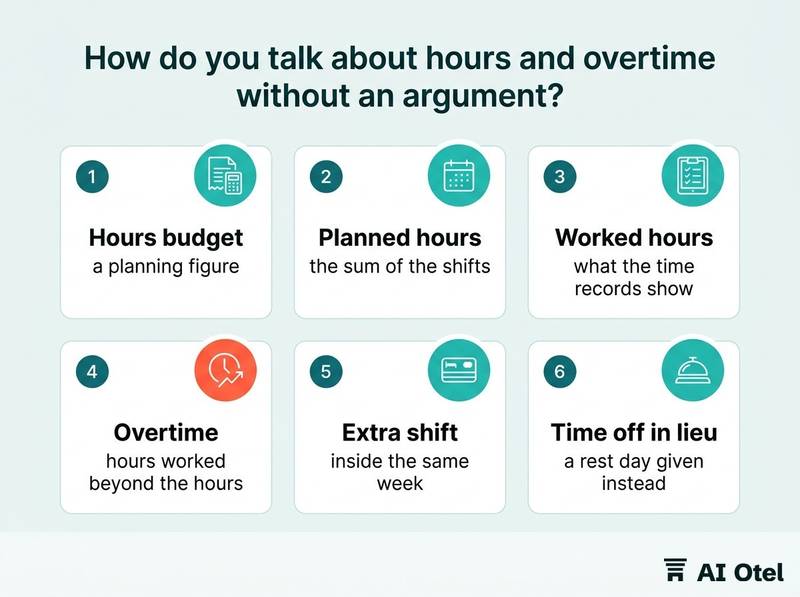
Hours budget (saat bütçesi) is the number of hours a department may plan for a period. It is a planning figure the hotel sets, not a legal one, and it belongs at the top of the rota. Planned hours are the sum of the shifts on the rota; worked hours are what the time records show. The gap between them is where overtime starts, so total both every week rather than at month end.
Overtime (fazla mesai) in plain words is hours worked beyond the hours the contract and the rota planned. What it is worth and how it is recorded belong in the contract; your HR adviser or accountant confirms the current position for your hotel. Two more cost words worth fixing: an extra shift, an additional shift inside the same week, which may or may not be overtime, and time off in lieu, a rest day given instead of payment. If the hotel uses either, write the rule down.
Mark the days that change what an hour is worth, such as nights and public holidays, on the rota itself, so the payroll clerk can find them without calling the department. A rota without a total column hides the overtime until payroll finds it, and by then the argument is about the past. How working hours and night shifts are counted in hotels is worth settling once, in writing.
NoteThree totals on every rota
Planned hours per person for the week; the department total against its hours budget; the number of shifts with no named person. If one of the three is missing, the sheet is a draft, whatever it is called.
How do you get every department to use the same words?
Write a one-page term sheet, agree it with the department heads, and then use the same word in the rota, in the software field and in conversation.
Start from the software. The rota tool has one field per concept, and the word on that field becomes the word people say. Choose it deliberately rather than accepting the default label. If you are evaluating a hotel operating system, read its shift and staffing fields against your term sheet before you commit to it; the same applies to any hotel platform you are considering, because the field names travel into daily speech.
One word per concept and one concept per word. If vardiya means both the block of time and the place the person stands, split them into vardiya and mevki. Put the two languages side by side rather than replacing one with the other. A team that reads both will translate in the corridor anyway; the sheet just makes the translation the same every time.
Test the sheet on a new hire: can they read next week's rota and answer when they start, who to call if they cannot come, and what a blank cell means? Review the words when the shape of the work changes, such as a new outlet or a new night shift. And give the sheet to the person who writes the rota, not only to the person who approves it. The words are set at the keyboard.
ChecklistThe one-page term sheet
- One word for the shift plan, used in the rota, the software field and the conversation
- A different word for the list of people
- Double shift, split shift, close-open and short shift written in full
- Rest day, leave and public holiday in three separate columns
- Swap, cover and standby defined, with the name of who approves a swap
- The rota week start day and the publication hour at the top of the sheet
- A named cover for the night shift before the rota is published
What to do next
Take next week's rota and mark every word on it that has two meanings in your hotel. Fix those first, add the three totals at the bottom, and publish the term sheet with the rota. Words come before the plan, because a plan nobody reads the same way is not a plan.
Frequently asked questions
Is an off day the same as annual leave?
No. An off day is the rest day the rota assigns; annual leave comes from an entitlement and is approved. Keep them in separate columns, because a rest day moved by a call-in is not a day of leave used, and a leave day written as a rest day leaves the balance wrong at year end.
What does double mean on a hotel rota?
On a rota it should mean a double shift, two shifts back to back. Alone, the word also means a double room in housekeeping and a double booking at the desk. Write double shift in full on the sheet and in the message.
Is standby the same as cover?
No. Standby is a person who is reachable but not working; cover is the person who actually fills the gap. Standby becomes cover at the moment of the call. The hotel writes how standby is recorded and what it is worth into the contract and the rota note, so the answer does not depend on who is asked.
Should the rota be written in Turkish or English?
In the language the team reads, with the other language beside it on the term sheet. The software field takes one word, so choose that word deliberately and use it in the rota, the message and the conversation. Two words for one thing is what makes a rota unreadable.
How far ahead should a rota be published?
The hotel sets its own rule; there is no single answer. A workable rule states the publication day and hour, the point after which changes go through the swap rule, and the name of the person who approves a change. Write all three at the top of the sheet so the rule travels with the rota.