Shift swaps between hotel staff: a one-page approval rule and a log
A shift swap is valid only when approved and logged. This guide provides a one-page rule, a half-page form, and a weekly review process to close staffing gaps and ensure compliance.
Contents
Key takeaways
- A swap changes two people's working day, so it needs two checks: the person coming in can do the job, and both people still get their rest.
- Approve swaps in writing in one place, and treat the chat message as a request, never as the record.
- Night shifts and roles that hold keys, cash or a licence need their own rule, because a swap there moves responsibility and not only hours.
- Read the log once a week: the same person giving away the same shift points at the rota, not at the staff.
- Name the three reasons for saying no in advance, so a refusal is about the rule and not about the person.
A shift swap is two staff members trading shifts, and it is valid only when the hotel approves it and writes it into the rota. A one-page shift swap policy names who may swap, how far ahead, which skills must match, who approves, and where the swap is logged.
The desk calls at 06:40. The 07:00 arrival shift is not there, and the person standing at reception says the swap was agreed in the group chat three days ago. Nobody wrote it down, and the printed rota still shows the other name. After reading this page you will have a one-page rule, a half-page form, a single log and a ten-minute weekly read that together close that gap before it opens.
Why do undocumented shift swaps leave gaps at the desk and on the floors?
Because the swap exists only in two people's messages, so the rota, the handover and the person actually on duty all disagree with each other.
The rota is the document the hotel runs on. A swap that never reaches it means the supervisor plans the morning, the breakfast cover and the checkout queue around someone who is not coming. This is one reason hotel shift planning across the desk, floors and nights starts from the rota as a single source, not from what people remember agreeing.
There are two different failures. Nobody shows up, which is visible and loud. Or the wrong person shows up, which is quiet and often worse: the desk loses the language it needed that morning, or the night audit is done by someone who has never closed a business day.
A swap moves more than hours. It moves the cash float, the safe keys, the key card encoder, the arrivals list and the promise made to a guest at 23:00.
Rest between shifts is the part staff rarely weigh themselves. A person who gives away a late shift and takes an early one can end up with too few hours between the two, and the hotel carries that.
Chat messages sink under later messages within a day. The log survives, and it is what you open when a payroll question, a guest complaint or a missing cash note arrives three weeks later.
Nobody is being dishonest. Staff swap because a child is ill, a bus is cancelled or a family event moved. The rule exists to make the ordinary case fast, not to catch people.
What four questions must every swap answer?
Who is taking the shift, when exactly it starts and ends, whether that person can do the job, and who approved it. If any of the four cannot be answered, the answer is not yet, not no.
Who: two named people, the one leaving the shift and the one taking it. Never someone from housekeeping, because that is a name the approver cannot check.
When: date, start time, end time and the post. A shift is not a day. A 07:00 to 15:00 front desk shift and a 15:00 to 23:00 front desk shift are different jobs on the same date.
Same skills: the arriving person must hold what the post requires that day, whether that is the language the desk needs for a group arrival, the training for night audit, the licence the hotel itself requires, or access to the system.
Who approves: one named approver per department, plus a named deputy for that person's off days, so a swap never waits two days for a signature and then happens anyway.
The fifth question nobody writes down: what the swap does to the rest of the rota. If it pushes a person into a seventh consecutive day or into overtime, the approver should see that before saying yes. For the words people actually use for these moves, see rota and staffing terms hotel managers use, including swap and cover.
Keep the same words for the same thing across the rule, the form and the log. If the rule says cover and the form says replacement, people fill in the wrong line.
ChecklistBefore approving, run this check
- Who: both names written, not a team name.
- When: date, start, end and post, not just the date.
- Can they do it: skill, licence, system access and language checked against the post.
- Who approves: named approver plus named deputy.
- Rest before and after checked for both people.
- Effect on consecutive days and overtime checked.
What goes on a shift swap form that fits on half a page?
Eight fields: the two names, the two shifts, the skill check, the rest check, the approver, the decision, the time the rota was updated, and a free-text note.
Keep it to half a page. A form that needs a second page does not get filled in at 06:40, and a form that is not filled in is not a record.
Paper at the desk and a shared sheet both work. What matters is one place and one format, so the weekly read takes ten minutes and not an hour.
The field people skip is the one that prevents the gap: who updated the rota, and when. Without it the form is a permission slip that never reached the document everyone works from.
Store the form with the rota for the pay period. A question about who actually worked a public holiday is then answered from the record rather than from memory.
Do not add a field that asks for medical or family detail. Personal is enough, and it keeps the form out of private territory that the hotel has no reason to hold.
For example: a housekeeping attendant asks on Tuesday to give away Saturday's 08:00 to 16:00 floor shift. The form shows the name of the colleague taking it, the supervisor's confirmation that the colleague already covers that floor section, the rest check for both, the approver's initials, and the line recording that the rota was reprinted on Wednesday morning.
| Field | What it must contain | Why it matters |
|---|---|---|
| Names | Person leaving, person taking, both in full | The approver checks two real people |
| Shifts | Date, start, end and post for each | A shift is a post, not a date |
| Skill check | Arriving person meets the post's requirements that day | Prevents the wrong person on duty |
| Rest check | Hours before and after, for both people | Rest is the hotel's responsibility |
| Approver | Name and role, plus deputy if approver is off | The swap never waits on one person |
| Decision and time | Approved or declined, with date and time | The decision is dated, not implied |
| Rota updated | Who changed it and when | The record reaches the document people work from |
| Note | Free text, no medical detail | Context without private detail |
What extra rules apply to nights and to roles that need a licence or a key?
Night shifts and key-holding roles need a second check, because the swap moves responsibility and not only hours.
Night: the person taking the night shift should have worked it at this hotel before, and the swap must leave enough rest on both sides. A night shift followed by an early one is the classic mistake, and it is usually made by the person trying to be helpful.
Alone on shift: where the night is worked alone, the approver confirms that the person knows the emergency steps and whom to call, before the swap is approved and not after.
Keys and cash: safe keys, the key card encoder, the cash float and the till are handed over in person and signed for. A swap does not transfer them by message, and the handover is a separate act from the swap.
System access: the person taking the shift needs their own access, not a shared login. If setting up access takes a day, the swap is planned ahead rather than improvised.
Licences and certificates the hotel itself requires for the post, such as a driver for the shuttle or a lifeguard at the pool, are checked against the hotel's own list before approval. The hotel's list is the reference, and it belongs in the rule.
Some posts cannot be replaced at short notice. The rule should say that those shifts are swapped only with the department head, and not within the team.
Key pointThe handover is not the swap
A swap moves the keys, the cash float and the responsibility for the night, so those three are handed over in person and signed for. The swap form is not the handover.
Where should the swap record live?
In one place next to the rota, never only in a chat group.
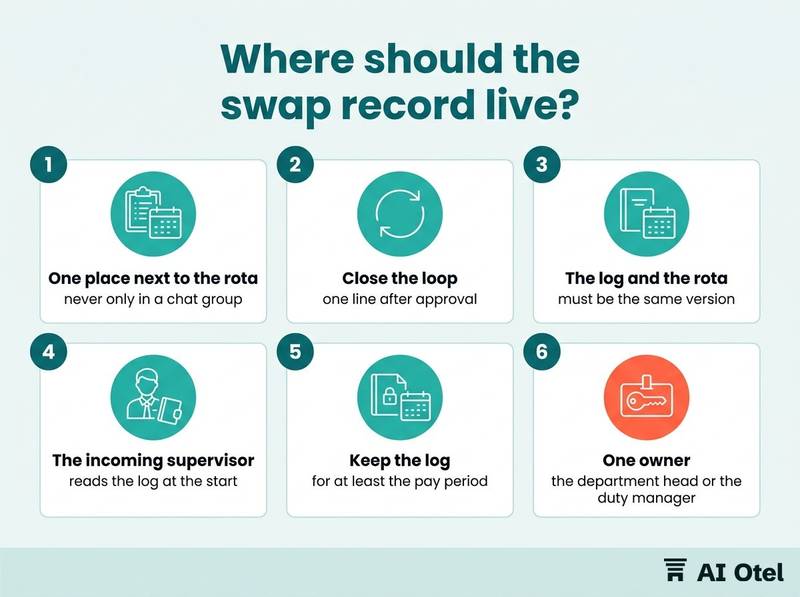
The chat group is where the request starts. It is a good place for that, because it is fast and everyone can see it. It is not where the record ends. If your team uses chat for daily coordination, the same discipline applies as in the rules for hotel staff chat groups that keep work in the record.
Close the loop in the same group with one line after approval, naming the two people and confirming the rota was updated. The team then knows without the chat becoming the record.
The log and the rota must be the same version. If the rota is reprinted, the swap is already in it, and the printed sheet at reception is never the older one.
The incoming supervisor reads the log at the start of the shift, so the desk knows who is actually on and who is expected. This is the same habit as a written handover, applied to staffing, and it pairs naturally with a front desk shift handover checklist for cash, arrivals and promises.
Keep the log for at least the pay period, so hours, overtime and any dispute can be reconstructed from documents rather than from recollection.
One owner: the department head or the duty manager. Not whoever remembers, because that person is on leave the week the question arrives.
What does the weekly look at the log tell you, and when do you say no?
The log shows the patterns a single swap hides: who is always giving shifts away, which days are always short, and which approver says yes to everything.
Read it once a week, for ten minutes, on the same day, with the coming week's rota open beside it. A log nobody reads is a filing exercise.
Pattern one: the same person gives away the same shift every week. That is a rota problem or a personal circumstance, and either way it needs a conversation rather than another approval.
Pattern two: swaps cluster on one day or one shift. The rota is thin exactly there, and the fix belongs in the rota, not in the log.
Pattern three: one approver approves everything. Either the rule is unclear or the approver is avoiding a difficult conversation, and both are worth naming in the weekly read.
Pattern four: swaps that quietly create overtime or a seventh consecutive day. The approver should have caught it; the weekly read catches it late, but it catches it.
Say no for three named reasons only: the skill is missing, the rest is too short, or the change breaks coverage. Naming them in the rule in advance makes the refusal about the rule and not about the person.
Say yes quickly in every other case. A rule that is slow gets routed around, and then the hotel is back to finding out at 06:40.
ChecklistThe ten-minute weekly read
- Count the swaps in the week and note the days they fell on.
- Name anyone who appears more than twice.
- Check every swap that created overtime or a seventh consecutive day.
- Check that each approved swap is already in the printed rota.
- Note any shift that needed a swap and found nobody, because that is a coverage gap and not a paperwork gap.
What to do next
Write the rule on one page this week: the four questions, the half-page form, one log beside the rota, and a ten-minute read every week. Then spend the first month correcting the rota wherever the log keeps pointing, because most swap problems are rota problems wearing a swap's clothes.
If your hotel keeps its reservations, front desk, housekeeping, billing, reports and compliance in one hotel operating system, built and working ahead of launch, the swap record can sit with the hotel's own records, so the record and the document never disagree. To see how reservations, housekeeping and compliance are designed to fit together in one platform, read the platform overview.
Frequently asked questions
Can two employees swap shifts between themselves without telling the manager?
They can agree between themselves, and that is often how it starts. The hotel's rule should say that a swap counts only when it is approved and written into the rota, because coverage, skills and rest are the hotel's responsibility and not the two colleagues'. Put that sentence in the rule so the answer is the same whoever is asked.
How far ahead should a shift swap be requested?
The hotel sets the notice period itself, and it should set two: one for planned swaps, long enough to arrange access and check skills, and a short-notice route through the duty manager for emergencies. Write both into the rule, name who decides at short notice, and say that the rota is updated the same day either way.
Does a shift swap need a written form?
A form is one way to do it and a shared sheet is another. What matters is that the same fields are captured in one place: both names, both shifts, the skill check, the rest check, the approver, the decision and the rota update. A chat message alone leaves the rota and the record disagreeing.
Who approves a swap when the department head is away?
Name a deputy in the rule, by role and not by habit, so the answer does not depend on who is in the building. The deputy uses the same form and the same three reasons for refusal. If no deputy is available, the swap waits, and the rule should say so plainly.
Should the swap log be visible to the whole team?
Yes, keep it visible, so the rota and the log agree and nobody is surprised by who is on. Keep personal reasons out of it: the form records that a swap happened and who approved it, not why. Visibility also makes the weekly read a shared habit rather than a manager's private check.