Split shifts in a hotel: designing the break, the rota and the commute
A split shift fits work that peaks twice a day but fails where continuous cover is needed. Learn to size the gap, plan facilities, and write a clear rota.
Contents
Key takeaways
- A split shift fits work that peaks twice a day and fails where the post needs continuous cover, such as the front desk or the night audit.
- Judge the gap by what it allows: a gap too short to travel home needs a seat, a meal and a locker, and the hotel's own written rule should say how it is treated.
- Write both blocks, the gap and the total hours on one rota line, so the person sees the shape of the day before the week is published.
- Count split shifts per person each period and rotate them; the same names every week is a retention problem, not a rota.
A split shift is one working day in two blocks with a long gap between them, used where demand peaks twice a day, such as breakfast and dinner service. Design it around the gap: what the person can do with it, where they rest, when they eat, and how they travel.
Breakfast service ends at ten and dinner starts at six. In between sits a trained waiter in uniform with nowhere to go, no meal until the evening, and a shuttle that will not return until the second block ends. The rota was legal on paper and unworkable in the day. After reading this guide you will be able to decide when a split shift fits the work, size the gap deliberately, and publish a rota line that shows the whole day.
What is a split shift in a hotel, and when does it fit the work?
A split shift is one working day divided into two blocks with a long gap between them, kept as one attendance for one person. It fits work that peaks twice a day and fails where the post needs continuous cover.
Define it plainly in the hotel's own documents: two blocks on one calendar day, one person, one attendance, with the gap written down. The same shape is also called a broken shift, so pick one term and use it everywhere, in the contract summary, the staff handbook and the rota itself.
Where it genuinely fits: a resort restaurant serving breakfast and dinner, banquet setup and evening service, spa or pool attendance, housekeeping morning clean and evening turndown, a driver covering two airport runs. Where it does not fit: front desk, night audit, security, a single-cover bar, or any post where a guest expects to continue a conversation with the same person later in the day.
The decision rule is to count the handovers the post needs in a day. If the second block can start clean from a written handover, a split works. If the second block needs the first person's memory of the morning, it does not. A full guide to covering the desk, floors and nights fairly, including which posts can be handed over, is in hotel shift planning: covering the desk, floors and nights fairly.
The real alternative is two part-time people, each working a short, normal day. That costs two trainings, two uniforms, two payroll records and a handover, and it buys two people with ordinary days. A split keeps one trained person who knows how the whole day went, which matters where the morning's events drive the evening's service, for example a large group arriving late or a wedding moving indoors.
| Shape | What the hotel gets | What the person gets | Fits when |
|---|---|---|---|
| Split shift | One trained person across the day | Two blocks and a long gap | Work peaks twice |
| Two part-time shifts | Two people, each with a short day | A normal working day each | A handover can be written and the second person can start cold |
| One long block, staggered starts | Continuous cover | A long day | The post cannot be handed over mid-service |
How long should the break between the two halves be?
Long enough that the person can leave, rest and come back without rushing, or short enough that the hotel treats it as time at work and provides a room, a meal and a seat. The middle is the trap.
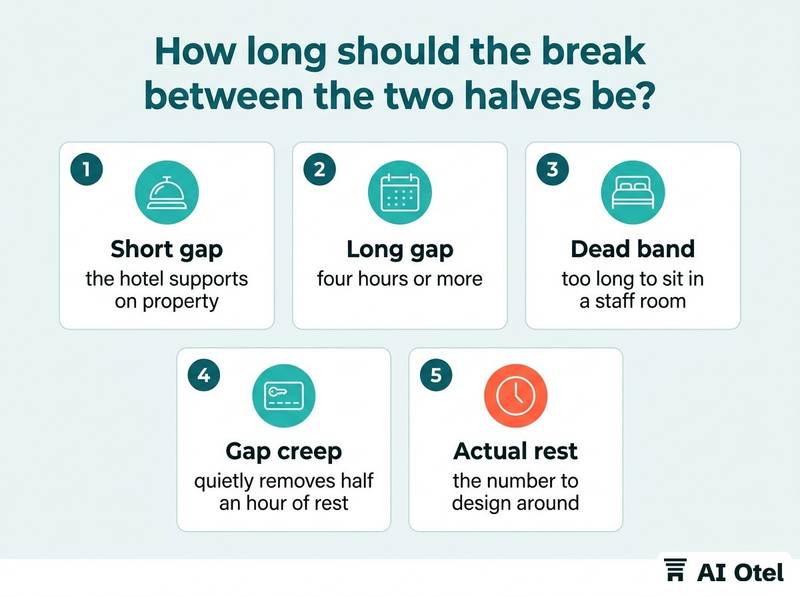
Measure the gap from the end of the first block to the start of the second, then subtract the commute both ways. What is left is the person's actual rest, and that is the number to design around, not the gap on the rota.
Two shapes work. A short gap, too short to go home, which the hotel supports on property. And a long gap, for example four hours or more, which lets the person go home, eat and lie down. The dead band is the middle: for example two and a half hours, too long to sit in a staff room and too short to travel home and return. A hotel that lands here usually has a transport timetable problem, not a service problem.
For the short gap, the hotel's own written rule should say how the time is treated, and the property must supply a seat, a meal and a locker. How the gap counts for pay and rest belongs in the contract and the hotel's rule, and the hotel confirms its own case with its adviser. For the long gap, the person leaves the property, the rota must show a return time, and a call back in the middle of the gap should be recorded as work, not absorbed.
Watch gap creep. A first block that ends twenty minutes late and a second that starts ten minutes early quietly removes half an hour of rest. Record actual clock times, not planned ones, and compare them at the end of the month. Put a threshold in the rota rule before the season starts, so a supervisor does not invent one at 16:00 on a Saturday.
Key pointThe gap test
Three questions the rota owner answers for every split line: 1) Can this person travel home, rest and return within the gap? 2) If not, is there a seat, a meal at the right hour and a locker assigned to them? 3) Does the hotel's written rule say how this gap is treated, and does the contract agree?
How do you plan staff rooms, meals and transport around the gap?
The gap is a facility problem as much as a rota problem: seats, a hot meal and a shuttle that runs at the gap's edges, not only at the start and end of the day.
Start with capacity, because a gap concentrates people. If eight staff are on a short gap at the same hour, the changing room, the lockers and the canteen must hold eight at once, not two. Count the peak, not the average. The canteen's service times must cover the gap itself: a person on a short gap eats in the middle of the afternoon, not at eleven in the morning before the first block ends.
Transport has four points to serve: first block start, first block end, second block start, second block end. Where a shuttle only runs twice a day, the gap is set by the shuttle and the restaurant has to accept it. Route design, shift-time alignment and a rider rule sheet are covered in staff transport for a remote hotel: shuttle routes and shift times.
Someone who stays on property needs to get out of uniform, sit down and change back, so plan lockers and changing rooms with the same care as the rota line. The space standards are their own topic, covered in staff changing rooms, lockers and canteen in a hotel.
Set one rest-space rule: the staff room is quiet during the gap. No team briefing, no training session, no stock count. Using the gap for work converts rest into work, and it shows up in the first month's complaints. Finally, name an owner for the gap: usually the department head who builds the rota, with the transport coordinator and the canteen informed of the split count each week.
How do you write a split shift into the weekly rota so everyone sees it?
One line per person per day, showing both blocks, the gap, the total hours and the place, published before the week starts and dated.
The line format is fixed: name, date, block one with start, end and post, the gap with start and end, block two with start, end and post, total hours, and a transport note. Mark the gap as a gap. A blank cell reads as a mistake or as unpaid work; a marked gap reads as a plan the person can agree to or question.
Publish the rule with the rota: how much notice, how a swap is requested, who approves it, and what happens when a second block has no cover. Keep one version, with a dated version number on the notice board and in the system, and the same version in both places. That ends most of the arguments before they start.
Build the handover into the line: the first block leaves a written note for the second, and the second block's supervisor reads it at the start of the shift. Without it, the split loses the advantage it was chosen for. A shared sheet works for a small property; a system that ties the rota to the time record is better, because the gap then appears in the record and actual times can be compared with the plan. A hotel operating system that keeps reservations, front desk, housekeeping, billing, restaurant sales, reports and compliance in one place is built and working, ahead of launch, and the wider platform overview shows how its parts sit next to the rest of hotel operations.
TipA worked rota line (example)
Sat 12 · A. Yılmaz · 07:00-11:00 restaurant breakfast · GAP 11:00-17:00 · 17:00-23:00 restaurant dinner · 10 h · shuttle 23:15. The gap is written, not blank; the total is on the line; the return transport is on the line.
Who gets the split shifts, and how often is it fair?
Fairness is a count, not a feeling. Count split shifts per person per period, next to the shifts they worked, and rotate them.
Keep a simple split count per person per month. Without the count, the rota drifts toward whoever says yes, and that is usually the same three people. Ask before assigning, not after: who depends on the shuttle, who has caring duties, who lives far, who has a health restriction recorded with HR. A two-minute question prevents a four-week problem.
Rotate the second block as well as the split. The late half is the unpopular half, and giving the same person both the split and the late finish is how a rota becomes a resignation. Give a first split a buddy: someone who has worked the shape before, on the same day, for the first two or three times. Record refusals and their reasons; a refusal with a reason is information about the design, not disobedience.
Read the pattern monthly. The same names on the split lines week after week is a retention risk, and it usually means the rota was built around availability rather than around the work.
ChecklistChecklist before publishing
- Every person's split count is within the hotel's rotation rule.
- Anyone on a short gap has confirmed they can use the staff room and the meal.
- Anyone dependent on the shuttle has a return trip after the second block.
- The late half is shared, not fixed.
- New staff have a buddy on their first split.
- Refusals and reasons are written down and answered.
How do you review split shifts after four weeks?
Read four signals: complaints, swaps, lateness at the second block, and absences on split days. Each one points to a different part of the design.
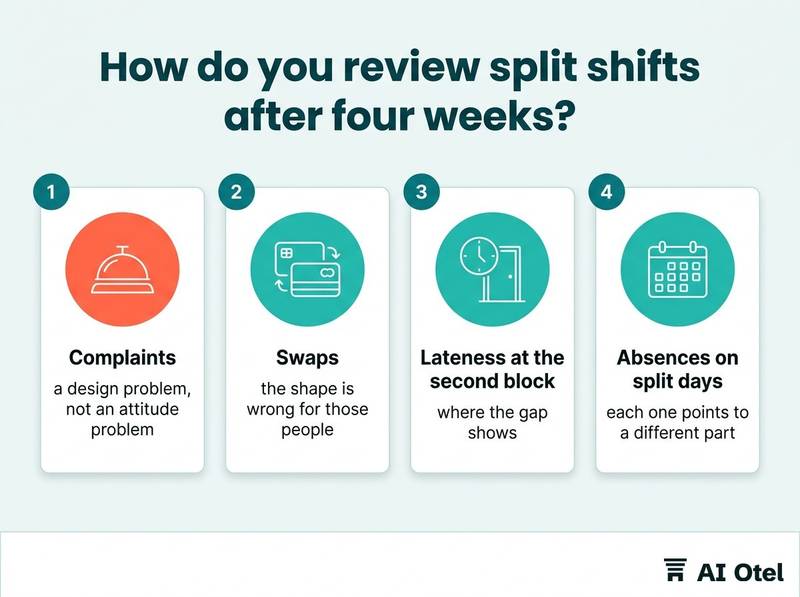
Complaints about the gap are a design problem, not an attitude problem. Read them for the specific hour or the specific missing facility. A high swap rate on split days means the shape is wrong for those people, and the swap log tells you which days and which departments; how to run that log is covered in shift swaps between hotel staff: an approval rule and a log.
Lateness and no-shows cluster at the second block, because that is where the gap shows. A person who arrives late for the evening has usually had a bad afternoon, not a bad attitude. Count how often the first block ended late: gap overruns are usually an upstream staffing or service problem, and the split is simply where they surface.
Watch guest signals too. Missed requests between the blocks and handover errors show that the written note is not being used. Hold a thirty-minute review with the rota owner and two staff from different departments, and leave with one decision per problem, written into the rota rule.
What should you check before publishing the week?
Run the same short check every week, before the rota goes on the board, and let it block publication until it passes.
The check is short enough to run in ten minutes and specific enough that two managers reach the same answer. One person signs it: the department head who built the rota, with the transport note confirmed by whoever runs the shuttle. Anything that fails goes back to the rota, not to the staff room notice board as an apology. Keep the signed check with the rota version, so a complaint three weeks later can be answered with the plan that was published.
ChecklistThe one-page rota check
- Every split line shows both blocks, the gap and the total hours.
- No gap sits in the dead band the hotel's own rule forbids.
- Every short gap has a seat, a meal time and a locker assigned.
- The shuttle timetable covers all four points of every split.
- Each person's split count is within the rotation rule.
- Every split has a named person for the second block and a written handover from the first.
- The version is dated and the notice period is met.
What to do next
Write the gap rule this week: the threshold the hotel will not cross, what it provides inside a short gap, and how the time is treated in the contract. Then run the one-page check before every publication and the four-week review after the first month. The split shift is not the problem; an unwritten gap is.
Frequently asked questions
Is a split shift allowed in Türkiye?
Türkiye's labor law regulates working hours and breaks, but the specific rules depend on your contract and any collective agreement. Write down both blocks, the gap and how the gap is treated before the season starts, and confirm your own case with your legal adviser.
Write down both blocks, the gap and how the gap is treated before the season starts, and confirm your own case with your adviser.
Do you pay for the gap in a split shift?
The hotel's own rule and the contract decide, and the answer must be written before the rota is published, not after a complaint. Two approaches are possible: an unpaid gap with a meal, a seat and a locker provided, or a gap counted as working time where it is too short for the person to leave. Pick one, write it, apply it to everyone.
What is a broken shift?
It is the same shape under another name: one working day in two blocks with a long gap between them. The hotel should choose one term and use it in the contract summary, the rota and the staff handbook, so a person reading three documents sees one rule.
Can the front desk run on split shifts?
Usually not. The desk needs continuous cover, the guest expects to continue a conversation with the same person, and the second block depends on the first person's memory rather than a written handover. Splits fit posts with two clear daily peaks, such as breakfast and dinner service, banquets, spa attendance or housekeeping turndown.
How do you cover a split shift when someone calls in sick?
The second block is the exposed half, because the person is already off the property when the call comes. Keep a named standby for each split day, cross-train one person per department on the second block, and make sure the first block's written handover still reaches whoever takes over.