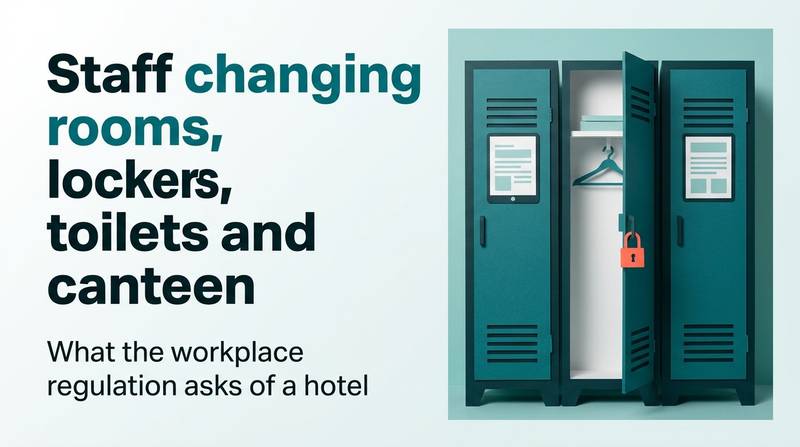
Staff changing rooms, lockers, toilets and canteen: what the workplace regulation asks of a hotel
The workplace regulation requires separate changing rooms, locked lockers and a suitable eating place for hotel staff. This guide explains the duties and provides a practical walk-round checklist.
AI draft · awaiting editorial review
Contents
Key takeaways
- Annex 1 item 50 of the Regulation on Health and Safety Measures to Be Taken in Workplace Buildings and Annexes requires separate changing rooms for women and men for employees who must wear work clothes, and does not allow changing anywhere else (Çalışma ve Sosyal Güvenlik Bakanlığı, İşyeri Bina ve Eklentilerinde Alınacak Sağlık ve Güvenlik Önlemlerine İlişkin Yönetmelik, Ek-1 madde 50).
- Item 51 requires a locked locker in the changing room for each employee, large enough to hold their clothes during working hours.
- Item 48 requires an eating place, of suitable size, equipment and hygiene, for employees who eat at the workplace.
- The annex states duties in words, not figures: room sizes, locker dimensions, toilet counts and temperatures are the hotel's own standard, set in the risk assessment and written down.
- Every finding belongs on a closed-season list with an owner, a cost, a completion photo and a date, because an inspector asks when the work was done, not whether it was planned.
The Regulation on Health and Safety Measures to Be Taken in Workplace Buildings and Annexes (İşyeri Bina ve Eklentilerinde Alınacak Sağlık ve Güvenlik Önlemlerine İlişkin Yönetmelik) sets out duties for the building and its annexes, including changing rooms for employees who must wear work clothes, a locked locker for each of them, and an eating place of suitable size, equipment and hygiene. It sets duties, not dimensions: sizes and temperatures are the hotel's own recorded standard. Confirm the current text and your own case with a legal adviser.
Picture the staff door of a hotel that has grown room by room: a store room with a curtain across it, a locker bank with broken doors, a folding table beside the dishwash. None of it shows on the guest side, and all of it is written into the workplace buildings regulation. This article reads three items of that regulation's annex and turns them into a walk-round you can do this week and a repair plan for the closed season.
Why are staff changing rooms part of the safety file?
Because the workplace buildings regulation treats them as a health and safety duty on the employer, not as a comfort item, and the annex lists them among the building's minimum requirements.
The regulation is the İşyeri Bina ve Eklentilerinde Alınacak Sağlık ve Güvenlik Önlemlerine İlişkin Yönetmelik, issued by the Ministry of Labour and Social Security. Its annex lists minimum requirements for the building and its annexes, and staff changing rooms, lockers and eating places are items on that list. The duty sits with the employer next to the general duty to protect workers, which means the risk assessment, the safety file and the monthly walk-round should all mention the back of house, not only the pool deck and the kitchen. If your department-by-department safety checklist does not yet have a back-of-house section, this is where to add one; see our occupational health and safety checklist by hotel department.
Shortcuts accumulate out of sight. A store room becomes a changing room, a locker bank loses its keys, the break table ends up next to the dishwash because that is where the space was. Seasonal turnover makes it worse: lockers are reassigned every spring, keys disappear, and nobody can say which locker belongs to whom. The written list is what turns a physical room into an auditable duty.
Does every hotel need separate changing rooms for women and men?
Yes, wherever employees must wear work clothes: the annex requires separate changing rooms for women and men and does not allow changing anywhere else.
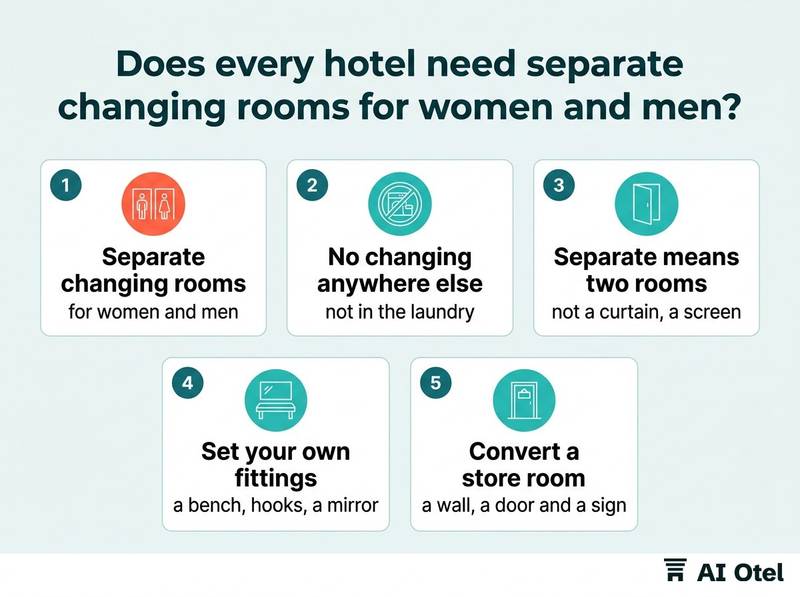
Annex 1 item 50 requires separate changing rooms for women and men for employees who must wear work clothes, and it does not permit changing outside them (Çalışma ve Sosyal Güvenlik Bakanlığı, İşyeri Bina ve Eklentilerinde Alınacak Sağlık ve Güvenlik Önlemlerine İlişkin Yönetmelik, Ek-1 madde 50 (opens in a new tab), 2026-11-15). The trigger is the duty to wear work clothes, not the size of the payroll. In a hotel that normally means housekeeping, kitchen, laundry, technical service, spa and anyone in a uniform at the front desk. Write down which roles you count and why, so the answer does not change with the person giving it.
The operative sentence is the second half: changing anywhere else is not allowed. Staff changing in the laundry, a store room, a staff toilet or a corridor is a finding even when a proper room exists two doors away. Separate means two rooms, not a curtain, a screen or a rota; one room used by women in the morning and men in the evening is not what the item describes.
The annex does not fix the fittings, so set your own: a bench, hooks at standing height, a mirror, a bin and a surface that can be wiped. Staff should not be dressing on the floor or over a mop sink. In a small seasonal hotel the cheapest route is often converting a store room on the back corridor: a wall, a door and a sign. That belongs in the closed-season plan rather than in a spring scramble.
Watch outChanging anywhere else is the finding
The laundry fails because it is wet, holds chemicals and cannot be locked. The store room fails because it has no bench and the door cannot be locked. The staff toilet fails because it is not a changing room. The corridor at shift change fails because there is no privacy. The guest gym before opening fails because it is not a staff area and is not controlled by the hotel's own rules.
Does every employee need a locked locker?
Yes: the annex requires a locked locker in the changing room for each employee, large enough to hold their clothes during working hours.
Annex 1 item 51 requires a locked locker in the changing room for each employee, sized for their clothes during working hours (Çalışma ve Sosyal Güvenlik Bakanlığı, İşyeri Bina ve Eklentilerinde Alınacak Sağlık ve Güvenlik Önlemlerine İlişkin Yönetmelik, Ek-1 madde 51 (opens in a new tab), 2026-11-15). Three conditions are easy to test on a walk-round: one locker per employee rather than one per shift, the locker inside the changing room rather than in the corridor, and a lock the employee can actually use.
The annex gives no dimensions. The test is practical: can a housekeeper fit a winter coat, a bag and a change of shoes with the door shut? If the answer is no, the locker is a shelf. Key management is where this fails quietly. Keep a numbered locker list, hold one spare key per locker in a sealed envelope with the duty manager, and record the handover when someone leaves. Unassigned lockers turn into storage within a month, so put a name and a number on every door and review the list at the start of each season.
Where work clothes get soiled, keeping them apart from street clothes is a rule from this annex.
What does a staff eating area have to provide?
An eating place of suitable size, equipment and hygiene for employees who eat at the workplace.
Annex 1 item 48 requires an eating place, of suitable size, equipment and hygiene, for employees who eat at the workplace (Çalışma ve Sosyal Güvenlik Bakanlığı, İşyeri Bina ve Eklentilerinde Alınacak Sağlık ve Güvenlik Önlemlerine İlişkin Yönetmelik, Ek-1 madde 48 (opens in a new tab), 2026-11-15). Test the three words separately. Size: can one shift sit down at the same time, or does the room only work if everyone eats in a different order? Equipment: table, chairs, a way to heat food, drinking water, somewhere to wash up. Hygiene: washable surfaces, covered waste, no cleaning chemicals stored in the same room.
A canteen can exist and still fail the item: staff eating standing up in the dishwash area or on the loading bay because the room meant for them is full of linen. Where staff eat in a guest outlet outside service hours, write the arrangement down and check it on a full-house night, when the outlet is being reset. The duty applies to employees who eat at the workplace, and the arrangement has to hold every day, not only on quiet ones.
Keep the eating place away from work that contaminates it. A room shared with chemical storage or linen sorting is not an eating place with a table in it. Drinking water and hand washing belong in the same check: a canteen with no sink sends staff back through the kitchen to wash their hands, and that is where the queue forms.
What does the regulation leave open?
Sizes, locker dimensions, toilet counts and temperatures: the annex states the duty in words, not figures, so the hotel has to set and record its own standard.
The three items say "suitable size" and "large enough", not square meters. A hotel that wants a defensible answer measures its own case: how many staff per shift, what they bring, how long the break is. Rest and waiting areas follow the same logic. The three items read here cover changing, lockers and eating; they set no heating, ventilation or lighting figure, so record your own set point and check the rest of the regulation with your safety expert. Do not quote a temperature as a legal limit, because the annex does not give one here.
Write a one-page staff areas standard: the number of lockers, the rooms used, the seating in the canteen, the heating set point, who holds the spare keys. A general manager's signature on that page shortens an inspection conversation. Your safety expert is the person who signs the risk assessment, so involve them before the contractor, not after; the same expert can tell you whether the change you are planning needs a new assessment. If you are unsure who must hold that role at your hotel, see safety expert and workplace doctor required for a hotel. Where the facts stop, your own case begins: confirm the current text, how it applies to your building and any consequences of non-compliance with a legal adviser or your occupational safety expert.
NoteWhat this article does not give you
No room sizes, no locker dimensions, no number of toilets, no temperature figures and no penalty amounts, because the annex items read here do not state them. The article gives the duty and the checks; the numbers are the hotel's own, recorded in the risk assessment.
Walk-round checklist: what to look at, area by area
Walk the route a housekeeper takes from the street door to the locker and back, and score every stop on the way.
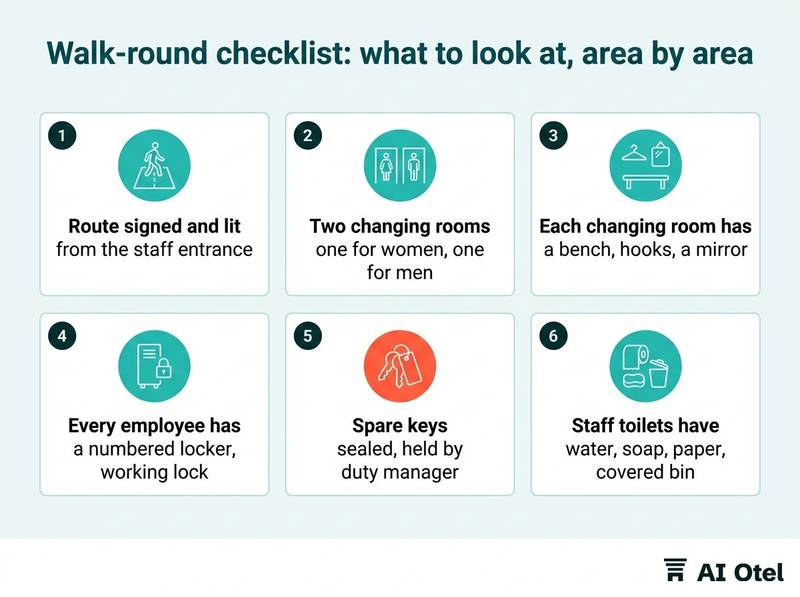
Do the walk with the housekeeping supervisor and an employee representative, at shift change, when the rooms are actually in use. An empty changing room at 11:00 tells you nothing. Photograph every finding with a date; a photo of a locker with no door is worth more in the repair plan than a paragraph in a report. Sort findings into two piles on the spot: fix this week, and fix in the closed season. Re-keying a locker and printing a list is the first pile; a new wall and door is the second. Repeat the walk once after the fixes, because the second walk is the evidence that the room is still a changing room and not a store again. For who should be in the room with you, see employee representatives and the health and safety board in a hotel.
ChecklistStaff areas walk-round
- Route from the staff entrance to the changing rooms is signed and lit.
- Two changing rooms exist, one for women and one for men, each with a door that closes.
- No employee changes in the laundry, a store room, a toilet or a corridor.
- Each changing room has a bench, hooks, a mirror and a wipeable surface.
- Every employee has a numbered locker inside the changing room, with a working lock.
- A locker list is posted or held by the supervisor, matching names to numbers.
- Spare keys are sealed and held by the duty manager.
- Staff toilets have water, soap, paper and a covered bin.
- The eating place has seating for one shift, a washable table, drinking water and a way to heat food.
- No chemicals or linen are stored in the eating place.
- A rest area exists away from through-traffic, heated and ventilated.
- The risk assessment names these rooms and the date of the last check.
How do you fix it in the closed season and prove it was done?
Turn every finding into a dated line with an owner, a cost and a completion photo, and close it before the season opens.
The closed season is the cheapest window for taking a back-of-house room out of service, because the room is empty and the contractor can work in daylight. Book the contractor before the season ends, while the finding is still fresh and the room is still empty. Prioritize by risk first and cost second: a locker list and a set of keys cost almost nothing and remove a whole category of finding, while a new wall and door cost more and take a week. Both belong on the same list, in that order.
Evidence is a package: a photo before, a photo after, the invoice, the updated risk assessment and the updated locker list. Keep it in one folder, because the question you will be asked is when, not whether. Tell the staff, too. A changing room that exists but is used as a store is a finding again by June, and the fastest way to prevent that is to give the key and the responsibility to the housekeeping supervisor. Staff accommodation is a separate subject with its own rules and its own repair list; keep the lojman out of this plan so that neither one hides the other, and see staff housing at a seasonal hotel for that side.
| Finding | Fix | Owner | Evidence |
|---|---|---|---|
| One shared changing room | Convert store room 2 into a second changing room with a lockable door | Technical service | Before and after photos, invoice, updated risk assessment |
| Lockers with missing doors | Repair or replace, number every locker, post the list | Housekeeping supervisor | Dated locker list, photo of the bank |
| Canteen used for linen storage | Clear the room, add seating for one shift, drinking water | Food and beverage manager | Photo, seating count in the staff areas standard |
| No rest area | Designate and heat a room off the back corridor | Technical service | Photo, temperature set point recorded |
| No written standard | Sign the one-page staff areas standard | General manager | Signed page filed with the risk assessment |
What to do next
Walk the staff route this week with the housekeeping supervisor, write down what you see against the three annex items, and move the structural findings into the closed-season plan with an owner and a date. The regulation is short: separate changing rooms, a locked locker each, an eating place of suitable size, equipment and hygiene. The work is in the record that proves the rooms were still being used for what they were built for when the season opened.
Frequently asked questions
Do we need separate changing rooms if we only employ a few staff?
The trigger in Annex 1 item 50 is the duty to wear work clothes, not the number of employees, and the item requires separate rooms for women and men. A small hotel meets it by converting a back-of-house store room rather than by sharing one room on a rota. Confirm how the item applies to your own building with your safety expert or legal adviser.
Can staff change in the laundry or the staff toilet?
No. Item 50 requires the changing rooms and does not allow changing anywhere else, so a laundry, store room, toilet or corridor is a finding even when a proper room exists elsewhere in the building. The practical fix is a signed route from the staff entrance to the staff changing rooms so nobody takes the shortcut.
How large must the staff canteen be?
Item 48 asks for suitable size, equipment and hygiene and gives no figure. The working test is whether one shift can sit down at the same time, with a washable table, drinking water and a way to heat food. Write the number you choose into the staff areas standard so the answer stays the same between inspections.
Do lockers have to be inside the changing room?
Yes. Item 51 places a locked locker in the changing room for each employee, sized for their clothes during working hours. A locker bank in the corridor or one locker shared across shifts does not meet the wording. Keep a numbered list and a sealed spare key so the assignment can be shown.
What evidence should we keep after fixing staff areas?
A photo before and after, the invoice, the updated risk assessment and the updated locker list, all with dates and kept in one folder. Add the signed one-page staff areas standard. The question an inspector asks is when the work was done, and this package answers it without a search.
Sources
- İşyeri Bina ve Eklentilerinde Alınacak Sağlık ve Güvenlik Önlemlerine İlişkin Yönetmelik, Ek-1 madde 50 (opens in a new tab)Çalışma ve Sosyal Güvenlik Bakanlığı / mevzuat.gov.trmevzuat.gov.tr
- İşyeri Bina ve Eklentilerinde Alınacak Sağlık ve Güvenlik Önlemlerine İlişkin Yönetmelik, Ek-1 madde 51 (opens in a new tab)Çalışma ve Sosyal Güvenlik Bakanlığı / mevzuat.gov.trmevzuat.gov.tr
- İşyeri Bina ve Eklentilerinde Alınacak Sağlık ve Güvenlik Önlemlerine İlişkin Yönetmelik, Ek-1 madde 48 (opens in a new tab)Çalışma ve Sosyal Güvenlik Bakanlığı / mevzuat.gov.trmevzuat.gov.tr