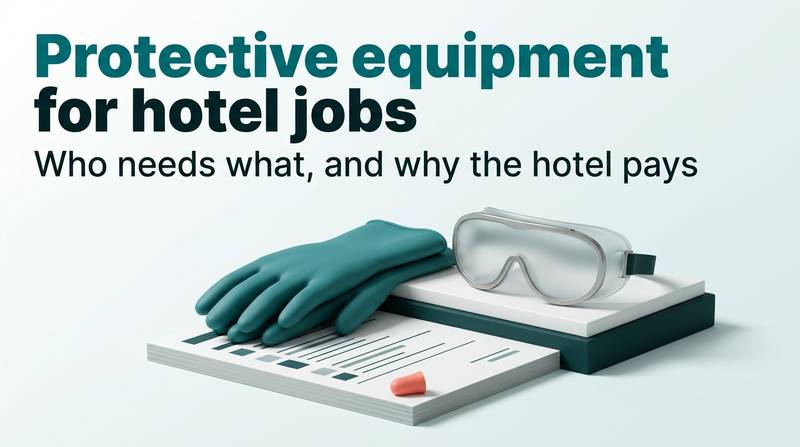
Protective equipment for hotel jobs: who needs what, and why the hotel pays
Discover who needs what protective equipment in a hotel and why the employer pays for it. Learn how to assess risks by department and maintain proper records.
AI draft · awaiting editorial review
Contents
Key takeaways
- Article 5 of the PPE regulation puts collective technical measures and work organization ahead of equipment: PPE is what remains after the risk has been reduced at the source.
- Article 6(1)(e) makes the equipment the employer's cost, provided free of charge, maintained, repaired, checked periodically, stored hygienically and kept ready for use.
- The regulation does not assign an item to a job title; the list of who wears what is the output of the hotel's own risk assessment, task by task.
- A handover sheet that records item, size, date, training and replacement turns a store room purchase into a record that can be followed later.
- Shared, unlabelled or unreplaced equipment fails quietly: it looks like compliance on the shelf and fails at the point of use.
In Türkiye, personal protective equipment (PPE) for hotel staff is the employer's last layer, not the first. Article 5 of the PPE regulation gives collective measures and work organization priority. Article 6(1)(e) requires the employer to provide equipment free of charge, maintain it, replace worn parts and store it hygienically, ready for use. Which job needs what comes from the hotel's risk assessment.
A housekeeping supervisor asks the store for gloves and is handed a box with no size on it. In stewarding, three people have worn the same pair of goggles this week. Neither scene is a purchasing problem first; both are a question about who is responsible for what. After reading this you will know what the regulation actually orders, which questions to ask department by department, and how to keep a record that stands up later.
Does the hotel have to provide protective equipment free of charge?
Yes. Article 6(1)(e) of the PPE regulation makes the employer provide the equipment at no cost to the employee, and keep it in a usable state.
Free of charge means no deduction from wages, no deposit and no "buy it and bring the receipt": the item is the hotel's cost, not the employee's. The same clause carries the maintenance duty: repair, periodic check, replacement of worn parts, hygienic storage and the item kept ready for use. In hotel terms, "kept ready" is a store rule: the sizes the department actually uses in stock, an issue point on every shift, and a replacement within the shift rather than at the next delivery.
The cost belongs to the department that creates the risk, not to the employee and not only to a central safety budget. A department that never sees the cost never manages the stock. Free does not mean one item per year, either: the replacement trigger is wear, damage and hygiene, not a calendar date the hotel invented for its own convenience.
Where housekeeping, laundry or stewarding is outsourced, ask in writing who supplies, replaces and records the equipment for those staff, and keep the answer with the contract.
Key pointWhat Article 6(1)(e) requires
The employer provides PPE free of charge, maintains, repairs and checks it periodically, replaces worn parts, stores it hygienically and keeps it ready for use. Source: Çalışma ve Sosyal Güvenlik Bakanlığı / mevzuat.gov.tr, Kişisel Koruyucu Donanımların İşyerlerinde Kullanılması Hakkında Yönetmelik, madde 6 (2026-11-15).
What comes first: removing the risk or handing out equipment?
Removing the risk comes first. Article 5 says equipment is used where risks cannot be prevented or fully limited by collective technical measures or by work organization and methods, and the employer gives collective protection priority.
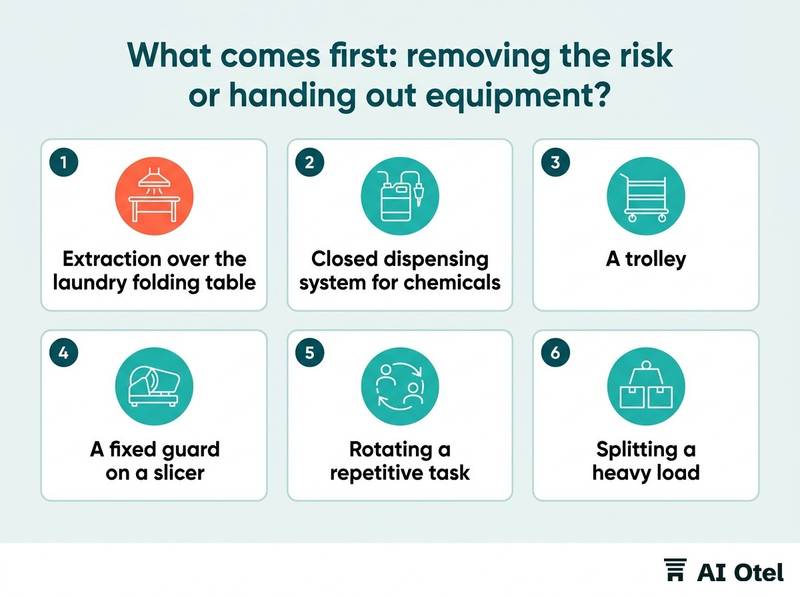
The regulation sets an order, not a shopping list. The first question about any task is whether the risk can be designed out or separated from the person. Collective technical measures in a hotel look like extraction over the laundry folding table, a closed dispensing system for chemicals instead of decanting into bottles, a trolley instead of carrying linen by hand, a fixed guard on a slicer.
Work organization counts as a control too: rotating a repetitive task, splitting a heavy load between two people, scheduling chemical work when the area is empty and ventilated. What survives those steps is the residual risk, and that is where equipment enters. The risk assessment should name the residual risk, not only the item bought for it.
A reliable warning sign: equipment ordered before anyone has asked the ventilation, guarding or dispensing question. The risk is still there, and now it has a purchase order attached to it. The two duties run together: whoever owns the risk assessment decides the residual risk, and the department head decides how the item is issued, replaced and recorded. For the wider task-by-task review, see the department-by-department occupational health and safety checklist for hotels.
Watch outEquipment is not a substitute for a fix
If a job needs a respirator because the extraction does not work, the first action is the extraction, not a better respirator. Equipment worn over an unfixed risk gives the hotel a document, not a safer task.
Who needs what? The questions to ask by department
No regulation assigns an item to a job title; the answer comes from the risk assessment of each task. What a hotel can standardize is the set of questions it asks of every department.
Housekeeping: ask about chemicals, dust, blood or body fluids in a checkout clean, and the grip a glove must still leave for making a bed. Laundry: ask about heat, steam, lint and the weight of wet linen, and ask the collective question about extraction and trolley height before the glove question. Kitchen: ask about cuts, burns, hot oil and wet floors; the glove that suits a slicer is the wrong glove at the stove, and one item cannot answer both.
Stewarding: ask who handles the dish machine chemicals, who clears broken glass, and whether the person doing it has been shown how to pick up glass without a hand. Pool and technical service: ask about chlorine and acid handling and the plant room; the person who changes a dosing drum is not the person who tests the water, and the two tasks carry different questions. Front office: ask whether the risk assessment identifies any task at all; a uniform is not equipment, and an item that unsettles guests needs a work-organization answer, not a rule to hide it.
The output per department is short: task, residual risk, item, who is issued it, and what triggers replacement.
| Department | Ask about the source of the risk | Ask about the person |
|---|---|---|
| Housekeeping | Which chemicals, which dilution, which decanting? | Does the glove still allow grip for bed making? |
| Laundry | Heat, steam, wet-linen weight, extraction? | Who lifts, how often, with what training? |
| Kitchen | Cuts, burns, hot oil, wet floors, guards? | Which glove for which task, and who was shown it? |
| Stewarding | Machine chemicals, broken glass, who does what? | Has anyone demonstrated safe glass handling? |
| Pool and technical | Chlorine, acid, dosing, plant room access? | Who changes drums, who tests, who is trained? |
| Front office | Does the risk assessment name any task here? | Does an item unsettle guests, and what is the workaround? |
For the chemical side of the housekeeping questions, see choosing, storing and training on housekeeping cleaning chemicals.
How do you choose equipment people will actually wear?
Choose for the task and the person, not for the shelf: fit, comfort over a full shift, compatibility with the other items worn, and instructions the staff can read decide whether it is still on at hour six.
Fit is a safety property. A glove that is too large loses grip and catches on edges; anything that seals against the face and does not seal gives false confidence, which is worse than no item at all. Comfort over a shift decides use: heat, sweat, grip, touch sensitivity. Let two or three people from the department try the item during real work before the hotel buys for the team.
Test the combination, not the item: glasses fogging under a mask, a glove under or over a sleeve, hearing protection under a cap. Each pairing has its own failure. Keep the manufacturer's markings and instructions, and keep a copy in a language the staff read; an instruction nobody can read is not an instruction.
Stock the sizes the department uses. A store that holds one size has quietly decided that fit does not matter. Write the hotel's specification as the task and the exposure, and let the supplier match the item; do not copy product names from another hotel's list.
ChecklistBefore you raise the purchase order, run these checks
- Does it fit the people who will wear it?
- Is it comfortable for a full shift?
- Does it work with the other items worn at the same time?
- Are the markings and instructions present and readable for the staff?
- Are the needed sizes in stock?
- Does the specification describe the task rather than a brand?
What does practical training look like, and what goes on the handover sheet?
Training is practical when the person puts the item on, adjusts it, uses it in the task and takes it off while someone watches; the handover sheet records what was issued and what was trained, so the two can be checked together.
The demonstration has four steps: put on, adjust, check, take off, plus where the item goes at the end of the shift and who cleans it. Anything that seals needs a fit check done by the wearer and watched once by someone who can recognize a bad seal. A new item means new training: a change of glove or mask model is a new instruction, not a top-up, because the fit and the feel have changed.
Keep the sheet where the department can reach it and make the store update it at every replacement. A form filled in once at induction and never again proves nothing. The equipment training and the general OHS training calendar should not contradict each other on who was trained, when and by whom; the safety expert and workplace doctor requirements for hotels set the frame for that calendar.
Checklist
- Employee name and department
- Task the item is issued for
- Item and size
- Date issued
- Training date and what was demonstrated
- Replacement date or trigger
- Date returned or withdrawn
- Signature of the employee
- Signature of the person issuing
What do hotels get wrong most often?
The failures are rarely in the purchase: they are sharing, storage, replacement and the missing record.
Shared equipment: anything worn against the skin or sealing to the face should be issued to a person where hygiene matters; a shared pair is a hygiene problem and a fit problem at the same time. Unlabelled boxes: a box in the store with no size, no task and no date is not stock, it is a guess that costs a shift.
No replacement trigger: when the item runs out, the department improvises; the sheet should say who replaces what and how quickly. Equipment locked away: kept ready means reachable on the shift that needs it, not in a manager's office with a key holder who leaves at six.
Equipment as the only control: if the only thing that changed after an incident is a new glove, the risk assessment has not been done, and the next incident will look the same. No record: without a sheet the hotel cannot show what it issued or trained, and a department head cannot tell a supply problem from a compliance problem. Staff who believe the task itself is unsafe have a separate route, covered in the article on refusing dangerous work.
What to do next
Take one department this week and run the two questions over its tasks: can this risk be removed or reduced at the source, and if not, what does the person wear and who replaces it. Then open a handover sheet for that department and let the store keep it current. The order from Article 5, the cost rule in Article 6(1)(e) and the sheet are one system: the regulation decides the order, the hotel pays and maintains, the sheet shows both. How an inspector treats those records, and any consequence of a gap, is a question for your legal adviser.
Frequently asked questions
Can a hotel charge staff for protective equipment or ask them to buy their own?
Article 6(1)(e) puts the cost on the employer: the equipment is provided free of charge and kept in a usable state. A deduction, a deposit or a "buy it and claim it back" arrangement moves a duty the regulation places on the hotel onto the employee. The duty sits with the employer for as long as the person is exposed to the risk.
How often should protective equipment be replaced?
The cited articles set no interval: they require periodic checking, repair and replacement of worn parts. The trigger comes from wear, damage, hygiene and the manufacturer's instructions, and the handover sheet is where the hotel records it. A fixed annual date is a hotel habit, not a rule.
Can employees share gloves, goggles or masks?
Article 6(1)(e) requires hygienic storage, which is hard to meet with an item worn against the skin or sealed to a face. Sharing also breaks fit: the item was chosen for one person's hand or face. Where sharing is unavoidable, the hotel needs a cleaning step between users and a record of it.
Is a signed training form enough to show staff were trained?
A signature records attendance, not competence. Practical training means the person put the item on, adjusted it, used it in the task and took it off while someone watched. The handover sheet links the item, the demonstration and the date, which is what makes the record useful later.
Sources
- Kişisel Koruyucu Donanımların İşyerlerinde Kullanılması Hakkında Yönetmelik, Madde 5 (opens in a new tab)Çalışma ve Sosyal Güvenlik Bakanlığı / mevzuat.gov.trmevzuat.gov.tr
- Kişisel Koruyucu Donanımların İşyerlerinde Kullanılması Hakkında Yönetmelik, Madde 6 (opens in a new tab)Çalışma ve Sosyal Güvenlik Bakanlığı / mevzuat.gov.trmevzuat.gov.tr