Occupational safety terms for hotel managers: hazard, risk, prevention and the words on the forms
This guide explains the legal definitions behind occupational safety terms hotel forms use, distinguishing hazards from risks. It clarifies prevention, risk assessment and hazard class so you can read, question and sign safety documents with confidence.
AI draft · awaiting editorial review
Contents
Key takeaways
- Risk is the probability that a hazard causes loss, injury or another harmful result (Law No. 6331, Article 3, mevzuat.gov.tr, 15.11.2026); the hazard is the source of that possible harm.
- The same article defines prevention as all measures planned and taken at every stage of the work to remove or reduce risks, which is wider than the mat, the sign or the purchase order.
- Risk assessment is defined as three pieces of work: identify the hazards, analyze and rank the risks, and decide the control measures (Law No. 6331, Article 3).
- Confirm your own class with your safety expert and never copy it from another hotel's form.
- A near miss is the cheapest warning a hotel gets; a form that collects them and nobody reads is a cost with no return.
A hazard is the thing that can hurt someone; risk is the probability that it does. Article 3 of Law No. 6331 defines risk as the probability that a hazard causes loss, injury or another harmful result, and defines prevention and risk assessment in the same article (mevzuat.gov.tr, "İş Sağlığı ve Güvenliği Kanunu, Madde 3", 15.11.2026 (opens in a new tab)).
A department head signs a risk assessment before an inspection, then cannot explain the difference between the hazard column and the risk column. The form is rarely the problem. The words are. This glossary gives you the legal definitions behind the occupational safety terms hotel forms use, plus the practice words, so you can read, question and sign what is put in front of you.
What is the difference between a hazard and a risk in a hotel?
A hazard is the thing that can cause harm; risk is the probability that it does, together with how bad the result would be. The two are separate words in the law and one word in most hotel conversations.
Article 3 of Law No. 6331 defines risk as the probability that a hazard causes loss, injury or another harmful result (mevzuat.gov.tr, Madde 3, 15.11.2026 (opens in a new tab)). The hazard is the source; the risk is the chance. Use the pointing test: if you can point at it, it is a hazard. A wet pool deck, a loose stair nosing, a gas cylinder stored beside a heat source: all hazards. If you are arguing about how likely and how serious, you are talking about risk.
The pair matters because a hazard stays the same while its risk moves with conditions. For example, the same wet pool deck at 07:00 with one attendant and at 19:00 with forty guests around it carries two different risks.
Two errors recur on hotel forms. The first is writing a hazard down and then treating the entry as if the risk had been dealt with. A list of hazards is an inventory, not a decision. The second is writing "dikkatsizlik", carelessness, in the hazard column. Carelessness is not a hazard; it is what happens when a hazard is left in place.
The pair buys the manager one thing: one column tells you what to fix, the other tells you what to fix first.
Key pointThe pointing test
Can you point at it? Then it is a hazard. Are you estimating how likely and how bad? Then it is a risk. Can you do neither? Then the entry is not ready for the form.
What does the law mean by prevention and risk assessment?
Prevention means all measures planned and taken at every stage of the work to remove or reduce risks; risk assessment means the work of identifying hazards, analyzing and ranking the risks they cause, and deciding on control measures (Law No. 6331, Article 3, mevzuat.gov.tr, 15.11.2026 (opens in a new tab)).
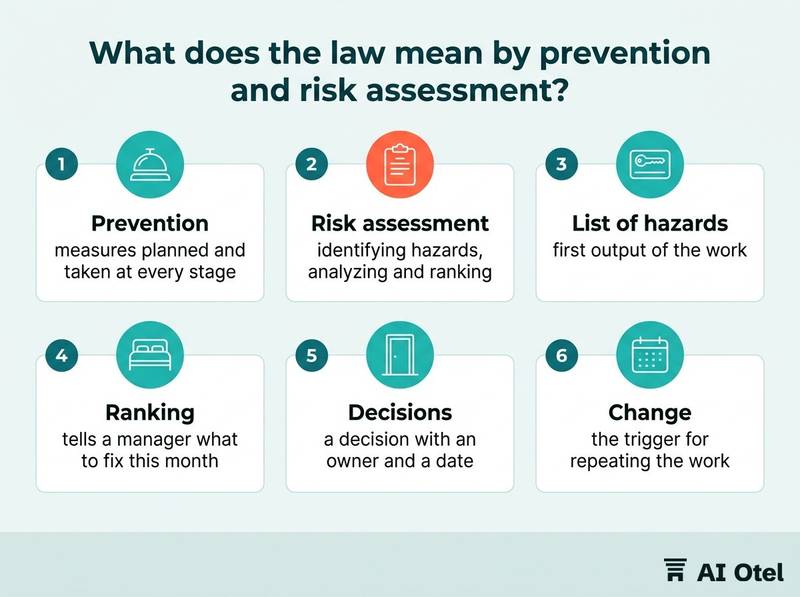
"At every stage of the work" is the part worth unpacking. The definition covers planning, purchasing, staffing and shift handover, not only the moment after an accident. A hotel that buys a non-slip mat after a fall has done prevention late, not prevention.
A risk assessment, by the same article, has three outputs: a list of hazards, a ranking, and a set of decisions. A document with the first and none of the other two is a survey. The ranking is the useful part, because it is the only thing that tells a manager with a fixed budget what to fix this month and what can wait until the winter. And the definition says "decide on control measures": a decision with an owner and a date, not a recommendation in a binder.
The trigger for repeating the work is change: a new kitchen line, a new pool, a new shift pattern, a new outsource contract. The hazards changed, so the assessment is out of date even if the paper is recent.
This article quotes three definitions and stops there. For the specific duties that apply to your operation's size and activity, and the order they fall in, consult your safety expert.
ChecklistFive checks before signing a risk assessment
- Every hazard names a place and a task, not a department.
- Risks are ranked, and the ranking is visible on the page.
- Every control measure has a person and a date.
- Measures that remove the hazard are listed before measures that only protect the person.
- The last review date is written, with what has changed since.
What does hazard class mean, and why does it follow the activity?
Hazard class is the category a workplace carries for safety purposes. It is not set by the building, the star rating or the number of rooms. Treat it as a separate lookup: confirm your own class with your safety expert rather than copying another hotel's form.
Hazard class is often filled in from memory. Ask your safety expert what your own operation carries.
The shortcut everyone takes is copying the class from another hotel's form, or from a colleague's message, because the two hotels look alike. Resist it. What to bring to the conversation with your safety expert instead: the registered activity, the departments that do different work, and the current assessment. The requirements that hang off the class, the safety expert's required time and the training hours, are covered separately in the article on safety experts and workplace doctors.
This glossary does not state a class for hotels, or for any department. Its job is to make you ask the question correctly.
Watch outDo not copy a hazard class
Do not copy a hazard class from another hotel's form. The class follows the registered activity, and a wrong class quietly changes which duties apply to you.
What do ramak kala, iş kazası and KKD mean on a hotel form?
They are a near miss that hurt nobody, a work accident that did, and personal protective equipment. Forms use them loosely, so the manager has to hold the line between them.
A near miss is an event that could have injured someone and did not: the tray that fell beside the waiter, the ladder that shifted with nobody on it. It is a practice word, not one of the legal definitions quoted above, and it is the cheapest information a hotel gets. Near misses show where the next accident is coming from, at no cost beyond the writing. A form that collects them and nobody reads is a cost with no return.
İş kazası, work accident, is an injury at work, and the word starts a clock; the notice and record steps are covered in the article on what to do after a work accident, not here.
KKD is kişisel koruyucu donanım, personal protective equipment: gloves, goggles, non-slip shoes, hearing protection, cut-resistant gloves in the kitchen. The mechanism to keep straight is that protective equipment protects a person who is already exposed; it does not remove the hazard. That is why it sits at the end of the decision, not the start. A usable KKD line on a form says who issues it, who replaces it, who checks it, and who trained the person to wear it.
| Word on the form | What it means | What a manager does with it |
|---|---|---|
| Ramak kala | An event that could have injured someone and did not | Record it, read it weekly, look for the pattern |
| İş kazası | An injury at work; the word that starts a clock | Follow the notice and record steps, not the glossary |
| KKD | Kişisel koruyucu donanım, personal protective equipment | Check issue, replacement and training, and ask whether the hazard can be removed instead |
What do tutanak, kurul and çalışan temsilcisi mean during an inspection?
They are the record, the board and the person: the tutanak is the written account of what was seen and agreed, the kurul is the health and safety board, and the çalışan temsilcisi is the employee representative who carries staff into the conversation.
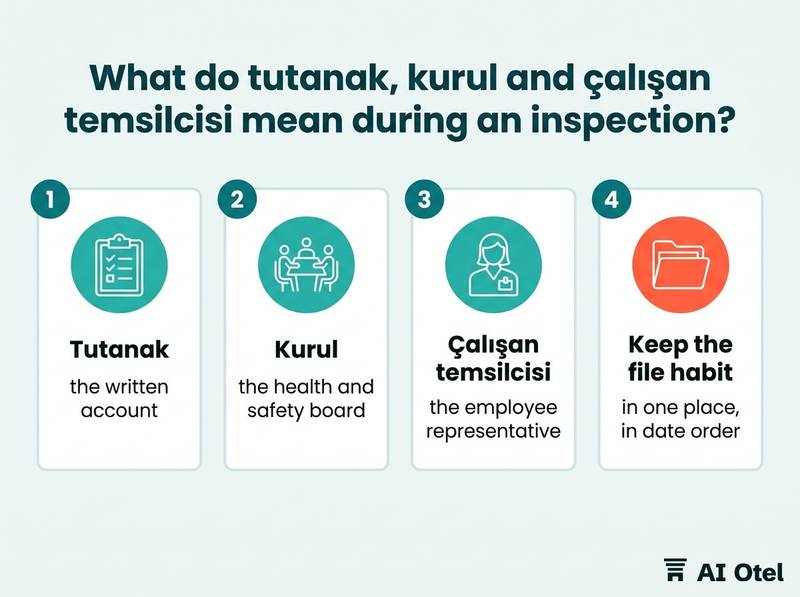
Define a tutanak by its reader. It is written for people who were not there, so it carries facts, places, times and names, and no adjectives. The test of a good tutanak: could a manager who arrived a month later act on it without calling anyone? If not, it is a summary of a mood.
The board and the representative are a route rather than a formality. Decisions are supposed to travel from the board to the staff, and the representative is the path they take. The sizes and conditions that decide when a hotel needs a board or a representative are covered in the article on employee representatives and the health and safety board.
Keep the file habit: hold the assessment, the tutanaklar and the near-miss records in one place, in date order, because the value is in the sequence, not in any single paper. The failure mode is three separate folders held by three people, none of whom can produce the sequence when it is asked for.
TipWriting a tutanak that survives being read later
What was seen, where exactly, at what time, who was present, what was agreed, by whom and by when. No adjectives, no conclusions about people.
How do these terms fit together on one page?
They form a chain: the hazard is found, the risk is ranked, the prevention is decided with a person and a date, the near miss tests whether the decision worked, and the tutanak records all of it.
You can repeat the chain to a department head in one sentence: hazard, risk, ranking, measure, owner, date, record. Each word sits at a fixed point on the chain, so a form missing one of them is visibly incomplete rather than merely short.
The near miss is the chain checking itself. That is why it belongs in the same file as the assessment, not in a separate incident box. And the department-level use, where these words become tasks for housekeeping, kitchen, pool, maintenance and front desk, is in the department-by-department OHS checklist.
Three definitions are quoted from the law, and the requirements that follow from them are covered in the linked articles.
What to do next
Take one form your department signs this month, find the hazard column and the risk column, and check whether each entry passes the pointing test and carries an owner and a date. That single pass teaches the vocabulary faster than any glossary, and it shows you which of the linked articles you need next.
Frequently asked questions
Is a hazard the same as a risk?
No. A hazard is the source of possible harm; risk is the probability that the hazard causes loss, injury or another harmful result, as Article 3 of Law No. 6331 defines it (mevzuat.gov.tr, 15.11.2026). The practical test: if you can point at it, it is a hazard; if you are estimating how likely and how bad, you are talking about risk.
Does a hotel need a risk assessment when nothing has gone wrong yet?
The law's definition describes work done in advance: identifying hazards, analyzing and ranking the risks they cause, and deciding on control measures. Nothing in that definition ties the work to an accident. A hotel that starts after an injury has skipped the step the definition describes.
What is a near miss and why should a hotel record it?
A near miss is an event that could have injured someone and did not. It is a practice word rather than one of the definitions quoted here. It is worth recording because it shows where the next accident is coming from, at no cost beyond the writing, and it tests whether the control measures already decided are working.
What does KKD mean on a hotel safety form?
KKD is kişisel koruyucu donanım, personal protective equipment: gloves, goggles, non-slip shoes, hearing protection. It protects a person who is already exposed to a hazard; it does not remove the hazard. A usable KKD line on a form says who issues it, who replaces it, who checks it and who trained the person to wear it.
Does a hotel's hazard class depend on its star rating?
No. Hazard class is not set by the building, the star rating or the room count. Treat it as a separate lookup: confirm your own class with your safety expert rather than copying another hotel's form.
Sources
- İş Sağlığı ve Güvenliği Kanunu (Kanun No. 6331), Madde 3 (opens in a new tab)Türkiye Büyük Millet Meclisi / mevzuat.gov.trmevzuat.gov.tr
- İş Sağlığı ve Güvenliği Kanunu (Kanun No. 6331), Madde 3 (opens in a new tab)Türkiye Büyük Millet Meclisi / mevzuat.gov.trmevzuat.gov.tr
- İş Sağlığı ve Güvenliği Kanunu (Kanun No. 6331), Madde 3 (opens in a new tab)Türkiye Büyük Millet Meclisi / mevzuat.gov.trmevzuat.gov.tr