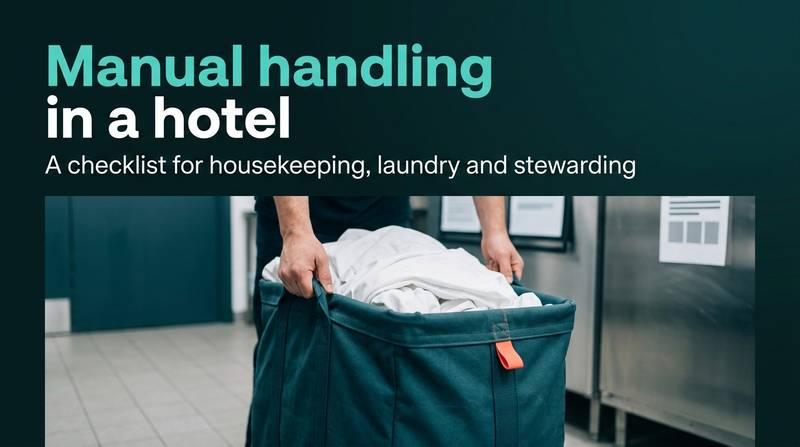
Manual handling in a hotel: a checklist for housekeeping, laundry and stewarding
Manual handling in hotels often hides in carts, linen bags and crates. This article provides a walk-round checklist for housekeeping, laundry and stewarding to identify risks and apply regulatory duties.
AI draft · awaiting editorial review
Contents
Key takeaways
- Article 5 of the Manual Handling Regulation puts the first duty on the employer: organize the work so the load is not carried by hand, and use mechanical means where it can be (Ministry of Labor and Social Security, Manual Handling Regulation, Article 5, mevzuat.gov.tr).
- Most housekeeping manual handling is a route and fill-level problem before it is a strength problem: a full cart, a knotted bag and a carpet threshold cause more trouble than a heavy mattress.
- A wet laundry bag or a crate of plates is harder to handle than a dry box of the same weight, because grip and balance change, not only the mass.
- Training teaches technique; it does not remove a lift. Use it after the trolley, the chute or the two-person rule is in place.
- Record the load, the route and the change you made; a fix nobody wrote down comes back as the same problem next season.
Manual handling is moving a load by hand or bodily force: lifting, carrying, pushing, pulling, lowering. In hotels it hides in carts, linen bags, mattresses and crates. Under Türkiye's Occupational Health and Safety Law (No. 6331), the employer must assess risks and prioritize eliminating manual handling through mechanical means or organizational changes. What remains after that is a question for the hotel's own risk assessment, and the specific regulatory text applicable to your facility is a question for a legal adviser.
A room attendant finishes a floor, drags a knotted linen bag to the service lift and lifts it onto a shelf. The task is in no risk assessment, because on paper the department moves linen, not loads. This article gives you a way to see those loads: what counts as manual handling in hotel housekeeping, laundry and stewarding, what the regulation asks of the employer, and a walk-round checklist you can run this week.
What counts as manual handling in a hotel?
Manual handling is any task where a person moves or supports a load by hand or bodily force: lifting, lowering, carrying, pushing, pulling, holding. In a hotel most of it is not a lift at all, it is a push, a drag or a hold.
The load is not only its weight. Size, grip, whether it is wet, hot, sharp or unstable, and whether the person has a free hand all change the effort. The same task done once is a different problem from the same task done all shift; frequency and recovery time belong in the assessment, not in a footnote. Pushing a loaded cart over carpet, a threshold or a ramp is manual handling even though nothing is lifted off the floor.
Holding a mattress corner while a second person turns it counts, and so does holding a fire door with a foot while pulling a trolley through. The test is the work, not the object: if a person's body moves or supports the load, it belongs on the list.
| Where | The task that hides | What makes it hard |
|---|---|---|
| Housekeeping | Linen bag from room to service lift | Weight shifts as the bag fills, the knot, the drag across carpet |
| Housekeeping | Mattress and bed base turn | Two people, bed height, grip on a soft edge |
| Laundry | Roll cage from sorting to the wash | Wheels on a wet floor, load above eye level, ramp at the door |
| Stewarding | Crate of plates from dishwash to the pass | Wet, sharp edges, repeated every few minutes |
| Kitchen stores | Case of water and keg from delivery door to store | Distance, a step, the driver waiting |
| Receiving | Pallet broken down by hand | Time pressure, no platform truck at the door |
What does the Manual Handling Regulation require of a hotel?
Article 5 requires the employer to organize the work so that loads need not be carried by hand, and to take the measures needed so they are moved by suitable methods, especially mechanical systems. Where a lift cannot be avoided, your risk assessment decides how it is reduced.
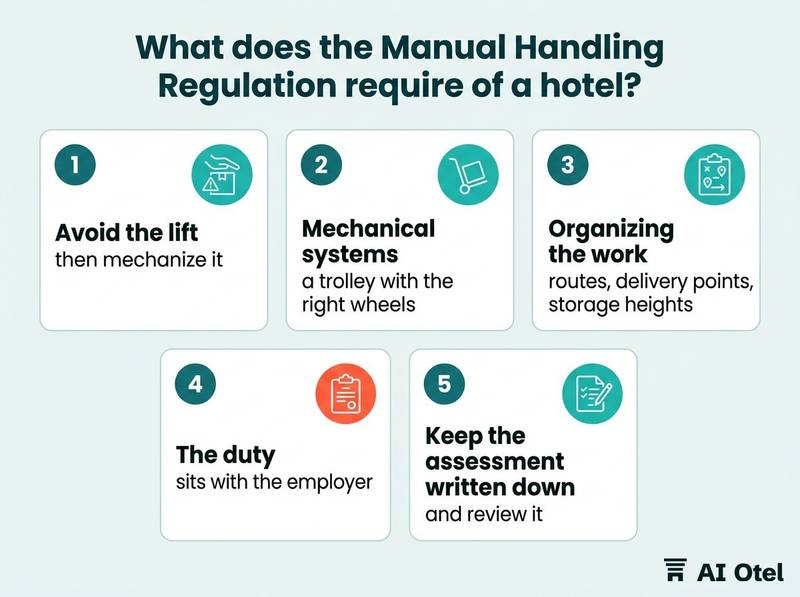
The order matters: avoid the lift, then mechanize it, then reduce what is left. Training the worker is not the first step. Organizing the work means routes, delivery points, fill levels, storage heights, shift design and equipment, not a poster in the staff corridor.
Mechanical systems in a hotel are unglamorous: a trolley with the right wheels, a bag stand, a linen chute, a platform truck, a ramp, a spring-loaded base, a service lift that works. The duty sits with the employer. As a working method, keep the assessment written down and review it; it is not a document produced once for an inspection.
A control that is broken, missing or the wrong size is worse than none, because people improvise around it and the improvisation becomes the routine. This regulation sits inside the wider occupational health and safety picture of the property, department by department.
Key pointThe Article 5 duty in plain words
The employer organizes the work so that loads need not be carried by hand, and takes the measures needed so they are moved by suitable methods, especially mechanical systems. Source: Ministry of Labor and Social Security, Manual Handling Regulation (Elle Taşıma İşleri Yönetmeliği), Article 5, mevzuat.gov.tr (15.11.2026).
Housekeeping: which lifts can you remove this week?
Most housekeeping manual handling is solved by changing the route, the fill level or the equipment, not by teaching a better lifting technique. Walk one floor with the attendant who works it and count every time a load is lifted, dragged or held.
Start with the cart. Loaded above the top rail it becomes top-heavy and hard to steer; check wheel condition, the brake, the bag hanging off the end, and whether the cart actually fits the lift and the corridor turns. On carpet, thresholds and ramps, check the transition strips and the ramp at the service lift, and whether the attendant pushes or pulls, since pulling gives less control and more twist.
Linen is a fill-level question. A bag filled to the knot is a different load from a half bag; a bag stand at cart height removes the floor-to-cart lift, and a chute removes the carry but raises the question of where it lands and who empties it. Mattresses and bed bases need two people, a strap or a mattress lifter, and the bed at working height; turning a mattress alone is a design fault, not a discipline problem.
Time pressure changes the load: the number of rooms in a shift decides how fast a cart is filled and how often a full bag is dragged instead of carried, and that trade-off is set out here. Add wet corridors, vacuum leads, trailing cart straps, and clean linen stacked above shoulder height in a small room, and the floor is done.
ChecklistTake this on the walk-round
- Is the cart loaded below the top rail?
- Do the wheels turn freely on carpet and over the threshold?
- Is there a bag stand at cart height?
- Where does the full bag go, and who lifts it?
- Does the chute land in a closed room, and who empties it?
- Is a mattress lifter kept on the floor?
- Are clean linen shelves between knee and shoulder?
- Is the service-lift ramp usable with a full cart?
- Is a second person available for every mattress turn?
Laundry and stewarding: bags, racks, crates and wet floors
In laundry and the dishwash the load is often wet, hot or sharp and moves through a tight space, so grip and balance matter as much as weight. The controls are mostly about height, wheels and where the clean and dirty flows cross.
Laundry bags first: damp linen is heavier than dry and shifts as it is carried. Set a fill level, use a bag stand or a spring-platform trolley, and stop bags being dragged across a wet floor. Sorting is a height question: a table or chute mouth at the wrong height forces a reach and a twist, so check the height against the people who actually use it, not against an average.
Roll cages and racks need the right wheel type for the floor surface, working brakes, no load above eye level, and a rule about pushing rather than pulling over ramps and into lifts. In stewarding, crates of plates and glass racks are wet, heavy and awkward, and the trip from dishwash to the pass repeats all service; a shorter route or a second stack point does more than technique. If you are new to planning this section, start with what stewarding actually is.
Wet floors need non-slip footwear, working drainage and a dry route, because a person carrying a crate cannot see the floor in front of them. And watch the small-load trap: repeated small loads with a twist are assessed as work, not as a single lift.
Watch outA wet floor plus a carried load is a design fault
If the only route from the dishwash to the pass crosses a wet floor, fix the route or the drainage before you brief the team on being careful. This is not a carelessness problem.
What should you check on every load?
Six things: how heavy it is, how well it can be gripped, how far it travels, how high it starts and finishes, how often it happens, and who is doing it. Write down what you find, because a change is only defensible if the starting point is recorded.
For weight, find the real figure from a scale in the laundry, the delivery note or the drum label; do not estimate by feel, and do not look for one headline number that covers every task in the building. For grip, look at handles, knots, wet surfaces, gloves, a load that shifts, a load that blocks the view of the feet. For distance, count steps, thresholds, ramps, lift door widths, turns, and doors that need a free hand.
For height, follow the hands: floor to shelf, shelf to cart, cart to chute; the worst combination is a low start and a high finish. For frequency, count how many times an hour, and whether the same person does it for the whole shift. For the person, consider the height and reach of the actual team, new starters, and anyone with a recent injury; personal medical questions go to the workplace doctor, not to the supervisor.
| Check | The question to ask | What to record |
|---|---|---|
| Weight | What is the measured figure for this bag, crate or drum? | The figure and where it came from |
| Grip | Can it be held with two hands without gloves slipping? | Handles, knots, surface |
| Distance | How many meters, how many doors, how many steps? | The route |
| Height | Where do the hands start and finish? | Two heights |
| Frequency | How many times an hour, and for how long? | Count and duration |
| Person | Who does this, and is a second person available? | Role, not name |
Kitchen stores, bar and receiving: cases, kegs and water
Receiving and stores produce the heaviest single loads in the building, and they arrive on someone else's schedule. The controls are a delivery point, a trolley and a storage height, decided before the truck arrives.
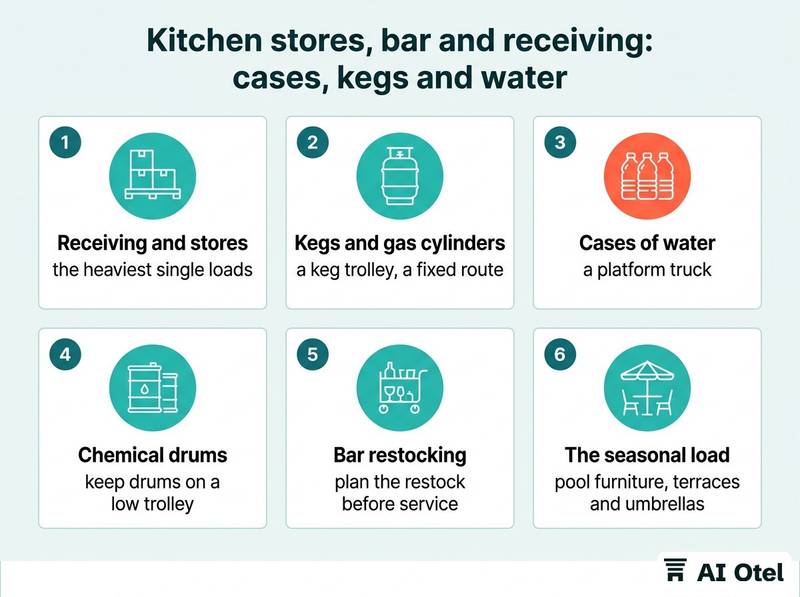
Where the delivery stops matters most: if the driver leaves a pallet at the back door and the store is up a step, the lift becomes a hotel task done under time pressure. Kegs and gas cylinders need a keg trolley, a fixed route and a two-person rule; a cylinder is also a storage question for the safety expert, not only a handling one.
Cases of water and soft drinks need a platform truck, a storage height between knee and shoulder, and no stacking above head height in a corridor. Chemical drums are a double question: decanting is manual handling plus an exposure question, so keep drums on a low trolley and decant at a stable height. Bar restocking means crates moved from store to bar during service, in a narrow space, on a wet floor; plan the restock before service rather than during it. And plan for the seasonal load: pool furniture, terraces and umbrellas at opening and closing, moved by a small team in a hurry.
Training, a ten-minute team talk and a change log
Training comes after the lift is removed or reduced, and it is short, specific and repeated. The change log is what turns a good week into a different department next season.
Train the task, not the theory: this cart on this carpet, this bag stand in this room, the two-person rule for this mattress. A ten-minute talk at the start of a shift, with the actual object in the room, does more than an annual session in a meeting room. Ask the team what they avoid doing and why; the workaround is the assessment talking back to you.
Anyone can stop and say the load is unsafe, and saying it stops the task; the way that request is handled decides whether the rest of the team reports anything at all. Keep a change log: date, task, what was wrong, what changed, who checked it and what it cost, reviewed at the next season opening.
ChecklistTen-minute team talk
- Show the object and name the task.
- Ask who has nearly dropped it or slipped with it.
- Ask what they do instead when the trolley is missing.
- Agree one change the team can make today.
- Agree one change the hotel must make and who owns it.
- Agree what anyone says when a load is too much, and confirm that saying it stops the task.
Where the regulation stops, your own risk assessment starts; a safety expert can confirm how the duty applies to your property and who signs the record.
What to do next
Walk one floor and one delivery this week with the people who do the work, write down every lift, drag and hold you see, and remove the first three. The order is the method: organize the work so the load is not carried by hand, reduce what is left, train the technique for what remains, and log the change so it survives the season.
Frequently asked questions
Does the Manual Handling Regulation set a maximum weight a hotel worker may lift?
Article 5 asks the employer to organize the work so loads need not be carried by hand, which is an organizational duty rather than a figure to post on the wall. The figure for a specific task comes from your own assessment, which weighs load, grip, distance, height, frequency and the person doing it. Do not replace the assessment with a number copied from another hotel.
Do we have to buy equipment to comply?
Mechanical means come first in Article 5, but the cheapest control is often a route, a fill level or a delivery point rather than a purchase. Equipment has to fit the floor, the lift and the person, and it has to be maintained, because a broken trolley creates a new risk. Start with what the team already avoids doing, and buy for that.
Who should carry out the walk-round?
The supervisor and the person who does the task, at the time of day it actually happens, because a floor at 9 a.m. and the same floor at 3 p.m. are different workplaces. The safety expert supports the assessment and keeps the training record. The findings belong in the risk assessment, not in a notebook that stays in a drawer.
Is pushing a housekeeping cart manual handling?
Yes. Pushing, pulling and holding are manual handling even when nothing is lifted off the floor. The effort is set by the wheels, the load height, the floor surface and the turns, so a cart that steers badly is an equipment problem before it is a training problem.
How do we know the change worked?
Repeat the same walk-round a few weeks later and ask the team which task they still avoid doing. A control that people work around has not worked, whatever the risk assessment says. Record the date and the check next to the original entry.
Sources
- Elle Taşıma İşleri Yönetmeliği, Madde 5 (opens in a new tab)Çalışma ve Sosyal Güvenlik Bakanlığı / mevzuat.gov.trmevzuat.gov.tr