Display screen work at the front desk and in reservations: breaks, eye checks and who pays
Türkiye's regulation requires hotels to assess screen risks, arrange eye exams, and plan breaks for front desk and reservations staff. The employer pays for all measures, and the risk assessment sets the schedule.
AI draft · awaiting editorial review
Contents
Key takeaways
- The Regulation on Health and Safety Conditions of Work Performed with Display Screen Equipment puts four duties on a hotel: assess the risks, arrange eye examinations, plan breaks or rotation, and carry the cost of the measures itself (Regulation on Health and Safety Conditions of Work Performed with Display Screen Equipment, Official Gazette No. 26953, 2008, amended, Ministry of Labor and Social Security).
- Eye examinations are due before screen work starts, when vision difficulties appear, and at regular intervals the workplace physician sets from the risk assessment; the regulation fixes no single interval for every hotel.
- The regulation asks for planned breaks or a change of task, which is a decision the hotel makes in the shift plan, not one the receptionist makes at the counter.
- The regulation says the cost of the measures taken under it cannot be passed on to employees, so the eye examination it asks for is not an employee expense.
- The risk assessment comes first: without it the physician has no basis for the examination interval and the front office has no basis for its break plan.
Work at display screens is covered by Türkiye's display screen regulation. It asks the hotel to assess the risks, offer an eye examination before the work starts and at intervals the workplace physician sets, plan breaks or rotation to other tasks, and keep the cost of these measures off the employee. The employer pays.
At 23:40 the night shift has been on the same screen since handover, and the queue at check-in is the reason nobody has stood up. The regulation that covers that work is not really about the screen. It is about how the shift was planned before anyone sat down. This article reads the display screen regulation for what it asks of a hotel with display screen work at the front desk and in reservations, and turns each duty into something a manager can put on paper: a role list, a risk assessment, an examination cycle, a break plan and a five-minute desk check.
Who counts as a display screen operator in a hotel?
The duties attach to work carried out at display screens, and in a hotel that reaches further than the front desk. The hotel has to decide role by role which jobs it treats as screen work, and write the decision down.
Start from the roster, not the organization chart. Reception and night audit, reservations, revenue, accounting, sales, purchasing, spa and activity booking, the switchboard, and the security camera room all belong on the first draft of the list.
The test is what the person does, not what the contract calls the job. A receptionist who spends the shift in the property management system and a reservations agent who never leaves the desk are both doing screen work. Mixed roles are the normal case in a small hotel: the same person checks in a guest, takes a phone booking and prints a folio. That mix helps with rotation, but it does not remove the duty to plan.
Write the decision down role by role inside the risk assessment, with a date and an owner, so it survives a change of front office manager. Do not settle the question with "they can stand up whenever they want": Article 7 asks for planned breaks or rotation, which is a decision the hotel makes. Seasonal staff and new hires join the list on their first day, not after the season.
What must the risk assessment look at?
Three things at once: the eyes, the body and the mental load of the work, plus the room the screen sits in and the way the shift is organized.
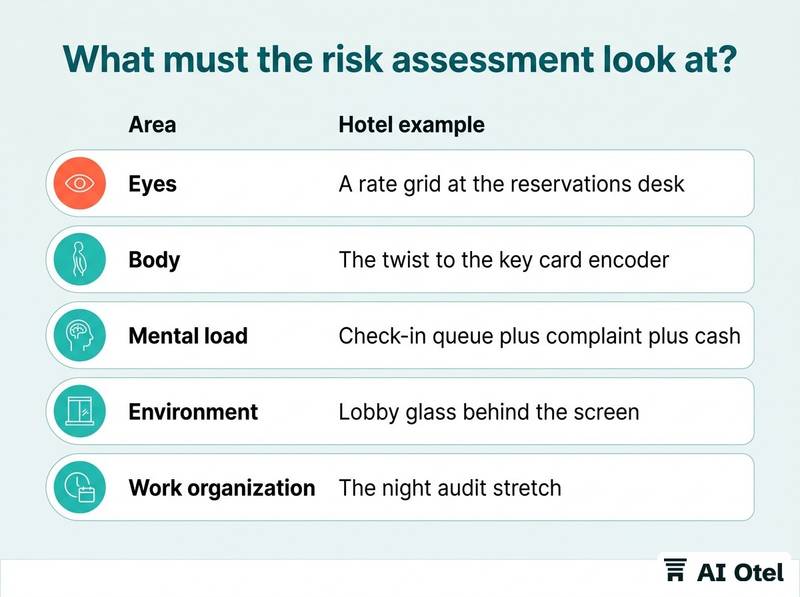
For the eyes, the assessment asks how much of the shift is spent reading, what is read (a rate grid, a folio, a scanned passport), and what sits between the eye and the screen: glare from the lobby glass, a lamp reflected in the panel, or dry air from the climate system. For the body, it asks where the chair, the desk, the keyboard, the phone and the key card encoder sit relative to the person, and what twist the printer behind the desk forces.
Mental load is the part hotels skip. A desk handling a queue, a complaint and a cash payment at the same time, or a reservations office working to a group deadline, is exactly the workload the break and rotation duty is aimed at. The employer carries out the assessment with the safety expert and the workplace physician, and the written result is the document the physician uses to set the examination interval. A dated assessment should name the roles, the findings, the measures, an owner for each measure, and a review date.
| Area | Question the assessment asks | Hotel example |
|---|---|---|
| Eyes | What is read, for how long, and what reflects in the screen | A rate grid at the reservations desk |
| Body | Where chair, keyboard, phone and printer sit relative to the person | The twist to the key card encoder |
| Mental load | What competes for attention at once | Check-in queue plus complaint plus cash |
| Environment | Light, reflection, noise, air | Lobby glass behind the screen |
| Work organization | Shift length, peak, cover | The night audit stretch |
The same department-by-department thinking sits in our occupational health and safety checklist by hotel department, which covers the rest of the property.
Eye examinations: when are they due and how often?
Article 9 of the display screen regulation (opens in a new tab) (Ministry of Labor and Social Security, mevzuat.gov.tr, 2026) sets three triggers: before the person starts screen work, when vision difficulties arise, and at regular intervals the workplace physician sets from the risk assessment.
The regulation does not fix one interval for every hotel. A night auditor at a dim desk and a reservations agent working in daylight can reasonably end up on different cycles, because the physician sets the cycle from the assessment. "Before starting" has a calendar meaning: a new receptionist on the first rota, a housekeeper moved to the switchboard, a seasonal worker arriving for the season.
What follows the examination matters more than the examination. The physician's findings feed back into the assessment and into the measures: the lighting, the desk, the rotation. The hotel's part is the invitation, the time, the record and the follow-up; the medical judgment is not the hotel's to make. Treat the result as input to fitting the work to the person, not as a filter applied to a candidate.
If the assessment does not exist, the physician has nothing to set an interval from, and the duty quietly turns into an annual form nobody reads.
Note
The regulation fixes no single interval. The workplace physician sets it from the risk assessment, so the assessment has to be written before the examination cycle can be planned.
How much physician time your property is entitled to depends on its hazard class and headcount; see safety expert and workplace doctor required time for hotels.
Breaks and task rotation: how does a front desk plan them?
Article 7 (opens in a new tab) (Ministry of Labor and Social Security, mevzuat.gov.tr, 2026) asks the employer to plan the work so operators take periodic breaks or rotate to other tasks. The plan belongs in the shift, not in the employee's judgment at a busy counter.
There are two levers: time away from the screen, and a change of task that takes the eyes off it, such as a floor walk, a handover, greeting arrivals or a store check. Plan around the peak. The check-in rush is exactly when nobody steps away, so the rotation goes before and after it, not through it.
Coverage is the design problem. If a break leaves the desk empty, the plan fails: cross-train a second person, or use the quiet window the occupancy pattern gives you. The night shift is the hardest case, with fewer people, longer stretches and no natural interruption; write the rotation into the night audit sequence rather than hoping for a gap. Reservations and accounting have the same shape around group deadlines and month-end, so the rotation is planned against the deadline, not after it. If you want to see where those peaks actually fall, the numbers in front office KPIs a desk can measure and calculate are a starting point.
Keep the screen break and the labor law's rest break apart. They answer different questions, and taking one does not discharge the other. Record the plan on the shift sheet and check afterwards whether it happened; a plan nobody measures is a sentence in a folder.
Who pays for the measures?
The employer. Article 5(2) of the display screen regulation (opens in a new tab) (Ministry of Labor and Social Security, mevzuat.gov.tr, 2026) says the cost of the measures taken under the regulation cannot be passed on to employees.
In practice that covers the assessment, the changes to desk, chair and lighting, the eye examination the regulation asks for, the time the examination takes, and the training. The reason is simple: a measure that depends on whether the employee can afford it is not a measure.
The boundary is narrower than the rule. Whether a particular purchase, such as corrective lenses, sits inside Article 5(2) is not settled by the article itself; that is a question for the workplace physician and your adviser. Two practical traps to avoid: charging a seasonal worker for something the hotel is required to provide, and scheduling the examination in the employee's own time and calling it a favor.
Put the measures in the annual occupational health and safety budget, so the cost does not land on a department head who then passes it down the line. Keep the receipt trail with the assessment, so a later question about who paid has an answer on file.
Key point
Article 5(2) of the display screen regulation says the cost of the measures taken under it cannot be passed on to employees. The hotel carries it.
A five-minute desk set-up check
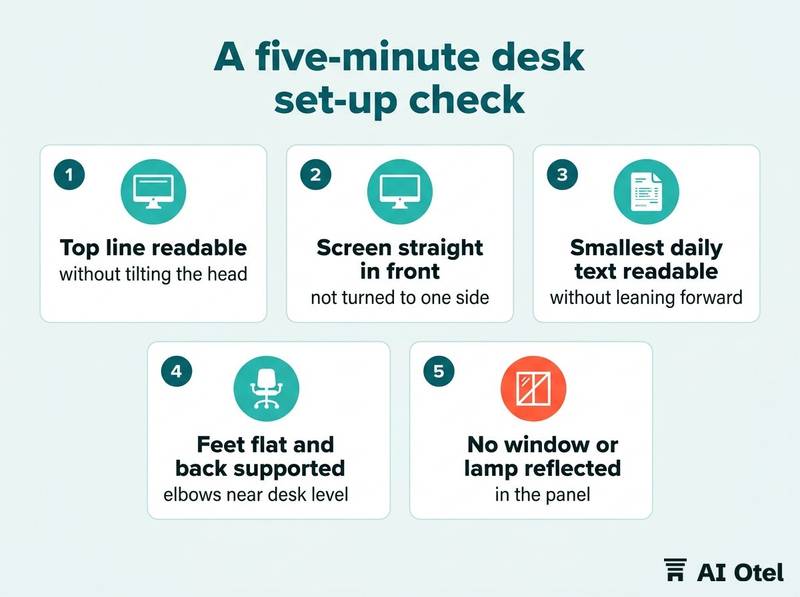
Five checks, done by the person who actually sits there, once a month and after any change of desk, screen or shift pattern. The person adjusts the chair, the screen and the document stand; a maintenance ticket handles the glare, the lighting and the desk. Behind a lobby glass wall, reflection is the usual culprit, and the fix is a blind or a different screen position.
ChecklistRun through this list, one item at a time
- Top line of the screen readable without tilting the head
- Screen straight in front, not turned to one side
- Smallest daily text (a rate line, a folio total) readable without leaning forward
- Feet flat and back supported, elbows near desk level
- No window or lamp reflected in the panel
- Keyboard, mouse and phone within reach without stretching the shoulder
- Document stand in use for passport scans and folios
Report glare, lighting and desk faults as a maintenance ticket.
Records, training and where the regulation stops
The paper trail is what makes the other duties real: the role list, the dated assessment, the examination record, the break plan and the training at the start.
Training belongs at the start of screen work and whenever the work changes: what the risks are, how to set up the desk, how to report a problem, and who to tell. Records to keep are the role list, the assessment with its dates, the examination invitations and the physician's records as the physician keeps them, the shift plan, and the maintenance tickets for lighting and furniture.
Revisit the assessment when the system changes, when a new screen or desk layout arrives, and when the shift pattern changes. A migration to a new property management system is a good trigger. The regulation adds to the hotel's general occupational health and safety duties; it does not replace the risk assessment, training and health surveillance that run across the property.
This article does not summarize the regulation's annex, which holds the detailed technical requirements. Read it with your safety expert before you sign off a desk layout or a shift plan, and confirm dates, penalties and your own case with your legal adviser. Where the text stops, the practice starts: the assessment, the physician's interval and the shift plan are the hotel's own documents, and they are what an inspector or a new manager will actually read.
What to do next
Take the front office and reservations rosters, mark which jobs are screen work, and hand that list to your safety expert together with the current risk assessment. Everything else follows from that one document: the workplace physician sets the eye examination interval from it, the break and rotation plan is written against the peaks it describes, the cost of the measures stays with the hotel, and the five-minute desk check has something to check against.
Frequently asked questions
Does the display screen regulation apply to a receptionist who also walks the floor?
The duties attach to the work done at the screen, not to a job title. A mixed role is still screen work for the part of the shift spent at the screen, and the hotel records which roles it treats that way in the risk assessment. The walking and standing help with rotation, but they do not remove the duty to plan breaks.
How often must the eye examination be repeated?
The regulation sets three triggers: before the work starts, when vision difficulties appear, and at regular intervals. The regular interval is set by the workplace physician from the risk assessment, so there is no single number that applies to every hotel or every role.
Can the hotel ask the employee to pay for the eye examination?
Article 5(2) says the cost of the measures taken under the regulation cannot be passed on to employees, and the examination is one of the regulation's measures. Where a specific purchase such as corrective lenses sits is not settled by the article, and that is a question for the workplace physician and your adviser.
Is a screen break the same as the rest break in the labor law?
No. The screen break is a health measure planned around the work under Article 7, while the labor law's rest breaks are a separate entitlement. A hotel should not count one as the other, and the shift plan should show both.
What can a hotel do when the desk cannot be left?
Coverage is part of the plan, not an excuse to skip it. Cross-train a second person, place the rotation in the quiet window the occupancy pattern gives you, or rotate to a task that keeps the person at the desk but off the screen, such as greeting arrivals, preparing key cards or filing.
Sources
- Ekranlı Araçlarla Çalışmalarda Sağlık ve Güvenlik Önlemleri Hakkında Yönetmelik, Madde 5 (opens in a new tab)Çalışma ve Sosyal Güvenlik Bakanlığı / mevzuat.gov.trmevzuat.gov.tr
- Ekranlı Araçlarla Çalışmalarda Sağlık ve Güvenlik Önlemleri Hakkında Yönetmelik, Madde 9 (opens in a new tab)Çalışma ve Sosyal Güvenlik Bakanlığı / mevzuat.gov.trmevzuat.gov.tr
- Ekranlı Araçlarla Çalışmalarda Sağlık ve Güvenlik Önlemleri Hakkında Yönetmelik, Madde 7 (opens in a new tab)Çalışma ve Sosyal Güvenlik Bakanlığı / mevzuat.gov.trmevzuat.gov.tr