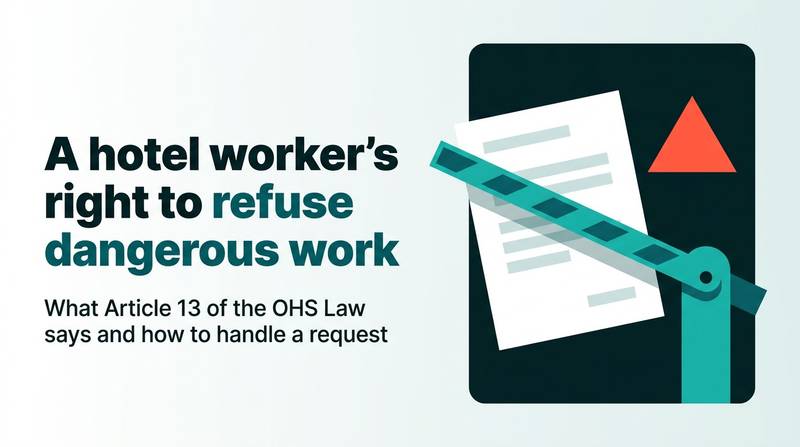
A hotel worker's right to refuse dangerous work: what Article 13 of the OHS Law says and how to handle a request
Article 13 of the OHS Law lets workers refuse dangerous tasks while keeping pay. This guide explains the legal text, the hotel's immediate steps, and a simple form to handle requests.
AI draft · awaiting editorial review
Contents
Key takeaways
- Article 13(1) of Law No. 6331 sends a worker's request to the health and safety board, or to the employer where there is no board (mevzuat.gov.tr, Law No. 6331, Article 13, 2026).
- The request asks for two things only: that the situation be established, and that measures be decided.
- Article 13(2) preserves the pay and other rights of a worker who abstains from the work until the measures are taken (mevzuat.gov.tr, Law No. 6331, Article 13, 2026).
- The employer's first move is to stop the task and write the request down, not to argue about whether the danger was serious enough.
- A one-page form with a request half and a decision half turns a rare, tense conversation into a routine the hotel can repeat.
Article 13 of the Occupational Health and Safety Law (No. 6331) lets a worker facing serious and imminent danger ask the health and safety board, or the employer where there is no board, to establish the situation and decide measures. While abstaining until those measures are taken, the worker keeps pay and other rights (mevzuat.gov.tr, Law No. 6331, Article 13 (opens in a new tab)).
A housekeeping supervisor opens the service lift door and finds the cage stopped half a floor below, doors open, a cart already half inside. She says she will not use it. What happens in the next hour depends on a routine the hotel either has or does not have. This article explains the right to refuse dangerous work in Türkiye under Article 13, and gives you the routine: who receives the request, what is decided, what goes in the minutes, and what happens to pay while the worker waits.
What does Article 13 of the OHS Law say, in plain words?
It gives a worker who faces serious and imminent danger the right to ask for the danger to be established and for measures to be decided, and it protects pay while the worker abstains.
The right belongs to the worker facing the danger, not to the manager, the safety expert or the employee representative. The request goes to the occupational health and safety board; where the workplace has no board, it goes to the employer. What is asked for is narrow: that the situation be established, and that measures be decided. It is a request for a decision, not a resignation from the task.
The article's text does not list which situations count as serious and imminent danger. The judgment is always about a specific task, a specific place and a specific moment, which is why the hotel's answer has to be written down. The second paragraph of the article carries the protection: while abstaining from the work until the measures are taken, the worker's pay and other rights under the law and the employment contract are preserved.
This article does not cover penalties, court outcomes, or whether a worker may leave the workplace. Those sit outside the text of Article 13 and outside this piece.
Key pointArticle 13 in two lines
Article 13(1): a worker facing serious and imminent danger applies to the board, or to the employer where there is no board, to have the situation established and measures decided. Article 13(2): during the abstention, pay and other rights are preserved. Source: mevzuat.gov.tr, Law No. 6331, Article 13 (2026).
Which hotel situations might qualify, and which probably do not?
Situations where one named task could injure someone in the next minutes or hours are the ones to treat as candidates; staffing and workload complaints are a different problem with a different answer.
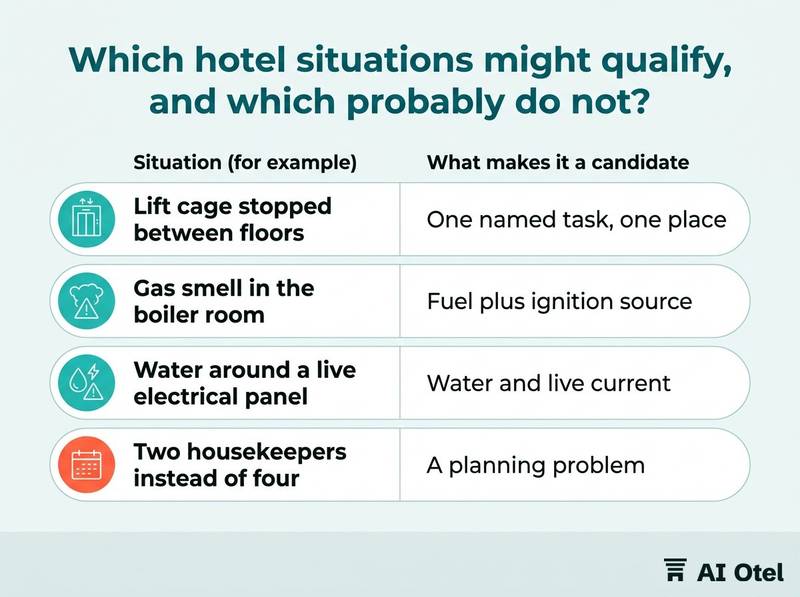
The pattern in a hotel is usually a task about to start: a lift about to be loaded, a burner about to be lit, a panel about to be opened. For example, a service lift whose cage is stopped between floors with the doors open, and a cart being pushed in. For example, a gas smell in the boiler room while a technician is preparing to light the burner. For example, standing water around a live electrical panel in a basement corridor after a pipe leak.
Contrast that with a Saturday with two housekeepers instead of four. That is a workload and planning failure, handled through the roster, the risk assessment and the department checklist, not through Article 13. Our department-by-department occupational health and safety checklist for hotels covers the planning side.
A test a manager can apply in the moment: is there a specific task, a specific place, and a harm that could arrive before any measure can be arranged? If yes, stop the task first and discuss the label afterwards. Housekeeping and laundry often produce the borderline cases, because the harm there is gradual rather than sudden; those belong in a manual handling review for housekeeping, laundry and stewarding rather than in a refusal.
| Situation (for example) | What makes it a candidate | First move |
|---|---|---|
| Lift cage stopped between floors, doors open, cart being loaded | One named task, one place, harm possible within minutes | Take the lift out of service, tag it, call the lift contractor |
| Gas smell in the boiler room before ignition | Fuel plus ignition source, harm before any measure can be arranged | Shut the gas valve, ventilate, keep people out, call the gas fitter |
| Water around a live electrical panel after a leak | Water and live current in the same place | Isolate the circuit, barricade the corridor, call the electrician |
| Two housekeepers instead of four on a Saturday | A planning problem, no single task with immediate harm | Fix the roster and the risk assessment |
Who receives the request in a hotel, and who decides when there is no board?
The health and safety board receives it where one exists; where there is none, the employer receives it and decides, so the hotel should name the person who receives it before anything happens.
Where a board exists, it is the body that receives the request. Whether a given hotel has a board at all is a separate question, and one to confirm with your legal adviser; our piece on employee representatives and the health and safety board in a hotel covers it.
Where there is no board, the request goes to the employer. Name a receiver and a deputy in advance, usually the technical service manager and the HR lead, so a request at 23:00 does not wait for the morning. The safety expert gives an opinion on the situation and on the measure; the expert does not replace the employer's decision, and a part-time contract needs a phone number that answers between visits.
Record who received the request, at what time, and which task was stopped. The time matters more than the wording. Tell the employee representative at the same time as the worker; a request handled quietly is the one that becomes a dispute.
ChecklistName these before the next shift
- The receiver by name, and a deputy
- A phone number that answers outside office hours
- The person who keeps the minutes
- The employee representative to be informed
- The safety expert's contact for an opinion
- Where the blank form is kept, at the technical service office and at the front office
If the answer is yes: measures first, and pay stays the same
Isolate the danger, decide and apply the measure, then let work resume; during the abstention the worker's pay and other rights continue.
The order is fixed: isolate the task first (lock the panel, close and tag the lift, shut the gas valve), then decide the measure, then resume. Deciding before isolating leaves people standing next to the hazard. On pay, Article 13(2) preserves the worker's pay and other rights under the law and the employment contract for the period of abstention (mevzuat.gov.tr, Law No. 6331, Article 13 (opens in a new tab)).
Write the minutes: the situation as found, the measure chosen, who applied it, at what time, and who checked it afterwards. Set a review date, because a temporary barrier or a handwritten warning sign becomes permanent by accident, and the next request about the same place will be harder to answer. Tell the worker and the employee representative in writing on the same day, with the review date in the note. Where the situation also triggers the hotel emergency plan, the two records should agree on times and names.
Watch outThree things not to do while the worker abstains
Do not deduct the hours from pay or from a bonus. Do not mark the day as absence or force annual leave. Do not ask the worker to make up the time on another shift. Each of these contradicts Article 13(2) and turns a lawful request into a wage dispute.
If the answer is no: what can the worker do next?
The worker can put the request again when the facts change, raise it through the employee representative or the safety expert, and take it outside the hotel to the labor inspectorate or a lawyer.
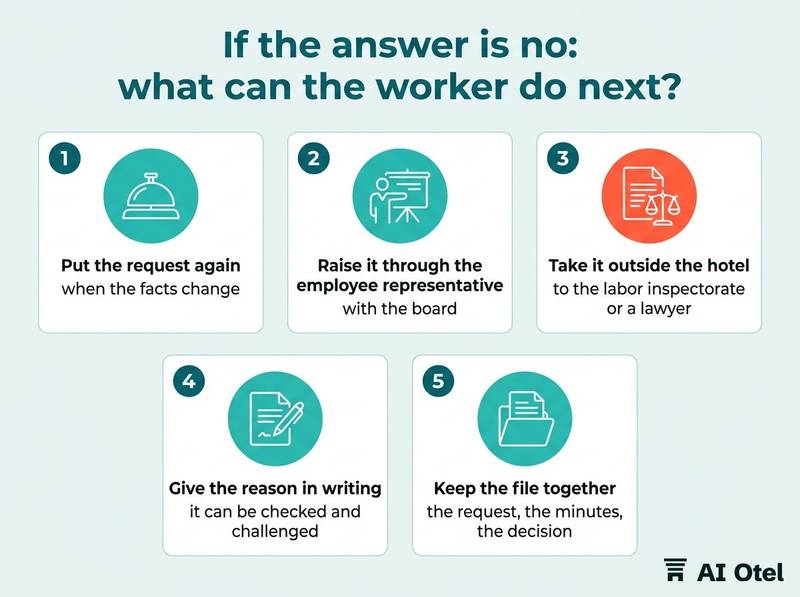
Give the reason for a refusal in writing. "No danger" is not a reason; "the panel was tested dead at 14:20 by the electrician on duty" is one, because it can be checked and challenged. The worker may repeat the request when the facts change, and the earlier record stays in the file; two requests about the same place are evidence about the risk assessment, not about the worker.
The employee representative can raise the matter with the board, and the safety expert can record a dissenting opinion in the minutes. Outside the hotel, the routes are the labor inspectorate and, for the individual case, a lawyer. This is where the text of Article 13 stops, and where you should confirm your own case with a legal adviser.
Do not treat a request as insubordination by default. A refusal handled as misconduct creates a second, larger problem on top of the first. Keep the file together: the request, the minutes, the decision, the correspondence and the review note.
What goes on a one-page request and decision form?
One page with a request half and a decision half is enough to make the routine repeatable and to leave a record that survives a change of manager.
The request half holds the date and time, the worker's name and department, the task, the place, what the worker saw, and which work stopped. The decision half holds who received it, who decided, the measure, who applied it, the time work may resume, and the review date. Add signature lines for the worker, the receiver and the employee representative; a form nobody signs is a note, not a record.
Keep printed copies where the work happens, at the technical service office and the front office, and scan the completed page into the personnel file the same day. Put the review date into the maintenance calendar rather than into someone's memory, and close it with a second signature when the measure is confirmed. Read the forms once a quarter: a repeated request about the same lift or the same corridor means the risk assessment no longer describes the building.
ChecklistForm fields, in order
- Date and time
- Name and department
- Task
- Place
- What was seen
- Work stopped
- Received by
- Decided by
- Measure
- Applied by, and at what time
- Work may resume at
- Review date
- Signatures of worker, receiver and employee representative
What to do next
Write the one-page form this week and name the person who receives it, so that the next request is answered by a routine rather than by whoever is on duty. The pieces fit in one order: receive and stop the task, decide at once, write the minutes, tell the worker and the representative in writing, keep pay unchanged, and check the measure on the review date.
Frequently asked questions
Can a hotel deduct pay for the hours a worker refused to work?
No. Article 13(2) preserves the pay and other rights of a worker who abstains until the measures are taken (mevzuat.gov.tr, Law No. 6331, Article 13, 2026). Deducting the hours, marking them as absence or forcing annual leave contradicts that sentence and turns a safety request into a wage dispute.
Does the request have to be in writing?
Article 13(1) does not set a form for the application; it sets the recipient and what is asked for. In practice the hotel should write it down at the moment it arrives, because the written record is what shows the situation was established and a decision was taken. A worker's spoken request should be turned into a written one by the receiver, not sent away.
What if the hotel has no health and safety board?
The request goes to the employer, who decides. Whether a particular hotel has a board is a separate question, and one to confirm with your legal adviser. The practical step is the same either way: name a receiver and a deputy in advance.
How quickly must the hotel answer?
Article 13(1) describes the application and the decision, not an hour count, so no deadline should be quoted from it. The working rule is to stop the task and decide at once, because the situations that reach this article are the ones where harm could arrive before a meeting can be arranged. Confirm any timing question with a legal adviser.
Can the worker simply go home?
The right in Article 13 is to abstain from the work until measures are taken, with pay and other rights preserved. Whether a worker may leave the workplace in a given case is not answered by the text quoted here, and this article does not advise it; that question belongs with a lawyer who can see the contract and the facts.
Sources
- İş Sağlığı ve Güvenliği Kanunu (Kanun No. 6331), Madde 13 (opens in a new tab)Türkiye Büyük Millet Meclisi / mevzuat.gov.trmevzuat.gov.tr
- İş Sağlığı ve Güvenliği Kanunu (Kanun No. 6331), Madde 13 (opens in a new tab)Türkiye Büyük Millet Meclisi / mevzuat.gov.trmevzuat.gov.tr