Software support words for hotel teams: ticket, severity, workaround, escalation and more
Understand key hotel software support terms like ticket, severity, and escalation. Learn how to write effective support messages and manage vendor expectations.
AI draft · awaiting editorial review
Contents
Key takeaways
- Severity belongs to the hotel because it describes impact; priority belongs to the vendor because it describes queue order, so argue the first and read the second in your contract.
- A workaround restores the job, a fix removes the cause, and a root cause is the reason found afterward; only the first two end a ticket.
- Response time is when a person acknowledges the ticket, resolution time is when the problem is gone, and a contract that names only one of them leaves the other open.
- Escalation is a documented request for more authority or skill, not a louder phone call, and it works when it carries the ticket number, the timeline and the impact.
- One ticket, one problem, one named contact at the hotel: a message with those three things is answered faster than five messages sent in panic.
A support ticket is a numbered record of one problem, kept by the vendor until it is closed. Severity describes how badly the hotel is affected; priority is the order the vendor works in. A workaround restores the job without fixing the cause, and escalation moves the ticket to someone with more authority. These software support terms decide how fast a hotel problem is solved.
It is 06:40, the first airport transfer is at the desk, and the system will not assign a room. Someone calls the vendor, and the two sides spend the first ten minutes discovering that they mean different things by the word urgent. This article fixes that. After reading it, your desk will have one page of shared words, a message template, and a severity rule you wrote yourself, so the next call starts with facts instead of definitions.
What is a support ticket, and what should one contain?
A support ticket is a numbered record of one problem, opened with the vendor and kept open until both sides agree it is closed. The number is your receipt: it is how you follow the problem, hand it to the next shift and prove later what was reported and when.
Hotels mix up three words. A ticket reports something broken, a request asks for a change or a new user, and a case is simply the vendor's word for the same record. Ask your vendor which word its portal uses and use that one everywhere, including in your own log.
One ticket should carry one problem. A message that lists a printer fault, a wrong rate and a slow report produces one thread nobody can close, and the printer fault disappears inside it. Report the impact in guest terms, not software terms: not "the reservation screen is broken" but "we cannot assign rooms, four guests are waiting, check-in is blocked".
Give the exact text of the error message or a screenshot, with the time it happened and the name of the person logged in, because vendors search by message text. Say what you already tried, including the restart, the second browser and the second computer; it stops the first reply being a request to do exactly that.
Never let a ticket close on "it works now". Ask for one line on what was changed, because the same change is what your team will need next month. Keep a paper or shared support log at the desk with ticket number, time opened, time closed and who owns it, so the night shift inherits facts instead of rumors.
Ticket, case and request: three words, three jobs
ChecklistWhat every ticket should carry
- Property and outlet
- Date and time of the fault
- The person and the screen where it happened
- The exact message text or a screenshot
- What the guest was trying to do
- How many guests, rooms or bills are affected
- What you already tried
- A named contact and a callable number at the hotel
Severity and priority: why do they differ?
Severity measures how badly the hotel is affected; priority is the order in which the vendor will work. They are set by different people, which is why a hotel can argue about severity and can only read priority in the contract.
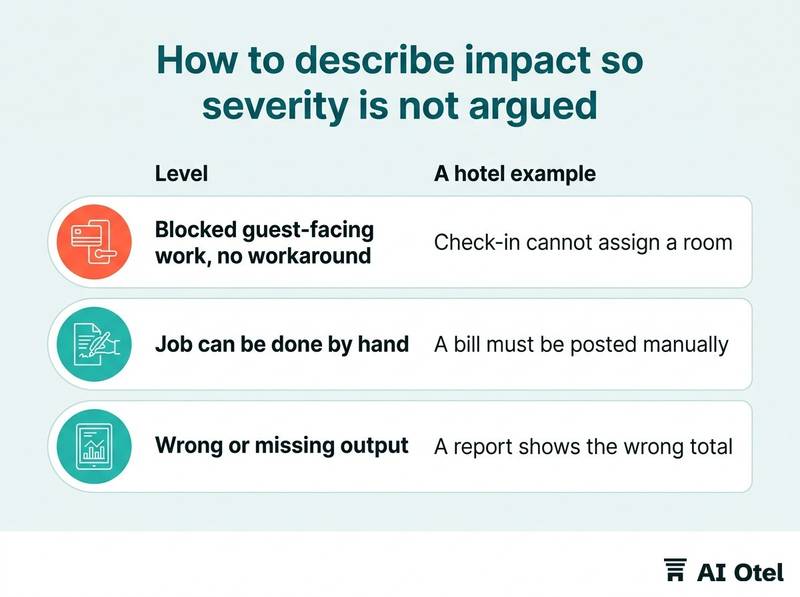
Severity is a description of impact: is a guest-facing job blocked, is there a workaround, how many people are affected, and does it touch money or a legal record. The hotel knows this better than the vendor does, so state it plainly. Priority is a queue position: it comes from the vendor's rules and from what your contract promises, and it changes with how many other tickets are open that morning.
Severity creep is the real enemy. If every ticket is opened as critical, the word stops carrying information and the vendor's queue quietly ignores it. Keep critical for blocked guest-facing work with no workaround. Severity can move in both directions: it rises when a workaround fails, and falls once a workaround holds and the fault becomes an inconvenience rather than a stoppage.
Write your own short severity rule for the desk, for example one level for a blocked check-in, one for a wrong number that can be corrected by hand, one for a cosmetic or reporting issue. Label it as your house rule, not as an industry standard. When you disagree with the severity the vendor assigned, reply in the ticket with the impact and ask for it to be re-rated, so the change is visible to whoever reads the thread later. If the fault blocks a cloud system entirely rather than one screen, a front desk checklist for internet outages is the companion piece to the ticket.
How to describe impact so severity is not argued
| Level | A hotel example (for example) | What the desk does meanwhile |
|---|---|---|
| Blocked guest-facing work, no workaround | Check-in cannot assign a room | Call and open a ticket |
| Job can be done by hand | A bill must be posted manually | Log the manual step for the night audit |
| Wrong or missing output | A report shows the wrong total | Note it for the next review |
What is a workaround, and when should you accept one?
A workaround lets the hotel finish the job without fixing the cause, while a fix removes the cause itself. Accept a workaround when it stops guest impact, and only when it is written down and has an end date.
Ask three questions before accepting one: what exactly do we do, who does it, and when will the real fix arrive. A workaround without those three answers becomes the process. Write the steps into the shift handover, not into somebody's memory, because the night shift, the weekend team and the new receptionist all need the same text.
Name the cost out loud: double entry, manual posting, a second check of the same bill. That cost is the argument for chasing the fix. Ask what the workaround does not cover: a manual room assignment may work at the desk and still leave the online inventory wrong, which is a different problem tomorrow.
If the workaround touches money, an invoice or a guest identity notification, agree in writing who signs it off at the hotel before the shift uses it. Set a review date in your own calendar, and reopen the ticket if the fix has not arrived by then. A workaround with no review date is a permanent change nobody approved. For faults that keep coming back at the desk, a daily fault routine for front desk printers shows how to log them so the ticket has evidence.
Workaround, fix and root cause in one line each
Watch outThe workaround that becomes the routine
The most expensive workaround is the one that quietly becomes the routine: manual room assignment, a second spreadsheet, a printed list taped to the monitor. These survive long after the fault is fixed. The review date is what stops them.
Escalation: who, when and how?
Escalation means moving a ticket to someone with more authority or more skill, inside the vendor or inside your own hotel. It is a documented request, not a louder call, and it works when it carries the facts the first responder already has.
Know the two kinds: technical escalation, where a second-line engineer takes over, and management escalation, where a person with authority over the queue or the contract gets involved. Ask for the one you actually need. Write your own triggers for the desk, for example: guest impact continues past a set number of hours, no workaround exists, the same fault returns three times, or the promised update never came.
Send the escalation inside the ticket, not beside it. Paste the ticket number, the timeline of what happened and when, the guest impact, what you need and by when. Ask for two things every time: a named owner and the time of the next update. Without a next update time, escalation just changes who is silent.
Escalate one level at a time, and say what you want fixed rather than how angry you are. Vendors triage by clarity, and a clear ask travels faster than a complaint. Tell your own team who is allowed to escalate, so the general manager is not called for a printer and the desk is not left waiting on a blocked check-in. Keep the escalation in the record even after it is solved, because the next contract conversation is easier with a list of what had to be escalated.
What to write in an escalation message
TipFive lines an escalation needs
Ticket number. One sentence of impact. A short timeline with times. The specific request. The time by which the hotel needs an answer or an update.
If the dispute is really about what the contract promised, the surrounding vocabulary is explained in SLA, response time, RTO and RPO in hotel software contracts.
Response time versus resolution time: which one is promised?
Response time is when a person acknowledges the ticket and starts work; resolution time is when the problem is gone. They are separate promises, and many contracts name only the first.
A response is not a solution. "We are looking into it" can satisfy a response promise while the desk is still assigning rooms by hand. Ask the vendor to define what counts as resolution for each severity: a fix, or an accepted workaround. Otherwise the ticket closes when the vendor is tired, not when the hotel is whole.
Ask about the update cadence as well, meaning how often you hear something while the ticket is open. This is the term that decides whether your shift can plan. Measure it yourself from your support log: time opened, first human reply, workaround in place, closed. Your own dates are the only evidence you control.
Read the contract for what happens when a promise is missed, and take that question to the vendor before signature rather than after the first bad night. Keep the same vocabulary in the contract and at the desk: if the contract says response time, the desk should not report it as resolution time to the general manager. Before signing anything, the questions to ask a hotel PMS vendor cover these promises alongside price and features.
The four times worth writing down
| Term | What it measures | What to check in your contract |
|---|---|---|
| Response time | First human acknowledgment | Does the clock run overnight and at weekends? |
| Update cadence | How often you hear something while open | Is a frequency promised per severity? |
| Workaround time | When the hotel can work again | Is this promised at all? |
| Resolution time | When the cause is gone | Is resolution defined as fix or accepted workaround? |
What should a model support message from the front desk look like?
A short message with six fixed lines gets a faster, more useful answer than a long description, because it hands the vendor the impact, the evidence and the deadline in the same place.
Line one: property, outlet and the ticket number if one exists. Line two: what the guest was doing and what happened instead. Line three: when it started, with the time, and whether it is still happening. Line four: how many guests, rooms or bills are affected right now. Line five: what you already tried, in the order you tried it. Line six: what you need and by when, plus the name and number of the person on shift.
Attach the screenshot or the exact message text, and avoid internal shorthand that only your hotel understands. Send it once, complete, rather than in five fragments, because fragments arrive out of order and reset the vendor's reading of the problem. Write in short sentences and plain words, especially if the message crosses a language: numbers, times and screen names travel better than idioms.
A template to copy
NoteSix-line template for the desk
1. Property, outlet, ticket number (if any). 2. What the guest was doing, and what happened instead. 3. Time it started, and whether it is still happening. 4. Guests, rooms or bills affected right now. 5. What we already tried, in order. 6. What we need and by when, plus contact name and number.
What to do next
Write one page of house rules this week: define ticket, severity, priority, workaround, escalation, response time and resolution time in your own words, add the six-line message template, and use that page for the next twenty tickets. The glossary only pays off when both sides of the phone call are using the same words, and the hotel is the side that can fix that first. If you are evaluating new software at the same time, the pages on a hotel operating system and on how a vendor documents trust and support show what to look for in the vendor's own wording.
Frequently asked questions
What does severity 1 mean in hotel software support?
The label itself is defined by the vendor and the contract, not by a common standard. Hotels usually mean a blocked guest-facing job with no workaround, for example check-in that cannot assign rooms. Ask the vendor to write the definitions of each level into the contract or the support page before signing.
Should I reopen a closed ticket or open a new one?
Reopen when it is the same fault returning within the window your vendor allows, because the history is already there. Open a new ticket when the symptom, the screen or the affected job is different, and reference the old ticket number in the new one so the link is visible.
What is a root cause analysis and does a hotel need one?
It is a short written explanation of why the fault happened and what changed to prevent it. A hotel does not need one for every ticket, but it is worth asking for on repeated faults and on anything that blocked check-in. Keep it in the same file as the contract.
Who at the hotel should be allowed to open support tickets?
Name a small number of people per shift, with one owner per ticket, so the vendor hears one clear voice and the desk does not duplicate reports. Give the night shift the same right as the day shift, since check-in problems can arrive when the office is empty.
How do I write a support ticket when my team's English is limited?
Use short sentences, exact times, screen names copied from the software, and a screenshot. Avoid idioms and internal abbreviations, and put the impact in the first line. A clear plain message in simple English is read faster than a long formal one.