The duty manager's shift log: what to write, who reads it and what becomes an action
A duty manager shift log is a one-page record that turns shift notes into checked actions. This guide explains the seven fixed fields, how to write lines that name an owner and a due time, and how the general manager reads and signs the log in two minutes.
AI draft · awaiting editorial review
Contents
Key takeaways
- A shift log is a page of decisions, not a diary: every line either names an owner and a due time or is deleted.
- Name a person, not a department, because a department cannot be asked why the action did not happen.
- An incident line must survive the shift; an information line should expire with it.
- The general manager's signature means seen and decided, not that every line was correct.
- The log holds personal data, so who may read it and how long it is kept are the hotel's own written rule, confirmed with counsel.
A duty manager shift log is a one-page record, written once per shift in a fixed order, of arrivals at risk, rooms out of order, guest incidents, staff issues, money and safety notes. Each line names an owner and a due time, so the next shift acts on it and the general manager can read it in two minutes.
At 23:40 a guest is told the room will be ready by ten. At 07:00 the next front desk has no idea who said it, to whom, or what was promised. The information existed; it simply had nowhere to live. This article gives that information a home: a one-page log with fixed fields, a way of writing lines that turn into actions, and a reading routine for the general manager that takes two minutes.
Why does a spoken handover lose details?
A spoken handover carries what the outgoing person remembers at the end of a long shift, filtered through attention and fatigue, and it leaves nothing the next shift can check against. The hotel day is three handovers, and each one passes through two memories: the teller's and the listener's. Detail drops at both ends.
Speech also does not separate a decision from an observation. "The guest was angry" and "we promised a late checkout" sound the same when spoken, and only one of them commits the hotel. When a guest later says "someone promised me", there is no record to compare the claim against, so the hotel either honors a promise it cannot confirm or denies one it made.
Spoken handover is genuinely good at mood, warnings and the shape of the night ahead. It is bad at commitments, money and safety, which are exactly the things that need a written line. The fix is not a longer meeting. It is a fixed page that the spoken handover then walks through, field by field, in the same order every time, much as a front desk shift handover checklist: cash, arrivals and promises does for the desk team. A written log also protects the duty manager: a timed, dated, signed line records what the hotel knew and when.
What fields belong on a one-page duty manager log?
Seven fixed fields, always in the same order, so that a reader's eye learns where to look and a writer cannot quietly leave one out. Fixed order matters more than the exact fields. The general manager reads the same place every morning, and a missing field is visible as a gap rather than hidden in prose.
| Field | What goes in it | What it must not become |
|---|---|---|
| Arrivals at risk | Unassigned arrivals, late arrivals, unconfirmed requests | A copy of the arrivals list |
| Rooms out of order | Room number, reason, who is fixing it, expected return to sale | A maintenance ticket duplicated in full |
| Guest incidents | What happened, what was done, what is open | An opinion about the guest |
| Staff issues | Fact, time, action taken | A personality note |
| Money and safety | Cash differences, voids, keys, fire panel, law-enforcement visits | A second night audit |
| Carried forward | Open items with status | A growing list with no closing date |
| Signature and time | Who wrote it, when the shift ended | A blank box |
Staff issues cover absence, lateness, an injury, a dispute, a training gap. Record the fact and the time, not a judgment about the person. Money and safety covers cash differences, voids, a safe left open, a key card not returned, a fire panel fault, a visit from law enforcement. The same fixed-page idea extends beyond the desk, as in shift handover forms for kitchen, floors, technical and security; the duty manager's page is the one that ties them together.
How do you write a line that becomes an action?
A line becomes an action when it names a person, a verb and a clock time, and when the next shift writes the outcome on the same line. Subject, verb, object. "Housekeeping to re-clean 412" is not an action. "Ayşe, housekeeping: re-clean 412 by 09:00" is, because it can be checked and it can be late.
Name a person, not a department. A department cannot be asked why the action did not happen, and a name creates a conversation instead of a search. Use a clock time. "In the morning" and "as soon as possible" both mean nobody is late, which means nobody is responsible.
Keep the observation and the instruction apart: one line for what happened, one line for what must now happen. Merging them produces a sentence that is neither a record nor a task. If you cannot name an owner, do not invent one. Write the line as an open decision for the general manager, which is honest and gets it resolved the next morning.
Close the loop. The next shift writes the outcome on the same line, so lines end instead of accumulating down the page for a week. Keep the page short. Forty lines have no priorities; twelve lines with owners can be worked through. This is the same discipline that makes a front desk supervisor's shift work: the person running the shift owns what the page says.
The action test
ChecklistApply these six checks to every line before the shift ends
- Does it name one person?
- Does it start with a verb?
- Does it carry a clock time, not a part of day?
- Can the next shift tell whether it was done?
- Is the observation kept separate from the instruction?
- If it has no owner, is it marked as a decision for the general manager?
What is the difference between an incident line and an information line?
An incident line records something that carries risk and must survive the shift; an information line gives the next shift context and should expire with it. Incidents include an injury, a complaint that carries a demand, damage, theft, a safety fault, a cash difference, a visit from law enforcement, a question about guest data. Information includes a VIP in house, a group arriving at 06:00, a lift out of service, a wedding that will be loud until midnight.
Information lines need a date so they expire. An undated information line becomes folklore that the next three shifts repeat. Put incidents at the top of the page. Information lines are numerous and will crowd out the two lines that matter if they are allowed to sit above them. Neither kind of line carries a conclusion about a person. Write what happened and when; the judgment belongs in a conversation, not in a document that outlives the shift.
Key pointThe three-month test
Before filing a line, ask: would this still matter if a claim arrived in three months? If yes, it is an incident: it goes to the top of the page with an owner, a due time and a note of what the guest was told. If no, it is information: date it and let it expire with the shift.
How does the general manager read and sign the log in two minutes?
Open items first, incidents second, everything else last, and the signature means seen and decided rather than correct in every detail. The writer sorts, not the reader. Carried-forward items sit at the top with their status, so the general manager starts with what is still unfinished.
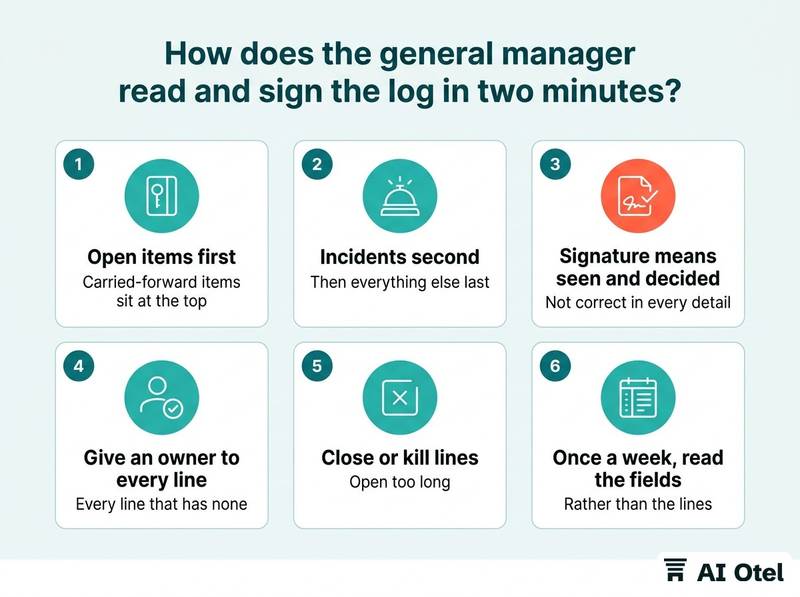
Two minutes is a design target. If the read takes longer, the page is carrying information that belongs in a department's own file. The signature means "seen and decided". It does not certify that the night was handled well, and treating it that way makes duty managers write defensively.
The general manager's real work in those two minutes is to give an owner to every line that has none, and to close or kill lines that have been open too long. A line that has survived three shifts is a management problem, not a shift problem. It usually needs money, a rota change or a supplier, none of which a duty manager can decide alone.
Once a week, read the fields rather than the lines. A fault that appears every night is a maintenance decision; a gap that appears every weekend is a staffing decision. Write the reply on the page. A short written answer is what teaches the next duty manager which lines were worth writing. The log also feeds the wider routine: the open items and the recurring faults are the natural agenda of the daily operations meeting for heads of department.
TipThe two-minute read
Read in this order: carried-forward items with status, then incident lines, then rooms out of order and arrivals at risk, then information lines, then sign. On the way, give every unowned item an owner or close it.
Paper or system, how long do you keep logs, and who may see them?
Paper works and a system wins on search and on carrying lines forward; retention and access are the hotel's own written rule, because the log holds personal data. Paper is fast, needs no training and survives a power cut. It is weak on search, on carrying an open line into tomorrow, and on reading a month later. A system timestamps each entry and keeps open items in front of the next shift. It needs a device at the desk and a rule about who may type into it. The middle option is a fixed template in a shared document, one file per month, with the same seven fields and the same order.
Retention is a hotel decision, not a fixed number. A common practice is to keep a rolling period long enough to answer a guest complaint or an insurance question, then archive the rest. The log holds personal data: guest names, staff names, sometimes health details. Under KVKK (the personal data protection law), access, retention and any sharing are set in the hotel's own written rule and confirmed with counsel.
Keep the circle small: duty managers, the general manager, and department heads for their own lines. Not the whole staff, and not a shared drive open to everyone. A hotel operating system that keeps reservations, front desk and housekeeping records in one place (the system: built, ahead of launch) puts a room's own history in the same place as the day's front desk work. The wider platform overview (the overview: built, ahead of launch) shows how these records connect to reporting and compliance.
Watch outWhat never goes in a log line
Card numbers, identity numbers, health details and conclusions about a named person. Write instead a reference to where the detail is properly kept, plus the time and the action taken. Access and retention are the hotel's own written rule, confirmed with counsel.
What to do next
Write tomorrow's log on one page, in the seven fields, in the same order, and give every line an owner and a clock time before the shift ends. The pieces fit together in one direction: the spoken handover loses detail, the fixed page keeps it, the action line moves it, the incident line protects it, the general manager's two-minute read decides it, and the hotel's own written rule on access and retention holds it.
Frequently asked questions
What is the difference between a duty manager's log and the night audit report?
The night audit closes the business day and reconciles money and postings; the duty manager's log is the human record of the shift. They have different writers and different readers, and one does not replace the other. A cash difference appears in both, but the audit shows the amount and the log shows what was done about it and who owns the follow-up.
Who should sign the shift log?
The duty manager signs at the end of each shift with the time, and the general manager signs the next morning. The duty manager's signature says the page is complete; the general manager's says the open items have been seen and decided. Neither signature certifies that everything on the page was handled well.
How do you stop a shift log turning into a diary?
Apply the action test to every line before the shift ends: one person, one verb, one clock time, and a way to tell whether it was done. Lines that fail the test are either rewritten or deleted. A page that keeps growing without lines closing is a sign that the general manager is reading rather than deciding.
What should a duty manager do with a line nobody owns?
Mark it as an open decision for the general manager and leave it at the top of the page. Inventing an owner who cannot decide produces a line that quietly dies. Unowned lines usually need money, a rota change or a supplier, which is exactly the general manager's call.
Can the shift log be used when a guest complains later?
A dated, timed and signed line records what the hotel knew and when, which is worth more than anyone's memory of the night. Whether and how it is used in a dispute is a question for counsel. That is one reason access to the log is kept to a small group and retention is set in writing.