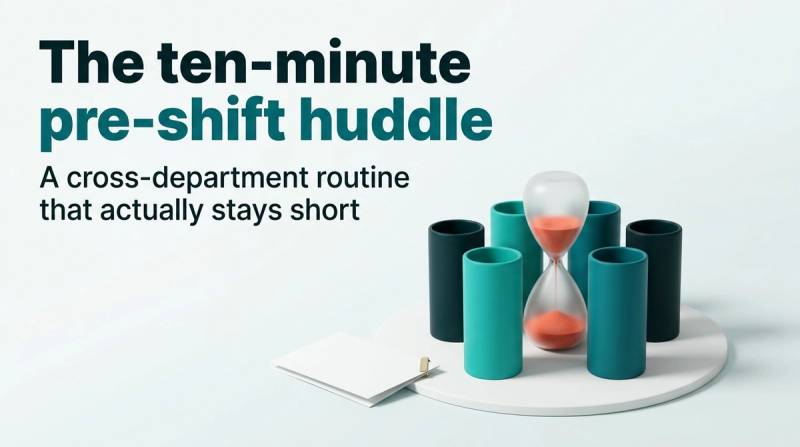
The ten-minute pre-shift huddle: a cross-department routine that actually stays short
A pre-shift huddle stays short when the agenda is fixed and everyone stands. This guide gives you a five-item routine, a speaking order, and a two-line record to turn daily talk into action.
AI draft · awaiting editorial review
Contents
Key takeaways
- A pre-shift huddle stays at ten minutes when the agenda is fixed to five items, everyone stands, and only decisions are written down.
- The supervisor on duty runs the huddle and speaks least; each department answers by name, in the same order, in one line.
- The standard of the day is chosen from yesterday's actual failure and stated as something a person can be seen doing.
- Two lines per decision in one place, what was decided and who owns it: a huddle that writes nothing decided nothing.
- Cancel the huddle rarely and never twice in a row; the replacement is a written note plus a two-minute stand-up at handover.
A pre-shift huddle is a standing, ten-minute meeting at the start of a shift where each department gives one line on today's arrivals, yesterday's failures, one standard and one safety point, and questions. It stays short because the agenda is fixed, everyone stands, and only decisions are written down.
It is 09:00. The desk is mid-handover, the kitchen is prepping, and the meeting that was meant to take ten minutes is on its twentieth with no decision written down. It did not fail because the team did not care; it failed because nobody fixed what it was for. This article gives you a pre-shift huddle for hotel teams that holds its length: a fixed five-item agenda, a speaking order, a way to choose the daily standard, and a two-line record that turns the routine into a loop.
What is a pre-shift huddle, and why does it have to be ten minutes?
A pre-shift huddle is a short standing meeting at the start of a shift, run by the supervisor on duty, where each department says one thing and the team leaves with the same picture of the day. Ten minutes is a container, not a target: it forces the agenda to stay fixed and the talk to stay operational.
Standing up is the mechanism, not the style. No chairs, no table, no coffee, because a huddle that sits down turns into a meeting. Same time, same place, every day: a huddle that moves around the building is a huddle people learn to skip.
The agenda is fixed and known in advance, so nobody prepares a speech and nobody decides on the day what to talk about. It is not the hotel's daily operations meeting for heads of department: that one is for decisions that cross the hotel, while this one is for the people who will do the work today.
Ten minutes holds about five items and one round of one-line answers. Anything that needs longer is a second meeting with its own time, not an extension of this one. The supervisor on duty owns it. When the general manager runs it, it becomes a reporting meeting and the front line stops talking.
Key pointThe one rule that keeps it short
Nothing is discussed in the circle that cannot be decided by someone standing in it. Anything else leaves with a name, a time and a place after the huddle.
What are the five fixed items on a ten-minute agenda?
Five items, always in the same order: today's arrivals and VIPs, what went wrong yesterday, one standard of the day, one safety point, and questions.
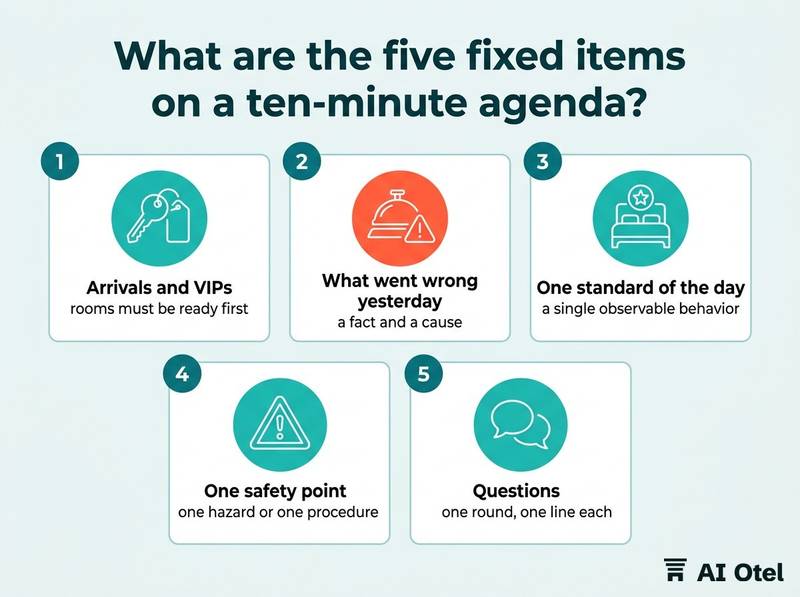
Arrivals and VIPs: the desk names the arrivals that need something special, and housekeeping hears which rooms must be ready first. What went wrong yesterday: one or two failures, stated as a fact and a cause, never as a person. One standard of the day: a single observable behavior, chosen from yesterday's failures so the huddle closes its own loop. One safety point: one hazard or one procedure, rotating by department so it is not always the same voice. Questions: one round, one line each, and anything needing a decision goes to a named person after the huddle, not into the circle.
The order never changes, because the order is what lets a supervisor run it from memory on a bad morning.
ChecklistA timed agenda card the supervisor can hold
- Arrivals and VIPs, 2 minutes
- What went wrong yesterday, 3 minutes
- One standard of the day, 2 minutes
- One safety point, 1 minute
- Questions, one line each, 2 minutes
- Close by reading back any decision in two lines
Who speaks, and who listens?
The supervisor on duty runs the huddle and speaks least. Each department speaks once, in the same order, and everyone else listens.
Every department is asked by name in a fixed order: front desk, housekeeping, kitchen, restaurant, technical, security, spa. Being asked by name is what stops a quiet department from disappearing. One line per department, and the supervisor's main job is to cut the second sentence without making the person feel cut.
The person closest to the problem speaks, not the manager of the person closest to the problem; the version from the floor is the one the others can act on. No debate: a disagreement that needs more than one exchange gets a name, a time and a place after the huddle.
Someone is named to write, and it is not the supervisor, whose hands are full. If nobody writes, nothing was decided. If the huddle happens near the desk, it stands two steps away from the counter so a guest never waits behind it.
How do you choose the one standard of the day?
Choose it from yesterday's actual failure, state it as something a person can be seen doing, and repeat it until it stops failing.
One standard, not a list. Three standards on a board is a poster; one standard repeated is a habit. Make it observable: "every key card is handed over with the room number said out loud" can be watched, while "improve the check-in experience" cannot.
Source it from the failure item two minutes earlier, so the team sees the link between what went wrong and what is being asked today. Rotate by department, so the kitchen and the floors get a standard as often as the desk does. Repeating the same standard for a week is evidence it is working, not evidence of laziness.
If the same standard keeps failing for a month, the fault is in the process or the training, not in the reminder, and it belongs in the training plan rather than in the huddle. Post it where people pass during the shift, not only where they stood at 09:00.
TipA test for a candidate standard
Can a supervisor watch for it once during the shift and answer yes or no without asking anyone? If not, it is a goal, not a standard.
What does each department bring to the huddle?
Each department brings one operational fact the others cannot see, and takes away the one thing it needs from another department. The value of a cross-department huddle is the exchange, not the reporting: a fact that stays inside one department is the fact that causes today's problem.
| Department | What it brings | What it needs |
|---|---|---|
| Front desk | Arrivals needing something; rooms not ready | A realistic room-ready time from housekeeping |
| Housekeeping | Blocked rooms; late departures; floor staffing | The list of which rooms are wanted first |
| Kitchen | Covers expected; a delivery that did not arrive | Changes to groups and functions |
| Restaurant and bar | A menu item that is out; terrace staffing | Arrival peaks and function times |
| Technical | The lift, the boiler, the pool pump | Which rooms to stop selling |
| Security | An incident; a lost key; a crowd expected | The desk's arrival peaks |
A department with nothing to say says "nothing today" in two seconds. Silence is not an answer, because the others cannot tell it apart from a missed problem. For the floors in particular, the housekeeping morning briefing checklist for supervisors pairs well with this round.
How do you record a decision in two lines?
Two lines: what was decided, and who owns it by when. Anything longer is a report, and reports do not get read.
One place, always the same one: the duty manager's shift log for anything that crosses departments, the department's own sheet for anything inside one. Two lines look like this: "Lift 2 out of order until Thursday; rooms 501 to 508 not sold. Owner: technical, confirmed by 14:00." For the wider frame of that document, see what the duty manager's shift log should contain.
No decisions, no lines. A huddle that writes nothing is fine when nothing was decided; a huddle that writes nothing every day is not deciding anything. The next huddle opens by reading yesterday's lines and closing them, which is what turns a routine into a loop.
A line still open after three days is no longer a huddle item; it moves up to the daily operations meeting with the reason it is stuck. Record the room, the time and the action, never a person as the problem. A log that names people stops being written honestly.
When should you cancel the huddle, and what replaces it?
Cancel it rarely and never twice in a row. When you must, replace it with a written note in the shift log and a two-minute stand-up at the handover.
Legitimate cancellations: a queue at the desk on a full house, an emergency, a fire drill, or a staff meeting already scheduled for the same morning. Not legitimate: "nothing to talk about today". That is exactly the morning the ten minutes earns its place.
The replacement is written, not remembered: the supervisor posts the five items as five lines before the shift starts, and departments read them at handover. Never cancel two days running. The routine dies on the second day, not the first, because the second day is when people learn it is optional.
The night team gets its own shorter version at its own start, since it never overlaps with the day; the bridge between the two is the written handover, not a shared meeting, and the shift handover forms for kitchen, floors, technical and security carry it. If the huddle keeps overrunning, cut an item rather than the time. Cutting the time teaches the team that the agenda is negotiable.
Watch outThe failure mode to watch for
A huddle that grows to twenty minutes, moves to an office, and becomes the meeting everyone already had. The symptom is chairs.
What to do next
Run it tomorrow with the five items, a clock and one page: arrivals and VIPs, yesterday's failures, one standard, one safety point, questions. Write down only what was decided, read those lines back at the next huddle, and leave the routine alone for two weeks before you change anything about it. The huddle earns its ten minutes by closing its own loop, not by being interesting.
Frequently asked questions
Should the general manager attend the pre-shift huddle?
By default, no. The huddle belongs to the supervisor on shift, and a GM in the circle turns it into a reporting meeting where the front line stops talking. If the GM does attend, they listen, speak last, and speak on one item only. Anything longer than a line belongs in the daily operations meeting.
How do we run a huddle when the night shift never overlaps with the day?
The night team gets its own shorter version at its own start, run by the night supervisor, with the same five items cut to the ones that matter at night. The bridge between the two shifts is the written handover, not a shared meeting. The day huddle then opens by reading what the night wrote.
What if a department has nothing to report?
"Nothing today" is a valid answer and takes two seconds. What is not allowed is silence, because the others cannot tell silence apart from a problem nobody mentioned. The supervisor asks each department by name in a fixed order, so nobody is skipped and nobody has to fight for the floor.
Does the huddle count as working time?
Hold it at the start of the shift, inside the roster, and it is simply part of the shift. If a hotel wants to hold it before the shift begins or on a rest day, that becomes a working-time and rest-break question, and the answer depends on the contract and the roster. Take that case to your own adviser rather than copying another hotel's arrangement.